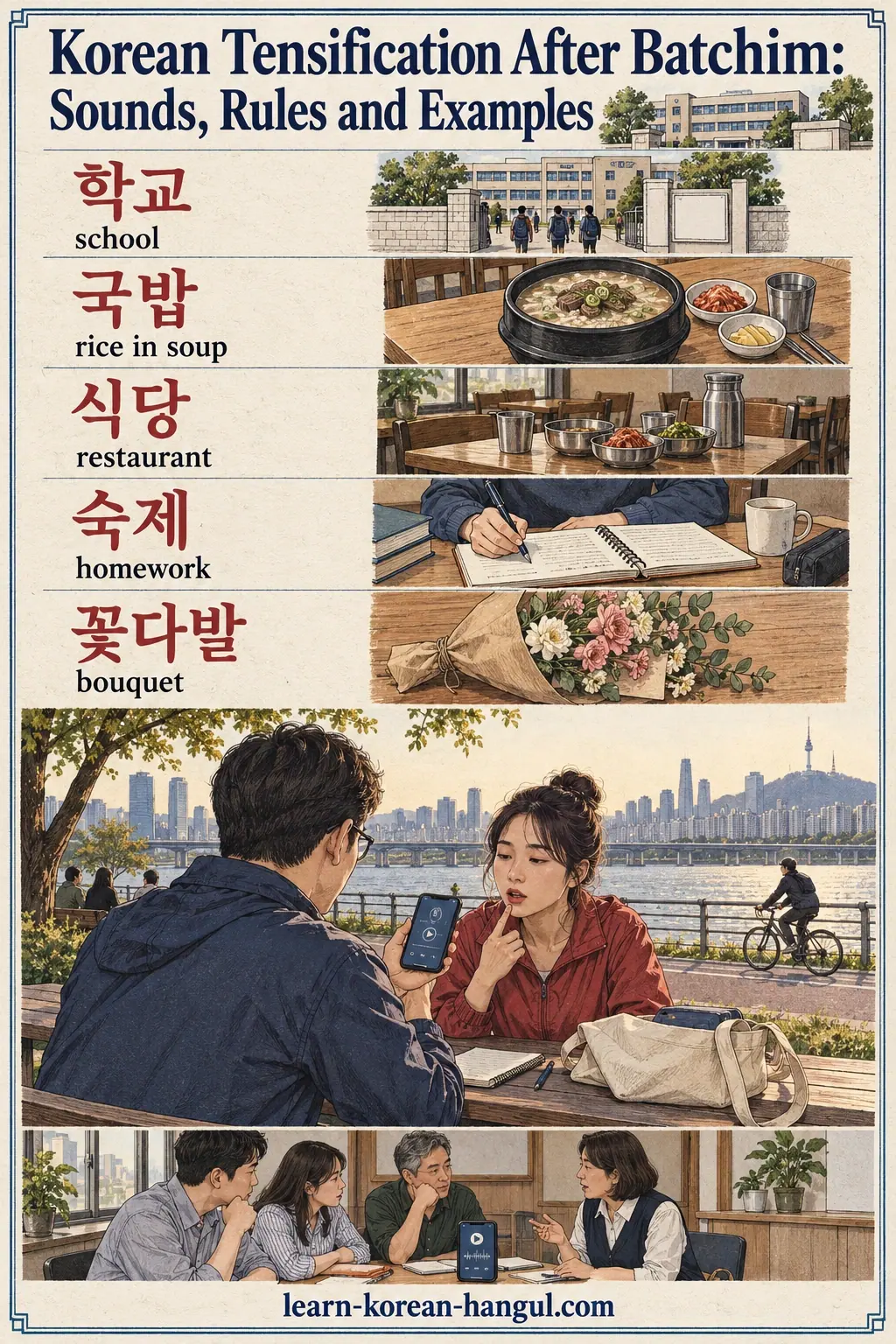
Korean tensification after batchim is the always-on rule that makes ㄱ, ㄷ, ㅂ, ㅅ and ㅈ tense when they follow a final [ㄱ], [ㄷ] or [ㅂ] sound. 학교 is said [학꾜], 국밥 [국빱] and 꽃다발 [꼳따발]. The rule has no exceptions in standard speech, so once you learn it, it works on every word.
What you'll learn
- State the rule in one sentence and list the batchim that trigger it.
- Reduce a batchim first, then decide whether the next consonant tenses.
- Say 학교, 국밥, 잡다, 옆집, 밥도 and 꽃다발 with tense consonants.
- Recognize the four neighbours (vowel, ㄴ ㅁ, ㄹ, ㅎ) that trigger a different rule.
Prerequisites: the five triggers in Korean Tensification Rules. Estimated time: 25 minutes.
What Is Korean Tensification after Batchim?
Korean tensification after batchim is the rule that a plain ㄱ, ㄷ, ㅂ, ㅅ or ㅈ becomes tense when the syllable before it ends in a stop sound. A stop sound here means a batchim that reduces to [ㄱ], [ㄷ] or [ㅂ]. The tense results are ㄲ, ㄸ, ㅃ, ㅆ and ㅉ: tight consonants with almost no breath.
Article 23 of the Standard Pronunciation Rules (표준 발음법), published by the National Institute of Korean Language, states the rule and gives examples such as 국밥 [국빱] and 옆집 [엽찝]. It is the first of the five tensification triggers covered in the tensification rules, and the one learners meet most often.
Why Is This Rule Always On?
A common explanation for why this rule is always on lies in how Korean final stops are made. A final [ㄱ], [ㄷ] or [ㅂ] is unreleased: the mouth closes and holds without a burst of air. During that hold, the throat tightens. When the next consonant is released, the throat is still tight, and a tight release is exactly what a tense consonant is.
On this account, a plain consonant cannot follow an unreleased stop without becoming tense, because the throat has no time to relax. Whatever the exact phonetics, this is why the rule has no exceptions in standard speech, unlike the triggers that depend on word type.
Why English Speakers Miss the Tense Sound
English speakers miss the tense sound because English stops before another consonant are not linked in this way. In "backpack" or "hot dog", the second consonant is a normal English p or d. Learners who carry this over say 학교 as "hak-gyo", with a soft g, or insert a small vowel, "ha-keu-gyo".
There is also a perception problem. English speakers hear ㄲ and ㄱ as the same sound, so they do not notice the change in audio either. Learning the rule by sight, from the batchim, helps the ear: once you expect [꾜], you start to hear it.
Which Batchim Trigger Tensification?
Every batchim that reduces to [ㄱ], [ㄷ] or [ㅂ] triggers tensification. The trigger is the sound, not the letter, so first reduce the batchim to its representative sound. The reduction step is explained in representative sounds.
| Representative sound | Written batchim | Example | Spoken |
|---|---|---|---|
| [ㄱ] | ㄱ ㄲ ㅋ ㄳ ㄺ | 깎다 (to cut) | [깍따] |
| [ㄷ] | ㄷ ㅅ ㅆ ㅈ ㅊ ㅌ | 꽃다발 (bouquet) | [꼳따발] |
| [ㅂ] | ㅂ ㅍ ㄼ ㄿ ㅄ | 옆집 (next door) | [엽찝] |
The three stop finals are the same three groups that appear in the seven final sounds lessons. The other four final sounds, [ㄴ], [ㄹ], [ㅁ] and [ㅇ], do not trigger this rule.
Which Consonants Become Tense?

Five plain consonants become tense after a stop final: ㄱ, ㄷ, ㅂ, ㅅ and ㅈ. Each has exactly one tense partner.
| Plain | Tense | Example | Spoken |
|---|---|---|---|
| ㄱ | ㄲ | 학교 (school) | [학꾜] |
| ㄷ | ㄸ | 식당 (restaurant) | [식땅] |
| ㅂ | ㅃ | 국밥 (rice in soup) | [국빱] |
| ㅅ | ㅆ | 약속 (promise) | [약쏙] |
| ㅈ | ㅉ | 숙제 (homework) | [숙쩨] |
The consonants that can never change this way are the nasals ㄴ, ㅁ, the liquid ㄹ, ㅇ and ㅎ, plus the aspirated letters ㅋ, ㅌ, ㅍ and ㅊ, which are already strong.
Twenty Words with Korean Tensification after Batchim

The table gives twenty common words, grouped by the stop final. Say each one aloud with the audio, then cover the last column and test yourself.
| Word | Meaning | Final sound | Next | Spoken |
|---|---|---|---|---|
| 학교 | school | [ㄱ] | ㄱ | [학꾜] |
| 국밥 | rice in soup | [ㄱ] | ㅂ | [국빱] |
| 식당 | restaurant | [ㄱ] | ㄷ | [식땅] |
| 약속 | promise | [ㄱ] | ㅅ | [약쏙] |
| 숙제 | homework | [ㄱ] | ㅈ | [숙쩨] |
| 먹다 | to eat | [ㄱ] | ㄷ | [먹따] |
| 책상 | desk | [ㄱ] | ㅅ | [책쌍] |
| 닭장 | chicken coop | [ㄱ] | ㅈ | [닥짱] |
| 듣다 | to hear | [ㄷ] | ㄷ | [듣따] |
| 옷장 | wardrobe | [ㄷ] | ㅈ | [옫짱] |
| 꽃다발 | bouquet | [ㄷ] | ㄷ | [꼳따발] |
| 낮잠 | nap | [ㄷ] | ㅈ | [낟짬] |
| 있다 | to exist | [ㄷ] | ㄷ | [읻따] |
| 맛보다 | to taste | [ㄷ] | ㅂ | [맏뽀다] |
| 잡다 | to catch | [ㅂ] | ㄷ | [잡따] |
| 옆집 | next door | [ㅂ] | ㅈ | [엽찝] |
| 입구 | entrance | [ㅂ] | ㄱ | [입꾸] |
| 접시 | plate | [ㅂ] | ㅅ | [접씨] |
| 없다 | to not exist | [ㅂ] | ㄷ | [업따] |
| 밥도 | rice too | [ㅂ] | ㄷ | [밥또] |
The last row matters. Particles such as 도 (also), 보다 (than) and 과 (and) tense after a stop final just like any other syllable: 밥도 [밥또], 책과 [책꽈].
Tensification after Batchim in Verb Endings and Particles
Tensification after batchim is especially frequent in grammar, because many verb endings and particles start with ㄱ, ㄷ, ㅅ or ㅈ. Every verb or adjective whose stem ends in a stop sound tenses these endings, and every noun ending in a stop sound tenses these particles.
| Form | Meaning | Spoken |
|---|---|---|
| 먹고 | eat and | [먹꼬] |
| 먹지 마세요 | don't eat | [먹찌 마세요] |
| 먹습니다 | eats (formal) | [먹씀니다] |
| 듣고 싶어요 | I want to hear | [듣꼬 시퍼요] |
| 좁다 | to be narrow | [좁따] |
| 책도 | the book too | [책또] |
| 집부터 | from home | [집뿌터] |
| 옷과 | clothes and | [옫꽈] |
An expert shortcut: learn -고, -다, -지 and -습니다 after one stop-final verb, such as 먹다, until they feel automatic. The same tense sounds then carry over to hundreds of verbs with stems ending in ㄱ, ㄷ or ㅂ, so you rarely need to think about the rule in grammar forms.
How Do You Apply the Rule to 꽃다발?
You apply the rule to 꽃다발 by reducing first and tensing second. The order matters because the trigger is the reduced sound, not the written letter.
- Find the batchim. 꽃 ends in ㅊ.
- Reduce it. ㅊ belongs to the [ㄷ] group: 꽃 → [꼳].
- Check the next consonant. 다 starts with ㄷ, one of the five that can tense.
- Tense it. [ㄷ] + ㄷ → [ㄷ] + [ㄸ]: [꼳따].
- Finish the word. 발 has no neighbour to change it: [꼳따발].
If you skipped step 2, you might think ㅊ is "aspirated, not a stop" and miss the rule. The reduction tells you that, at the end of a syllable, ㅊ is simply [ㄷ].
Does Tensification after Batchim Ever Not Apply?
Tensification after batchim does not apply when the next sound is not ㄱ, ㄷ, ㅂ, ㅅ or ㅈ. In those cases, a different rule takes over:
| Next sound | Rule instead | Example | Spoken |
|---|---|---|---|
| vowel | liaison | 학원 (academy) | [하권] |
| ㄴ or ㅁ | nasalization | 국물 (broth) | [궁물] |
| ㄹ | ㄹ → [ㄴ] plus nasalization | 독립 (independence) | [동닙] |
| ㅎ | aspiration | 입학 (school entrance) | [이팍] |
The pair 학교 [학꾜] and 학원 [하권] is worth memorizing: the same first syllable, two different rules, decided only by the next sound. There is one more limit: a real pause between two words cancels the rule, because the stop is no longer directly linked to the next consonant.
Tensification after Batchim in Whole Sentences
In connected speech, tensification after batchim links words as well as syllables, as long as the speaker does not pause. Short sentences show how often the rule appears in a single breath.
- 학교에 가요. (I go to school.) → [학꾜에 가요]
- 숙제 다 했어요? (Did you finish the homework?) → [숙쩨 다 해써요]
- 국밥 먹고 싶어요. (I want to eat rice soup.) → [국빰 먹꼬 시퍼요]
- 옆집에 살아요. (I live next door.) → [엽찌베 사라요]
Sentence 3 contains three rules at once: tensification in 국밥 and 먹고, nasalization across the space (the final [ㅂ] of 밥 becomes [ㅁ] before the ㅁ of 먹), and liaison in 싶어요. With a small break after 국밥, the nasalization disappears, but tensification and liaison remain. Listening for the tense sounds first is the easiest way to start hearing the rest.
How to Practise the Tense Sound after a Stop

The tense sound after a stop is easiest to practise with a slow, two-part drill, because the hold on the first consonant does most of the work.
- Say the first syllable and freeze on the final stop: 학… with the tongue held up.
- Count "one" silently while holding the closure.
- Release into the next syllable with a tight throat and no breath: 꾜.
- Shorten the hold step by step until the word sounds natural: [학꾜].
You'll know you have it when the tissue in front of your mouth barely moves on the second syllable, while the sound is still clear and crisp.
Worked Example: 학교
- Find the batchim. 학 ends in ㄱ.
- Reduce it. ㄱ is already [ㄱ].
- Check the next consonant. 교 starts with ㄱ.
- Tense it. [학꾜].
- Say it. Raise the back of the tongue for 학 and hold it, with no puff. Keep the throat tight and release straight into a crisp ㄲ with no breath: [학꾜].
You'll know it worked when the second syllable starts with the tight ㄲ of 꼬리 (tail), not the softer ㄱ of 교실 said on its own.
Common Mistakes with Tensification after Batchim
Soft second consonant. Learners often say 학교 as "hak-gyo"; actually the second ㄱ is tense, [꾜]. Fix: think of the word as written 학꾜.
Aspirating instead of tensing. Learners often overcorrect to [학쿄]; actually tense consonants have almost no breath. Fix: hold a tissue in front of your mouth; it should barely move.
Releasing the first stop. Learners often say [하그꾜] or [학으꾜], with a vowel after 학. Fix: keep the first consonant closed and silent.
Applying it before ㄴ or ㅁ. Learners sometimes keep a hard, closed ㄱ in 국물 or try to tense the ㅁ; actually nasalization applies: [궁물].
Practice: Tense or Not?
Exercise 1. Write the spoken form.
- 잡다
- 옆집
- 밥도
- 꽃다발
- 국수 (noodles)
- 젓가락 (chopsticks)
Exercise 2. Tensification or another rule? Name the rule.
- 학년
- 책상
- 낮에
Answers.
Exercise 1: 1 [잡따]. 2 [엽찝]. 3 [밥또]. 4 [꼳따발]. 5 [국쑤]. 6 [젇까락] (also allowed: [저까락]). If you wrote a plain consonant for 5 or 6, look again at the batchim: ㄱ in 국 and ㅅ in 젓 both reduce to stop sounds, so the next consonant must be tense.
Exercise 2: 1 nasalization, [항년]. 2 tensification, [책쌍]. 3 liaison, [나제].
Where to Go Next
Continue with Korean Verb Stem Tensification, which covers the second trigger: endings after stems in ㄴ and ㅁ, as in 신고 [신꼬]. The full set of triggers is in the Tensification section.
This lesson does not cover tensification after ㄹ in Sino-Korean words, after the future modifier -(으)ㄹ, or in compound nouns. It also does not cover casual word-initial tensing such as [쪼금] for 조금, which is not standard.
In short, Korean tensification after batchim needs one check: if the batchim reduces to [ㄱ], [ㄷ] or [ㅂ] and the next consonant is ㄱ, ㄷ, ㅂ, ㅅ or ㅈ, say the tense partner.
Frequently Asked Questions
Is 먹다 pronounced 먹따? Yes. 먹다 (to eat) has a final ㄱ before ㄷ, so the ㄷ becomes tense and the word is said [먹따]. Every verb whose stem ends in a stop sound does the same in its dictionary form: 잡다 [잡따], 듣다 [듣따], 있다 [읻따]. It is one of the first places learners meet the rule.
Is 합니다 an example of tensification? No. In 합니다, the final ㅂ meets ㄴ, which is a nasal, not one of ㄱ ㄷ ㅂ ㅅ ㅈ. That pairing triggers nasalization instead, so the word is [함니다]. Tensification does appear in 먹습니다 [먹씀니다]: the ㅅ after final [ㄱ] becomes tense, and then the ㅂ before ㄴ becomes [ㅁ].
Why is 국밥 pronounced 국빱? 국밥 (rice in soup) joins 국 (soup), which ends in ㄱ, with 밥 (rice), which starts with ㅂ. A plain ㅂ after a final [ㄱ] becomes tense, so 밥 is said [빱] and the word is [국빱]. The second ㅂ, at the very end, stays an unreleased [ㅂ].
Does tensification after batchim apply across two words? Yes, when the two words are said as one phrase without a pause. 책 좀 주세요 (please give me the book) is usually [책쫌 주세요], and 밥 sounds like [밥] before a pause but tenses the next word in 밥 다 먹었어요 [밥따 머거써요]. With a clear pause between words, the next consonant stays plain.
Does Revised Romanization show this tensification? No. Revised Romanization does not mark tensification, so 학교 is hakgyo, 국밥 is gukbap and 옆집 is yeopjip. The romanization rules state this choice explicitly, which keeps romanized words close to their written form. Romanization therefore cannot warn you about the tense sound; the batchim can, because a stop final always triggers it.