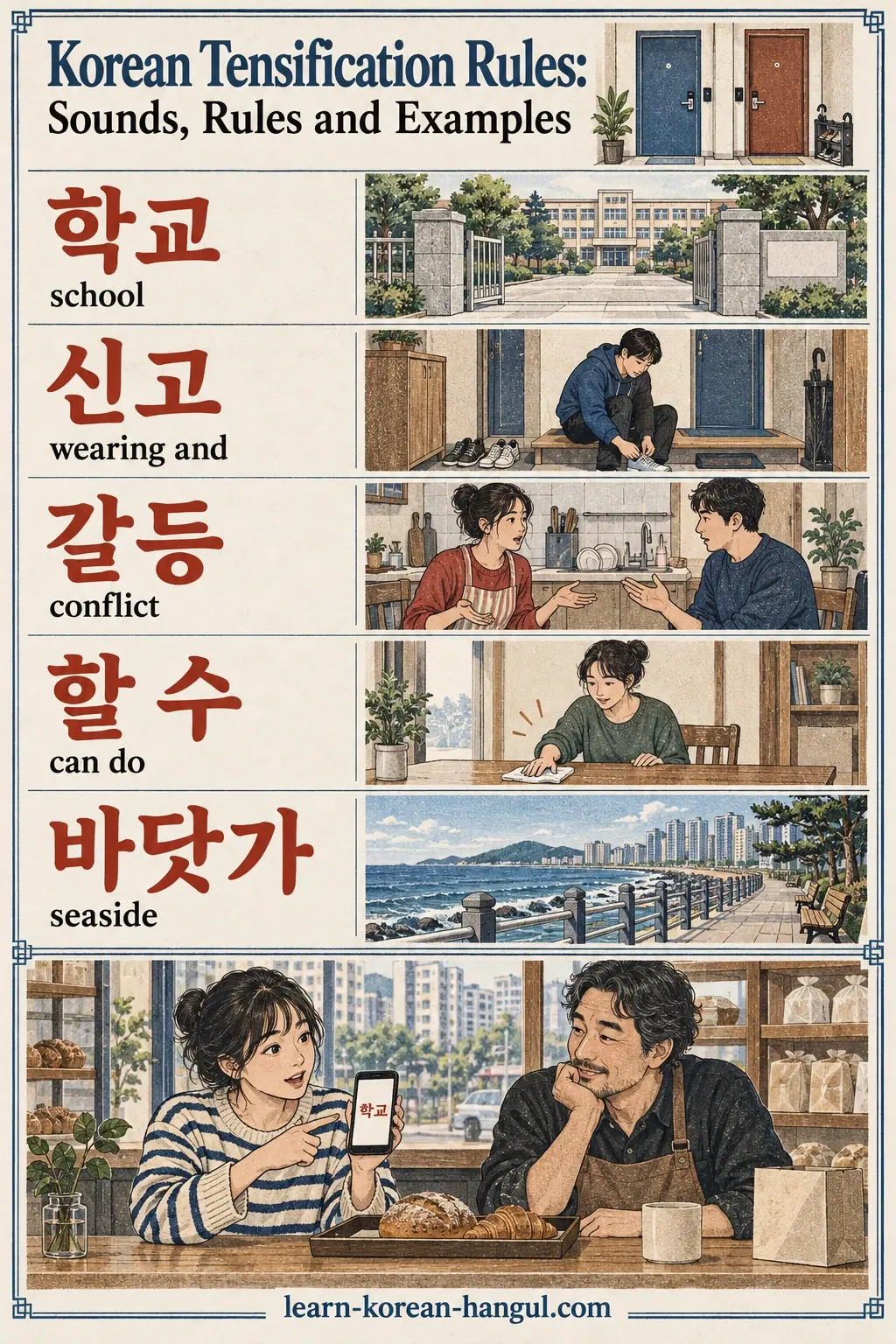
Korean tensification rules (경음화) explain when a plain ㄱ, ㄷ, ㅂ, ㅅ or ㅈ is pronounced as its tense partner ㄲ, ㄸ, ㅃ, ㅆ or ㅉ, although the spelling stays plain. Five triggers cover nearly every case, and this lesson gives you a decision list to identify the trigger in 학교, 신고, 갈등, 할 수 and 바닷가.
What you'll learn
- Name the five tensification triggers and give one word for each.
- Identify the trigger in 학교, 신고, 갈등, 할 수 and 바닷가 and say each with a tense consonant.
- Use a decision list to check unfamiliar words in a fixed order.
- Tell which triggers always apply and which depend on the word.
Prerequisites: you can produce tense consonants (see How to Pronounce Korean Tense Consonants) and you know Batchim Representative Sounds. Estimated time: 30 minutes.
What Are the Korean Tensification Rules?
The Korean tensification rules are a set of conditions under which a plain obstruent becomes tense in speech. Korean has five plain consonants that can tense: ㄱ, ㄷ, ㅂ, ㅅ and ㅈ. Their tense partners are written as doubled letters, ㄲ, ㄸ, ㅃ, ㅆ and ㅉ. Tensification makes a plain letter sound like its partner while the spelling stays the same.
Articles 23 to 28 of the Standard Pronunciation Rules (표준 발음법), published by the National Institute of Korean Language, list the conditions; compounds written with 사이시옷 are covered in Article 30. Linguists call the process 경음화 (gyeongeumhwa); school grammar also calls it 된소리되기. One rule is mechanical and always applies; the others depend on the type of word.
What Does a Tense Consonant Sound Like?
A tense consonant sounds tight and sharp, with almost no puff of air. You make it by tightening the throat and the mouth before release, then releasing without breath. The vowel after a tense consonant often starts slightly higher in pitch. Compare 자다 (to sleep) and 짜다 (to be salty): the second has a tight, clipped start.
If you cannot yet make the contrast on purpose, practise it first with how to make tense consonants. Tensification rules only tell you where the tense sound goes; producing it is a separate skill.
Why Do English Speakers Struggle with Tensification?
English speakers struggle because English has no tense series, and because Korean spelling hides the result. In English, the k in "sky" sounds close to Korean ㄲ, but English speakers do not hear it as a separate sound. When they read 학교, they see a plain ㄱ and say a soft g, so the word comes out as "hak-gyo" instead of [학꾜].
Romanization makes this worse. Revised Romanization ignores tensification completely, so learners who read hakgyo, galdeung or badatga have no clue that a tense sound is coming. The triggers below give you the clues that the spelling leaves out.
What Are the Five Tensification Triggers?
The five tensification triggers are a stop final, a verb stem ending in ㄴ or ㅁ, ㄹ in a Sino-Korean word, the future modifier -(으)ㄹ, and a compound noun. Each needs a different clue: a sound, a word class, a word origin, a grammar ending or a word structure. The table puts them in the order you should check them.
| Trigger | Clue to notice | Example | Spoken | Applies |
|---|---|---|---|---|
| 1. Stop final | batchim reduces to [ㄱ ㄷ ㅂ] | 학교 | [학꾜] | always (Article 23) |
| 2. ㄴ/ㅁ verb stem | verb or adjective stem + ending | 신고 (wearing and) | [신꼬] | verb endings only (Articles 24, 25) |
| 3. Sino-Korean ㄹ | ㄹ + ㄷ ㅅ ㅈ in a Sino-Korean word | 갈등 | [갈뜽] | most such words (Article 26) |
| 4. Future -(으)ㄹ | modifier -(으)ㄹ before a noun | 할 수 | [할쑤] | always (Article 27) |
| 5. Compound noun | two nouns joined into one | 바닷가 | [바다까] | word by word (Articles 28 and 30) |
Rule
stop final | ㄴ/ㅁ stem | Sino-Korean ㄹ | -(으)ㄹ modifier | compound noun
The five sections below follow the same order: the condition, example words, and the limit of the trigger.
Trigger 1: after a Stop Final
The condition: the batchim reduces to [ㄱ], [ㄷ] or [ㅂ], and the next syllable starts with ㄱ, ㄷ, ㅂ, ㅅ or ㅈ. Examples: 학교 [학꾜], 국밥 (rice soup) [국빱], 잡지 (magazine) [잡찌], 옷장 (wardrobe) [옫짱], 숙제 (homework) [숙쩨]. The limit: none in standard speech; this is the always-on rule, taught in full in tensification after ㄱ ㄷ ㅂ.
Trigger 2: after a Verb Stem Ending in ㄴ or ㅁ
The condition: a verb or adjective stem ends in ㄴ or ㅁ (including ㄵ and ㄻ), and an ending starting with ㄱ, ㄷ, ㅅ or ㅈ follows. Examples: 신고 (wearing shoes and) [신꼬], 안다 (to hug) [안따], 삼고 (making it into and) [삼꼬], 앉지 [안찌], 젊다 [점따]. Stems ending in ㄼ and ㄾ behave the same way: 넓게 [널께], 핥다 [할따]. The limit: nouns and the passive or causative suffix -기- do not tense, so 안기다 (to be hugged) stays [안기다].
Trigger 3: after ㄹ in Sino-Korean Words
The condition: in a Sino-Korean word (one built from Chinese-origin morphemes), a ㄹ batchim is followed by ㄷ, ㅅ or ㅈ. Examples: 갈등 (conflict) [갈뜽], 발전 (development) [발쩐], 일시 (date and time) [일씨], 물질 (substance) [물찔]. The limit: ㄱ and ㅂ do not tense after ㄹ here, so 결과 (result) stays [결과]. Words with a repeated character, such as 절절하다 (to be heartfelt), are also excluded and stay [절절하다].
Trigger 4: after the Future Modifier -(으)ㄹ
The condition: the modifier ending -(으)ㄹ, which turns a verb into a describing form ("that will…", "to…"), is followed by a word starting with ㄱ, ㄷ, ㅂ, ㅅ or ㅈ. Examples: 할 수 있어요 (I can do it) [할쑤 이써요], 갈 데 (a place to go) [갈떼], 먹을 게 (something to eat) [머글께]. Endings that contain -ㄹ also tense: 할게요 (I will do it) [할께요], 할수록 (the more one does) [할쑤록]. The limit: an ㄹ that belongs to the stem does not trigger this rule, so 알고 (knowing and) stays [알고].
Trigger 5: inside Compound Nouns
The condition: two nouns form one compound, and the second starts with a plain consonant. Some compounds write a 사이시옷 (an extra ㅅ under the first part); others write nothing. Examples: 바닷가 (seaside) [바다까] (also allowed: [바닫까]), 냇가 (stream bank) [내까], 길가 (roadside) [길까], 눈동자 (pupil of the eye) [눈똥자], 등불 (lamp light) [등뿔]. The limit: not every compound tenses. 고무신 (rubber shoes) stays [고무신]. Learn these word by word with audio.
How Can You Tell When a Word Tenses?

You can tell when a word tenses by checking the five triggers in a fixed order, because the early triggers are reliable and the late ones need knowledge of the word. Use this decision list on any plain ㄱ, ㄷ, ㅂ, ㅅ or ㅈ at the start of a syllable:
- Is the batchim before it a stop sound ([ㄱ], [ㄷ], [ㅂ])? If yes, tense it. Stop here.
- Is it a verb ending after a stem in ㄴ, ㅁ, ㄵ, ㄻ, ㄼ or ㄾ? If yes, tense it.
- Is the batchim ㄹ, the consonant ㄷ, ㅅ or ㅈ, and the word Sino-Korean? If yes, tense it.
- Does a future modifier -(으)ㄹ come right before it? If yes, tense it.
- Is the word a compound noun? If yes, check a dictionary or audio; it may tense.
- None of the above? Say it plain.
The first and fourth checks need only your eyes and basic grammar. The second and third need you to know what kind of word you are reading. The fifth needs a dictionary: the Standard Korean Language Dictionary (표준국어대사전) gives the standard pronunciation of compounds in brackets.
Why Do the Same Letters Sound Different in Two Words?

The same letters sound different because tensification depends on triggers, not on letters. Pairs of words with the same spelling pattern and different pronunciations prove it.
| Tensed | Spoken | Not tensed | Spoken | Why |
|---|---|---|---|---|
| 학교 (school) | [학꾜] | 하교 (going home from school) | [하교] | no stop final before 교 |
| 신고 (wearing and) | [신꼬] | 신고 (a report) | [신고] | verb ending versus noun |
| 갈등 (conflict) | [갈뜽] | 결과 (result) | [결과] | ㄷ tenses after ㄹ, ㄱ does not |
| 할 수 (can do) | [할쑤] | 하수 (sewage) | [하수] | future modifier -ㄹ |
The pair 신고 and 신고 is the most useful. The two words are spelled identically, but one is a verb form and one is a noun, and only the verb form tenses. Spelling alone can never tell you which; grammar can.
Worked Example: 학교 and 신고

학교 (school).
- Look at the batchim before 교: ㄱ in 학, which reduces to [ㄱ].
- Check 1 of the decision list: yes, a stop sound. Tense the next consonant.
- ㄱ becomes [ㄲ]: [학꾜].
- Say it: close the back of the tongue for 학 without releasing, then release a tight ㄲ with no breath.
신고 (wearing shoes and), as in 신발을 신고 나가요.
- Batchim before 고: ㄴ, not a stop. Check 1 fails.
- Check 2: 신- is the stem of the verb 신다 (to wear shoes), and -고 is an ending. Tense it.
- [신꼬].
- In 신고했어요 (I reported it), 신고 is a noun, so check 2 fails and it stays [신고].
You'll know you have the rule when you hesitate on 신고 and look for the grammar before you speak.
Common Mistakes with Korean Tensification
Reading romanization. Learners often say 학교 as "hak-gyo" with a soft g; actually the ㄱ is tense: [학꾜].
Over-applying trigger 2. Learners who learn the ㄴ/ㅁ stem rule often tense nouns too, saying 신고 (report) as [신꼬]; actually only verb endings tense.
Tensing every ㄹ. Learners often say 결과 as [결꽈]; actually trigger 3 covers only ㄷ, ㅅ and ㅈ after ㄹ.
Adding air. Learners often confuse tense and aspirated sounds and say [학쿄]; actually tense consonants have almost no breath. Hold a hand in front of your mouth: it should feel very little air.
Copying casual word-initial tensing. Learners who hear Seoul speakers say [쪼금] for 조금 sometimes copy it in formal speech; actually that form is casual and not standard.
Practice: Find the Trigger
Exercise 1. Name the trigger (1 to 5) and write the spoken form.
- 국밥
- 안고
- 발전
- 먹을 거
- 길가
- 책상
Exercise 2. Tense or plain? Write the spoken form.
- 결과
- 안기다
Answers.
Exercise 1: 1 trigger 1, [국빱]. 2 trigger 2, [안꼬]. 3 trigger 3, [발쩐]. 4 trigger 4, [머글꺼]. 5 trigger 5, [길까]. 6 trigger 1, [책쌍].
Exercise 2: 1 plain, [결과], because ㄱ does not tense after Sino-Korean ㄹ. 2 plain, [안기다], because -기- is a suffix, not an ending.
Where to Go Next
Continue with Korean Tensification After Batchim, which drills trigger 1 with 20 words; it is the trigger you will use most often. The other triggers each have a lesson in the Tensification section, and a one-page summary sits in the sound change cheat sheet.
This lesson does not list every compound noun that tenses, cover casual word-initial tensing in detail, or explain the spelling rules for 사이시옷. Those topics have their own pages.
In short, the Korean tensification rules turn a written ㄱ, ㄷ, ㅂ, ㅅ or ㅈ into ㄲ, ㄸ, ㅃ, ㅆ or ㅉ after a stop final, after a ㄴ or ㅁ verb stem, after Sino-Korean ㄹ, after the future modifier -(으)ㄹ, and in some compound nouns. Check the triggers in that order.
Frequently Asked Questions
Why do some Korean consonants sound doubled? Some Korean consonants sound doubled because tensification turns a plain consonant into its tense partner, and Hangul writes tense consonants as doubled letters: ㄲ, ㄸ, ㅃ, ㅆ, ㅉ. When you hear [꾜] in 학교, you are hearing a tense ㄲ sound that the spelling still writes as a plain ㄱ.
Is 학교 pronounced hakgyo? No. 학교 (school) is pronounced [학꾜], roughly hak-kkyo. The romanization hakgyo spells the letters, but the ㄱ after a final [ㄱ] is tense. Saying a soft g in the middle sounds like a learner reading romanization. Hold the first ㄱ closed, then release a tight, breathless ㄲ.
Does Revised Romanization show tensification? No. Revised Romanization deliberately ignores tensification, so 학교 is hakgyo, 갈등 is galdeung and 바닷가 is badatga. The official romanization rules state this choice explicitly, which keeps romanized words closer to their spelling. That is why learners who read romanization often miss tense sounds; read the Korean and apply the triggers instead.
Is tensification common in everyday Seoul speech? Yes. All five triggers are part of standard pronunciation and occur constantly in Seoul speech. Seoul speakers also tense some words at the start, saying 조금 as [쪼금] or 작다 as [짝따]. Those word-initial forms are casual and not standard, so recognize them when you hear them but learn the standard forms first.
What is 경음화? 경음화 (gyeongeumhwa) is the Korean linguistic term for tensification, literally 'becoming a tense sound'. 경음 means tense consonant: ㄲ, ㄸ, ㅃ, ㅆ and ㅉ. School grammar also uses the native name 된소리되기. Both terms cover the five triggers taught on this page.