
Korean consonants and pitch are linked: in Seoul speech, tense and aspirated consonants make the next vowel start higher in pitch than a plain consonant does. This pitch difference is a second cue, beside breath and tension, that listeners use to tell 달, 탈 and 딸 apart. This lesson explains the cue and shows how to listen for it.
Key facts
- Phonetic research on Seoul Korean describes the pitch effect; Korean itself is not a tonal language.
Last updated: 2026-10-09.
What you'll learn
- Explain in one sentence how consonants affect pitch in Seoul Korean.
- Name the three cues that separate plain, tense and aspirated consonants.
- Listen for the pitch cue in three paired words.
- Decide whether to practise producing it.
Prerequisites: you know the plain, tense and aspirated series (see the overview of plain, tense and aspirated consonants). Estimated time: 20 minutes.
How Do Korean Consonants and Pitch Work Together?
Korean consonants and pitch work together because a consonant changes how the voice starts in the vowel that follows. Pitch is how high or low the voice sounds, and it depends on how fast the vocal folds vibrate. After a tense or aspirated consonant the vocal folds start vibrating at a higher rate, so the vowel begins higher. After a plain consonant they start lower.
Korean has three kinds of stop and affricate consonants at each place of the mouth. The plain series is ㄱ ㄷ ㅂ ㅈ, the tense series is ㄲ ㄸ ㅃ ㅉ, and the aspirated series is ㅋ ㅌ ㅍ ㅊ. A word such as 달 (moon), 탈 (mask), 딸 (daughter) shows the three at the tip of the tongue. The overview lesson teaches how the three differ in breath and tension. This lesson adds the third difference, pitch.
The next section explains why this cue is easy for English speakers to miss.
Why English Speakers Struggle to Hear It
English speakers struggle to hear the pitch cue because English uses pitch for sentence melody and not as a clue to which consonant started a syllable. English listeners already sort consonants by voicing ("b" against "p") and by a puff of air at the start of "p", "t" and "k". Those habits capture the Korean contrast only partly: the English "p" in "pin" has a puff like ㅍ, but the English "b" is voiced, which is a cue Korean plain consonants do not use at the start of a word.
So an English speaker tries to hear the three Korean consonants as two. Plain ㄷ sounds like "t" or "d", aspirated ㅌ sounds like "t" and tense ㄸ sounds like "d" or "t" without a puff. The pitch of the vowel is a cue English does not use, so it falls outside the listener's attention. Training the ear to notice it improves the sorting of all three. The next section answers a question that often comes up.
Is Korean a Tonal Language?
No, Korean is not a tonal language. A tonal language, such as Mandarin, uses the pitch pattern of a whole syllable to tell words apart, and every syllable has a tone as part of its identity. In Korean the pitch on the vowel is a by-product of the consonant before it, so it only helps listeners confirm which consonant they heard.
| Feature | Tonal language (Mandarin) | Korean pitch effect | English intonation |
|---|---|---|---|
| What carries pitch | the syllable | the start of the vowel after a consonant | the sentence |
| Does pitch change the word? | yes, by itself | no, it supports the consonant cue | no |
| Is it learned as part of the word? | yes | no, it follows from the consonant | no |
Seoul Korean does use pitch in a phrase melody, which is covered in the lesson on Korean pitch and phrasing. The pitch effect described here is small by comparison. The next section describes it in detail.
What Is the Pitch Effect after Korean Consonants?
The pitch effect is a difference in the pitch at the beginning of the vowel: it is higher after tense and aspirated consonants and lower after plain consonants. It is one of three cues that together separate the series.
| Cue | Plain (ㄷ) | Aspirated (ㅌ) | Tense (ㄸ) |
|---|---|---|---|
| Breath after the release | a little | a strong puff | none |
| Tension of the throat and tongue | relaxed | relaxed | tight |
| Pitch at the start of the vowel | lower | higher | higher |
Older descriptions of Korean give breath (also called voice onset time, the delay between the release of the consonant and the start of the vowel's vibration) as the main cue between plain and aspirated. Phonetic studies of Seoul speech since the mid-2000s, for example David Silva's 2006 paper in the journal Phonology, report that for many younger speakers this breath difference has shrunk and that pitch separates the two. This is described as a sound change in progress.
The simplified view for a learner is therefore: breath and tension separate the series for everyone, and for many younger Seoul speakers pitch does a large part of the work as well. The effect is clearest at the start of a phrase, where the consonant begins a new accentual phrase, and it is weaker in the middle of a phrase. The next section asks who uses the cue most.
Who Uses the Pitch Cue Most
Younger Seoul speakers use the pitch cue most, according to published phonetic research. Speakers born in earlier decades keep a larger breath difference between plain and aspirated consonants, and pitch plays a smaller part. The change is gradual, so there is no sharp age line.
| Speaker group | Main cues described in studies |
|---|---|
| Older Seoul speakers | breath (long aspiration) and tension |
| Younger Seoul speakers | pitch, with breath and tension supporting |
| Speakers of other dialects | varies by dialect; Gyeongsang speech has its own word pitch system |
Three cautions apply. First, the research is on Seoul speech, and other regions differ. Second, every speaker is different, so some young speakers show little pitch effect and some older speakers show a lot. Third, studies measure averages over many words, while any single word may deviate. A learner should treat these as tendencies. The next section shows how to hear the cue.
How to Hear the Pitch Cue
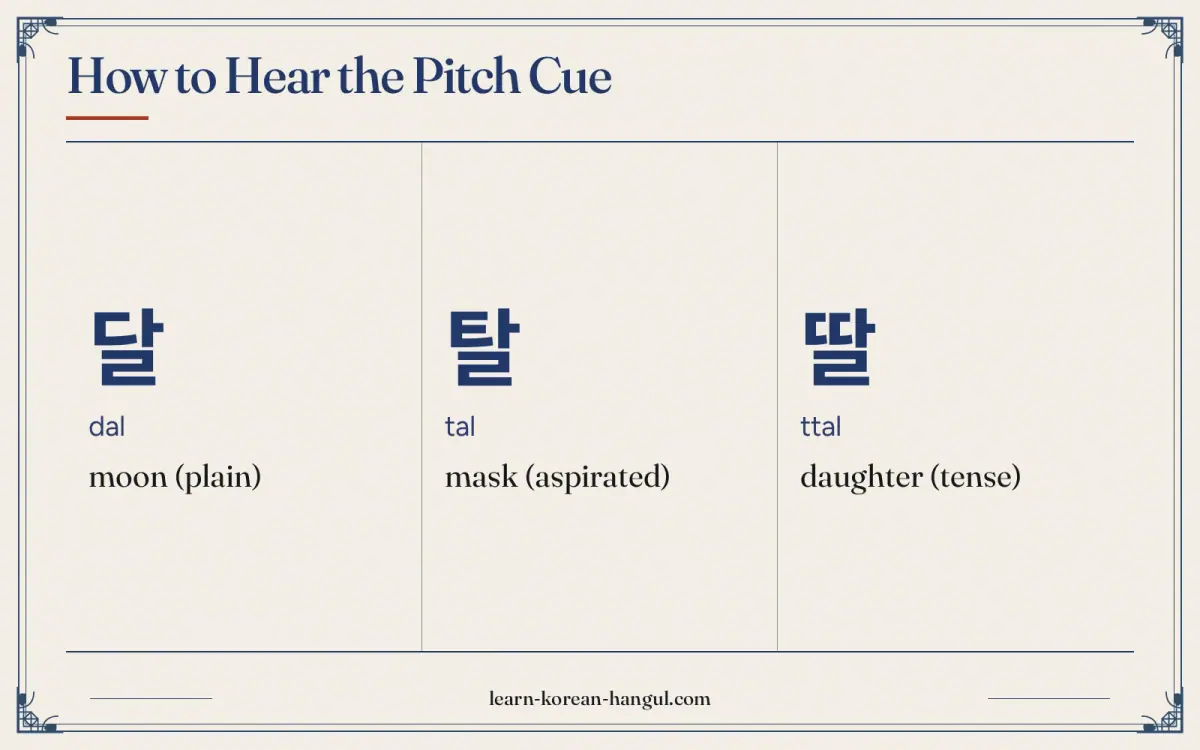
You can hear the pitch cue by listening to a minimal triple, three words that differ only in the consonant, with headphones and by attending to the start of the vowel. Follow these steps.
- Wear headphones and use a quiet room. The effect is small, and speakers add room noise.
- Play the first word and listen to the beginning of the vowel. Ignore the consonant for now and ask whether the voice starts low or high.
- Play the second and third words. Notice that the aspirated and tense words start higher than the plain word.
- Hum the starts. Hum a low note, then a higher note, and match them to the words.
- Repeat with the second set. Check that the same pattern holds with a different consonant.
Plain: Soft, Lower Start. Aspirated: Puff of Breath, Higher Start. Tense: Tight, No Breath, Higher Start.
| Korean | Romanization | Meaning | Sound |
|---|---|---|---|
| 달 | dal | moon (plain) | |
| 탈 | tal | mask (aspirated) | |
| 딸 | ttal | daughter (tense) |
Same Three-Way Pattern with the Lips: Plain ㅂ, Aspirated ㅍ, Tense ㅃ.
| Korean | Romanization | Meaning | Sound |
|---|---|---|---|
| 불 | bul | fire (plain) | |
| 풀 | pul | grass (aspirated) | |
| 뿔 | ppul | horn (tense) |
The two triples show the same three-way contrast at the tongue tip and the lips. If you cannot hear the pitch cue at first, return to the breath cue: place your hand in front of your mouth and feel the puff on 탈 and 풀. Text-to-speech may not reproduce the pitch effect as a person does, so use real speech from several speakers for serious training. Now consider whether you need to produce the cue.
Does a Learner Need to Produce the Pitch Cue?
No, a learner does not need to produce the pitch cue on purpose. If you pronounce the tension and the breath correctly, the pitch follows from them without extra effort, because the raised pitch comes from the throat posture of tense and aspirated consonants. Adding extra pitch on top can make the speech sound unnatural.
The cue is useful for listening. If your ear can use it, you will separate 달, 탈 and 딸 more reliably in fast speech, on the phone and with unfamiliar speakers. A sensible plan is:
- Learn the series through breath and tension first, using the lesson on how to pronounce tense consonants.
- Train your ear with minimal pairs and the sound discrimination practice.
- Add the pitch cue as a listening aid once the first two feel stable.
- Check your own recordings and listen for the difference between your plain and tense starts.
Beginners can skip the pitch cue entirely. The next section works through one set in detail.
Worked Example: 달, 탈, 딸
The three words 달, 탈 and 딸 show every cue in a single set. Follow these steps.
- Read the words. 달 (dal, moon), 탈 (tal, mask), 딸 (ttal, daughter). All three have the vowel ㅏ and the final ㄹ. Only the first consonant changes.
- Say 달. Let the tongue tip touch the ridge behind the teeth and release softly. Keep the throat relaxed. The vowel starts at a lower pitch.
- Say 탈. Release with a clear puff of air that you can feel on your hand. The vowel starts at a higher pitch.
- Say 딸. Tighten the throat, release with no puff and let the vowel start higher.
- Listen to all three in a row. Notice that 탈 and 딸 begin higher, and 달 begins lower.
You will know it worked when you can say all three so that a listener can pick the right one without seeing the Hangul. The Revised Romanization is dal, tal and ttal. It shows the consonant letters but not the breath or the pitch. The common mistake at this step is to over-puff on 달 or to voice it as an English "d". Keep 달 soft and short.
Common Learner Mistakes
Mistake 1: hearing two sounds, not three. Learners often map 달, 탈 and 딸 to "d", "t" and "t". Actually Korean has three series, and the third has tension. Fix: practise 딸 as a tight sound with no puff.
Mistake 2: over-aspirating the plain series. Learners often add a strong puff to every first consonant. Actually plain consonants have only a little breath. Fix: say 달 with a soft release and check with your hand.
Mistake 3: adding pitch on purpose. Learners often raise the pitch to imitate the cue. Actually the pitch effect follows from the throat posture. Fix: concentrate on tension and breath and let the pitch follow.
Mistake 4: calling Korean tonal. Learners often believe the pitch effect means Korean has tones. Actually Korean does not use pitch to tell words apart by itself. Fix: think of pitch as a clue to the consonant.
Mistake 5: expecting every speaker to show it. Learners often assume the cue is always clear. Actually it varies by speaker, age and phrase position. Fix: listen to several speakers before you decide.
Mistake 6: relying on text-to-speech alone. Learners often practise only with synthetic audio. Actually synthetic voices can flatten small pitch differences. Fix: add real speech from different speakers.
Practice: Listen and Answer
Answer in your own words, then check below.
- Which of 달, 탈 and 딸 is the plain consonant?
- Which two words start the vowel higher in Seoul speech?
- Is Korean a tonal language?
- Which speakers rely more on pitch: older or younger Seoul speakers?
- A phrase starts with 커피를. Does it start high or low, and why?
Answers.
- 달.
- 탈 and 딸 (aspirated and tense).
- No. The pitch effect supports the consonant cue and does not change the word by itself.
- Younger Seoul speakers, according to published research.
- High, because ㅋ is aspirated. See the lesson on Korean pitch and phrasing.
For a listening task, play the three words in random order five times and write the Hangul you hear. Aim for four of five correct before you move on.
Where to Go Next
The overview of the three series is plain, tense and aspirated consonants, and the practical lesson is how to pronounce tense consonants. The wider section is Korean intonation and rhythm, and the hub for this lesson is plain, tense and aspirated sounds.
This lesson does not teach a full phonetic analysis, regional differences or how to measure pitch. The research is on Seoul Korean and describes tendencies, and the findings are still debated. In short, Korean consonants and pitch go together: tense and aspirated consonants raise the pitch of the next vowel, and many younger Seoul speakers use that rise as a second cue for telling the three series apart.
Frequently Asked Questions
Is Korean a tonal language? No. A tonal language uses the pitch of a whole syllable to tell words apart, as Mandarin does. Korean has a small pitch effect after some consonants, but it supports the consonant cue and does not make words different by itself. Seoul Korean also uses pitch for phrase melody, which is a separate topic.
Do plain and aspirated sounds differ in pitch? Yes, in Seoul speech the vowel after an aspirated consonant usually starts higher than after a plain one. The tense consonants also start higher. The difference is small and varies by speaker. It is easiest to hear with headphones at the start of a phrase.
Why do younger speakers differ? Research reports that the breath difference between plain and aspirated consonants has become smaller for many younger Seoul speakers, while the pitch difference has grown. Linguists describe this as a sound change in progress. Older speakers keep a larger breath difference, so the balance of cues differs by age.
How can I train my ear for the pitch cue? Use headphones and listen to minimal triples such as 달, 탈 and 딸. Attend to the start of the vowel, hum the high and low starts, and repeat with several speakers. Combine this with the breath test: hold your hand in front of your mouth and feel the puff on the aspirated word.
Do I need to produce the pitch cue? No. If your breath and tension are right, the pitch follows without effort. Adding pitch on purpose can sound unnatural. Treat the pitch cue as a listening aid that helps you sort the three series in fast or unfamiliar speech.