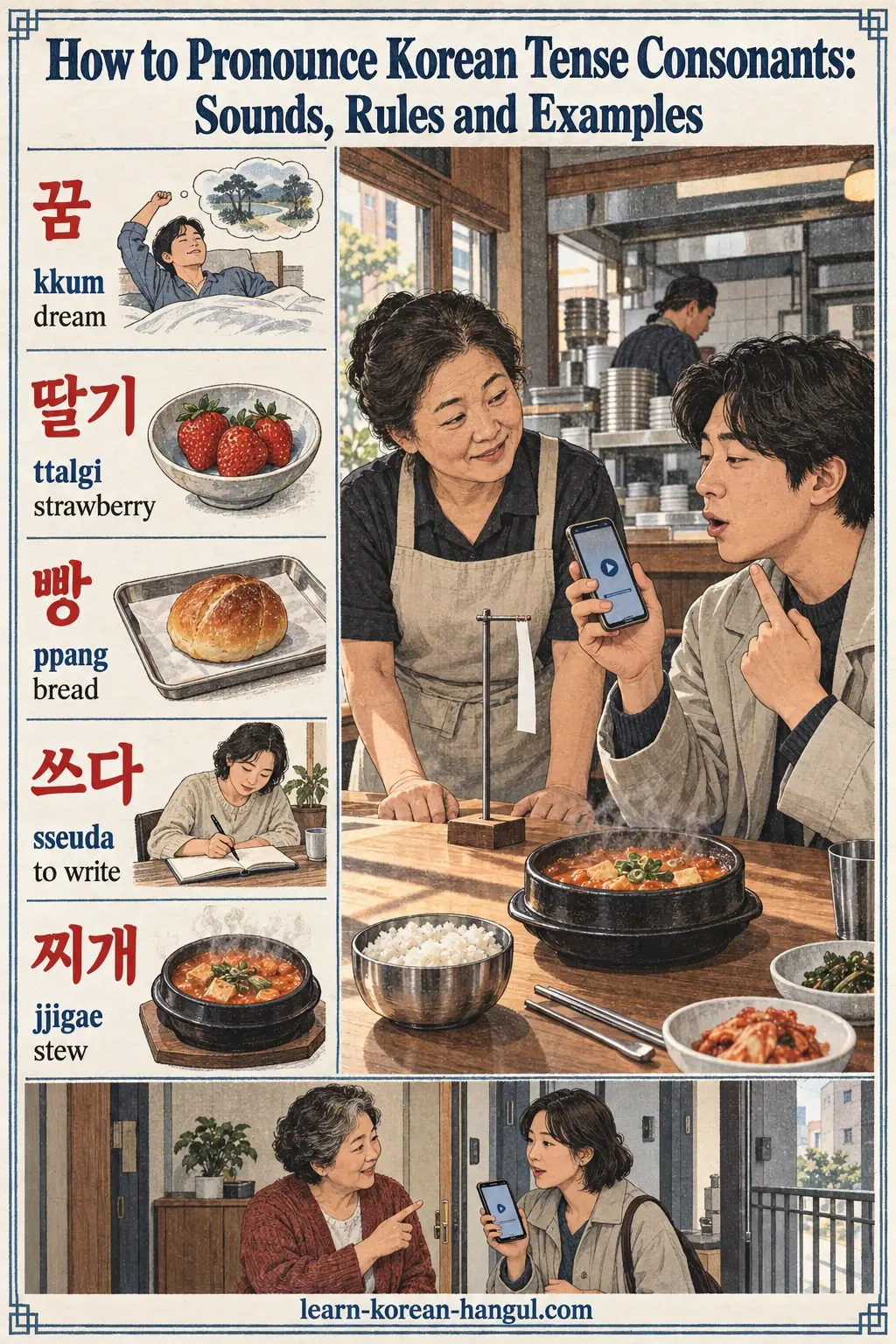
To pronounce Korean tense consonants, follow four steps: set the mouth in the plain position, tighten the throat, release without pushing air, and start the vowel high and short. The method works for ㄲ, ㄸ, ㅃ, ㅆ and ㅉ, takes about 30 minutes to learn, and has one success factor: a tight throat with no puff of breath.
What you'll learn
- Produce ㄲ, ㄸ, ㅃ, ㅆ and ㅉ on purpose.
- Pass the paper test for missing breath.
- Diagnose and fix the five most common errors.
- Hear the tense consonants in 꿈, 딸기, 빵, 쓰다 and 찌개.
What Do You Need before You Start?

Before you start, you need only a strip of paper and a quiet room. The method assumes that you know the plain and aspirated sounds, so read the overview Plain Tense Aspirated Consonants first if the three-way contrast is new.
| Item | Detail |
|---|---|
| Difficulty | Medium: the sound exists in English, but not as a separate letter |
| Time | About 30 minutes for the first session; short daily repeats afterwards |
| Tools | A strip of paper about 3 cm wide, a mirror, a phone for recording |
| Prerequisite | Basic letter sounds from Korean Consonant Sounds |
The five tense letters are the plain letters doubled: ㄱ becomes ㄲ, ㄷ becomes ㄸ, ㅂ becomes ㅃ, ㅅ becomes ㅆ and ㅈ becomes ㅉ. Their Korean name is 경음 (gyeongeum, "hard sounds") or 된소리 (doensori). The definition of the term is on the tense consonant glossary page. First, a closer look at what the sound actually is.
What Are Korean Tense Consonants?

Korean tense consonants are stops and affricates (and one fricative, ㅆ) pronounced with a tight throat and almost no puff of air. Phoneticians call them fortis sounds. The tightness comes from the larynx (the voice box), and it carries into the next vowel, which starts at a higher pitch.
| Place | Plain | Tense | Example |
|---|---|---|---|
| back of tongue | ㄱ | ㄲ | 꿈 (dream) |
| tongue tip | ㄷ | ㄸ | 딸기 (strawberry) |
| lips | ㅂ | ㅃ | 빵 (bread) |
| hissing | ㅅ | ㅆ | 쓰다 (to write) |
| tongue blade | ㅈ | ㅉ | 찌개 (stew) |
Tense does not mean loud, long or forceful. The sound is short and clipped, and the air from the lungs stays almost still. The opposite sound is the aspirated consonant, which has a strong puff. With the target defined, the four steps follow.
How to Pronounce Korean Tense Consonants Step by Step
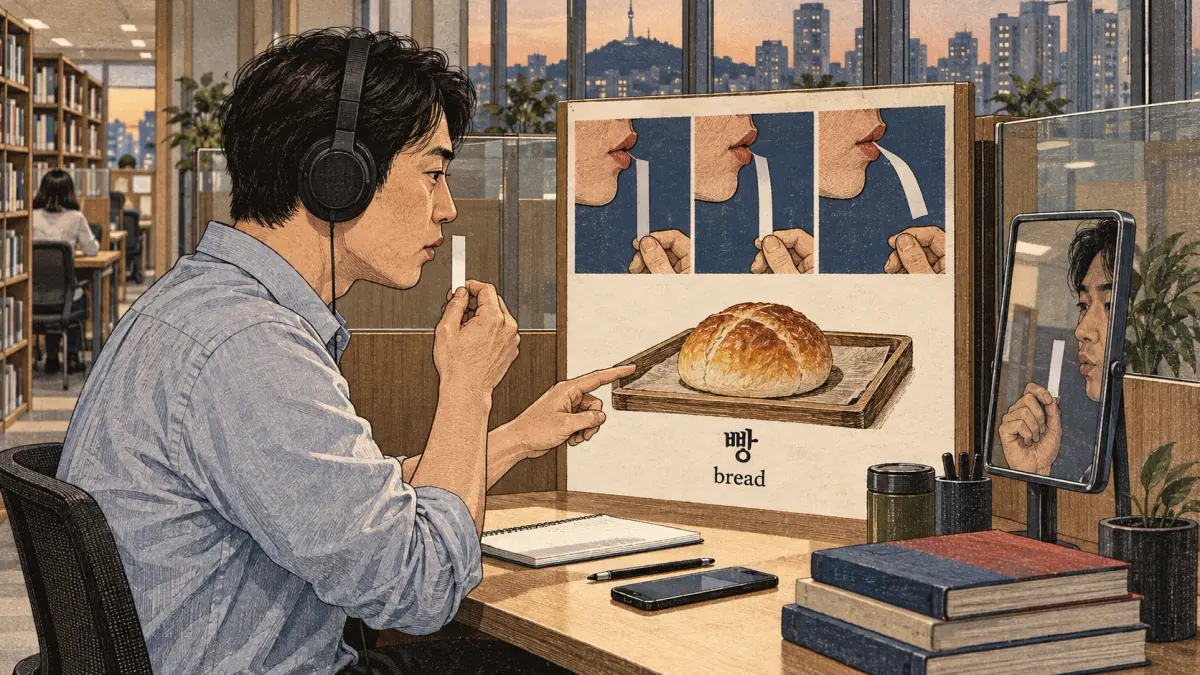
The four steps below build the tense sound from the plain position. Practise with ㅃ first, because the lips are visible in a mirror, then repeat the steps for the other four letters.
Step 1: Set the Place of the Mouth
Put your mouth in the position of the plain letter. For ㅃ, close both lips. For ㄸ, touch the tongue tip to the ridge behind the upper teeth. For ㄲ, raise the back of the tongue. For ㅉ, raise the front of the tongue. For ㅆ, bring the tongue close to the ridge. Checkpoint: you can describe where your tongue or lips are. Common mistake: starting from a different place and changing the letter.
Step 2: Tighten the Throat
Close the throat as if you were holding your breath for one second or stopping a cough. A helpful cue is the catch in the middle of "uh-oh". Keep the mouth closed. Checkpoint: you feel a small, firm tightness at the throat and no air moves. Common mistake: squeezing the neck muscles so hard that it hurts; use only enough tension to stop the air.
Step 3: Release without Air
Open the closure like a click and do not push any air out. The air stays in your lungs. Checkpoint: a hand held in front of your mouth feels almost nothing. Common mistake: breathing out as you release, which turns the sound into an aspirated consonant.
Step 4: Start the Vowel High and Short
Begin the vowel immediately, at a slightly higher pitch than you would use after a plain consonant, and keep it crisp. Checkpoint: the syllable sounds clipped, like 빵 and not "bahng". Common mistake: stretching the vowel to give the consonant time, which makes the syllable sound foreign.
Say 빵 four times, one step at a time, then run the steps together. Hear the target below before moving on.
With the steps in place, the next job is to check the result.
How Do You Know the Sound Is Right?

You know the sound is right when it passes the paper test and the recording test. Both checks look for the same fact: a tense consonant moves almost no air.
- Paper test. Hold a strip of paper about 3 cm from your lips. Say 파 (aspirated) and watch the paper move. Say 빠 (tense) and the paper should barely move.
- Hand test. Hold your palm 5 cm from your mouth. Tense consonants feel like nothing, plain consonants like a light touch and aspirated consonants like a push.
- Recording test. Record 바 빠 파, 바 빠 파 and listen back. The middle sound should be tighter and shorter than the others.
Treat the tests as relative. Distance and loudness change how much air moves, so compare your own three sounds with each other. The paper test cannot measure throat tension, so use the recording test and the audio models for that. Some tricks make Step 2 easier.
Which Tricks Help English Speakers?
Three tricks help English speakers find the tight throat without strain. Each uses a sound that English already has.
- The "s" trick. In "spin", "sky" and "stop", the p, k and t have no puff, because English drops the breath after s. Say "spin" slowly, then remove the s and keep the same p. The result is close to ㅃ. The same works for ㄲ (from "sky") and ㄸ (from "stop"). The match is not exact, because the Korean sound is tighter.
- The "uh-oh" trick. Say "uh-oh" and notice the catch between the two syllables. Start the consonant from that catch.
- The whisper trick. Whisper 빵 with no voice. Without the voice, it is easy to feel that the air has stopped. Then add the voice.
Choose one trick and use it for a week. The tricks are scaffolding, so drop them once the sound is automatic. Each letter has small differences, covered next.
What Does Each Tense Letter Need?
Each tense letter needs the same four steps plus one extra detail. The table shows the detail for each.
| Letter | Place | Extra detail | Word to practise |
|---|---|---|---|
| ㄲ | back of tongue | keep the back of the tongue pressed until the release | 꿈 (dream) |
| ㄸ | tongue tip | keep the tongue tip firm on the ridge, not on the teeth | 딸기 (strawberry) |
| ㅃ | lips | press the lips together, without puffing the cheeks | 빵 (bread) |
| ㅆ | ridge | keep a short, sharp hiss, not a long one | 쓰다 (to write) |
| ㅉ | tongue front | keep the hiss short after the release | 찌개 (stew) |
Each letter also has a full lesson that compares it with its plain and aspirated partners: ㄱ ㅋ ㄲ, ㄷ ㅌ ㄸ, ㅂ ㅍ ㅃ, ㅈ ㅊ ㅉ and ㅅ ㅆ. One more feature affects every tense consonant in the middle of a word.
Why Do Tense Consonants Sound Longer between Vowels?

Tense consonants sound longer between vowels because the closure is held a moment longer before the release. In 아빠 (dad) and 어깨 (shoulder), the lips or the tongue stay closed for a short extra time, and the word sounds as if the consonant were doubled. Romanization reflects this: 아빠 is "appa" and 어깨 is "eokkae".
| Word | Meaning | Closure | Spoken form |
|---|---|---|---|
| 아빠 | dad | held slightly longer | [아빠] |
| 어깨 | shoulder | held slightly longer | [어깨] |
| 아파요 | it hurts | normal, then a puff | [아파요] |
The extra length is small, and it is not the main cue. Tightness is the main cue. A second source of tense sounds is tensification, a sound change in which a plain consonant becomes tense after a final stop. 학교 (school) is spoken [학꾜] because ㄱ becomes ㄲ after the final ㄱ of 학.
The rules for this change are in Korean tensification. Even with the method, the usual errors appear, so a troubleshooting table follows.
What Goes Wrong, and How Do You Fix It?
Five errors account for most failed attempts. Each has a cause and a fix.
| Problem | Cause | Fix |
|---|---|---|
| The paper still moves | air is pushed during the release | hold the breath and release only the closure |
| The sound is loud or shouted | tension is mistaken for volume | speak at normal volume and tighten the throat only |
| The sound is the same as the plain letter | the throat stays relaxed | add the "uh-oh" catch before the release |
| The vowel is too long | the vowel is stretched to give the consonant time | start the vowel at once and keep it short |
| The neck hurts | tension is too strong | stop and relax; use the smallest tension that stops the air |
A second group of errors comes from reading romanization. The doubled letters in kk, tt, pp, ss and jj look like long English consonants, so learners lengthen them. In fact, the doubling marks tension. See the consonant mistakes page for more patterns. A worked example shows the steps working together.
Worked Example: 빵
The worked example runs the four steps on the word 빵 (bread).
- Set the place. Close both lips lightly, as for ㅂ.
- Tighten the throat. Press the lips firmly and catch the breath, as in "uh-oh".
- Release without air. Open the lips like a small click. Hold a strip of paper 3 cm away: it should barely move.
- Start the vowel high and short. Say ㅏ right away at a slightly higher pitch, then close with the ng sound of ㅇ.
- Compare. Say 방 (room) and 팡, the plain and aspirated versions, and notice that 빵 has the least breath of the three and the tightest throat.
You will know it worked when the paper stays almost still and the word sounds clipped. A listener can then hear 빵 (bread) and not 방 (room). The result is also the foundation for the next lessons, which build on the pitch and voicing effects.
Practice and Answer Key
Work through the exercises in order. The answers follow after Exercise 4.
Exercise 1: listen and choose. Play each clip once, then write whether the first consonant is tense or not.
Practice · Read
Show answer
꿈
tense ㄲ: 꿈, dream
Show answer
딸기
tense ㄸ: 딸기, strawberry
Show answer
빵
tense ㅃ: 빵, bread
Show answer
쓰다
tense ㅆ: 쓰다, to write
Show answer
찌개
tense ㅉ: 찌개, stew
Show answer
꿈 딸기 빵 쓰다 찌개
all five tense consonants in a row
Show answer
아빠
tense ㅃ between vowels: 아빠, dad
Show answer
어깨
tense ㄲ between vowels: 어깨, shoulder
Show answer
학교
tensification: 학교, school, spoken [학꾜]
Exercise 2: name the letter. Write the tense letter at the start of each word: 1 빵, 2 꿈, 3 딸기, 4 쓰다, 5 찌개.
Exercise 3: paper test. Say 파, 바 and 빠 with a strip of paper in front of you. Rank them from most to least paper movement.
Exercise 4: predict the spoken form. Write how 학교 is spoken.
Answers.
Exercise 2: 1 ㅃ. 2 ㄲ. 3 ㄸ. 4 ㅆ. 5 ㅉ.
Exercise 3: 파 moves the paper most, 바 moves it a little, 빠 barely moves it.
Exercise 4: [학꾜].
If Exercise 1 is hard at first, your hearing is behind your mouth, which is typical. Repeat the clips daily and add the plain, tense and aspirated listening practice. For speaking drills, try the Korean tongue twisters once the single sounds feel steady.
Where to Go Next
Continue with Korean Consonant Voicing, which explains how plain consonants change between vowels, and read Korean Consonants and Pitch to understand why the vowel after a tense consonant starts higher. The full list of lessons is in Plain, Tense and Aspirated Sounds.
This lesson teaches production. It does not cover every sound change that creates tense sounds, regional differences or the acoustic measurements behind the pitch cue. It also cannot replace feedback from a teacher, because tension is hard to judge from your own recording.
Knowing how to pronounce Korean tense consonants comes down to four steps: set the place, tighten the throat, release without air, and start the vowel high and short. Check with the paper, trust the audio models, and keep the tension small.
Frequently Asked Questions
Do tense consonants need more air than plain ones? No. Tense consonants use less air than plain ones, not more. The name tense refers to the tight throat, not to force from the lungs. If you push air, the sound turns into an aspirated consonant. Think of closing the throat, releasing a click and stopping the breath.
Why can't I hear the difference between ㄲ and ㄱ? English does not use tension to separate words, so the ear ignores it. The clearest cue is the start of the vowel, which is higher and more clipped after ㄲ. Listen for the pitch of the vowel, not the consonant. Repeating minimal pairs such as 굴 and 꿀 trains the ear over time.
Is it safe to tense my throat? Light tension is safe, and native speakers use it all day. The tension is small, like holding your breath for a second. If your throat hurts, you are squeezing too hard. Stop, relax, and use only enough tension to stop the air. Hoarseness or pain is a signal to rest.
Are tense consonants louder than plain ones? No. Tense consonants are tighter and more clipped, not louder. In fact, they use less air, so they can sound softer in volume. Louder speech does not make a consonant tense. A listener hears the sharp release and the higher start of the next vowel.
Can the p in English 'spin' help me say ㅃ? Yes. The p in 'spin' has no puff of air, so it is a good model for ㅃ. Say 'spin', then drop the s and keep the same p: 'pin' with no puff is close to ㅃ. Add a tighter throat for a closer match. The same trick works for ㄲ in 'sky' and ㄸ in 'stop'.