The Korean sound system is the set of consonants, vowels and glides that Standard Korean uses, plus the rules for joining them into syllables. It has 19 consonant sounds, up to 10 simple vowels, two glides and one syllable frame: (consonant) + (glide) + vowel + (consonant). That frame explains much of what makes Korean sound Korean.
What you'll learn
- Sort Korean sounds into consonants, vowels and glides.
- State the Korean syllable shape and build examples of each type.
- Explain why English loanwords such as "strike" gain extra vowels in Korean.
- Name three differences between the Korean and English sound systems.
Prerequisites: none. Knowing a few Hangul letters helps, but every example has audio. Estimated time: 30 minutes.
What Is the Korean Sound System?
The Korean sound system is the inventory of meaningful sounds in Korean (its phonemes) together with the rules for combining them. A phoneme is a sound that can change the meaning of a word: ㄷ and ㅌ are different phonemes because 달 (moon) and 탈 (mask) are different words.
It helps to separate letters from sounds. Hangul has 40 letters: 19 consonants and 21 vowels. The 19 consonant letters match 19 consonant sounds, but 11 of the 21 vowel letters are diphthongs (a glide plus a vowel, as in ㅑ = y + ㅏ), and a few vowel letters are pronounced the same by many speakers. Counting letters and counting sounds therefore give different numbers, a point many guides blur.
The description on this page follows Standard Korean (표준어) as set out in the Standard Pronunciation Rules (표준 발음법) of the National Institute of Korean Language (국립국어원), with notes where everyday Seoul speech differs.
Why English Speakers Struggle with Korean Sounds

English speakers struggle with Korean sounds in three places: the consonant contrasts, the syllable shape and the rhythm. Most individual sounds are not the problem. Korean ㄴ, ㅁ and ㅅ are close to English n, m and s.
The difficulties are systemic. English sorts consonants by voicing (b versus p); Korean sorts them by breath and tension. English allows clusters such as "str" and "nts"; Korean does not. English stresses one syllable per word; Korean gives each syllable similar weight. Knowing the whole system first makes each later lesson easier to place.
How Do Consonants and Vowels Fit into One Korean Syllable?

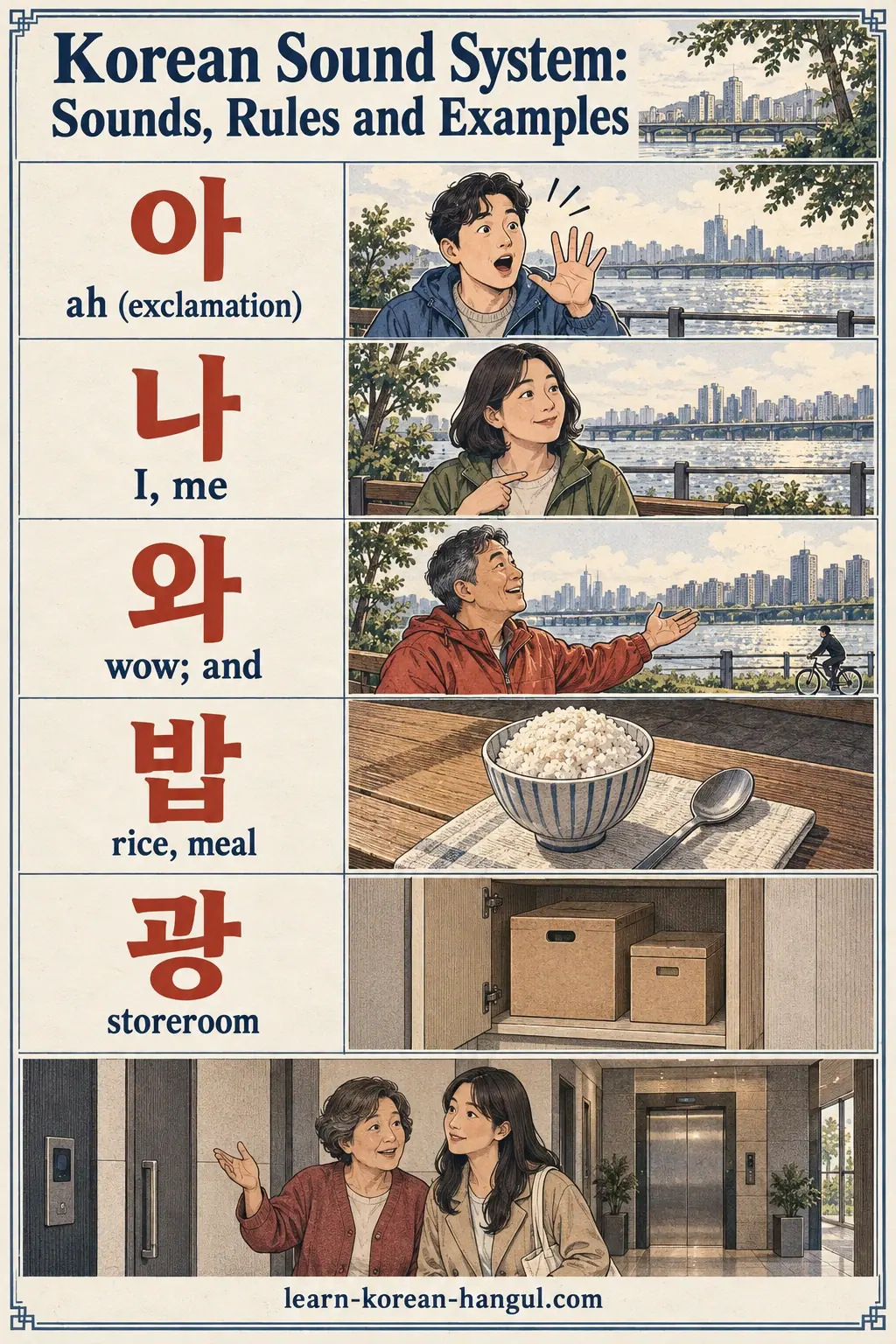
Korean consonants and vowels fit into one fixed syllable frame: an optional consonant, an optional glide, a required vowel, and an optional final consonant. Written as a formula, it is (C)(G)V(C). Every spoken Korean syllable fits this frame; spelling alone can add a second final letter.
| Type | Frame | Example | Meaning |
|---|---|---|---|
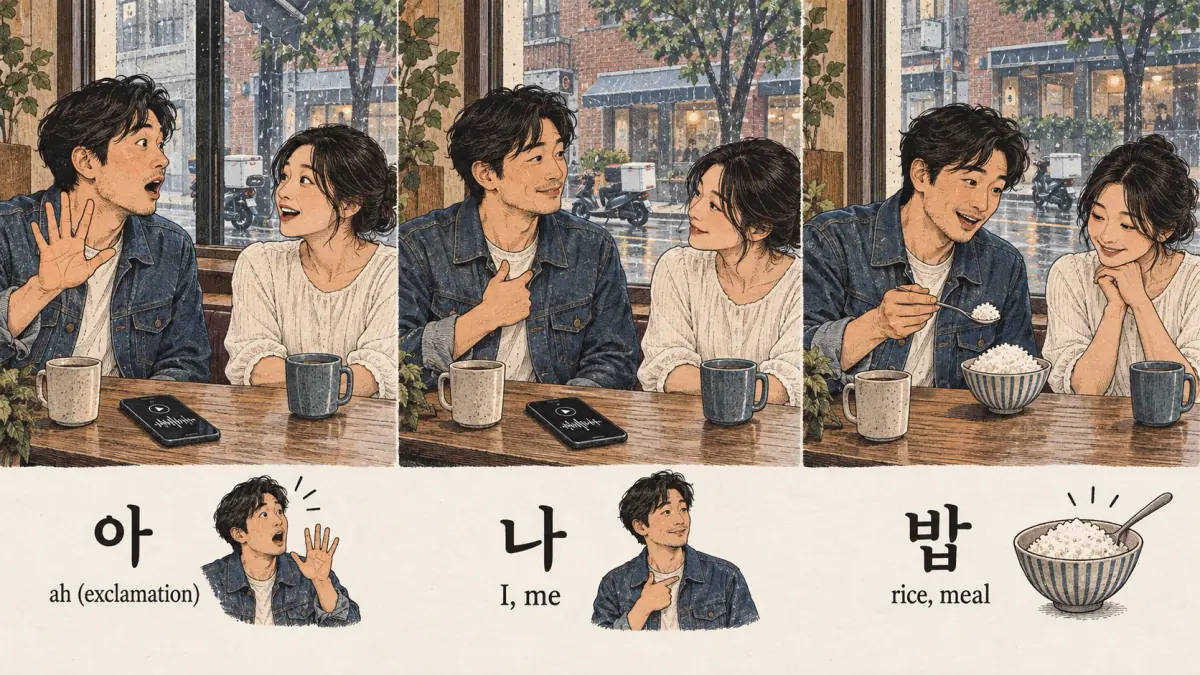
| vowel only | V | 아 | ah (exclamation) |
| consonant + vowel | CV | 나 | I, me |
| glide + vowel | GV | 와 | wow; and |
| consonant + vowel + consonant | CVC | 밥 | rice, meal |
| consonant + glide + vowel + consonant | CGVC | 광 | storeroom |
Two limits follow. First, no syllable starts with two consonants. Second, no syllable ends with two consonant sounds. Spelling can show two final letters, as in 닭 (chicken), but speech keeps only one: 닭 is [닥]. Only seven consonant sounds can occupy the final slot; they are covered in the seven final sounds. The written block layout is explained in how syllable blocks are built.
Why Do English Loanwords Gain Extra Vowels?
English loanwords gain extra vowels because the Korean syllable frame has no room for consonant clusters. Each consonant that cannot fit into a frame gets its own syllable, usually with the vowel ㅡ, the most neutral Korean vowel.
| English | Korean | Romanization | Syllables |
|---|---|---|---|
| strike | 스트라이크 | seuteuraikeu | 5 |
| stress | 스트레스 | seuteureseu | 4 |
| Christmas | 크리스마스 | keuriseumaseu | 5 |
| desk | 데스크 | deseukeu | 3 |
"Strike" has one syllable in English and five in Korean. The process is called epenthesis (adding a vowel). It is a direct, predictable result of the syllable frame, not a spelling choice.
Which Consonant Families Does Korean Use?

Korean uses four consonant families: obstruents with a three-way contrast, two fricatives plus ㅎ, three nasals, and one liquid.
| Family | Sounds | What makes them special |
|---|---|---|
| Stops and affricates | ㄱ ㄲ ㅋ, ㄷ ㄸ ㅌ, ㅂ ㅃ ㅍ, ㅈ ㅉ ㅊ | four sets of plain, tense and aspirated |
| Fricatives | ㅅ ㅆ, ㅎ | ㅅ has only a plain and a tense form |
| Nasals | ㄴ ㅁ ㅇ | ㅇ is [ng] at the end, silent at the start |
| Liquid | ㄹ | [l] at the end, a quick flap between vowels |
The three-way contrast is the most important new feature for English speakers, and it has its own sub-section on plain, tense and aspirated sounds. The families and each letter's sound are taught in consonant sounds.
One Letter, Several Sounds
Several Korean consonants have more than one pronunciation, depending on position. Linguists call these variants allophones: different sounds that do not change meaning.
- ㄹ: [l] at the end of a syllable (달), a quick tap like the t in American "water" between vowels (다리).
- ㅅ: an s sound before most vowels (사), closer to "sh" before ㅣ (시).
- Plain stops: voiceless at the start of a word, voiced between vowels. In 고기 (meat), the first ㄱ is [k] and the second is [g].
- ㅇ: no sound at the start of a syllable, [ng] at the end (앙).
Allophones explain why romanization sometimes writes one letter two ways (ㄹ as r or l, ㄱ as g or k) although Korean speakers hear one sound.
Which Vowels and Glides Does Korean Use?
Korean uses up to 10 simple vowels and two glides, y and w, which combine with vowels to form the remaining vowel letters. A simple vowel (monophthong) keeps one mouth position from start to finish; a glide is a quick y or w movement into the vowel.
| Simple vowel | Rough English reference | Note |
|---|---|---|
| ㅏ | a in "father" | |
| ㅓ | open "aw", lips unrounded | no exact English match |
| ㅗ | o in "go", without the w ending | lips rounded |
| ㅜ | oo in "food" | lips rounded |
| ㅡ | oo in "food" with spread lips | no exact English match |
| ㅣ | ee in "see" | |
| ㅐ / ㅔ | e in "bed" | merged for most younger Seoul speakers |
| ㅚ / ㅟ | listed as simple vowels | usually said [we] and [wi] today |
The y-glide forms ㅑ ㅕ ㅛ ㅠ ㅒ ㅖ, and the w-glide forms ㅘ ㅝ ㅙ ㅞ (and, in everyday speech, ㅚ ㅟ). ㅢ is a special case, with a glide made with the tongue high at the back; it has its own lesson. Full details are in the vowel sounds section. The mergers in the last two rows are described here as Seoul speech tendencies; the Standard Pronunciation Rules still list the vowels separately.
How Is the Korean Sound System Different from English?
The Korean sound system differs from English most in how consonants contrast, how syllables are built and how rhythm works. The table summarizes the main differences.
| Feature | Korean | English |
|---|---|---|
| Consonant contrast | breath and tension (plain, tense, aspirated) | voicing (b versus p) |
| Syllable start | at most one consonant | up to three ("str") |
| Syllable end | one of seven sounds, unreleased | many sounds, often released |
| Fricatives | ㅅ ㅆ ㅎ only | f, v, th, z, sh and more |
| Vowel reduction | none; vowels keep full quality | unstressed vowels become schwa |
| Word stress | none in Standard Korean | one stressed syllable per word |
Three differences matter most for being understood: the consonant contrast, the closed and unreleased finals, and the absence of vowel reduction. Korean also lacks f, v, z and th, so English names with these sounds are adapted: "coffee" becomes 커피 and "zero" becomes 제로.
How Does Hangul Reflect the Korean Sound System?
Hangul reflects the Korean sound system because its consonant letters were designed from the speech organs that make each sound. The Hunminjeongeum Haerye (훈민정음 해례본), the 1446 explanation of the new script, describes five basic consonant shapes and how the other letters grow from them.
| Basic letter | What the shape shows | Letters built from it | Sound family |
|---|---|---|---|
| ㄱ | back of the tongue raised to block the throat | ㅋ, ㄲ | back-of-tongue stops |
| ㄴ | tongue tip touching the ridge behind the teeth | ㄷ, ㅌ, ㄸ | tongue-tip sounds |
| ㅁ | the closed mouth | ㅂ, ㅍ, ㅃ | lip sounds |
| ㅅ | a tooth | ㅈ, ㅊ, ㅆ, ㅉ | hissing and blade sounds |
| ㅇ | the open throat | ㅎ (via the obsolete letter ㆆ) | throat sounds |
The design follows two principles. First, an extra stroke marks a stronger sound: ㄱ becomes aspirated ㅋ, and ㄴ becomes ㄷ, then ㅌ. Second, a doubled letter marks a tense sound: ㄱ becomes ㄲ. The three-way contrast you will practise in later lessons is therefore visible in the letters themselves. If you can see that ㄷ, ㄸ and ㅌ share one shape, you already know that they share one place in the mouth.
The vowels follow a different logic. Their three base strokes stand for heaven (a dot, now a short stroke), earth (ㅡ) and person (ㅣ), and the other vowels combine them: ㅗ puts the short stroke above ㅡ, and ㅏ puts it to the right of ㅣ.
One limitation is worth knowing. The letters fit the Korean of the 15th century, and the sound system has changed since then. Some letters, such as ㆍ and ㅿ, are no longer used, and some modern letters now share one sound, as ㅐ and ㅔ do for most Seoul speakers. The full story is in how Hangul was created. The letter shapes cover consonants and vowels, but they say nothing about rhythm, which is the last part of the system.
Stress, Tone and Rhythm in Korean

Standard Korean has no word stress and no lexical tones. Instead, pitch is organized over short phrases, called accentual phrases, of about three or four syllables, which typically rise toward the end. The result is a rhythm in which syllables take roughly equal time, often described as syllable-timed.
Regional varieties differ. Gyeongsang Korean, spoken around Busan and Daegu, uses pitch accent: a word's pitch pattern is part of the word. Vowel length is a further point: the Standard Pronunciation Rules recognize long vowels, as in 눈 [눈:] (snow) versus 눈 (eye), but most younger Seoul speakers no longer distinguish them. The rhythm lessons are in Korean rhythm.
Worked Example: Building Syllables from 나
One consonant and one vowel can show every syllable type. Start from 나 and add parts.
- 나 (CV). ㄴ + ㅏ: the basic open syllable. Meaning: I, me.
- 난 (CVC). Add a final ㄴ. The syllable closes: [난].
- 냐 (CGV). Put a y-glide before the vowel: ㅑ = y + ㅏ. Heard in the ending -냐 in casual questions.
- 냥 (CGVC). Add a final ㅇ: [냥], as in the cat sound 냥.
- 낡 (written CVCC). Spelling allows two final letters, but speech keeps one: 낡다 (to be worn out) is [낙따].
You'll know you understand the frame when you can explain why step 5 has four letters but only three sounds.
Common Mistakes about the Korean Sound System
Counting letters as sounds. Learners often assume 21 vowel letters means 21 vowel sounds; actually many are glide combinations, and some letters share a sound.
Pronouncing clusters. Learners often try to say both letters of 닭; actually only one is said before a pause: [닥].
Reducing vowels. Learners often say unstressed Korean vowels as a weak "uh"; actually every Korean vowel keeps its quality.
Adding stress. Learners often stress one syllable, as in "an-NYEONG-haseyo"; actually Korean syllables carry similar weight, with pitch set by the phrase.
Practice: Sort and Build
Exercise 1. Sort into consonant, vowel or glide sound: ㅁ, ㅓ, the y in ㅑ, ㄹ, ㅡ, the w in ㅘ.
Exercise 2. Give the syllable type (V, CV, GV, CVC, CGVC): 1 오, 2 물, 3 요, 4 관.
Exercise 3. How many syllables does the Korean form of "desk" have, and why?
Answers. Exercise 1: consonant ㅁ, ㄹ; vowel ㅓ, ㅡ; glide y, w. Exercise 2: 1 V, 2 CVC, 3 GV, 4 CGVC. Exercise 3: three (데스크), because the cluster "sk" cannot fit into one Korean syllable, so ㅡ is added after ㅅ and after ㅋ.
Where to Go Next
Continue with Korean Consonant Sounds, which teaches each consonant family with audio. The vowel lessons follow, then the three-way contrast in detail. All of these sit in Korean Sounds.
This page gives the system, not each sound in depth. It does not cover sound change rules, intonation patterns or dialects beyond brief notes. Those topics are taught in their own sections.
In short, the Korean sound system combines 19 consonant sounds, a small set of vowels and two glides in one syllable frame, (C)(G)V(C). The frame, the three-way consonant contrast and the even rhythm are the three features that most separate Korean from English.
Frequently Asked Questions
How many consonants and vowels does Korean have? Hangul has 19 consonant letters and 21 vowel letters. The 19 consonant letters match 19 consonant sounds. The 21 vowel letters stand for up to 10 simple vowels plus combinations with the glides y and w. Most Seoul speakers merge ㅐ and ㅔ and say ㅚ and ㅟ as glide combinations, which leaves 7 simple vowels in everyday speech.
Does Korean have consonant clusters? Korean spelling has double batchim such as ㄺ and ㅄ, but speech has no consonant clusters inside a syllable. Before a pause or consonant, only one of the two letters is said: 닭 is [닥]. Before a vowel, the second letter moves to the next syllable: 닭이 is [달기]. English loanwords gain vowels for the same reason.
Is Korean pronunciation phonetic? Korean spelling is regular but not purely phonetic. Each letter has a predictable sound, yet the spelling keeps the meaningful parts of words, so sounds change where parts meet: 감사합니다 is said [감사함니다]. Once you know about ten core rules, you can predict the pronunciation of most written words.
Does Korean have tones? Standard Korean, based on Seoul speech, has no lexical tones: pitch does not distinguish words the way it does in Mandarin. Some regional varieties, especially Gyeongsang (around Busan and Daegu) and parts of Hamgyeong, use pitch accent, where pitch patterns can distinguish words. Seoul Korean uses pitch only for phrases and questions.
Does Korean have a schwa sound? Korean has no schwa, the weak 'uh' vowel in the English word 'about'. Every Korean vowel keeps its full quality, even in fast speech. English speakers often replace ㅓ or ㅡ with a schwa, which blurs words. The nearest Korean vowels are ㅓ, which is more open, and ㅡ, which is said with spread lips.