What you will learn
- Place each Korean consonant by lips, tongue tip, tongue back or throat.
- Name which consonants form a plain, tense and aspirated set, and which stand alone.
- Say 바다, 빠르다 and 파도 so that the three ㅂ-family sounds are different.
- Explain why the English labels "b" and "p" mislead for ㅂ.
Before you start: you have met the Korean sound system and you can read the consonant letters in the Korean consonants lessons. Time: about 30 minutes with audio.
Key Facts
- The 19 consonants are 14 basic letters and 5 tense (doubled) letters.
- Stops and affricates come in three types: plain (ㄱ ㄷ ㅂ ㅈ), tense (ㄲ ㄸ ㅃ ㅉ) and aspirated (ㅋ ㅌ ㅍ ㅊ).
- ㅅ has a plain and a tense form (ㅅ, ㅆ) but no aspirated form.
- ㄴ, ㅁ and ㅇ (at the end of a syllable) are nasal sounds; ㄹ is a liquid; ㅎ is a glottal sound.
- Plain stops are voiceless at the start of a word and often voiced between vowels.
- This page describes the Standard Korean of Seoul.
Last updated: 2026-10-08. The Korean text, romanization and audio scripts on this page are generated drafts that still await review by a Korean specialist.
What Are Korean Consonant Sounds?
Korean consonant sounds are the speech sounds that the 19 consonant letters stand for. A consonant is a sound made by blocking or narrowing the air somewhere in the mouth or throat, in contrast to a vowel, which is made with an open mouth. Korean writes consonants in two ways: 14 basic letters (ㄱ ㄴ ㄷ ㄹ ㅁ ㅂ ㅅ ㅇ ㅈ ㅊ ㅋ ㅌ ㅍ ㅎ) and five doubled letters (ㄲ ㄸ ㅃ ㅆ ㅉ) for tense sounds.
Every consonant is described by two facts. The place is where in the mouth the sound is made, and the manner is how the air is released. The table below shows all 19 on one grid.
| Manner | Lips | Tongue tip | Middle of tongue | Tongue back | Throat |
|---|---|---|---|---|---|
| Plain stop or affricate | ㅂ | ㄷ | ㅈ | ㄱ | |
| Tense stop or affricate | ㅃ | ㄸ | ㅉ | ㄲ | |
| Aspirated stop or affricate | ㅍ | ㅌ | ㅊ | ㅋ | |
| Nasal | ㅁ | ㄴ | ㅇ (end of a syllable) | ||
| Fricative | ㅅ, ㅆ | ㅎ | |||
| Liquid | ㄹ |
The stops, nasals and ㄹ each sit in a clear place, and the letters are explained one by one in the lessons on basic consonants, double consonants and aspirated consonants. The grid is a map, but English speakers need to know where the map clashes with their own habits.
Why English Labels Mislead for Korean Consonants

English speakers tend to sort Korean consonants into the English pairs b/p, d/t and g/k. This sorting does not work, because English separates those pairs by voicing (whether the vocal cords vibrate), and Korean separates its three sets by breath and tension.
At the start of an English word, "p" is aspirated: "pin" has a puff of air. "B" in "bin" has no puff and some voicing. Korean ㅂ is in between. It has a light puff and no strong voicing at the start of a word. Korean ㅍ has the full puff of English "p", and Korean ㅃ has no puff, like the "p" in "spin".
| Korean | Closest English habit | Where it misleads |
|---|---|---|
| ㅂ | between "b" in "bin" and "p" in "pin" | not clearly either; it changes with position |
| ㅍ | "p" in "pin" | stronger puff than most English speakers expect |
| ㅃ | "p" in "spin" | tense, with a tight throat |
Expert tip: the English "p" of "spin" is a good first model for ㅃ, because both have no puff. The Korean sound is also tight in the throat, so it is only a start.
A second problem is position. A plain Korean stop such as ㄷ is voiceless at the start of a word and voiced between vowels, so 바다 sounds like "pa-da" to an English ear. Position explains many of the mismatches between Korean spelling and English letters. The next section shows how the places of articulation fit together.
How Are Korean Consonants Grouped by Place of Articulation?
Korean consonants fall into five places: the lips, the tongue tip, the middle of the tongue, the back of the tongue and the throat. Each place has a family of sounds, and a learner who feels the place can predict which consonants are related.
| Place | Consonants | Where it happens | Example word |
|---|---|---|---|
| Lips | ㅂ ㅃ ㅍ ㅁ | both lips close | 바다 (sea) |
| Tongue tip | ㄷ ㄸ ㅌ ㄴ ㄹ ㅅ ㅆ | tip touches behind the upper teeth | 다리 (leg, bridge) |
| Middle of tongue | ㅈ ㅉ ㅊ | flat of the tongue against the hard palate | 자다 (sleep) |
| Tongue back | ㄱ ㄲ ㅋ ㅇ (end) | back of the tongue touches the soft palate | 가다 (go) |
| Throat | ㅎ | breath through the open throat | 하나 (one) |
The families explain why some mistakes are small and some are large. Confusing ㅂ and ㅍ is a matter of breath, because both close the lips. Confusing ㅂ and ㄷ is a matter of place, which is a bigger change. Place is also how the sound changes work: nasalization turns ㅂ into ㅁ and ㄱ into ㅇ, and each pair keeps its place.
The grid shows 19 sounds and three kinds of stops, and the next section explains how those three kinds differ.
What Are Plain, Tense and Aspirated Consonants?

Plain, tense and aspirated consonants are three ways of releasing the same stop. The place stays the same, and only the breath and tension change. Plain stops (ㄱ ㄷ ㅂ ㅈ) are soft with a light puff. Tense stops (ㄲ ㄸ ㅃ ㅉ) have no puff and a tight throat. Aspirated stops (ㅋ ㅌ ㅍ ㅊ) have a strong puff.
The lip set shows it best, because the three words are real words that differ only in this one sound.
| Set | Word | Meaning | Breath |
|---|---|---|---|
| plain ㅂ | 불 | fire | light puff |
| tense ㅃ | 뿔 | horn | no puff, tight throat |
| aspirated ㅍ | 풀 | grass | strong puff |
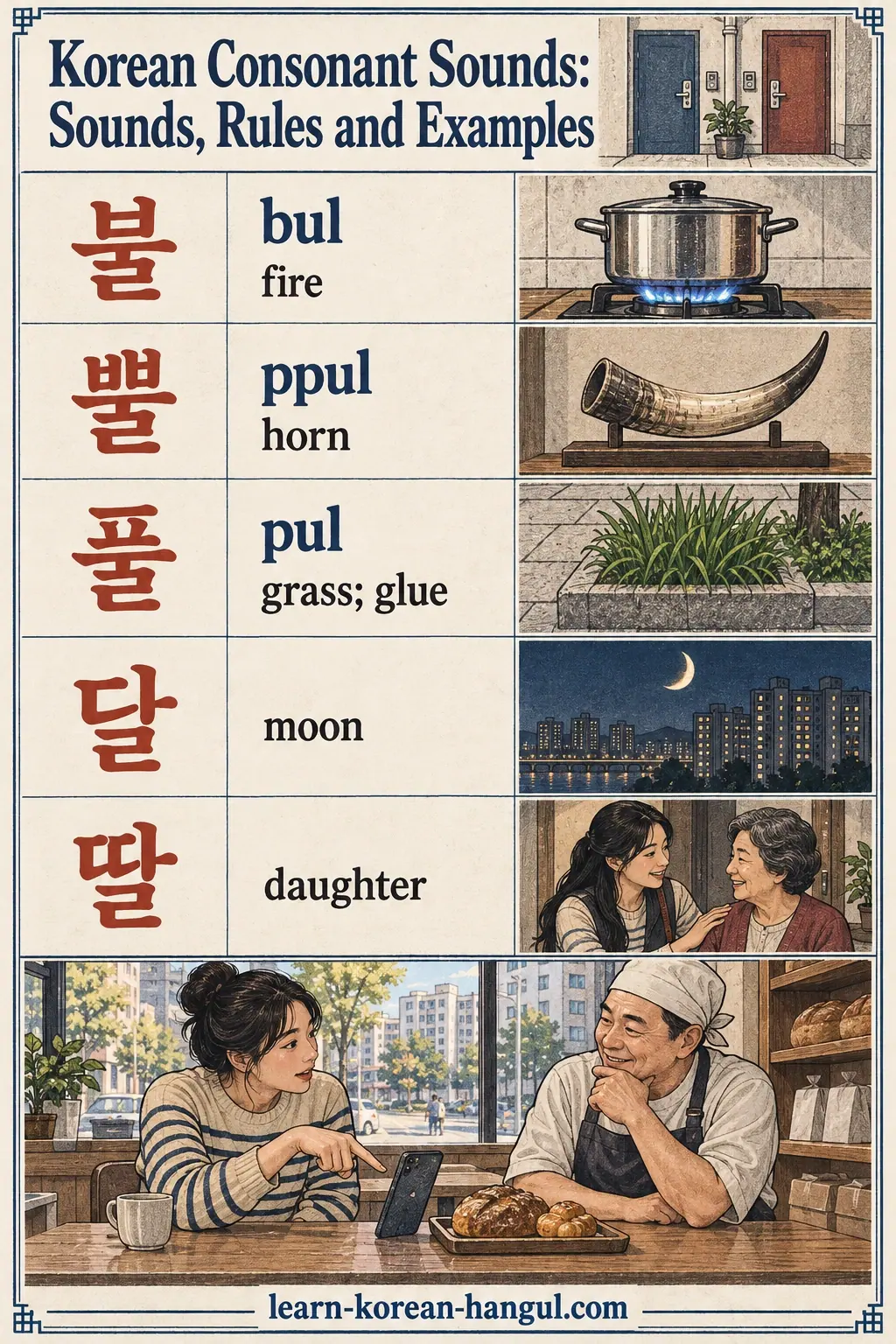
Plain: Light Puff; Tense: No Puff, Tight Throat; Aspirated: Strong Puff
| Korean | Romanization | Meaning | Sound |
|---|---|---|---|
| 불 | bul | fire | |
| 뿔 | ppul | horn | |
| 풀 | pul | grass; glue |
Hold a sheet of paper in front of your mouth to test it. The paper moves most for 풀, less for 불, and least for 뿔. The same three-way pattern exists at three more places, as the table shows.
| Place | Plain | Tense | Aspirated |
|---|---|---|---|
| Tongue tip | 달 (moon) | 딸 (daughter) | 탈 (mask) |
| Middle of tongue | 자다 (sleep) | 짜다 (be salty) | 차다 (be cold) |
| Tongue back | 기 (energy) | 끼 (flair, talent) | 키 (height) |
Tense does not mean loud or stressed. A tense consonant is made with a tight throat and a short, firm release, and the speaker does not need to speak louder. The detailed contrast belongs to the next lesson, plain, tense and aspirated consonants, and the page here only introduces the idea. The remaining consonants stand alone, without a three-way set.
Which Consonants Are Nasals, Liquids and Glottals?

The consonants ㄴ, ㅁ and ㅇ are nasals, ㄹ is a liquid, ㅅ and ㅆ are fricatives, and ㅎ is a glottal sound. These seven letters do not form plain, tense and aspirated sets, except that ㅅ has a tense partner ㅆ.
| Letter | Type | How it sounds | Example |
|---|---|---|---|
| ㄴ | nasal | like "n" in "no" | 나 (I) |
| ㅁ | nasal | like "m" in "me" | 마음 (heart) |
| ㅇ at the start | none | silent; the vowel stands alone | 아이 (child) |
| ㅇ at the end | nasal | like "ng" in "sing" | 강 (river) |
| ㄹ between vowels | liquid | a quick tap, like the "tt" in American "butter" | 나라 (country) |
| ㄹ at the end | liquid | like "l" in "ball" | 달 (moon) |
| ㅅ | fricative | like "s"; closer to "sh" before ㅣ | 사람 (person), 시계 (clock) |
| ㅆ | fricative | a tense "s", with no breathy start | 싸다 (be cheap) |
| ㅎ | glottal | like "h" in "hat" | 하나 (one) |
The letter ㅇ is the most confusing, because it has two jobs. At the start of a block it is silent, and at the end it is the "ng" sound, so 아이 has no consonant at all while 강 ends with one. The letter ㄹ is also two sounds in one letter: a tap between vowels and a lateral [l] at the end of a block or before another ㄹ.
Because each of these has a fixed place on the grid, they are the easier consonants for most learners. The harder challenge is that consonants do not stay fixed inside words.
How Do Consonants Change inside a Word?

Consonants change inside a word in five common ways, each with its own set of lessons. The written letters stay the same, and only the sound shifts.
- At the end of a syllable, only seven sounds remain. The final consonants ㄱ ㄴ ㄷ ㄹ ㅁ ㅂ ㅇ are all that Korean uses, so 밖 is [박], 앞 is [압] and 꽃 is [꼳]. This is the batchim rule.
- Before a vowel, a final consonant moves forward. 책이 is [채기]. This is liaison.
- Before a nasal, a stop becomes a nasal. 합니다 is [함니다]. This is nasalization.
- After some stops, a plain consonant becomes tense. 학교 is [학꾜]. This is tensification.
- Next to ㅎ, a stop becomes aspirated. 좋다 is [조타]. This is aspiration.
These five changes explain why Korean spelling and Korean sound differ in many everyday words. The full overview of the system is on the page about Korean pronunciation rules, and the first change is the subject of the batchim lessons. One word makes the grid and the contrasts concrete.
Worked Example: 바다
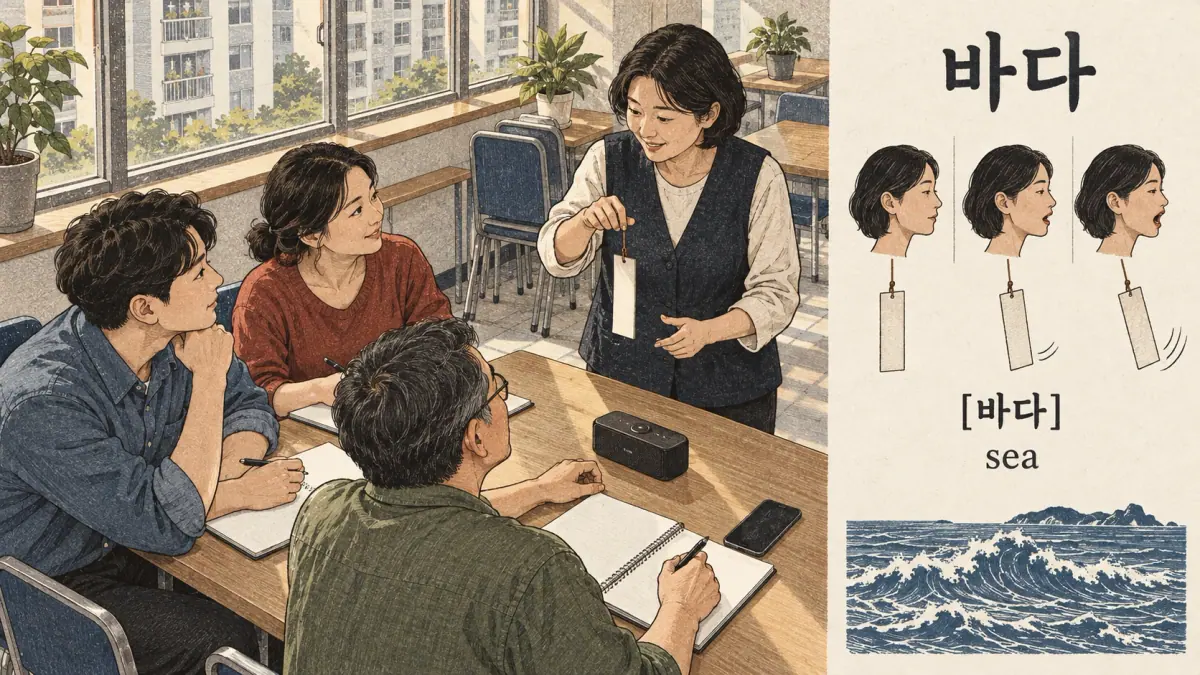
The word 바다 means "sea", and it is spoken [바다]. It looks simple, but each of its two consonants behaves differently.
- Break it into blocks: 바 / 다.
- Place the first consonant: ㅂ is made with both lips. It is a plain stop, so it has a light puff of air and no strong voicing.
- Place the second consonant: ㄷ is made with the tongue tip behind the upper teeth. It is a plain stop between two vowels, so it is voiced, close to the English "d".
- Say it as one flow: [바다], with the first sound close to "pa" and the second close to "da".
- Compare with its neighbors: 빠르다 (be fast) has the tense ㅃ, with no puff. 파도 (wave) has the aspirated ㅍ, with a strong puff.
You will know it worked when the first sounds of 바다, 빠르다 and 파도 are audibly different, and the paper test confirms it: the paper moves most for 파도, a little for 바다, and least for 빠르다.
The three words all begin with the vowel ㅏ, so the first consonant is the only difference you hear at the start. A 12-word drill extends the same idea to the other places.
A 12-Word Drill by Consonant Family
The drill below holds the vowel steady and varies only the first consonant, one place at a time. Listen to each triple in a row and then say it aloud.
| Place | Plain | Tense | Aspirated |
|---|---|---|---|
| Lips | 불 | 뿔 | 풀 |
| Tongue tip | 달 | 딸 | 탈 |
| Middle of tongue | 자다 | 짜다 | 차다 |
| Tongue back | 기 | 끼 | 키 |
Every row is a true minimal set: the three words differ only in the first consonant. Listening to the lip and tongue-tip rows first is the easier order, because the puff is easiest to feel there. The mistakes that remain are mostly about habit, so they come next.
Common Learner Mistakes
Learners often carry the English sorting of b/p, d/t and g/k into Korean. The mistakes below come from that habit.
- Mistake 1: treating ㄱ as always "g". Learners often assume that ㄱ is "g" everywhere. Actually ㄱ is voiceless at the start of a word and voiced between vowels, so it sounds like "k" at first and "g" in the middle, because it is a plain stop.
- Mistake 2: treating ㅂ as "b" or "p". Learners often pick one English letter. Actually ㅂ sits between them, because Korean contrasts breath, not voicing.
- Mistake 3: making tense sounds louder. Learners often shout ㅃ or ㄲ. Actually tense sounds are tight and short, and they need no extra volume.
- Mistake 4: sounding ㅇ at the start. Learners often say "ng" at the start of 아이. Actually the initial ㅇ is silent, because it only holds the place of the missing consonant.
- Mistake 5: using the letter name to read. Learners often say the name of ㄱ (기역) inside a word. Actually the names (기역, 니은, 디귿) are labels for the letters, and a word like 가 uses only the sound of ㄱ.
Rule of thumb: when in doubt, listen for the breath. A strong puff means aspirated, no puff and a tight throat means tense, and anything in between is plain.
Honest scope note: this page describes the pronunciation of Standard Korean in Seoul, and speakers from other regions and older speakers may differ. The practice set checks the main points.
Practice and Answer Key
Answer each question, and say the Korean words aloud.
- How many consonants does Korean have?
- Which three letters form the plain, tense and aspirated set at the lips?
- Which letter has a tense partner but no aspirated partner?
- Where is ㅁ made?
- What does ㅇ sound like at the start of a block?
- What does ㅇ sound like at the end of a block?
- Which word has a tense consonant: 달, 딸 or 탈?
- Which word has an aspirated consonant: 불, 뿔 or 풀?
Answer key
- 19 (14 basic and 5 tense).
- ㅂ (plain), ㅃ (tense) and ㅍ (aspirated).
- ㅅ, whose tense partner is ㅆ.
- At the lips.
- Nothing; it is silent.
- "ng", as in "sing"; 강 is the example.
- 딸.
- 풀.
Seven or eight correct means you can move on. If you missed number 3, return to the grid. The next lesson takes the three-way contrast further.
Where to Go Next
The next lesson, plain, tense and aspirated consonants, drills the three-way contrast set by set. For the sounds that cause the most trouble, see difficult Korean sounds, and return to the Korean Sounds section for the full list of lessons.
This lesson does not teach the vowels, which have their own section, and it does not teach letter shapes or stroke order. It covers Korean consonant sounds as sounds only, with one standard Seoul pronunciation. Pitch and rhythm are not covered.
Frequently Asked Questions
How many consonants are there in Korean? Standard Korean has 19 consonants. Fourteen are basic letters (ㄱ ㄴ ㄷ ㄹ ㅁ ㅂ ㅅ ㅇ ㅈ ㅊ ㅋ ㅌ ㅍ ㅎ) and five are tense doubles (ㄲ ㄸ ㅃ ㅆ ㅉ). The letter ㅇ counts as a consonant even though it is silent at the start of a block, because it is the "ng" sound at the end.
Is Korean ㅂ a b or a p? Neither exactly. Korean ㅂ is a plain stop that sits between English "b" and "p". At the start of a word it has a light puff and little voicing, so it can sound like "p". Between vowels it is voiced and sounds like "b". Revised Romanization writes b before a vowel (바다, bada) and p before a consonant or at the end of a word (밥, bap).
Are there silent consonants in Korean? Yes, in one sense. The letter ㅇ is silent at the start of a block, where it only holds the place of the missing consonant, so 아이 begins with a vowel. The letter ㅎ also becomes silent in some positions, such as before a vowel, so 좋아요 is [조아요].
Which consonants are the hardest for English speakers? The tense stops (ㄲ ㄸ ㅃ ㅉ) and the aspirated-versus-plain contrast are the hardest, because English separates its stops by voicing and not by breath and tension. The letter ㄹ, which is a tap between vowels, and the final ㅇ are the next most common problems for learners.