What you'll learn
- Pronounce ㅐ and ㅔ as one vowel, the way most Seoul speakers do.
- Spell 개 (dog) and 게 (crab) correctly from a picture or a sentence.
- Use endings, particles and word groups to decide between ㅐ and ㅔ.
- Avoid confusion between 내 (my) and 네 (your; yes) in conversation.
Before you start: you should know the eight simple vowels from Korean Simple Vowels. The lesson takes about 20 minutes. Audio plays only when you press a button.
What Is the Korean ㅐ vs ㅔ Pronunciation Difference?

The Korean ㅐ vs ㅔ pronunciation difference is small in speech and large in writing. The standard language, described in the 표준 발음법 (Standard Pronunciation Rules) of the 국립국어원 (National Institute of Korean Language), lists ㅐ and ㅔ as two separate single vowels. In everyday Seoul speech, they have merged into one sound. A vowel merger is a change in which two vowels that were once different become the same.
Listen to both words. Most Seoul speakers say them with the same vowel.
The first clip is 개 (gae, dog) and the second is 게 (ge, crab). If you cannot hear a difference, your ears are working normally. Native speakers who learned to spell the two vowels in school often cannot hear it either. They rely on spelling memory, and so will you.
This changes how to study. For ㅓ and ㅗ, or ㅡ and ㅜ, you train your ears. For ㅐ and ㅔ, you train your eyes and your memory. First, why this pair feels harder than it should.
Why English Speakers Struggle with ㅐ and ㅔ
English speakers struggle with ㅐ and ㅔ because they expect two sounds and search for a contrast that is no longer there. Textbooks often say "ㅐ is like the 'a' in 'cat' and ㅔ is like the 'e' in 'bed'". That description matches an older, more careful pronunciation. Modern Seoul speakers use one vowel in both letters.
Romanization adds a second problem. Revised Romanization writes ㅐ as ae and ㅔ as e. An English reader who sees "gae" may say "gay" or "guy". Neither is right. Romanization is a spelling aid for the letters, not a sound guide.
Three habits cause most errors:
- Searching for a contrast. Learners strain to say ㅐ more open than ㅔ and end up with an unnatural, exaggerated vowel.
- Reading "ae" as an English diphthong. English "ay" in "say" glides. The Korean vowel stays steady.
- Using one letter everywhere. Learners who write only ㅔ, or only ㅐ, make spelling errors that look like sound errors.
The fix is to pick one steady "e" vowel for speaking and to learn spelling as a separate skill. The next section describes that vowel.
Do ㅐ and ㅔ Sound the Same?

Yes, for most Seoul speakers they sound the same. Both are pronounced as a steady, mid-front vowel, close to the "e" in English "bed", and neither one glides. This is the speech you will hear in Seoul, in dramas, news and everyday conversation.
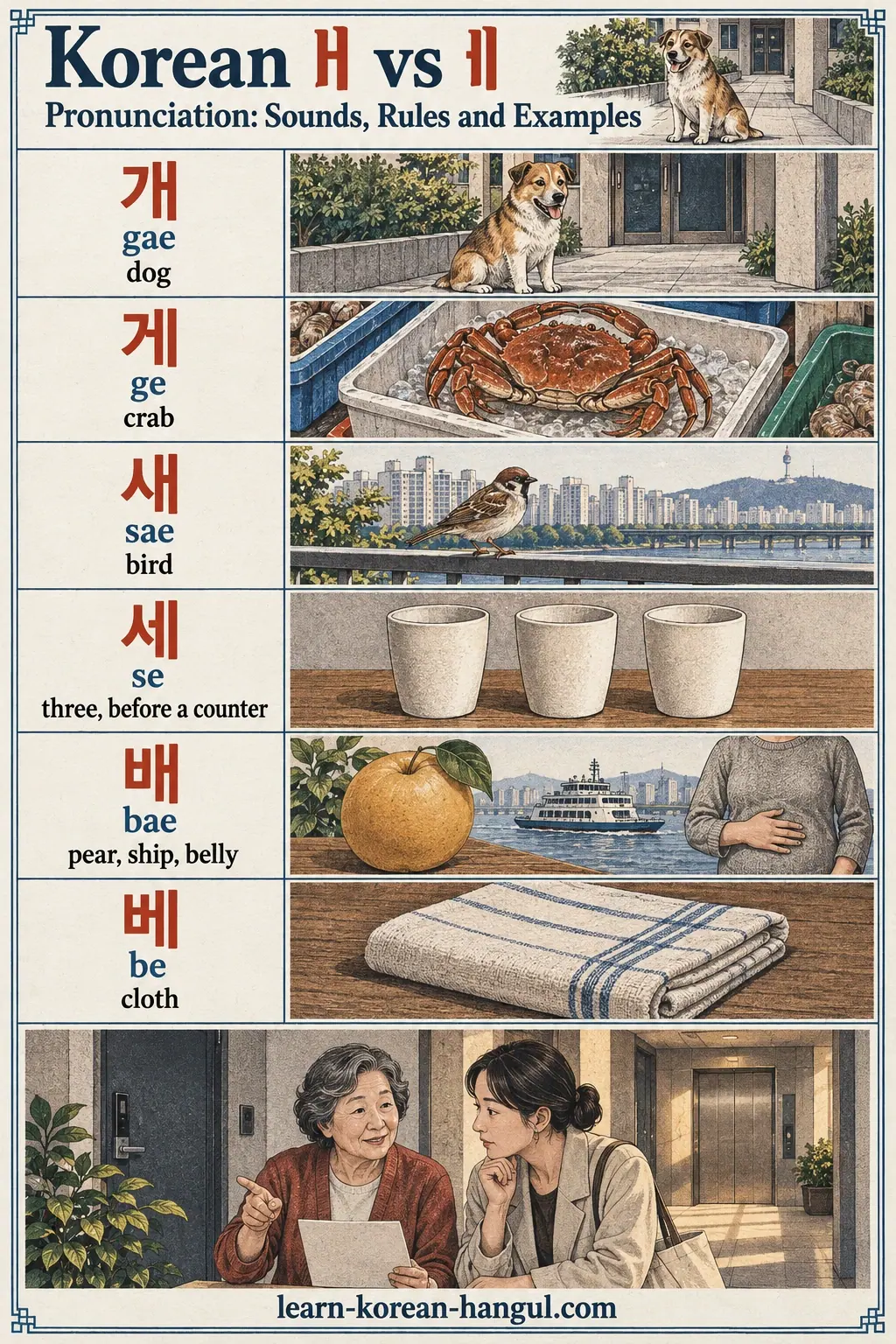
Three pairs show the effect. Each pair is spelled differently but usually sounds identical.
| Spelling 1 | Spelling 2 | Revised Romanization | Usual Seoul sound |
|---|---|---|---|
| 개 (dog) | 게 (crab) | gae / ge | [게] like "geh" |
| 새 (bird) | 세 (three, before a counter) | sae / se | [세] like "seh" |
| 배 (pear, ship, belly) | 베 (cloth) | bae / be | [베] like "beh" |
The sound column is a learning aid, not a transcription. It shows that one syllable serves for both spellings.
How should you treat this as a speaker of the standard language? Say one clear "e" vowel. Korean listeners decide which word you mean from context, exactly as English speakers do with "to" and "two". The standard still describes two vowels, and some older speakers or regional varieties may keep a small difference. This page describes common practice and does not tell you to hide a contrast that you naturally make. The next question is where the merger came from.
How Did the ㅐ and ㅔ Merger Happen?
The ㅐ and ㅔ merger happened because the two sounds drifted together over the 20th century, and Korean has few word pairs that depend on the difference. The letters themselves show the older picture. ㅐ is built from ㅏ and ㅣ, and ㅔ is built from ㅓ and ㅣ. Speakers once pronounced each as a glide: roughly "a + i" for ㅐ and "eo + i" for ㅔ. Over time, both glides shortened into single vowels that came closer and closer in the mouth.
The result is a near-merger that became a full merger for many speakers. Linguists describe it as strongest among Seoul speakers born after the mid-20th century. Older speakers, careful reading aloud and some regional varieties may keep a contrast. This page does not survey regions. The Korean accents and dialects section covers regional differences.
Dictionaries still list both letters separately, because the writing system kept the old distinction. The 표준국어대사전 (Standard Korean Language Dictionary) sorts words by both vowels, and the 한글 맞춤법 (Hangul Orthography rules) require the correct vowel in each word. The merger changed the sound, not the spelling.
Expert insight: a merger can make spelling harder, because the sound no longer tells you which letter to write. Korean schoolchildren practise this too.
Because speech cannot tell you which letter to write, you need spelling tools. Here are the tools that help most.
How Can You Keep ㅐ and ㅔ Apart in Spelling?

Keep ㅐ and ㅔ apart in spelling by learning each word with its picture or meaning, and by using four rules of thumb for the patterns that repeat. Spelling is a memory skill, so the aim is to build associations, not to hear a difference.
| Pattern | Spelling | Examples |
|---|---|---|
| Particles meaning "at", "in", "from" | always ㅔ | 에, 에서, 에게 |
| Polite endings -에요 and -세요 | always ㅔ | 책이에요 (it is a book), 하세요 (please do) |
| Verb 하다 in the polite form | always ㅐ | 해요 (does), 공부해요 (studies) |
| Loanwords with an English "e" or "ay" sound | usually ㅔ | 메뉴 (menu), 게임 (game), 케이크 (cake) |
| Everyday single-syllable nouns | memorize | 개 (dog), 게 (crab), 새 (bird), 배 (pear) |
The first four rows are rules. The last row is memory work. Make small pictures: draw a dog and write 개 beside it, then draw a crab beside 게. Pairing a letter with a picture beats repeating the letter.
One more trap deserves a warning. 베개 (pillow) is often misspelled as 배게. The correct spelling has ㅔ in the first syllable and ㅐ in the second. Treat it as a word to memorize whole.
Do not choose between ㅐ and ㅔ by looking at "ae" or "e". The romanization tells you which letter was already chosen. It cannot tell you which one to choose. With the rules in hand, the next problem is a pair that appears in conversation every day.
How Do Speakers Avoid Confusion in 내 and 네?

Speakers avoid confusion between 내 (nae, my) and 네 (ne, your; yes) by using context first and a different word second. The two words sound the same, and both are very common. 네 also means "yes" and, before a counter, "four", as in 네 사람 (four people).
These workarounds are common:
- Context. 내 책 (my book) and 네 책 (your book) rarely cause trouble when the speakers can see the book.
- A different word for "your". Colloquially, speakers say 니 instead of 네 for "your": 니 책.
- Polite speech. The humble 제 (my) replaces 내, and casual 네 (your) is not used at all, so the clash does not arise.
- Naming the person. Speakers say 너의 (of you) or a name, when the meaning could be lost.
Treat these as spoken habits, not rules of grammar. A listener who is unsure can ask the speaker to repeat the sentence. In writing, spell the word you mean, and the eye will sort it out. Now let us follow one word from a picture to a correct spelling.
Worked Example: 개 and 게

This worked example takes the pair 개 and 게 from a picture to a correct spelling. Follow the steps in order.
- Look at the picture. A dog is standing next to a crab. The learner must label each one.
- Say the word. Both words sound like "geh" in Seoul speech. Nothing in the sound decides the spelling.
- Recall the meaning. The dog is the common household animal. Its spelling is 개, with ㅐ.
- Recall the second word. The crab is 게, with ㅔ.
- Check it in a sentence. Use a sentence where only one answer makes sense.
개가 있어요
gaega isseoyo
There is a dog.
The sentence 개가 있어요 means "There is a dog." The word 개 is followed by the subject marker 가. In writing, the sentence cannot mean "crab" unless the spelling changes to 게가. The sound is identical, so context and spelling carry the meaning.
- Write it. On a keyboard, ㅐ is the key for O and ㅔ is the key for P on the standard Korean layout. Type 개, then 게, and compare the two syllables on screen.
You now have a method that works for any pair: sound, meaning, sentence, writing. Next, the mistakes that appear most often.
Common Learner Mistakes
Learners often assume that ㅐ and ㅔ must sound different, and that failing to hear it means a weak ear. Actually most Seoul speakers do not make the contrast, so a failed listening test here is normal. The page you are reading is built on that fact.
Four further mistakes:
- Learners often assume that ㅐ is "ay" as in "say". Actually the Korean vowel is steady and shorter, close to "e" in "bed". The romanization "ae" misleads English readers.
- Learners often assume that a romanized word shows the Korean spelling. Actually romanization copies a spelling that is already known: a learner who hears [게] cannot tell from the sound whether to write ge (게) or gae (개). Learn the Korean spelling together with each word.
- Learners often assume that spelling errors do not matter because the sound is the same. Actually a wrong vowel is a spelling error, and teachers, dictionaries and search engines notice it.
- Learners often assume that 베개 is spelled with ㅐ twice. Actually the first syllable has ㅔ. Memorize the whole word.
Mistakes are easier to fix with practice, so here is a short set.
Practice and Answer Key
Use these four exercises after the audio. Cover the answer key until you finish.
Practice · 8
How do most Seoul speakers pronounce ㅐ and ㅔ?
Show answer
As the same vowel, close to the 'e' in 'bed'
The two vowels have merged in everyday Seoul speech into one steady mid-front vowel.
Which is the word for 'crab'?
Show answer
게
Crab is 게 with ㅔ; dog is 개 with ㅐ. Spelling, not sound, tells them apart.
Which polite ending is spelled correctly?
Show answer
책이에요
The polite ending -에요 is always spelled with ㅔ.
Which is the correct spelling of 'pillow'?
Show answer
베개
베개 has ㅔ in the first syllable and ㅐ in the second; memorize the whole word.
Complete the sentence '___가 짖어요' (the ___ barks).
Show answer
개
A dog barks, and dog is spelled 개; context and spelling carry the meaning.
How is the polite form of 하다 spelled?
Show answer
해요
하다 verbs in the polite form are always spelled with ㅐ: 해요, 공부해요.
Which spelling do the particles meaning 'at', 'in' and 'from' use?
Show answer
ㅔ: 에, 에서
The particles 에, 에서 and 에게 are always spelled with ㅔ.
In polite speech, which word replaces 내 (my) and avoids the clash with 네?
Show answer
제
The humble 제 replaces 내 in polite speech; 니 is a casual substitute for 'your', not 'my'.
- Picture spelling. Which is the word for "crab": 개 or 게?
- Ending. Choose the correct polite ending: 책이애요 or 책이에요?
- Whole word. Which is the correct spelling of "pillow": 베개 or 배게?
- Context. In the sentence "___가 짖어요" (the ___ barks), which word fits: 개 or 게?
Listen to the last two clips, then say each word aloud with one steady "e" vowel.
Answer key: 1. 게. 2. 책이에요. 3. 베개. 4. 개 (a dog barks). The clips are 새 (bird) and 세 (three); notice that you cannot tell them apart by ear, so spelling decides.
A short set of common questions follows, and then the next step.
Frequently Asked Questions
Is there a difference between ㅐ and ㅔ? In the standard language and in spelling, yes: they are two vowels with separate letters. In everyday Seoul speech, most speakers pronounce them the same, close to the "e" in "bed". Learn the spelling for each word, and use one steady "e" vowel when you speak. Listeners will use context.
Why do dictionaries list both? Dictionaries list both because the writing system keeps the older distinction, and the Hangul Orthography rules require the correct letter in each word. The 표준국어대사전 sorts entries by both vowels. The sound merged, but the spelling stayed. Without both letters, words like 개 (dog) and 게 (crab) would look identical in writing.
Do Busan speakers separate them? Usually not. Gyeongsang speech, which includes Busan, is generally described as having no ㅐ and ㅔ contrast at all, so Busan speakers are no more likely than Seoul speakers to separate them. For study, follow Seoul usage, say one steady vowel and rely on spelling for meaning. The accents and dialects section has regional notes.
Which one is in 에요? The polite ending 에요 uses ㅔ, as in 책이에요 (it is a book). So does 예요, which adds a glide. The particles 에, 에서 and 에게 also use ㅔ. A good rule is that grammatical endings and particles with an "e" sound are usually spelled with ㅔ, while 하다 verbs become 해요 with ㅐ.
Where to Go Next
Korean ㅐ vs ㅔ pronunciation is mostly a spelling skill, so keep practising with real words. This lesson does not cover other vowel pairs that merge, the ㅚ/ㅙ/ㅞ group, or regional differences. It also does not score your speech. Other near-identical vowels are in the vowels that sound the same lesson. Spelling habits are under Korean spelling. Return to Korean Vowel Sounds for the full set of lessons, or review Korean Simple Vowels first.
Next in the series: Korean Vowels That Sound the Same.