
Take the Korean Batchim Quiz
Practice
꽃
Question 1 replay clip
책
Question 2 replay clip
꽃이
Question 4 replay clip
밥만
Question 5 replay clip
강
Question 6 replay clip
옷
Question 9 replay clip
밖
Question 10 replay clip
앞
Question 11 replay clip
낮
Question 12 replay clip
집이
Question 13 replay clip
물
Question 14 replay clip
음악
Question 15 replay clip
Practice · 15
How is 꽃 (flower) pronounced when nothing follows?
Show answer
kkot
ㅊ at the end of a word sounds like t, so 꽃 is read [꼳].
How is 책 (book) pronounced?
Show answer
chaek, with an unreleased k
ㄱ at the end is a stop with no puff of air.
How many sounds can end a Korean syllable?
Show answer
7
The seven are k, n, t, l, m, p and ng.
What does 꽃이 (the flower, as subject) sound like?
Show answer
kkochi
The ㅊ moves to the next block when a vowel-starting block follows and keeps its ch sound: [꼬치].
How do you read 밥만 (only rice)?
Show answer
bamman, said like 밤만
Final ㅂ becomes m before ㅁ (nasalization), so [밤만].
Which sound does ㅇ make at the end of a block?
Show answer
ng
At the end, ㅇ is ng, as in 강 (gang, river).
Where does the batchim sit in a block?
Show answer
At the bottom of the block
Batchim is the final consonant and fills the bottom position.
Which letters all sound like k at the end of a word?
Show answer
ㄱ, ㅋ and ㄲ
ㄱ, ㅋ and ㄲ all become k; ㄷ, ㅅ and ㅈ become t.
How is the final ㅅ in 옷 (clothes) pronounced alone?
Show answer
ot, with a final t sound
ㅅ at the end becomes t: [옫].
How is 밖 (outside) pronounced alone?
Show answer
bak
The double ㄲ at the end is pronounced as a single k: [박].
How is 앞 (front) pronounced alone?
Show answer
ap
ㅍ at the end becomes p: [압].
How is 낮 (daytime) pronounced alone?
Show answer
nat
ㅈ at the end becomes t: [낟].
How is 집이 (house, as subject) pronounced?
Show answer
jibi
The final ㅂ moves to the next block and is voiced between vowels: [지비].
Which sound does the final ㄹ make in 물 (water)?
Show answer
l
Final ㄹ is l; it is a tap only between vowels.
How is 음악 (music) pronounced?
Show answer
eumak, read as 으막
ㅁ moves to the next block because 악 starts with silent ㅇ: [으막].
Follow these steps. Each one tells you what you should see.
- Read the question and say any Korean text aloud once. You should see four choices.
- Pick one choice by click, tap or by pressing 1, 2, 3 or 4. The Check button turns active.
- Select Check. You see "Correct" or "Not quite", the right answer and a one-sentence reason. Select Next.
- After question 15, read the summary. It shows how many answers were correct in this session and links to the lesson and deck for the questions you missed.
Question order and choice order change every session, so a retake is never the same sequence. Answers use the sound of the word said alone, unless the question gives a following block.
What Does the Korean Batchim Quiz Cover?

The quiz has 15 questions on final consonants. Most ask what sound a final letter makes at the end of a word. Three ask what happens when a vowel-starting block follows. One asks about a final before ㅁ. Double finals such as ㄺ are not in this version.
| Question type | Count | Example |
|---|---|---|
| Final sound of a single word | 9 | How is 꽃 pronounced alone? |
| Liaison before a vowel | 3 | What does 꽃이 sound like? |
| Nasalization | 1 | How do you read 밥만? |
| Counting and position | 2 | How many sounds can end a syllable? |
The lessons behind the quiz are final consonants (batchim) in blocks and the 7 final sounds. The rules come from the NIKL Standard Pronunciation rules (표준 발음법).
How Is the Korean Batchim Quiz Scored?
The quiz gives one point for each of the 15 questions you answer correctly on the first try in the current session. At the end it shows a line such as "You answered 12 of 15 correctly in this session", and the same wording appears in the page data. There is no timer, no streak and no ranking, so you can slow down and say each answer aloud.
The count is not a CEFR level, a TOPIK level or a measure of fluency. It only shows what you recalled today. Your answers and score stay in your browser and disappear when you close the tab, unless you choose to save progress on your own device. A question about a word alone uses the standard pronunciation of that word on its own. A question about a word followed by a particle says so in the prompt.
What Should You Know about Batchim First?

Batchim (받침, "support") is the final consonant in the bottom position of a Korean block. Although Korean writes 19 consonants, only seven sounds are allowed at the end of a syllable. The Standard Pronunciation rules (표준 발음법, articles 8 and 9) state this. Every other final letter is pronounced as one of the seven.
| Final sound | Letters that make it | Example, as spelled and as said alone |
|---|---|---|
| k | ㄱ ㅋ ㄲ | 책 [책], 부엌 [부억], 밖 [박] |
| n | ㄴ | 산 [산] |
| t | ㄷ ㅅ ㅆ ㅈ ㅊ ㅌ ㅎ | 옷 [옫], 낮 [낟], 꽃 [꼳] |
| l | ㄹ | 물 [물] |
| m | ㅁ | 밤 [밤] |
| p | ㅂ ㅍ | 밥 [밥], 앞 [압] |
| ng | ㅇ | 강 [강] |
The sounds k, t and p at the end are unreleased: the mouth closes and no puff of air comes out. English speakers often add a small vowel or puff, which sounds foreign to Korean ears.
What Happens When a Vowel Follows?
When a block that starts with the silent ㅇ follows a batchim, the final letter moves to the next block and keeps its own sound. This is liaison (연음, yeoneum), described in article 13 of the Standard Pronunciation rules. So 꽃이 is read [꼬치], with the ch sound restored, and 집이 is read [지비]. The same effect makes 음악 sound like [으막].
What Happens before ㅁ or ㄴ?
Before ㅁ or ㄴ, a final k, t or p turns into its nasal partner: k becomes ng, t becomes n and p becomes m. This is nasalization (비음화, article 18). So 밥만 is read [밤만]. The quiz includes only this one example, to keep the focus on the seven sounds. The full set of sound-change rules is outside this quiz.
Sample Questions with Answers
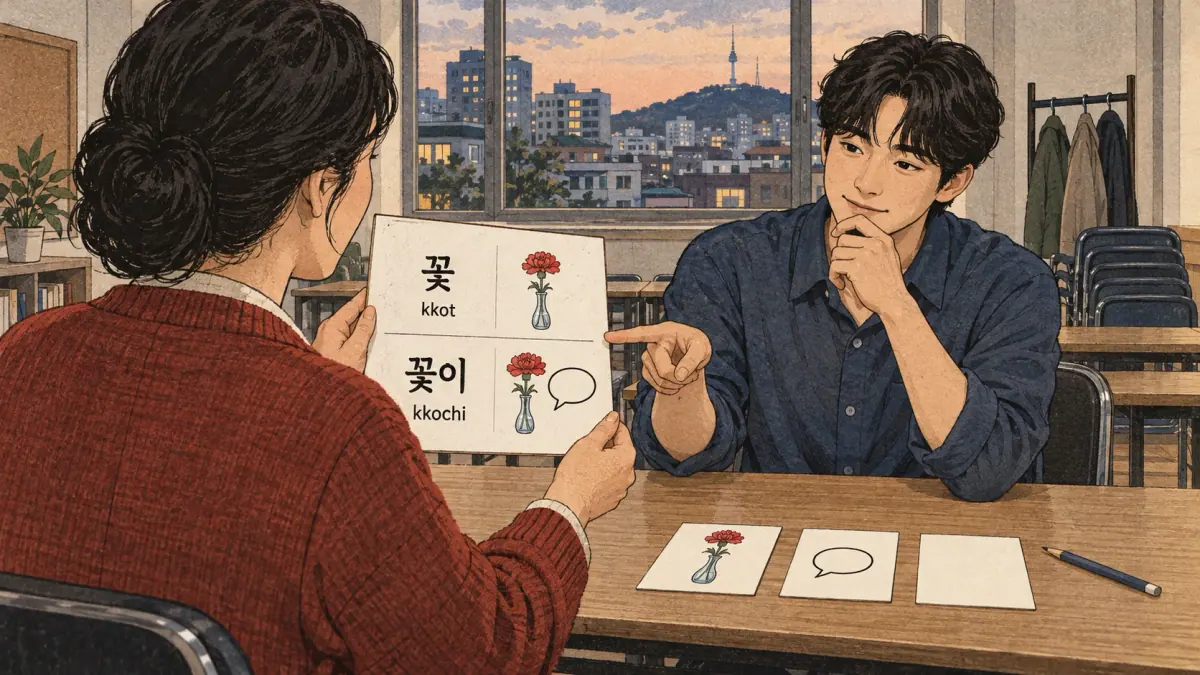
These six questions come from the quiz, with the answer and the reason for each. They also work as a no-JavaScript preview. Samples one and four are a pair: the same letter ㅊ is t alone and ch before a vowel.
Sample Question 1 and Its Answer
Question: How is 꽃 (flower) pronounced when nothing follows?
Choices: kkoch; kkot; kkos; kkoh.
Answer: kkot. Why: ㅊ at the end of a word sounds like t, so 꽃 is read [꼳].
Sample Question 2 and Its Answer
Question: How is 책 (book) pronounced?
Choices: chaek, with an unreleased k; chaeg, with a voiced g; chae, with a silent final; chaekk, with a puff of air.
Answer: chaek, with an unreleased k. Why: ㄱ at the end is a stop with no puff of air.
Sample Question 3 and Its Answer
Question: How many sounds can end a Korean syllable?
Choices: 14; 19; 3; 7.
Answer: 7. Why: The seven are k, n, t, l, m, p and ng.
Sample Question 4 and Its Answer
Question: What does 꽃이 (the flower, as subject) sound like?
Choices: kkoti; kkosi; kkochi; kkohi.
Answer: kkochi. Why: The ㅊ moves to the next block when a vowel-starting block follows and keeps its ch sound: [꼬치].
Sample Question 5 and Its Answer
Question: How do you read 밥만 (only rice)?
Choices: bapman; bamman, said like 밤만; babman; bambam.
Answer: bamman, said like 밤만. Why: Final ㅂ becomes m before ㅁ (nasalization), so [밤만].
Sample Question 6 and Its Answer
Question: Which sound does ㅇ make at the end of a block?
Choices: ng; g; n; It is silent.
Answer: ng. Why: At the end, ㅇ is ng, as in 강 (gang, river).
Tips before You Start
- Memorise the seven final sounds first, then the letters that map to each.
- Say the word aloud in two ways: alone, then with a vowel-starting particle such as 이.
- Leave the liaison and nasalization questions until you are sure of the seven sounds.
- Re-read the batchim deck after any missed question, and then retake the quiz.
Which Mistakes Does the Korean Batchim Quiz Catch?

Four errors cover most misses.
- Pronouncing the ㅊ of 꽃 as ch at the end of a word, where it sounds like t.
- Releasing p, t and k with a puff of air, as English does.
- Forgetting that ㅇ at the end is ng, not silent.
- Not moving the final to the next block when a vowel follows.
What Should You Study after the Quiz?

Drill with the Korean batchim flashcards and write words with the Korean batchim worksheet. Check a word of your own with the Korean sound change checker. Review final consonants in blocks for missed items. The next quiz in the sequence is the Korean syllable blocks quiz, and the Korean level test gives a wider check.
Answer Key for Questions 7 to 15
Prefer to test yourself first? Take the quiz above, then check this table. The first six answers are in the sample questions.
| # | Question | Correct answer | Reason |
|---|---|---|---|
| 7 | Where does the batchim sit in a block? | At the bottom of the block | Batchim is the final consonant and fills the bottom position. |
| 8 | Which letters all sound like k at the end of a word? | ㄱ, ㅋ and ㄲ | ㄱ, ㅋ and ㄲ all become k; ㄷ, ㅅ and ㅈ become t. |
| 9 | How is the final ㅅ in 옷 (clothes) pronounced alone? | ot, with a final t sound | ㅅ at the end becomes t: [옫]. |
| 10 | How is 밖 (outside) pronounced alone? | bak | The double ㄲ at the end is pronounced as a single k: [박]. |
| 11 | How is 앞 (front) pronounced alone? | ap | ㅍ at the end becomes p: [압]. |
| 12 | How is 낮 (daytime) pronounced alone? | nat | ㅈ at the end becomes t: [낟]. |
| 13 | How is 집이 (house, as subject) pronounced? | jibi | The final ㅂ moves to the next block and is voiced between vowels: [지비]. |
| 14 | Which sound does the final ㄹ make in 물 (water)? | l | Final ㄹ is l; it is a tap only between vowels. |
| 15 | How is 음악 (music) pronounced? | eumak, read as 으막 | ㅁ moves to the next block because 악 starts with silent ㅇ: [으막]. |
What Does This Quiz Not Do?
The quiz covers only single final letters, liaison and one nasalization case. It does not cover double finals such as ㄺ, ㅎ-related changes, tensification or palatalization. Colloquial speech often differs from the standard. All Korean text in the questions and answers was generated and is waiting for review by a Korean reviewer.
Frequently Asked Questions
Does the batchim quiz include double finals?
No. Version 1 covers single final letters, liaison and one nasalization example. Double finals such as ㄺ and ㄼ have special rules that are better learned after the seven final sounds are secure. They are covered in the pronunciation lessons on batchim.
Is nasalization included?
Only one question uses it: 밥만 read as 밤만. That example shows the idea that a final p turns into m before ㅁ. Other nasalization patterns, such as k before n, appear in the sound-change lessons and in the sound change checker.
Where can I read the rules?
The official source is the National Institute of Korean Language (NIKL), which publishes the Standard Pronunciation rules (표준 발음법). Our lessons on batchim and final sounds explain articles 8 to 13 in plain English with examples and audio for each rule.
How is this different from the sound-change checker?
The quiz tests what you remember and explains each answer. The sound change checker is a tool: you type a Korean word and it shows the rule that applies. Use the quiz to find gaps and the checker to explore words of your own.
Is the quiz free?
Yes. The quiz is free, needs no account and runs in your browser on a phone, tablet or computer. Nothing you answer is uploaded to a server. If you choose to save progress, it is stored on your own device only, and you can delete it in the settings at any time.
Retake the Korean Batchim Quiz
Retake the korean batchim quiz after you can list the seven final sounds from memory. The reason line for each question is also a mini-lesson, so reading it twice often helps more than a fast retake. When the quiz feels easy, move on to syllable blocks.