What you will learn
- Read 40 loanwords aloud and match at least 36 to their English meanings.
- Recognise ㅋ, ㅌ, ㅍ, ㅓ and ㅡ inside real words.
- Spot the extra ㅡ that Korean adds to English consonant clusters.
- Choose the standard spelling when two spellings seem possible.
Before you start: know the consonants and vowels, or review how to read Hangul. Time: about 15 minutes with audio.
Key Facts
- The set has 40 words in four groups of ten: food and drink, transport and places, technology, and sports.
- The first four words in each group have no final consonant, so each group starts with the easiest blocks.
- Examples include 커피 (keopi), 버스 (beoseu), 택시 (taeksi) and 컴퓨터 (keompyuteo).
- Korean spells the sound it hears, so some words look different from the English spelling: 주스 for "juice", 케이크 for "cake".
- The target is 36 correct matches out of 40, which is this lesson's own guide and not an official score.
*Last updated: 2026-10-09. The Korean text, romanization and audio on this page are AI-assisted drafts.
What Is Korean Loanwords Reading Practice?
Korean loanwords reading practice is decoding practice with words that Korean borrowed from other languages, mostly English, and wrote in Hangul. A loanword (외래어, oeraeeo) is a borrowed word that follows Korean spelling and sound rules. For example, 커피 comes from "coffee" and is spoken keopi.
The practice works because the meaning is known. When you read 피자 aloud and hear "pizza", you have proof that you decoded ㅍ, ㅣ, ㅈ and ㅏ correctly. A wrong guess points to a letter or sound you need to review. The National Institute of Korean Language (국립국어원) sets the standard spellings in its Loanword Orthography (외래어 표기법), which is covered on the page about Korean loanword orthography. The next section explains why the task is harder than it looks.
Why Is This Hard for English Speakers?
English speakers find loanwords hard because the Hangul word sounds like English, so the eye jumps to the English word and skips the letters. The reader says "computer" when the page says 컴퓨터, and the letters never get checked. Read what is written, not what you expect.
Three differences cause most slips. The vowel ㅓ is not an English "o"; it is an open, unrounded vowel written eo in Revised Romanization, close to the u of English "up", and Korean uses it for the vowels of "bus" and "computer". Korean adds the vowel ㅡ after many consonants, so "bus" becomes two blocks, 버 and 스. And Korean ㅋ, ㅌ and ㅍ are aspirated, which means a puff of air follows them, as in the English k of "kick".
| English word | Hangul | What changed |
|---|---|---|
| coffee | 커피 | The vowel o becomes ㅓ; the ff becomes ㅍ. |
| bus | 버스 | The vowel u becomes ㅓ; ㅡ is added after s. |
| taxi | 택시 | The a becomes ㅐ; the x splits into final ㄱ plus 시, spoken [택씨]. |
| sports | 스포츠 | ㅡ is added after s; the final ts becomes 츠. |
| ice cream | 아이스크림 | Each consonant with no vowel after it gets ㅡ: 스, 크. |
The comparison shows that the spelling follows Korean sounds, which leads to the question of why loanwords are a good place to start.
Why Start with Loanwords?
Loanwords are a good first reading set because they remove the vocabulary problem and keep only the reading problem. Every word here has a known English meaning, so you can check your decoding in seconds. They are also words you will see on menus, signs and phones.
The limit is coverage. Loanwords use mostly open syllables and a few finals, so they do not train the full range of final consonants. The batchim set that follows this lesson covers those. Use loanwords to build speed and confidence in the first sessions, then move on. The next section shows how to run the set.
How Do I Use the Set in Three Passes?
Use the set in three passes: decode, guess, then check. The passes keep reading and meaning apart, which is the point of the exercise.
- Decode. Cover the Revised Romanization and English columns. Say each Hangul word aloud, one block at a time, before you think of any English.
- Guess. Say the English word you think it is. If you have no guess, write down the sounds you heard.
- Check. Uncover the columns and listen to the audio. Mark the word if your guess matched.
Aim for 36 matches out of 40 before you continue. For timing, try reading each group of five words in about 15 seconds by your third session. That pace is a suggested starting point, and accuracy matters more than speed in the first week.
Practice · Read
커피
커피
Worked example, normal speed: coffee (keopi)
커피
커피
Worked example, slow speed: coffee (keopi)
버스
버스
Group 2 example: bus (beoseu)
택시
택시
Group 2 example: taxi, spoken [택씨]
컴퓨터
컴퓨터
Group 3 example: computer (keompyuteo)
주스
주스
Spelling-trap example: juice, standard spelling 주스
아이스크림
아이스크림
Added-vowel example: ice cream (aiseukeurim)
스포츠
스포츠
Added-vowel example: sports (seupocheu)
Group 1 starts with food and drink.
Group 1: Food and Drink

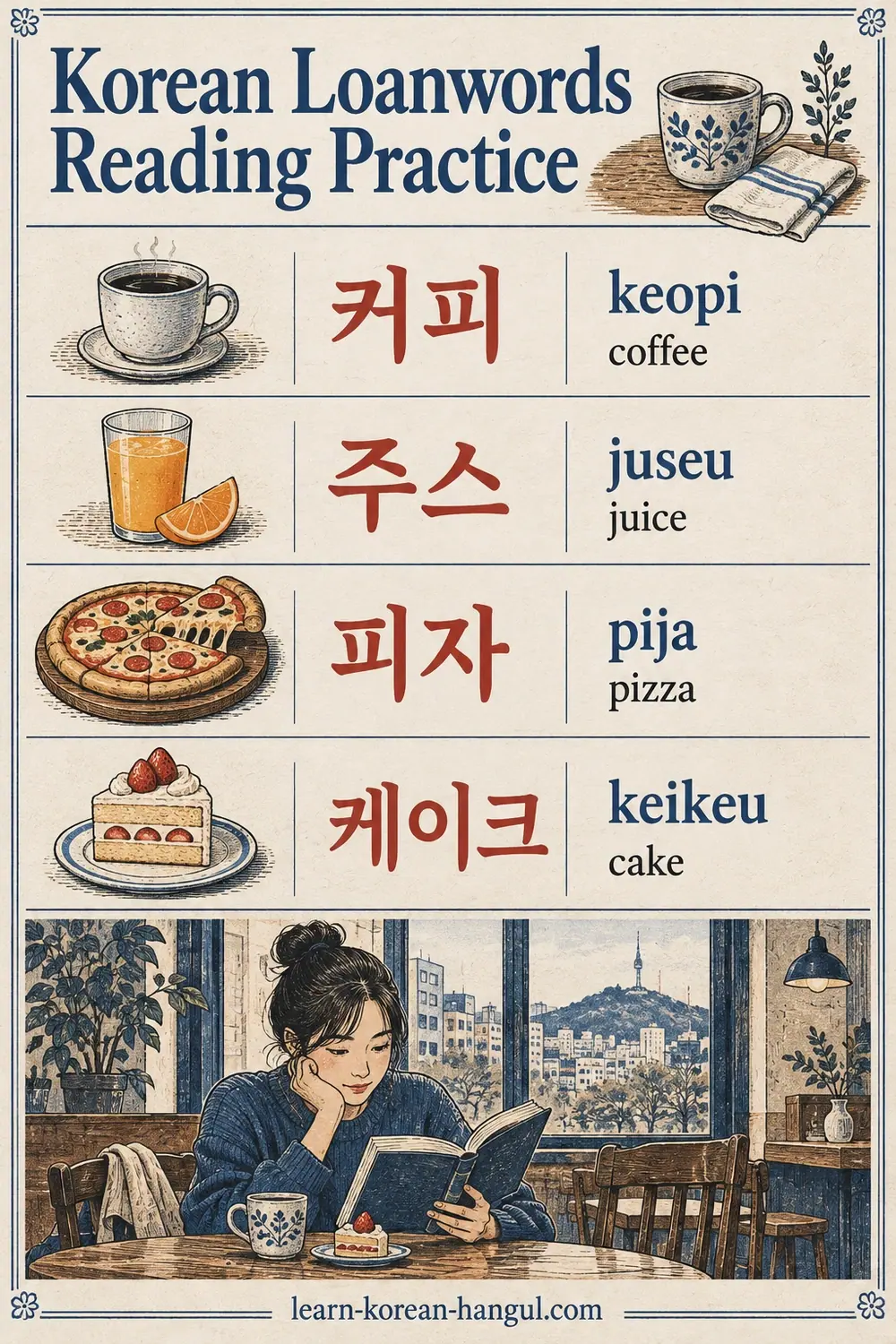
This group trains the aspirated consonants ㅋ and ㅍ, plus the ㅡ vowel at the end of 주스 and 케이크. Words 1 to 4 have no final consonant. Words 5 to 10 add finals: ㄴ in 레몬, ㄹ in 샐러드 and ㅁ in 아이스크림.
| # | Hangul | Revised Romanization | English |
|---|---|---|---|
| 1 | 커피 | keopi | coffee |
| 2 | 주스 | juseu | juice |
| 3 | 피자 | pija | pizza |
| 4 | 케이크 | keikeu | cake |
| 5 | 레몬 | remon | lemon |
| 6 | 샐러드 | saelleodeu | salad |
| 7 | 샌드위치 | saendeuwichi | sandwich |
| 8 | 햄버거 | haembeogeo | hamburger |
| 9 | 초콜릿 | chokollit | chocolate |
| 10 | 아이스크림 | aiseukeurim | ice cream |
Look at 초콜릿. Its last block 릿 has the final ㅅ, which is spoken [ㄷ] when nothing follows, so the word is said [초콜릳]. Group 2 moves to transport and places.
Group 2: Transport and Places
This group practises ㅓ and ㅡ, the two vowels that need the most attention in loanwords. Words 11 to 14 have no final consonant. Words 15 to 20 add finals: ㄱ in 택시 and 트럭, ㄹ in 호텔, 터미널 and 엘리베이터, and ㅇ in 레스토랑.
| # | Hangul | Revised Romanization | English |
|---|---|---|---|
| 11 | 버스 | beoseu | bus |
| 12 | 카페 | kape | café |
| 13 | 마트 | mateu | supermarket (from 'mart') |
| 14 | 아파트 | apateu | apartment building (from 'apartment') |
| 15 | 택시 | taeksi | taxi |
| 16 | 트럭 | teureok | truck |
| 17 | 호텔 | hotel | hotel |
| 18 | 터미널 | teomineol | terminal |
| 19 | 엘리베이터 | ellibeiteo | elevator |
| 20 | 레스토랑 | reseutorang | restaurant |
택시 is written with ㅅ, but the ㄱ before it makes it sound like [택씨]. The Standard Pronunciation Rules (표준 발음법) call this tensing, and Revised Romanization still writes taeksi. Group 3 covers technology.
Group 3: Technology
This group contains two four-block words, 와이파이 and 스마트폰, so read them block by block. Words 21 to 24 have no final consonant. Words 25 to 30 add finals such as ㅁ in 컴퓨터 and 게임, ㄹ in 이메일 and ㅅ in 인터넷, which is spoken [인터넫].
| # | Hangul | Revised Romanization | English |
|---|---|---|---|
| 21 | 라디오 | radio | radio |
| 22 | 카메라 | kamera | camera |
| 23 | 비디오 | bidio | video |
| 24 | 와이파이 | waipai | Wi-Fi |
| 25 | 컴퓨터 | keompyuteo | computer |
| 26 | 게임 | geim | game |
| 27 | 이메일 | imeil | |
| 28 | 인터넷 | inteonet | internet |
| 29 | 스마트폰 | seumateupon | smartphone |
| 30 | 노트북 | noteubuk | laptop (from 'notebook') |
Note that 노트북 means laptop: Korean shortened "notebook computer" to "notebook". Group 4 covers sports.
Group 4: Sports and Leisure
This group practises ㅋ, ㅌ and ㅍ again in different positions, and it ends with the four-block word 배드민턴. Words 31 to 35 and 테니스 (37) have no final consonant. The others add finals: ㄹ in 골프, ㄴ in 마라톤 and 배드민턴, and ㄹ plus ㅇ in 볼링.
| # | Hangul | Revised Romanization | English |
|---|---|---|---|
| 31 | 스키 | seuki | ski |
| 32 | 하키 | haki | hockey |
| 33 | 요가 | yoga | yoga |
| 34 | 코치 | kochi | coach |
| 35 | 스포츠 | seupocheu | sports |
| 36 | 골프 | golpeu | golf |
| 37 | 테니스 | teniseu | tennis |
| 38 | 마라톤 | maraton | marathon |
| 39 | 볼링 | bolling | bowling |
| 40 | 배드민턴 | baedeuminteon | badminton |
Words with an added ㅡ, such as 스키 and 스포츠, show a pattern that causes spelling traps, which the next section lists.
Which Loanword Spellings Are Tricky?
Four spelling traps come up in this set, and each one has a reason. Korean loanwords follow rules, not English letters.
| Looks right | Standard spelling | Reason |
|---|---|---|
| 쥬스 | 주스 | After ㅈ and ㅊ the rules write a plain vowel, because 쥬 and 주 sound the same in Korean. |
| 케익 | 케이크 | After a long vowel or diphthong, as in "cake", a final k gets ㅡ (크). After a short vowel, as in "book", it is written as a final (북). |
| 쵸콜릿 | 초콜릿 | Same rule as 주스: ㅊ with ㅗ. |
| 뻐스 | 버스 | Loanword spelling does not use tense letters for these stops. |
The rules behind these are in the Loanword Orthography: finals are limited to ㄱ ㄴ ㄹ ㅁ ㅂ ㅅ ㅇ, and tense letters are normally avoided for stops. A second trap is meaning, because some loanwords changed on the way into Korean.
- 아파트 is an apartment building, usually a high-rise block.
- 마트 is a supermarket.
- 노트북 is a laptop.
Learners and Korean speakers often call these Konglish, meaning English-looking words that Korean uses in its own way. Check the meaning in the table when a guess feels wrong. Hear the standard spelling of "juice" before the worked example.
The next section puts the three-pass method on one word.
Worked Example: 커피
The word 커피 (coffee) shows the three-pass method on a two-block word. Follow the steps in order.
- Split the blocks: 커 and 피.
- Decode block 1: 커 is ㅋ + ㅓ. ㅋ is aspirated, so it begins with a puff of air. ㅓ is an open, unrounded vowel, close to the u in English "up". Together: keo.
- Decode block 2: 피 is ㅍ + ㅣ, an aspirated p plus ee. Together: pi.
- Join them: keo-pi, spoken with even weight on both blocks.
- Guess: the sound is close to "coffee", so the meaning is coffee.
You will know it worked when you decoded the letters before you thought of the English word. English "coffee" stresses the first syllable, but 커피 has no strong stress, and that is the next habit to watch.
What Mistakes Do Learners Make Here?
Learners often guess from the first block and skip the rest. These mistakes repeat across the set.
- Mistake 1: reading ㅓ as "o". Learners often assume 컴 is "com". Actually ㅓ is a different vowel from ㅗ, so 컴 is keom, and 컴퓨터 is keom-pyu-teo.
- Mistake 2: dropping the added ㅡ. Learners often read 스키 as "ski" in one beat. Actually ㅡ is a full vowel, so the word has two blocks, seu-ki.
- Mistake 3: stressing English syllables. Learners often stress the first syllable of 아이스크림. Actually each block gets similar weight, so keep the rhythm even.
- Mistake 4: trusting English spelling. Learners often expect 쥬스 or 케익. Actually the standard spellings are 주스 and 케이크.
Expert tip: say the English word out loud after you decode, not before. If your decoded sound and the English word disagree, trust the letters first. Test the skill now.
Practice and Answer Key
Read each word aloud, then give its English meaning. None of these appear in the 40-word set.
- 오렌지
- 바나나
- 토마토
- 파티
- 스테이크
Then answer these two questions.
- Which is the standard spelling of "juice": 쥬스 or 주스?
- How many blocks does 스키 have, and which block holds the added ㅡ?
Answer key
- orange (orenji)
- banana (banana)
- tomato (tomato)
- party (pati)
- steak (seuteikeu; ㅡ is added after s in 스 and after k in 크)
- 주스
- Two blocks, 스 and 키. The ㅡ is in 스, the first block, and it comes after the s.
Four or five matches in the first list means the method works for you. Now see where to go from here.
Where to Go Next
After Korean loanwords reading practice, continue with Korean Batchim Reading Practice, where 60 words train the seven final sounds. To fix a weak spot, review the Korean aspirated consonants if ㅋ, ㅌ or ㅍ felt slippery, or Korean vowel pronunciation if ㅓ and ㅗ blurred. The reading strategies section shows how to get more from every text, the Korean dictation practice hub lets you write words by ear, and the full list of reading sets is in Beginner Reading.
This set covers 40 common loanwords in standard Seoul pronunciation. It does not cover words from other languages, brand names or the full Loanword Orthography.
Frequently Asked Questions
Are loanwords good for learning to read Korean? Yes, for the first reading sessions. Loanwords let you test decoding without learning new meanings, because you can often guess the English source. The limit is coverage: they use few final consonants and few sound changes. Use them for the first week, then move to native words with batchim.
Why does Korean add extra vowels to English words? Korean syllables are built from a consonant, a vowel and at most one final, so clusters like "str" cannot stand alone. Speakers insert ㅡ between consonants, giving 스트레스 (seuteureseu) for "stress". Only seven sounds can close a syllable, so even "bus" gains a vowel and becomes 버스.
Do loanwords always match English spelling? No. Korean spells the sound it hears, not the English letters. "Juice" becomes 주스, "cake" becomes 케이크, and "mart" is used for a supermarket. Some meanings shift as well: 아파트 is an apartment building and 노트북 is a laptop. The Loanword Orthography (외래어 표기법) sets the standard spellings.
How fast should I read this set? Start slowly and read each word correctly twice before you speed up. A suggested target is five words in about 15 seconds by your third session. That pace is this page's own guide, not a standard. Accuracy matters more than speed in the first week, because fast, careless reading repeats errors.