
What Are Korean Aspirated Consonants?
Aspirated consonants are sounds followed by a burst of breath. Aspiration means the air that escapes right after the tongue or lips release the consonant. Put a hand in front of your mouth and say "pin": you feel a puff. Say "spin": the puff is almost gone. Korean writes the puffed version as its own letter, so ㅍ is "pin" and ㅂ is closer to "spin".
Korean has three kinds of stop and affricate consonants at each place in the mouth: plain, aspirated and tense. The aspirated set covers four places: the back of the tongue (ㅋ), the tongue tip (ㅌ), the lips (ㅍ) and the flat of the tongue against the palate (ㅊ). You can see all three series in the table later on this page, and the wider system on the Korean consonants hub.
Is ㅎ an Aspirated Consonant?
ㅎ is not counted among the four aspirated letters on this site. It is a breathy h sound (a fricative, made by air rubbing through a narrow gap) and not a stop with a puff. It still creates aspiration when it meets ㄱ, ㄷ, ㅂ or ㅈ in a word, as in 축하 [추카] (congratulations) and 좋다 [조타] (to be good). Some books call ㅎ aspirated because of this effect, so you may see a different count elsewhere.
The next section shows how the four letters are built.
How the Aspirated Letters Are Built from Plain Ones
Each aspirated letter is a plain letter plus one stroke, a design rule called 가획 (gahoek, "adding a stroke") described in the 1446 commentary 훈민정음 해례본 (Hunminjeongeum Haerye). The extra line marks the extra breath.
| Plain | Aspirated | Added stroke | Place in the mouth |
|---|---|---|---|
| ㄱ (g/k) | ㅋ (k) | a bar through the middle | back of the tongue |
| ㄷ (d/t) | ㅌ (t) | an extra bar inside | tongue tip |
| ㅂ (b/p) | ㅍ (p) | counted as one added stroke, though the shape is redrawn (both have 4 strokes) | lips |
| ㅈ (j) | ㅊ (ch) | a short tick on top | flat tongue on the palate |
This pattern means you only need to learn four changes to your plain letters, and only ㅍ looks clearly different from its partner. The plain letters are covered in the basic Korean consonants set.
The 4 Aspirated Consonant Lessons
The set has four lessons, one per letter, and each one follows the same order: sound, writing, position in a word, worked example, a minimal-pair listening test, mistakes, practice. Each lesson has audio for every example word.
ㅋ (kieuk): the Breathy K
The lesson on the letter ㅋ teaches the breathy k in 커피 (coffee) and 코 (nose), the 2-stroke shape, and the rare final-ㅋ word 부엌 (kitchen). It ends with the listening test 개 / 캐다 / 깨.
ㅌ (tieut): the Breathy T
The lesson on the letter ㅌ covers the breathy t in words like 탈 (mask), the extra bar that turns ㄷ into ㅌ, and how final ㅌ becomes [t].
ㅍ (pieup): the Breathy P
The lesson on the letter ㅍ covers the breathy p in 풀 (grass) and loanwords such as 피자 (pizza), the four-stroke shape, and final ㅍ as [p].
ㅊ (chieut): the Breathy Ch
The lesson on the letter ㅊ covers the breathy ch in 차 (tea; car) and 친구 (friend), the top tick, and the pronunciation of 꽃 as [꼳] and 꽃이 as [꼬치].
You can hear the full contrast between plain, aspirated and tense sounds in plain, tense and aspirated sounds. The next section explains how to make the puff.
How Do You Make the Puff of Air?
Make the puff by letting air out right after the release of the consonant, as if you were blowing out a candle gently. Follow these steps:
- Hold a thin strip of paper in front of your lips.
- Say 파 with a push of air. The strip should flutter.
- Say 바 with a softer push. The strip moves only a little.
- Say 빠 with a tight throat and no push. The strip stays still.
You will know it worked when the strip moves clearly for ㅍ, slightly for ㅂ and not at all for ㅃ. The same test works for 카 / 가 / 까, 타 / 다 / 따 and 차 / 자 / 짜.
The common mistake is pushing air out before the consonant, which sounds like an h plus a sound. Keep the push after the release, and keep it short.
Next, see all three series side by side.
Plain, Aspirated and Tense Consonants Compared
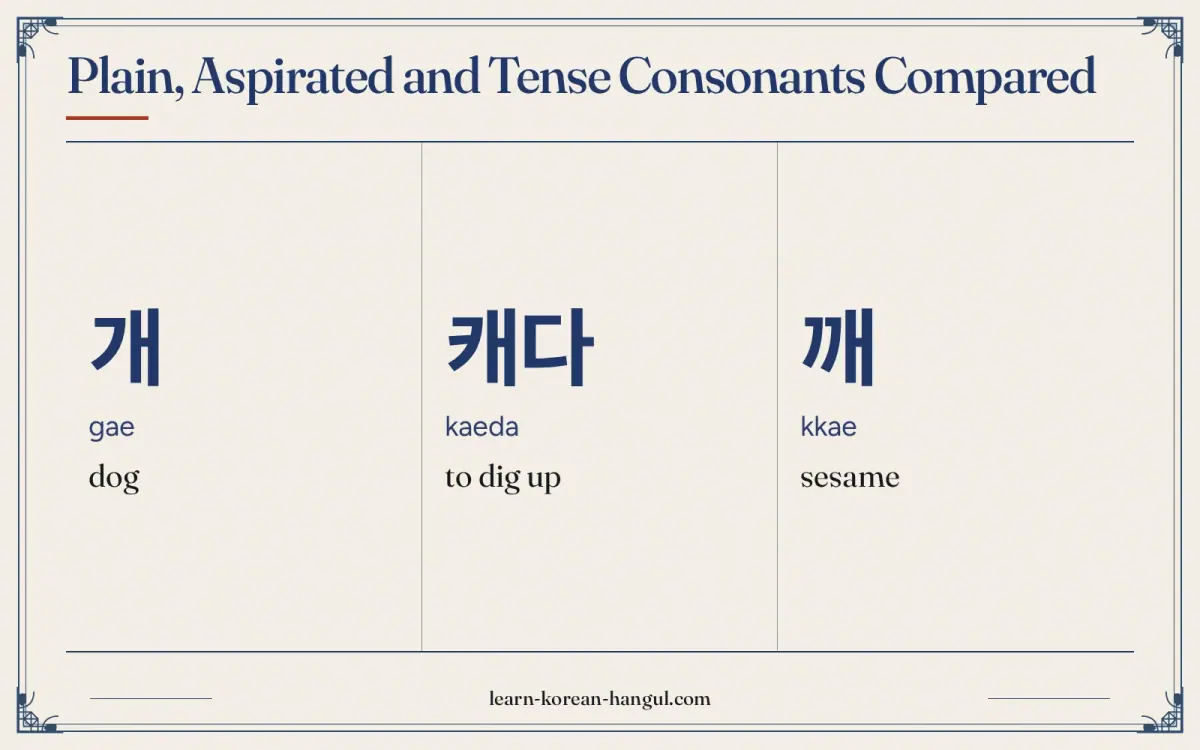
The table shows the full grid. Each row is one place in the mouth; each column is one series. Four rows have all three versions; ㅅ has no aspirated partner.
| Place | Plain | Aspirated | Tense | Minimal set |
|---|---|---|---|---|
| Back of tongue | ㄱ | ㅋ | ㄲ | 개 / 캐다 / 깨 |
| Tongue tip | ㄷ | ㅌ | ㄸ | 달 / 탈 / 딸 |
| Lips | ㅂ | ㅍ | ㅃ | 불 / 풀 / 뿔 |
| Flat tongue | ㅈ | ㅊ | ㅉ | 자다 / 차다 / 짜다 |
| Tongue blade | ㅅ | none | ㅆ | 사다 / none / 싸다 |
The meanings are: 개 dog, 캐다 to dig up, 깨 sesame; 달 moon, 탈 mask, 딸 daughter; 불 fire, 풀 grass, 뿔 horn; 자다 to sleep, 차다 to be cold, 짜다 to be salty; 사다 to buy, 싸다 to be cheap.
Back of Tongue: Plain, Aspirated, Tense
| Korean | Romanization | Meaning | Sound |
|---|---|---|---|
| 개 | gae | dog | |
| 캐다 | kaeda | to dig up | |
| 깨 | kkae | sesame |
Tongue Tip: Plain, Aspirated, Tense
| Korean | Romanization | Meaning | Sound |
|---|---|---|---|
| 달 | dal | moon | |
| 탈 | tal | mask | |
| 딸 | ttal | daughter |
Lips: Plain, Aspirated, Tense
| Korean | Romanization | Meaning | Sound |
|---|---|---|---|
| 불 | bul | fire | |
| 풀 | pul | grass; glue | |
| 뿔 | ppul | horn |
Flat Tongue: Plain, Aspirated, Tense
| Korean | Romanization | Meaning | Sound |
|---|---|---|---|
| 자다 | jada | to sleep | |
| 차다 | chada | to kick; to be cold | |
| 짜다 | jjada | to be salty |
English speakers already make aspirated and unaspirated stops without noticing: the p in "pin" is aspirated and the p in "spin" is not. Korean turns that hidden habit into a spelling difference. The tense series is covered in Korean double consonants.
What Happens to Aspirated Letters at the End of a Syllable?
At the end of a syllable the puff disappears, because Korean allows only seven final sounds. The rule comes from the South Korean standard pronunciation rules (표준 발음법) of the National Institute of Korean Language (국립국어원).
| Letter | Final sound | Example |
|---|---|---|
| ㅋ | [k] | 부엌 [부억] (kitchen) |
| ㅌ | [t] | 밭 [받] (field) |
| ㅍ | [p] | 앞 [압] (front) |
| ㅊ | [t] | 꽃 [꼳] (flower) |
The aspirated sound returns when a vowel follows, as in 꽃이 [꼬치]. This is why aspiration only exists before a vowel. You can read more on the aspiration rule.
Which Aspirated Consonant Should You Learn First?
Learn ㅋ first, then ㅌ, ㅍ and ㅊ in that order. This matches the order of the lessons and moves from the most familiar plain letter (ㄱ) to the letter with the most unusual behaviour (ㅊ, which becomes [t] at the end of a syllable). Follow this guide:
- If you know ㄱ well, start with ㅋ.
- If loanwords are your motivation, ㅍ gives 피자 and 파티, and ㅌ gives 택시 (taxi).
- If your problem is final sounds, finish with ㅊ.
Whichever you choose, return to the plain letter in the basic Korean consonants set if the contrast feels blurry.
Practice Tools for Korean Aspirated Consonants
Use these tools to turn the lessons into habit:
- Hangul flashcard decks for letter and word cards.
- Hangul quizzes for listening discrimination.
- The interactive hangul alphabet for letter lookup with audio.
A good routine is 5 minutes a day: say three triples aloud (for example 카 / 가 / 까), then play the audio and write which you heard.
The audio on these pages is generated and awaits review by a Korean specialist, so treat it as a guide, not a final authority.
Frequently Asked Questions
How many aspirated consonants does Korean have?
Korean has 4 aspirated consonant letters: ㅋ, ㅌ, ㅍ and ㅊ. They are part of the 14 basic consonants. Some books also count ㅎ because it creates aspiration next to ㄱ, ㄷ, ㅂ or ㅈ, which gives 5, but this site keeps ㅎ outside the four aspirated stops.
Why is there no aspirated ㅅ?
Korean has no separate aspirated partner for ㅅ because ㅅ is already a breathy fricative: air rubs through a narrow gap instead of bursting out. The tense partner ㅆ exists, and ㅎ adds breath in other contexts. So the grid has a gap in the ㅅ row, and that is normal.
Are aspirated consonants the same as English k, t, p?
Close, but not identical. English k, t and p are aspirated at the start of a stressed syllable, as in 'kite', 'top' and 'pin', so they match ㅋ, ㅌ and ㅍ well. The same letters lose most of the puff after s, as in 'sky', which sounds closer to plain ㄱ, ㄷ and ㅂ.
Do aspirated consonants change the pitch of a word?
Typically, yes. In Seoul speech the vowel after an aspirated consonant often starts on a higher pitch than after a plain consonant, and tense consonants tend to do the same. This is a tendency, not a spelling rule. Beginners should train the puff of air first and notice pitch later.
How do I practise hearing aspiration?
Listen to minimal sets, which are words that differ only in the consonant, such as 자다 / 차다 / 짜다 or 불 / 풀 / 뿔. Play each three times in random order, write what you heard, and aim for 4 out of 5. A paper strip held in front of your lips shows the puff.