What you will learn
- Read a five-line Korean text aloud with the spoken forms of 합니다, 좋아요 and 같이.
- Record yourself, compare the recording with the model audio and mark three points to correct.
- Choose between aloud and silent reading in a weekly plan.
Before you start: you should read Hangul blocks without romanization, as covered in Read Korean Without Romanization. Time: about 25 minutes, plus recording. Audio plays only when you press a button.
Key Facts
- Reading aloud tests pronunciation; silent reading builds speed.
- Recording yourself and comparing the recording with model audio finds errors faster than listening alone.
- Sound changes such as liaison and nasalization appear in almost every line of text.
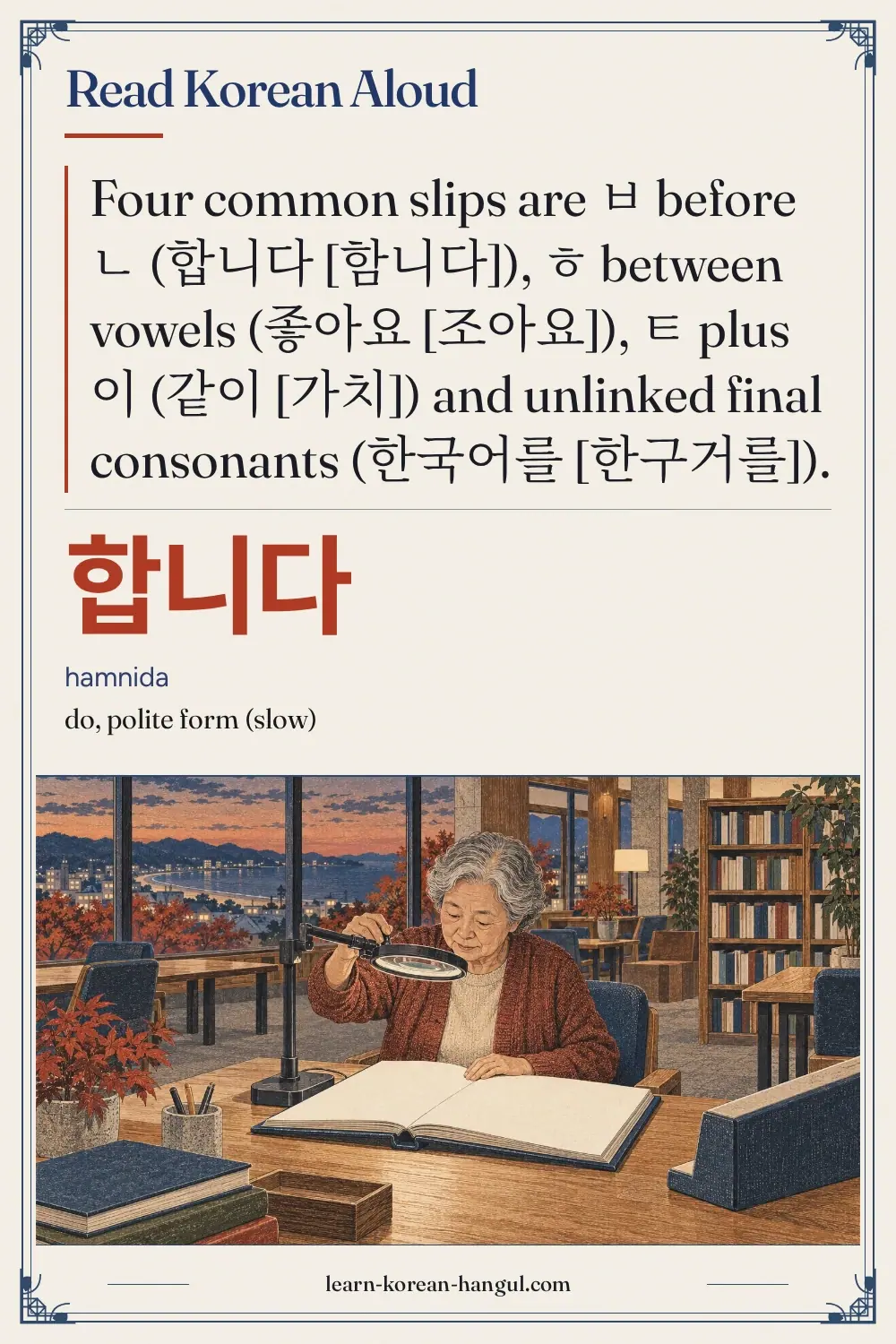
- Four common slips are ㅂ before ㄴ (합니다 [함니다]), ㅎ between vowels (좋아요 [조아요]), ㅌ plus 이 (같이 [가치]) and unlinked final consonants (한국어를 [한구거를]).
- A five-line text is enough for one session, and three corrections are enough per recording.
*Last updated: 2026-10-09. The Korean text, romanization and audio on this page are AI-assisted drafts.
What Does It Mean to Read Korean Aloud?
To read Korean aloud means to say a written text out loud in Standard Korean pronunciation, one line at a time, while you watch the spelling. The spelling of Korean is not a perfect record of its sound. Standard Korean pronunciation is described by the 표준 발음법 (standard pronunciation rules) of the National Institute of Korean Language, and many written forms are spoken differently.
A short example makes the gap clear. The word 같이 (together) is written with ㅌ, but a Korean speaker says [가치]. The word 좋아요 (it is good) is written with ㅎ, but the ㅎ is not spoken: [조아요]. Silent reading does not expose these gaps, because your eyes can recognise the word without producing its sound. Reading aloud forces you to produce the sound, so the gaps become visible.
That is the whole value of the method. It gives you a check on pronunciation that needs no teacher and no partner, only a text, a model recording and a phone. The method is not a replacement for conversation, and the last sections say what it cannot do. First, the reason English speakers find this harder than expected.
Why Do English Speakers Struggle When They Read Korean Aloud?
English speakers struggle because English spelling is read letter by letter in the head, and the same habit produces letter-by-letter Korean. A learner who sees 합니다 says "hap-ni-da", following the letters. A Korean speaker says [함니다], because a final ㅂ before ㄴ becomes the sound ㅁ. Nothing in the English reading habit warns the learner that the sound will change.
Three other habits add to the problem. English speakers release final stops with a small puff, but Korean closes them silently, so 학 ends with the back of the tongue closed and no air. English speakers pronounce every written letter, but Korean ㅎ often drops out between vowels. And English speakers tend to read each word separately, but Korean connects a final consonant to a following vowel, so 한국어를 becomes [한구거를].
| English habit | Korean reality | Example |
|---|---|---|
| Say each letter as written | Letters change next to other letters | 합니다 is spoken [함니다] |
| Release final stops with a puff | Final stops close silently | 학 ends with the tongue back closed |
| Say every consonant | ㅎ between vowels is silent | 좋아요 is spoken [조아요] |
| Pause between words | Final consonants link to the next vowel | 한국어를 is spoken [한구거를] |
The four habits are all fixable once the learner can hear them. Next, why bother with aloud reading at all.
Why Read Aloud?
Reading aloud is worth the time because it shows you errors you cannot see on the page. It does three jobs that silent reading does not. It forces you to apply sound rules, it lets you hear your own mistakes on a recording, and it connects the written form to the mouth, which helps memory.
Silent reading does a different job. It builds speed, because the eyes can move faster than the mouth, as covered in the lesson on how to read Korean faster. A balanced week uses both. The table below sets out the difference.
| Aspect | Reading aloud | Silent reading |
|---|---|---|
| What it trains | Pronunciation and rule application | Speed and comprehension |
| Feedback | Immediate, from your own ear and a recording | Only your own sense of ease |
| Speed | Limited by speech rate | Limited by recognition |
| Best for | Short texts, 5 lines at a time | Longer texts at an easy level |
| Main risk | Practising an error again and again | Never noticing sound errors |
The main risk of aloud reading is that a wrong sound, repeated, becomes a habit. That is why the routine below includes a comparison with model audio. The next section gives the routine.
What Are the Six Steps for Reading Korean Aloud?
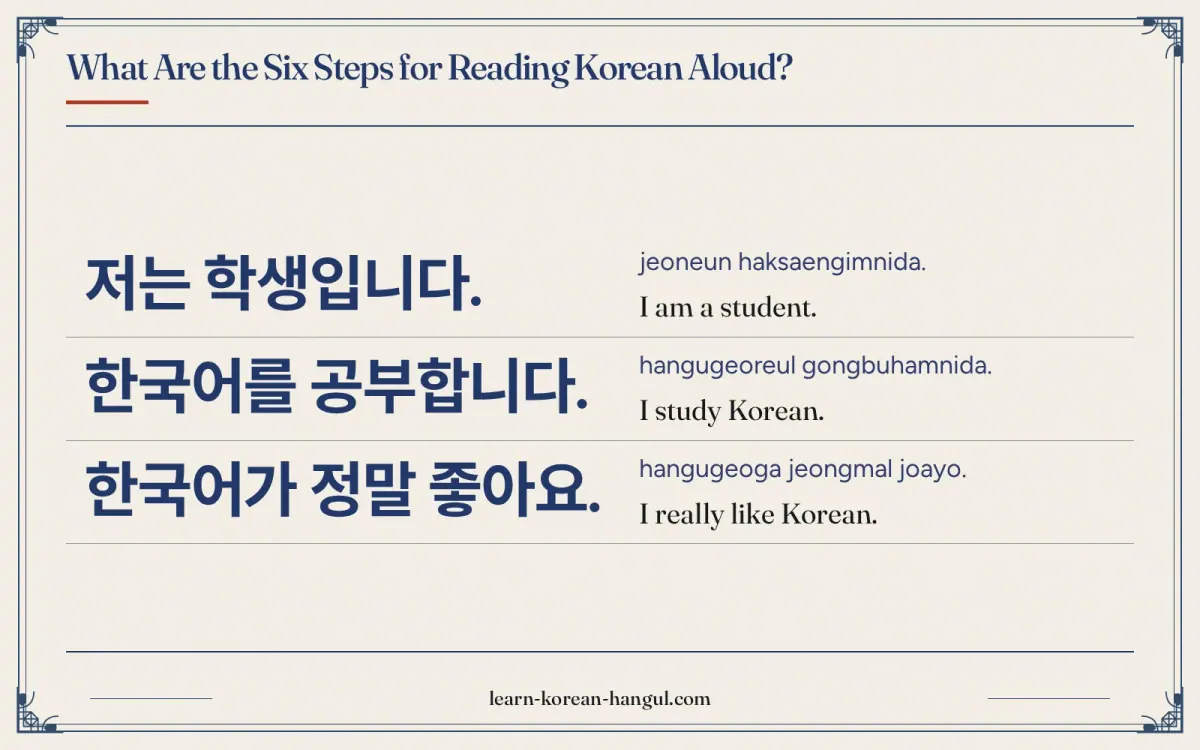
The routine has six steps and takes about 15 minutes for a five-line text. Use the sample text in this section the first time, then repeat with any short text you can read.
The sample text has five lines. Each line has a model clip.
안녕하세요. 저는 수진입니다.
annyeonghaseyo. jeoneun sujinimnida.
Hello. I am Sujin.
저는 학생입니다.
jeoneun haksaengimnida.
I am a student.
한국어를 공부합니다.
hangugeoreul gongbuhamnida.
I study Korean.
한국어가 정말 좋아요.
hangugeoga jeongmal joayo.
I really like Korean.
주말에 친구와 같이 영화를 봐요.
jumare chinguwa gachi yeonghwareul bwayo.
On weekends I watch a film with a friend.
Now follow these steps.
- Listen once, without reading. Play each line and let the rhythm settle. You will know it worked when you can hum the length of each line.
- Read silently and mark traps. Put a mark under any letter that you suspect will sound different, such as the ㅎ in 좋아요. Checkpoint: you should have about three to six marks. The common mistake is to skip this step and read aloud cold.
- Read aloud slowly. Say each line at half normal speed, with the spoken forms, not the spelling. Checkpoint: no line should have a pause in the middle of a word.
- Record yourself. Read all five lines once at a steady speed on any phone or computer. Do not stop to fix mistakes.
- Compare with the model. Play your line, then the model clip, and listen for differences in the marked places. Checkpoint: you can name at least one difference.
- Mark three points and re-read. Choose three places to correct, say them ten times each, then re-record the full text.
Three points are enough. A list of ten corrections cannot be held in mind and leads to a vague "do better". The recording comes next, because that is where most learners get stuck.
What Should You Check on the Recording?
Check five things on the recording, in this order: ㅂ before ㄴ, ㅎ between vowels, ㅌ before 이, linking, and finally speed. The first four are common slips when learners read 합니다, 좋아요, 같이 and 한국어를 aloud. Each has a rule in the 표준 발음법 (standard pronunciation rules).
| Slip | Written | Spoken | Rule (article) | Cue to listen for |
|---|---|---|---|---|
| ㅂ stays as ㅂ before ㄴ | 합니다, 입니다 | [함니다], [임니다] | nasalization, Article 18 | A hum, not a closed puff, before 니 |
| ㅎ is pronounced between vowels | 좋아요 | [조아요] | ㅎ dropping, Article 12 | No "ha" sound in the middle |
| ㅌ + 이 stays as "ti" | 같이 | [가치] | palatalization, Article 17 | The syllable sounds like "chi" |
| Final consonant does not link | 한국어를, 주말에 | [한구거를], [주마레] | liaison, Article 13 | The final letter jumps to the next block |
Listen to the three most important words on their own, then compare with your recording.
The article numbers are given so that you can look up the rule, not so that you can memorise them. The sound-change rules themselves are taught in the Korean pronunciation rules section. Speed is the last check. Your reading should sound steady, not rushed, and your recording does not need to match the model clip's speed. The next section places aloud reading beside silent reading in a weekly plan.
How Do Aloud and Silent Reading Fit Together?
Aloud and silent reading fit together as two different sessions, not one: use aloud reading for short, accuracy-focused practice and silent reading for volume. The plan below is a suggestion, not the result of a study. Adjust it to your time.
| Day | Session | Length | Aim |
|---|---|---|---|
| Monday | Aloud, five-line text with recording | 15 minutes | Find three corrections |
| Tuesday | Silent, an easy text | 15 minutes | Read for meaning |
| Wednesday | Aloud, re-read the Monday text | 10 minutes | Fix the three points |
| Thursday | Silent, a new easy text | 15 minutes | Build speed |
| Friday | Aloud, a new five-line text | 15 minutes | Mark three new points |
Repeat the same text on a second day, because the second reading shows whether the corrections held. If you want to push further, shadowing, in which you speak along with a model at natural speed, is the next method; it is covered in the Korean shadowing section. Aloud reading prepares for it by teaching the sounds first. A full worked example now follows a single word through the routine.
Worked Example: 합니다
The worked example takes 합니다 through the six steps, on its own.
- Listen. Play the slow clip of 합니다.
합니다
hamnida
do, polite form (slow)
- Mark the trap. The final ㅂ in 합 comes before ㄴ in 니. That is the trap.
- Read aloud slowly. Say "ha", then close your lips for a hum, then "ni-da": [함니다]. The lips close on the hum.
- Record. Say 합니다 three times at a steady speed.
- Compare. On the recording, did the lips close on a hum or a puff of air? A puff means the ㅂ was said as written.
- Correct. Repeat the word ten times with the humming ㅁ, and add 입니다 [임니다] and 갑니다 [감니다], which follow the same rule.
You will know it worked when your recording of 합니다 sounds like the model clip in the middle of the word. The rule behind it is general: a final ㅂ, ㄷ or ㄱ before ㄴ or ㅁ becomes a nasal sound. The same rule explains 학년 [항년] and 믿는 [민는]. Next come the mistakes that often undo the routine.
What Mistakes Do Learners Make When Reading Aloud?
The most common mistakes are reading too fast, correcting too much and treating the model clip as the only correct speed.
- Learners often assume that reading faster sounds more fluent. Actually errors multiply with speed, and the spoken forms become spelling pronunciations. Read slowly first, then raise the pace.
- Learners often assume the spelling is the sound. Actually 같이 is [가치] and 좋아요 is [조아요]. Always compare your recording with the model.
- Learners often assume one clean recording means the job is done. Actually the habit needs a second session on another day. A rule you applied once in a calm moment may vanish in the next text.
- Learners often assume aloud reading replaces conversation. Actually reading aloud trains sound production from a printed script, and conversation trains choosing words in real time. Both are needed.
A further risk is to practise a sound you cannot yet hear. If you cannot hear the difference between your recording and the model, listen to the clips at slow speed first. The Korean pronunciation practice section has drills for training the ear. Practice follows.
Practice and Answer Key
Use this written check before you record. Write the spoken form of each word, then check the key.
- 입니다
- 좋아요
- 같이
- 한국어를
- 학생
- 갑니다
Then do the speaking task: record lines 1 to 5 of the sample text, compare with the model clips and write down three corrections.
Answer key: 1. [임니다]. 2. [조아요]. 3. [가치]. 4. [한구거를]. 5. [학쌩]. 6. [감니다].
Score yourself: five or six correct means you know the main rules, three or four means repeat the table above, and fewer than three means read the sound-change rules first. Say each word aloud once as you check it.
Where to Go Next
The routine above covers how to read Korean aloud from a short printed text and how to find three corrections from a recording. It does not judge your accent, it does not score your pronunciation, and it does not teach every sound-change rule. The rules live in the pronunciation sections, and conversation skills live in the speaking sections.
Next: Extensive Reading Korean, which builds volume with easy texts. To return to the other methods, such as chunking and guessing, see Reading Strategies.
Frequently Asked Questions
Is reading aloud useful for learning Korean? Yes, for pronunciation. Reading aloud forces you to produce the spoken form of each word, which exposes sound changes such as 합니다 [함니다] and 같이 [가치] that silent reading hides. It does not build reading speed or replace conversation, so use it for short texts alongside silent reading.
How often should I read aloud? Two or three short sessions a week is a sensible start, with a five-line text and about 15 minutes each. Repeat the same text on a second day to check that your corrections held. This is a practical suggestion, not a research-based figure, so adjust it to your schedule.
Should I record myself? Yes. You hear your own speech differently while speaking, so a recording shows errors you cannot notice live. Record the whole text once without stopping, play it beside the model clip, and mark three differences. Delete the recording after the session if you prefer; it is a tool, not a record.
What should I listen for? Listen for four things in this order: ㅂ that becomes a hummed [ㅁ] before ㄴ, ㅎ that disappears between vowels, ㅌ that becomes [ch] before 이, and final consonants that link to the next vowel. Then check that your speed is steady, not rushed, because errors multiply when you read too fast.