What you'll learn
- Find the ingredient list, allergen line and storage line on a package.
- Read ten key ingredients and the nine allergens most learners need first.
- Read nutrition lines such as 열량 (calories) and 나트륨 (sodium).
- Handle a label without relying on English alone.
Before you start: you should read Hangul blocks, as covered in how to read Hangul. Time: about 35 minutes. Audio plays only when you press a button.
Please note: this page is a reading aid. It is not medical or dietary advice. If you have a serious allergy or a strict diet, ask a doctor, or ask the maker, and do not rely on your own reading of a label alone.
Key Facts
- 원재료명 is the ingredient list and 함유 means "contains".
- Allergens appear in a box labelled 알레르기 유발물질.
- Storage words include 냉장 (refrigerate) and 냉동 (freeze).
- 열량 means calories, 용량 means volume.
- Common allergens include 우유, 계란, 땅콩, 밀 and 대두.
- This page is a reading aid, not medical or dietary advice.
What Are Korean Food Ingredient Labels?
Korean food ingredient labels are the printed panels on packaged food that state what is in it, how to store it, who made it and what it contains nutritionally. Most are a block of short headings, each followed by its details. The rules for what must appear are set by Korea's Ministry of Food and Drug Safety (식품의약품안전처, mfds.go.kr), and they can change, so use this page to learn to read the words and check the official site for current requirements.
A typical label has six zones.
| Zone | Korean | Revised Romanization | What it tells you |
|---|---|---|---|
| Product name | 제품명 | jepummyeong | what the food is |
| Food type | 식품유형 | sikpumyuhyeong | the category, such as noodles |
| Ingredients | 원재료명 | wonjaeryomyeong | everything inside |
| Allergens | 알레르기 유발물질 | allereugi yubalmuljil | foods that cause allergies |
| Storage | 보관방법 | bogwanbangbeop | how to keep it |
| Date | 소비기한 | sobigihan | the use-by date |
The label also carries the net amount (내용량), the maker (제조원), the place where an ingredient comes from (원산지) and a nutrition table (영양성분). Not every package prints all of them in the same order, but the headings are the same.
Why Do English Speakers Struggle with Korean Food Labels?
English speakers struggle because labels are dense, printed small and written in a compact noun style. A line such as 알레르기 유발물질: 우유, 대두 함유 has no verb you can sound out into a sentence. The words are also Sino-Korean, built from Chinese-origin syllables, so even a learner who reads Hangul fluently may not know what they mean.
| English habit | Korean label reality | What to do |
|---|---|---|
| Read the front first | The facts are on the back | Turn the package over |
| Look for "Contains: milk" | The line is 우유 함유 | Look for 함유 |
| Expect a full sentence | Labels use headings and nouns | Read heading, then list |
| Expect English | Many import labels add English, many do not | Read the Hangul first |
The most important habit is to read the allergen line even when the ingredient list looks safe. The second is to check the date and storage line before you buy.
Where Is the Ingredient List?
The ingredient list sits under the heading 원재료명 on the back or side of the package. It lists every ingredient, usually from the largest amount to the smallest. The list runs together on one line, with commas between items.
Here is an invented label to practise on.
제품명 매콤 볶음면 식품유형 면류 내용량 120g 원재료명 밀가루(밀), 팜유, 정제소금, 간장(대두, 밀), 고춧가루, 마늘, 양파 알레르기 유발물질 밀, 대두 함유 보관방법 직사광선을 피해 서늘한 곳에 보관 소비기한 제품 상단에 별도 표기
Read it in order. 밀가루(밀) is wheat flour, with the wheat named inside the bracket. 팜유 is palm oil, 정제소금 is refined salt and 고춧가루 is red pepper powder. 간장(대두, 밀) is soy sauce, with soybean and wheat inside it. The last line says the date is printed separately on the top of the pack (별도 표기).
Brackets show the parts of a compound ingredient. This is useful because an allergen can hide inside a sauce. In this example, 대두 and 밀 appear both in the bracket and in the allergen line, so the two places agree.
Ten Ingredients to Know
| Word | Revised Romanization | Meaning |
|---|---|---|
| 밀가루 | milgaru | wheat flour |
| 설탕 | seoltang | sugar |
| 소금 | sogeum | salt |
| 간장 | ganjang | soy sauce |
| 된장 | doenjang | soybean paste |
| 고춧가루 | gochutgaru | red pepper powder |
| 참기름 | chamgireum | sesame oil |
| 마늘 | maneul | garlic |
| 양파 | yangpa | onion |
| 정제수 | jeongjesu | purified water |
Romanization here is only a reading aid. Say the Hangul first. 고춧가루 is said [고추까루] with a tense ㄱ, as the spelling uses a linking ㅅ. 밀가루 is said [밀가루] with the plain sound.
Which Allergen Words Matter?
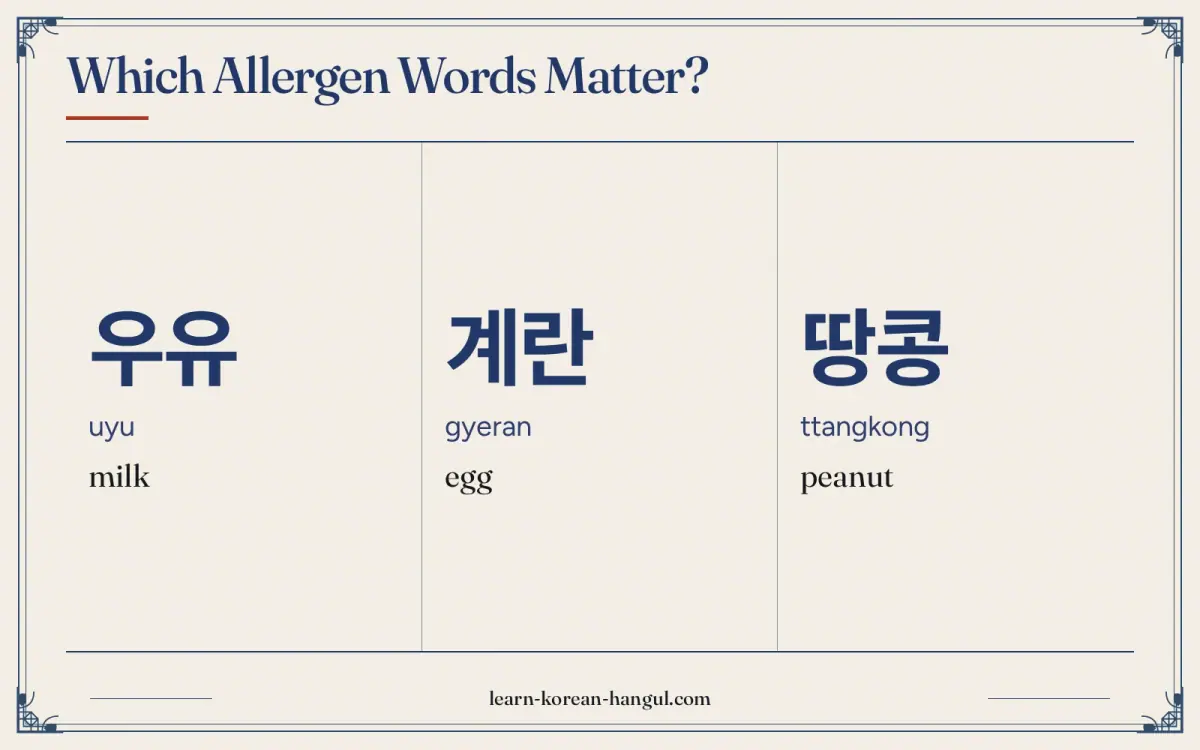
The allergen line is the part of the label that matters most for safety, so learn it first. It is usually a box or line headed 알레르기 유발물질, followed by the foods and the word 함유, "contains". 함유 is said [하뮤].
The list of foods that must be declared is set by Korea's Ministry of Food and Drug Safety (mfds.go.kr), and it can change. Start with these nine.
| Hangul | Revised Romanization | Meaning |
|---|---|---|
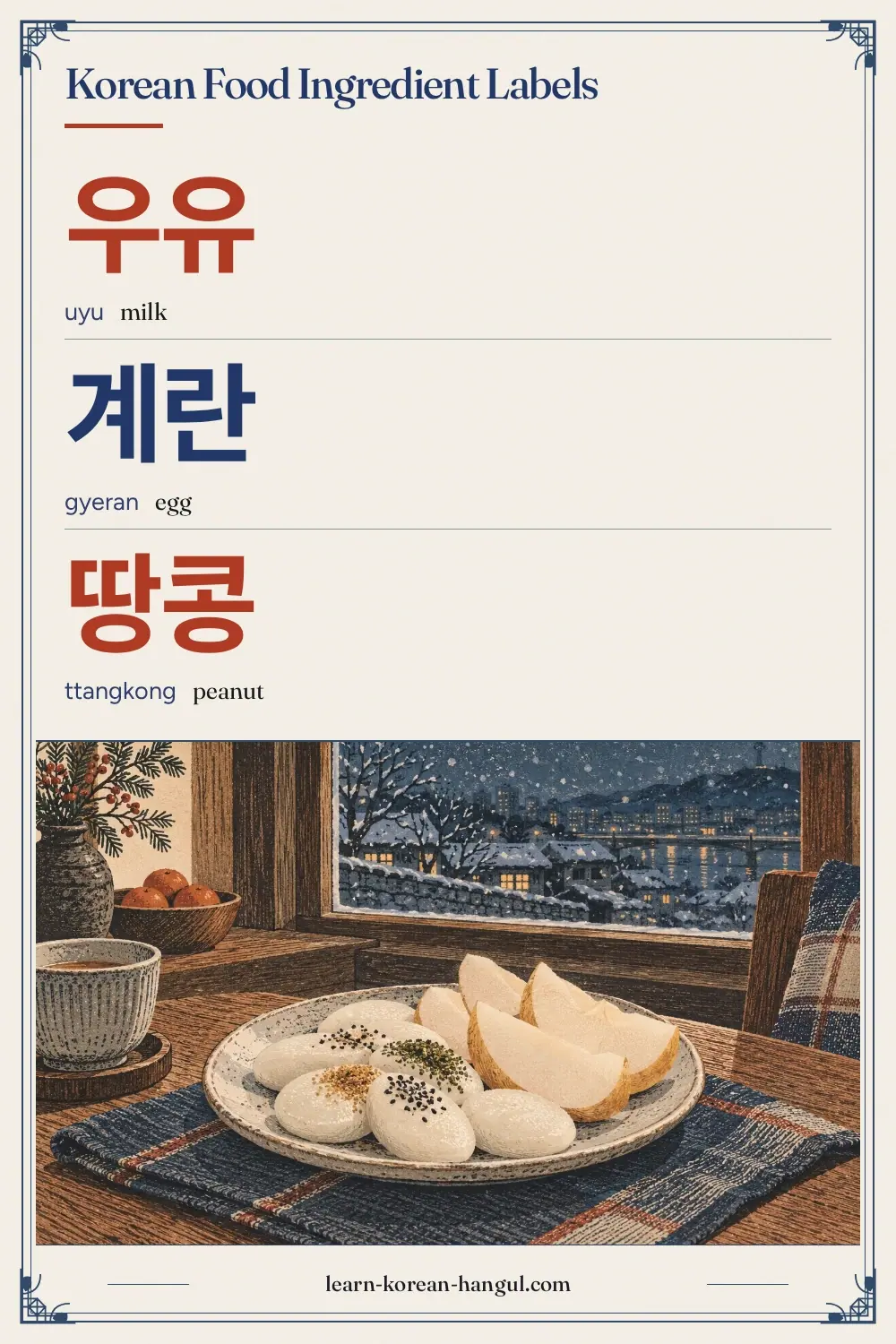
| 우유 | uyu | milk |
| 계란 | gyeran | egg |
| 땅콩 | ttangkong | peanut |
| 밀 | mil | wheat |
| 대두 | daedu | soybean |
| 새우 | saeu | shrimp |
| 게 | ge | crab |
| 호두 | hodu | walnut |
| 고등어 | godeungeo | mackerel |
The official list is longer than these nine. It also includes foods such as 메밀 (buckwheat), 돼지고기 (pork), 쇠고기 (beef), 닭고기 (chicken), 오징어 (squid), 복숭아 (peach), 토마토 (tomato) and 잣 (pine nut), and it can change over time. Eggs may appear as 계란 or as 알류 (egg products), so read both. The safe habit is to read the whole line, not only the first word.
Many packs also print a warning about the factory. 이 제품은 땅콩을 사용한 제품과 같은 시설에서 제조하고 있습니다 means "this product is made in the same facility as products that use peanuts". It does not say the food contains peanuts, but it warns you of a risk.
A Quick Check for Pork and Gelatin
Some learners avoid pork, beef or all meat for religious, health or personal reasons. On a Korean label, look for these words.
| Hangul | Revised Romanization | Meaning | What to check |
|---|---|---|---|
| 돼지고기 | dwaejigogi | pork | direct pork |
| 쇠고기 | soegogi | beef | direct beef |
| 닭고기 | dakgogi | chicken | direct chicken |
| 젤라틴 | jellatin | gelatin | may come from pork or beef |
| 육수 | yuksu | meat broth | stock made from meat |
| 멸치 | myeolchi | anchovy | fish stock and sauces |
| 액젓 | aekjeot | fish sauce | fish in the seasoning |
Gelatin is made from animal parts. The label may not say which animal, so if it matters for your diet, ask the maker. Fish products such as 멸치 and 액젓 often hide in soups and kimchi. This table is a guide to reading words, not a guarantee that a food is suitable for any diet.
How Are Storage and Dates Written?
Storage and date lines tell you how to keep the food and when to eat it by. They are short and use a few repeating words.
| Hangul | Revised Romanization | Meaning |
|---|---|---|
| 보관방법 | bogwanbangbeop | storage method |
| 냉장 보관 | naengjang bogwan | keep refrigerated |
| 냉동 보관 | naengdong bogwan | keep frozen |
| 실온 보관 | silon bogwan | keep at room temperature |
| 개봉 후 | gaebong hu | after opening |
| 직사광선 | jiksagwangseon | direct sunlight |
| 서늘한 곳 | seoneulhan got | a cool place |
A longer line puts these together. 직사광선을 피해 서늘한 곳에 보관 means "store in a cool place, away from direct sunlight". 개봉 후 냉장 보관하고 빨리 드세요 means "after opening, keep refrigerated and eat soon".
The date is usually 소비기한 (use-by date) or older 유통기한 (sell-by date). In recent years, Korea has been moving from 유통기한 to 소비기한, so you may see either on packs. For the rules that apply now, check the Ministry of Food and Drug Safety site (mfds.go.kr). A date is often written with dots or Korean counters: 2027.03.15까지 or 2027년 3월 15일까지, read as 이천이십칠 년 삼월 십오 일까지. See Sino-Korean numbers for years, months and days.
Convenience stores add short shelf labels of their own, such as price tags and promotion stickers. These are covered in convenience store labels.
How Do I Read Nutrition Lines?
The nutrition table is headed 영양성분. It lists the amount per serving or per package. Look first at 총 내용량 (total amount) and 1회 제공량 (amount per serving), because every number below depends on which one is used.
| Hangul | Revised Romanization | Meaning |
|---|---|---|
| 열량 | yeollyang | calories |
| 나트륨 | nateuryum | sodium |
| 탄수화물 | tansuhwamul | carbohydrate |
| 당류 | dangnyu | sugars |
| 지방 | jibang | fat |
| 포화지방 | pohwajibang | saturated fat |
| 트랜스지방 | teuraenseujibang | trans fat |
| 단백질 | danbaekjil | protein |
| 콜레스테롤 | kolleseuterol | cholesterol |
Calories appear as 열량 and a number with kcal: 열량 250kcal. Weights use g and mg. The word 용량 means volume or capacity and appears on drinks and bottles with ml. The word 내용량 (net contents) is said [내용냥].
You do not need to read every row to decide. Start with 열량, 나트륨, 당류 and 단백질. Then check whether the number is for one serving or the whole bag. A 120g bag may be listed as two servings, so the calorie number may be half of what you eat if you finish it.
Worked Example: 원재료명
Take the heading 원재료명 and the first line under it: 밀가루(밀), 팜유, 정제소금.
- Split the heading. 원재료명 is 원재료 (raw materials) + 명 (name). It means "the names of the raw materials".
- Read the first item. 밀가루 is wheat flour. The bracket (밀) names the wheat inside it, which is also an allergen.
- Read the next items. 팜유 is palm oil and 정제소금 is refined salt. Commas separate each item.
- Check the order. The list usually goes from most to least, so wheat flour is the largest part of this food.
- Check the allergen line. The label says 밀, 대두 함유, so wheat and soybean are both marked.
Put it together: a wheat-flour noodle with palm oil and salt that contains wheat and soybean.
대두, 밀, 우유 함유
daedu mil uyu hamyu
Contains soybean, wheat and milk.
이 제품은 땅콩을 사용한 제품과 같은 시설에서 제조하고 있습니다.
i jepumeun ttangkongeul sayonghan jepumgwa gateun siseoreseo jejohago itseumnida
This product is made in the same facility as products that use peanuts.
What Mistakes Do Learners Make with Korean Food Labels?
Learners often make four mistakes.
| Learners often assume | Actually | Because |
|---|---|---|
| A missing allergen means it is absent | Read 함유 and the brackets too | Allergens can hide inside a compound ingredient |
| 유통기한 and 소비기한 are the same | They are two different date types | One is sell-by, the other is use-by |
| The calorie number is for the whole bag | It may be per serving | Check 1회 제공량 and 총 내용량 |
| The English line is the full label | The Hangul has more detail | Import stickers often shorten it |
A fifth slip is to trust the ingredient list alone. A line such as 같은 시설에서 제조 (made in the same facility) warns of cross-contact, which does not show in the ingredient list. Another slip is to treat the order of ingredients as exact. The order is a guide to amount, not a measurement.
A final slip is to guess when a word is unfamiliar. If the word is a possible allergen and you do not know it, do not eat the food until you check. Use a dictionary or ask the staff at the shop.
Practice and Answer Key
Part A: find the zone. Which heading tells you each of these? The ingredients, the allergens, the storage method, the use-by date.
Part B: read the allergen line. What foods does 우유, 대두, 밀 함유 name? Does 같은 시설에서 제조 mean the food contains the allergen?
Part C: storage. What does 개봉 후 냉장 보관 mean? What does 직사광선을 피해 mean?
Practice · 6
Which heading is the ingredient list?
Show answer
원재료명
원재료명 means the names of the raw materials, the ingredient list.
What does 함유 mean?
Show answer
Contains
함유 means contains, and it follows the allergen foods, as in 밀, 대두 함유.
What does 냉장 보관 mean?
Show answer
Keep refrigerated
냉장 is refrigeration, and 보관 is storage. Keep frozen is 냉동 보관.
What does 같은 시설에서 제조 tell you?
Show answer
The food is made in the same facility as an allergen, a risk of cross-contact
The same-facility line warns of cross-contact. It does not say the food contains the allergen.
Which word on the nutrition table means calories?
Show answer
열량
열량 means calories, as in 열량 250kcal. 나트륨 is sodium, 단백질 protein and 당류 sugars.
Which heading is the use-by date?
Show answer
소비기한
소비기한 is the use-by date. 유통기한 is the older sell-by date.
Answers
- Part A: 원재료명, 알레르기 유발물질, 보관방법, 소비기한.
- Part B: milk, soybean and wheat. No, the same-facility line warns of a risk of cross-contact, and it does not say the food contains the allergen.
- Part C: 개봉 후 냉장 보관 means keep refrigerated after opening. 직사광선을 피해 means away from direct sunlight.
If Part A went wrong, go back to the label map and match each heading to its zone.
Where to Go Next
Shelf labels and price tags use a different set of words. Read convenience store labels next. For food words you can say, see Korean vocabulary. The full list of reading texts is under Korean signs. For dates and years on labels, review Sino-Korean numbers.
This lesson covers the common words on packaged-food labels. It does not cover every allergen, religious dietary rules, imported-food stickers or medical advice. A good next step is to take one package from your kitchen and find its 원재료명, 알레르기 유발물질 and 소비기한 lines.
Frequently Asked Questions
How Do I Find Allergens on Korean Food Labels?
Look for the line 알레르기 유발물질 or the word 함유, which means "contains". The foods follow, for example 우유, 대두, 밀 함유. Allergens may also appear in brackets inside the ingredient list. Read both places. A missing allergen in the first line does not prove it is absent, so check the full list and, if the risk is serious, ask the maker.
What Is 원재료명?
원재료명 is the ingredient list. 원재료 means raw materials, and 명 means name. The ingredients usually come in order of amount, with the largest first. A compound ingredient shows its own parts in brackets, as in 간장(대두, 밀), soy sauce made from soybean and wheat.
How Do I Read the Storage Instructions?
Look for 보관방법 or 보관 방법, which means storage method. 냉장 보관 means keep refrigerated, 냉동 보관 means keep frozen and 실온 보관 means keep at room temperature. A longer line such as 직사광선을 피해 서늘한 곳에 보관 means keep away from direct sunlight in a cool place.
How Are Calories Written?
Calories appear as 열량 followed by a number and kcal, as in 열량 250kcal. Check whether the number is for the whole package (총 내용량) or one serving (1회 제공량). The nutrition table also lists 나트륨 (sodium), 탄수화물 (carbohydrate), 당류 (sugars), 지방 (fat) and 단백질 (protein).