What you will learn
- Read promotion tags (1+1, 2+1, 할인) and say how they are spoken.
- Find the expiry line on a package and read a date in year-month-day order.
- Understand and answer three cashier questions: 데워 드릴까요?, 봉투 필요하세요? and 영수증 필요하세요?
Before you start: you should read Hangul blocks, as covered in how to read Hangul. Time: about 25 minutes. Audio plays only when you press a button.
Key Facts
- 1+1 and 2+1 promotions are spoken with English loan numbers: 원 플러스 원 and 투 플러스 원.
- The expiry line is 유통기한 (sell-by) or 소비기한 (eat-by), and dates are written year, month, day.
- Cashiers commonly ask 데워 드릴까요? (shall I heat it?), 봉투 필요하세요? (do you need a bag?) and 영수증 필요하세요? (do you need a receipt?).
- Ready meals are 도시락 and triangular rice balls are 삼각김밥.
- The tag price on a 1+1 deal is paid once for two items, and receipts are optional.
Last updated: 2026-10-09. The Korean text, romanization and audio scripts on this page are generated drafts that still await review by a Korean specialist.
What Are Korean Convenience Store Labels?
Korean convenience store labels are the small printed tags and package lines that tell you the price, any promotion, the expiry date and how to heat the item. A shelf tag sits under the product, and a label sits on the package. Each line is a fixed phrase, so the same few words repeat across thousands of products.
A typical shelf has two kinds of text. The tag shows the name, the price in won and sometimes a promotion tag. The package shows the product details, the expiry line and, for ready meals, heating notes. You do not need to read every word. You need the four lines this lesson covers: promotion, price, date and heating.
| Where | What it shows | Key words |
|---|---|---|
| Shelf tag | Price, promotion, unit price | 가격, 1+1, 2+1, 단위가격 |
| Package front | Product name, size | 도시락, 삼각김밥, 컵라면 |
| Package back or side | Expiry, storage, heating | 유통기한, 소비기한, 냉장 보관, 전자레인지 |
| Cashier | Three questions | 데워 드릴까요?, 봉투, 영수증 |
The table is the map for the rest of the lesson. First, why these labels look harder than they are.
Why Do English Speakers Struggle with Convenience Store Labels?
English speakers struggle because the labels are dense, the abbreviations are unfamiliar and the dates run in a different order. A shelf in Korea can show a name, a promotion, a price, a unit price and a date, each in small print. In addition, an English reader expects a date such as 10/09/26 to mean month first, but Korean dates run year, month, day.
There are three recurring problems:
- Tags look like arithmetic. 1+1 reads as a sum, but it means "buy one, get one". The Korean reading is borrowed English, 원 플러스 원, not a Korean number.
- Dates change order. 26.10.09 is 9 October 2026, not 26 October.
- The cashier speaks quickly. The three questions are short and formulaic, but at speed they blur. Hearing them first, with audio, helps.
| English habit | Korean label habit | Example |
|---|---|---|
| Month/day/year or day/month/year | Year, month, day | 2026.10.09 |
| "Buy one get one free" in words | 1+1 symbol | 1+1 |
| Sentence instructions | Short noun phrases | 전자레인지용 |
| "Do you need a bag?" varied | Fixed formula | 봉투 필요하세요? |
The next section starts with the tag that attracts the most attention.
How Are Promotion Tags Read?
Promotion tags are read with English loan numbers: 1+1 is 원 플러스 원 ("one plus one"), and 2+1 is 투 플러스 원 ("two plus one"). Both mean "buy that many, get the extra one". With 1+1, you buy one and receive one more. With 2+1, you buy two and receive a third.
| Tag | Spoken | Meaning |
|---|---|---|
| 1+1 | 원 플러스 원 | buy one, get one extra |
| 2+1 | 투 플러스 원 | buy two, get one extra |
| 할인 | harin, said [하린] | discount |
| 증정 | jeungjeong | free gift with purchase |
| 덤 | deom | a small free extra |
| 행사 | haengsa | promotion event |
The number words are English loans, not Korean numbers. The Korean numbers 하나 and 둘 are not used for the tag. The tag price is the price of one item, and you receive two for that price. If the tag says 1,800원 with 1+1, you pay 1,800 won for two items, which is 900 won each. Check the tag for a note such as 행사상품 (promotion item), because the extra item is not always the same product. The unit price line may also appear, and it reads per unit of weight or volume.
| Printed | Spoken | Meaning |
|---|---|---|
| 100g당 450원 | 백 그램당 사백오십 원 | 450 won per 100 grams |
| 100ml당 300원 | 백 밀리리터당 삼백 원 | 300 won per 100 millilitres |
The unit price lets you compare two sizes of the same food. A small number is a cheaper price for the same weight. The expiry line is the next line to find.
How Do I Read Expiry Dates?
Read the expiry line by finding 유통기한 or 소비기한, then reading the date in year, month, day order. 유통기한 is the sell-by date: the last day a shop may sell the item. 소비기한 is the eat-by date: the last day the food can be eaten safely if stored as directed. Korea has been moving labels from the old term to the new one, so both appear on shelves.
A date line may look like any of these:
| Printed | Reading | Date |
|---|---|---|
| 2026.10.09 | 이천이십육 년 시월 구 일 | 9 October 2026 |
| 26.06.15 | 이십육 년 유월 십오 일 | 15 June 2026 |
| 2026-12-31 | 이천이십육 년 십이월 삼십일 일 | 31 December 2026 |
Two month names are irregular. 10월 is read 시월, not 십월, and 6월 is read 유월, not 육월. The other months follow the Sino-Korean numbers: 일월, 이월, 삼월 and so on. The full system is in the dates in Korean section.
Look for the ending 까지 after the date. 2026.10.12까지 means "until 12 October 2026". Some packages also show 제조일자 (manufacture date) before the expiry line. Do not confuse the two: the earlier date is the manufacture date, and the later one is the expiry.
Storage words sit near the date. 냉장 보관 means keep refrigerated, 냉동 보관 means keep frozen and 실온 보관 means keep at room temperature. Next, the cashier.
What Does the Cashier Ask?
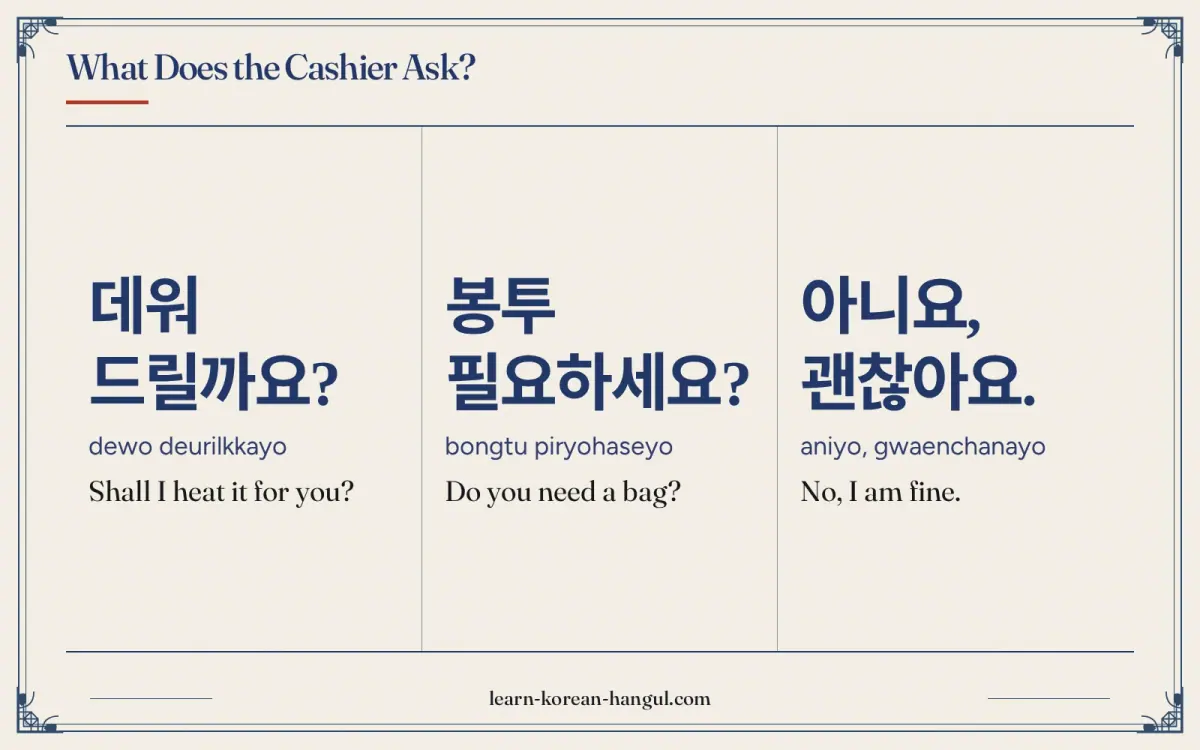
The cashier asks three formulaic questions in most convenience stores: whether to heat the item, whether you need a bag and whether you need a receipt. Each has a short answer.
| Question | Meaning | Short answer |
|---|---|---|
| 데워 드릴까요? | Shall I heat it for you? | 네, 데워 주세요. / 아니요, 괜찮아요. |
| 봉투 필요하세요? | Do you need a bag? | 네, 주세요. / 아니요, 괜찮아요. |
| 영수증 필요하세요? | Do you need a receipt? | 네. / 아니요, 괜찮아요. |
데워 드릴까요?
dewo deurilkkayo
Shall I heat it for you?
봉투 필요하세요?
bongtu piryohaseyo
Do you need a bag?
아니요, 괜찮아요.
aniyo, gwaenchanayo
No, I am fine.
괜찮아요 is the all-purpose polite answer: it means "I am fine" and turns an offer down. Many shops charge a small fee for a bag, so say yes only if you need one. Receipts are optional and can be declined. The other common question is about payment, and the fuller phrase set is in the Korean shopping phrases section.
To hear the exchange as a conversation, the Korean audio dialogues section has full scripts. The pattern in all three questions is the same: the cashier offers, and you accept with a short phrase or decline with 괜찮아요. The shelf also carries food words you should know.
Which Food Words Appear on Shelf Labels?
The food words on convenience store labels are mostly names of ready meals and snacks, plus a few heating and storage phrases. A short list of products covers most of what you will see.
| Hangul | Meaning |
|---|---|
| 도시락 | boxed lunch, ready meal |
| 삼각김밥 | triangular rice ball wrapped in seaweed |
| 컵라면 | instant noodles in a cup |
| 샌드위치 | sandwich |
| 우유 | milk |
| 생수 | bottled water |
Heating notes are on the package. 전자레인지용 means "for microwave use", and 가열 means heating. A line such as 전자레인지 500W 2분 reads "microwave, 500 watts, 2 minutes", with 분 meaning minutes. Cup noodles say 뜨거운 물 (hot water) and a waiting time. The store may have a hot-water machine and a microwave you can use yourself.
Pay attention to 냉장 (refrigerated), because refrigerated items spoil faster than shelf-stable ones. Ingredient and allergen lines are on the package too, and they are covered in a separate lesson on Korean food ingredient labels. Price tags are further explained in Korean price tags and receipts. The worked example follows one package from start to finish.
Worked Example: 유통기한
The worked example reads one expiry line on a ready meal, step by step.
- Find the line. On the back of the 도시락, look for 유통기한. The line reads 유통기한: 2026.10.12까지.
- Split the word. 유통 means distribution and 기한 means deadline, so the line is a sell-by deadline.
- Read the date. The order is year, month, day: 2026 year, 10 month, 12 day. Say it: 이천이십육 년 시월 십이 일.
- Check the ending. 까지 means "until", so the item may be sold up to and including 12 October.
- Compare with today. If today is 9 October 2026, there are three days left.
유통기한은 10월 12일까지예요.
yutonggihaneun siwol sibiilkkajiyeyo
The sell-by date is 12 October.
- Decide. A boxed lunch with three days left is fine to eat today. If the date has passed, choose another.
You will know it worked when you can say the date in Korean and state the number of days remaining. Check the heating line next: if the label says 전자레인지, ask the cashier 데워 드릴까요? or heat it yourself. The mistakes below catch many learners.
What Mistakes Do Learners Make with Convenience Store Labels?
The most common mistakes are reading the date in the wrong order, treating 1+1 as a Korean number and ignoring the unit price.
- Learners often assume 26.10.09 is 26 October. Actually the order is year, month, day, so it is 9 October 2026. Look for a four-digit or a two-digit year at the start.
- Learners often assume 1+1 is spoken with Korean numbers. Actually the tag is read with English loans: 원 플러스 원. A cashier who says 원 플러스 원 is pointing at the tag.
- Learners often assume 유통기한 and 소비기한 are the same. Actually the first is the last day a shop may sell the item, and the second is the last day it is considered safe to eat. Both are found on labels now, and the exact legal difference is set by Korea's food-safety rules, which this lesson does not cover.
- Learners often assume the tag price on a 1+1 deal is the price of each item. Actually you pay the tag price once and receive two items, so each costs half. Divide by two.
- Learners often assume a refusal needs a long sentence. Actually 아니요, 괜찮아요 is enough for any offer.
A further trap is the unit price, which can look like the real price in large print. Always find the price in won for the whole item. Practice puts these to work.
Practice and Answer Key
Use these six tasks. Write each answer before opening the key.
- Read the tag: 1+1 / 1,800원. How much is each item?
- Say the date 2026.06.15 in Korean month and day only.
- What does 데워 드릴까요? ask?
- You do not want a bag. What do you say?
- The label says 유통기한 2026.10.12까지 and today is 2026.10.09. How many days remain?
- What does 100g당 450원 tell you?
Answer key:
- 900 won each (1,800 for the pair).
- 유월 십오 일.
- Whether the cashier should heat the item.
- 아니요, 괜찮아요. (Or 괜찮아요.)
- Three days.
- The price is 450 won per 100 grams.
For a speaking task, say the three cashier answers aloud. Then listen to the question about the receipt once and reply.
Where to Go Next
The lesson above covers Korean convenience store labels: promotion tags, expiry lines, a date in year-month-day order and three cashier questions. It does not cover ingredient and allergen lines, full price-tag layouts or payment by app. The 소비기한 and 유통기한 distinction is explained here in plain terms only, and the legal rules are outside the scope of a reading lesson.
Next: Korean price tags and receipts, which reads the total, VAT and change. To see the other lessons, return to Real-World Texts (Signs, Menus).
Frequently Asked Questions
What does 1+1 mean in Korea? 1+1, spoken 원 플러스 원, means buy one and get one extra for the same price. The tag price is for one item, and you receive two. 2+1, spoken 투 플러스 원, means buy two and get a third. The extra item is not always the same product, so read the tag note.
What does 유통기한 mean? 유통기한 means the distribution deadline, or sell-by date: the last day a shop may sell the item. Its newer counterpart, 소비기한, means the eat-by date. The date after it is written year, month, day and often ends in 까지, meaning until. Find the line near the barcode or on the back.
How do I answer 데워 드릴까요? Answer 네, 데워 주세요 if you want the item heated, or 아니요, 괜찮아요 if you do not. 데워 드릴까요 means shall I heat it for you. Cashiers ask it for ready meals, boxed lunches and some rice balls. You can also just say 네 or 괜찮아요 with a nod.
How do I ask for a bag? The cashier will usually ask first: 봉투 필요하세요? To say yes, answer 네, 주세요, meaning yes, please. To ask yourself, say 봉투 하나 주세요, meaning one bag please. Many shops charge a small fee for bags, so say 괜찮아요 if you can carry the items.