
To find a Korean tutor that fits, set a goal, shortlist teachers on a platform or through a school, take trial lessons with a checklist and agree a plan before you pay for a block of lessons. The whole process takes about two weeks and roughly 3 hours of your time, and it saves you from spending months with a teacher who is not right for you.
Key facts
- Six steps: goal, platform, shortlist of three, trials, materials and schedule, review.
- Trial lessons before commitment, with the same checklist each time.
- A good tutor has a plan, corrects you usefully and sets homework.
- Start with two lessons a week for six weeks, then review.
- Prices and policies change. Check current terms.
Last updated: 2026-10-09.
Find Korean Tutor: the Essentials
A tutor is the fastest way to fix speaking and to get feedback that no app can give. A good one tells you why a sentence sounds wrong, hears your pronunciation and adjusts to your goals. A poor match wastes money and time. The six steps below turn a risky search into a short, structured test.
Before you start
| Item | What to prepare |
|---|---|
| Time | About 3 hours spread over two weeks (research 1 hour, three trials of 30 to 50 minutes each, plus notes after each trial) |
| Difficulty | Easy, but it takes some courage to speak |
| Cost | Trial lessons are often cheaper than regular ones, but terms vary. Check each teacher's profile |
| Tools | A quiet room, a headset, a notebook, a stable internet connection and the checklist in Step 4 |
| Level | Any. You can begin at A0 if you also learn Hangul |
| Prerequisite | A written goal (Step 1) |
If you are not sure that a tutor is the right tool yet, the Korean tutors and classes hub compares tutors, classes and exchange partners.
Step 1: Set Your Goal and Budget
Action. Write one sentence that says what you want to do in Korean and by when, then set a monthly budget.
How. Be specific. "I want to learn Korean" is too wide for a tutor to plan around. Good goals look like these:
- "Hold a five-minute conversation about my day within three months."
- "Pass TOPIK I level 2 by next spring." (For exam facts, use the official site topik.go.kr.)
- "Understand the main points of a drama scene without English subtitles."
- "Travel to Korea in four months and manage restaurants, transport and shopping."
Then fix a budget as a number per month, and decide how many lessons that allows. Prices differ a lot between platforms, countries and teachers, so work out your own limit before you look at profiles. Use only prices you find on the teacher's or school's own page.
Checkpoint. You will know it worked when you can read your goal aloud and a stranger would understand what you want.
Common mistake. Choosing a goal like "speak fluently". Fluency has no clear finish line, so progress feels invisible. Pick something you could demonstrate in a lesson.
Step 2: Choose a Platform or School
Action. Decide where you will look: a tutoring marketplace, a language school, an independent teacher or a university board.
How. The main routes are below. Each has an honest drawback.
| Route | Good for | Honest drawback |
|---|---|---|
| Online tutoring marketplace | Many teachers, flexible times, trial lessons, reviews | Quality varies widely, so you must screen |
| Language school or institute | A set curriculum, a placement test, a certificate | Fixed schedules and often higher cost |
| Independent teacher (by referral or website) | A personal plan, direct contact | Harder to compare, no platform protection |
| University or community exchange board | Low cost, a student or local partner | Not always trained to teach |
For free practice partners rather than paid teachers, see Korean language exchange apps.
For a closer look at one marketplace, see italki Korean. If you prefer group lessons, the guide to Korean classes online compares formats.
A note on forums: people often ask for tutor recommendations on social sites such as Reddit. Read these threads for ideas on what to look for, but remember that a recommended tutor may not suit your level or goal, and posts can be promotional. Always run your own trial.
Checkpoint. You will know it worked when you have chosen one or two routes and can say why.
Common mistake. Joining three platforms at once. You will spend all your time comparing and no time learning. Start with one.
Step 3: Shortlist Three Teachers
Action. Pick three teachers whose profiles fit your goal, and message each with a short, specific note.
How. Read each profile for:
- Teaching experience with your level. Does the profile mention beginners if you are a beginner?
- Lesson style. Conversation, exam preparation, grammar, or a mix?
- Language of instruction. English, Korean, or both?
- Availability. Do their hours fit your time zone? Korea is 9 hours ahead of UTC, so the gap to your own time zone can be large. Check it carefully.
- Materials. Do they use a textbook or their own notes?
- Cancellation terms. Read the policy before you book.
Then send each a short message: your level, your goal, your available times and a request for a trial. Teachers who reply quickly and clearly are showing you how they work.
Do not choose only on price or on a high star rating. A cheaper tutor who plans lessons can beat an expensive one who only chats.
Checkpoint. You will know it worked when you have three replies, or at least two, and the same questions asked of each.
Common mistake. Shortlisting only one teacher. If it goes badly, you start again from scratch. Three gives you a choice.
Step 4: Take Trial Lessons
Action. Book a trial with each shortlisted teacher in the same week, and use the same checklist in every one.
How. A trial is an interview in both directions. Bring the checklist below.
| Check | What to look for |
|---|---|
| Goal talk | Does the tutor ask about your goal and your level before teaching? |
| Level check | Do they test or listen to your Korean in the first 10 minutes? |
| Correction style | Do they correct you in a way you can understand, with reasons? |
| Materials | Do they have a book or notes, or do they improvise? |
| Homework | Do they offer homework or a next-step plan? |
| Balance | Do you speak for at least half of the lesson? |
| Comfort | Do you feel able to make mistakes? |
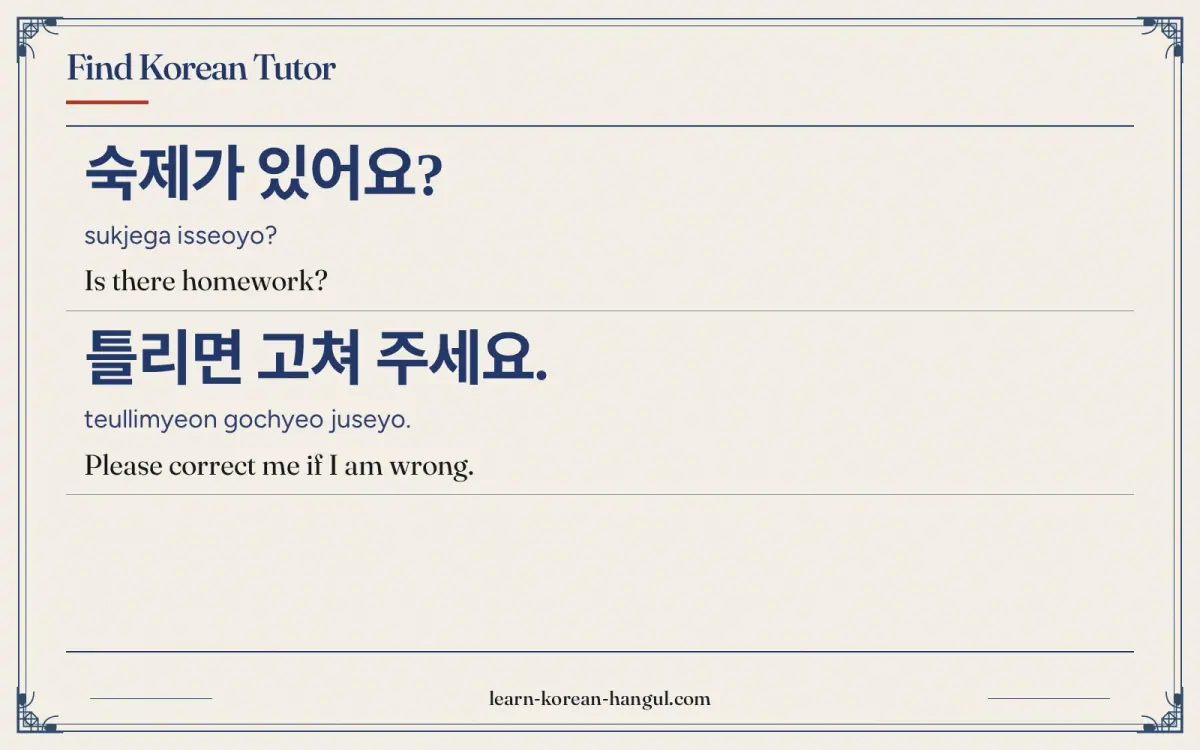
Prepare two or three sentences to say. For a trial, you might introduce yourself, ask about homework and ask for correction.
저는 한국어를 배우고 있어요.
jeoneun hangugeoreul baeugo isseoyo.
I am learning Korean.
숙제가 있어요?
sukjega isseoyo?
Is there homework?
틀리면 고쳐 주세요.
teullimyeon gochyeo juseyo.
Please correct me if I am wrong.
If you are at A0, you can say the first line in English and ask the tutor to teach it. Learning one real sentence in a trial is a good test.
After each trial, spend five minutes writing notes rather than scores: What did I learn? What did I say? Would I book again? Do this while the lesson is fresh.
Red flags. These are signs that a tutor may not suit you:
- no plan and no questions about your goal
- only free chat, with no corrections
- repeating a textbook page by page with no adaptation
- long silences while the tutor searches for materials
- pressure to buy a large package before you have tried a lesson
- repeated lateness or cancellation
Checkpoint. You will know it worked when you can rank your three trials without much doubt.
Common mistake. Judging by personality alone. A friendly tutor is pleasant, but you need one who teaches. Use the checklist.
Step 5: Agree Materials and Schedule
Action. Choose your tutor, then agree in writing what you will study, when and how.
How. Settle five things in the first week.
- Goal and plan. Ask the tutor to set out the first six weeks in a few lines.
- Materials. A textbook, the tutor's notes, or topics you choose. Decide who supplies what.
- Schedule. The days, times and length of lessons. A steady slot works better than changing times.
- Homework. How much, how often and how it is checked.
- Policies. Cancellation, rescheduling and what happens if one of you is late.
A good starting rhythm is two lessons a week for six weeks. That gives 2 × 6 = 12 lessons. If each is 50 minutes, the total is 12 × 50 = 600 minutes, which is 10 hours. Keep the first block short, then decide whether to continue.
Pair lessons with self-study. A tutor cannot teach you everything in 100 minutes a week, so use apps, flashcards, listening and reading for the rest. A balanced week might be two lessons (100 minutes), two homework sessions (40 minutes) and three short self-study sessions (60 minutes), which is 200 minutes in total.
Checkpoint. You will know it worked when you both can say what the next lesson will cover.
Common mistake. Leaving everything vague. Without a plan, lessons drift into chat. Ask for a short written plan.
Step 6: Review Progress
Action. After six weeks, or 12 lessons, review your progress against your goal and decide whether to continue, change or stop.
How. Sit down for 20 minutes with your notes and ask:
- Can I do something now that I could not do six weeks ago?
- Are the corrections sticking, or do I make the same mistakes?
- Do I enjoy the lessons, and do I do the homework?
- Is the price still worth it?
- Is my goal still right, or should it change?
Test your goal directly. If your goal was a five-minute conversation about your day, have it. Record yourself and compare with a recording from week one.
Then choose: continue with the same tutor for another block, change the focus, change the tutor or take a break. All four are normal.
Checkpoint. You will know it worked when you can name two things you can do now and one thing to work on next.
Common mistake. Staying on out of habit. If progress has stalled, say so politely and try something different.
Which Kind of Tutor for Which Goal?
The right kind of tutor depends on what you want to do. Use the table as a starting point when you read profiles.
| Goal | Look for | Ask in the trial |
|---|---|---|
| Speak with confidence | A tutor who talks with you for most of the lesson and corrects gently | "Will we have a conversation every lesson?" |
| Pass a TOPIK level | A tutor with exam experience and past-paper practice | "How do you plan lessons around the exam sections?" |
| Fix pronunciation | A tutor who listens closely and models sounds | "Can you hear and correct my vowels and final consonants?" |
| Learn from zero | A patient tutor who explains in English and teaches Hangul | "How will you teach me to read in the first lessons?" |
| Prepare for travel or work | A tutor who builds role-plays from your real situations | "Can we practise ordering, asking directions and meetings?" |
| Study for a university course | A tutor who follows your textbook | "Can you work from my course book?" |
Whatever your goal, the best sign is a tutor who adapts. If every learner gets the same lesson, the tutor is following a script, not teaching you.
A Sample Message to a Tutor
A short, specific message gets better replies. Here is a model you can adapt.
Hello. I am a beginner and I can read Hangul. I want to be able to introduce myself and order food in Korean within three months. I am free on weekday evenings. Do you have time for a trial lesson this week? Do you teach in English and Korean?
The message states the level, the goal, the time and a clear question. Replies that answer all of it are a good first sign.
What Mistakes Should You Avoid?
- Buying a large package up front. Start with a trial and a small block. Pay for more only when you know it works.
- Choosing by price alone. The cheapest option is not the best value if you learn little. The most expensive option is not better by default.
- Having no goal. Without one, lessons turn into conversation and you cannot tell if you improve.
- Skipping homework. A tutor cannot fix what they do not see. Do the homework and bring questions.
- Expecting the tutor to do everything. A tutor guides. You still need daily study.
- Never recording. Short recordings show your progress and your habits.
- Accepting no corrections. Ask for correction, and ask why.
What Should I Do If My Tutor Cancels Often?
Count the cancellations. One in a block is life. Two or more in six weeks is a pattern. Raise it politely, ask what has changed and read the platform's or school's cancellation terms to see what you are owed. If it continues, switch tutors and use your notes from Step 4 to choose the next one. Do not prepay for many lessons with a tutor who is unreliable.
How Much Homework Should a Tutor Give?
Enough to keep you moving, not so much that you cannot do it. For most learners, 20 to 30 minutes between two weekly lessons is a good guide. The tutor should set it, check it and use it in the next lesson. If you never get homework, ask for some. If you get too much, say so.
Next Steps
After you have chosen a tutor, use the lessons to practise speaking and bring new questions each time. The Korean conversation practice pages give topics and phrases to rehearse, and the Korean speaking hub shows how to build confidence. If you prefer a group, see Korean classes online.
FAQ
How many trial lessons should I take?
Two or three is a good number. One trial can be a bad day for either of you, and more than three starts to feel like a way of avoiding commitment. Book trials with different teachers in the same week so that you can compare them while the experience is fresh, and use the same checklist each time.
Should my tutor speak English?
At A1 and A2, a tutor who can explain in English saves a lot of time, because you can ask questions and understand grammar at once. At B1 and above, a tutor who speaks mostly Korean gives you more speaking practice. Some learners prefer an all-Korean approach from the start, so ask in the trial lesson how each tutor handles your level.
How often should I have lessons?
Two lessons a week is a good rhythm for most learners, because it keeps the language fresh without costing too much. One lesson a week works if you do solid homework. More than three can be tiring unless you have a clear exam goal. Whatever you choose, keep the schedule steady.
What if I don't click with the tutor?
It is fine to change. Fit matters more than credentials, so if you dread lessons, feel talked at or do not learn anything you can use, switch. Finish any prepaid lessons if you can, tell the tutor politely that you would like to try a different style and use your checklist to choose the next one.