
Korean classes online come in three formats, live group classes, self-paced video courses and programmes run by schools or institutions, and the best fit depends on your schedule, your need for feedback and your budget. This page compares the formats on six criteria, shows the quality signals to look for, explains what to expect from free classes and gives a weekly plan with the hours added up.
Key facts
- Three formats: live group, self-paced, institution programme.
- Six criteria: live or recorded, class size, feedback, curriculum, flexibility, price. No scores.
- A trial class, a placement test and a visible syllabus are good signs.
- A school certificate is not a TOPIK result.
- Check providers directly, because prices and schedules change.
Last updated: 2026-10-09.
Korean Classes Online: the Essentials

A class gives you what an app cannot: a schedule, a teacher who knows your name and other learners. The price is less choice and, usually, less flexibility than a private tutor. The main question is which format suits you.
| Format | Typical schedule | Typical class size | Good for | Honest drawback |
|---|---|---|---|---|
| Live group class | Fixed times, once to a few times a week | Small group; ask the provider (often a handful to about a dozen) | Speaking practice, accountability, social learning | Fixed times, and your pace is the group's pace |
| Self-paced video course | Any time | None (you study alone) | Flexibility and low cost | Little or no feedback; easy to stop |
| University or institution programme | A term of several weeks, with set hours | Varies by programme | Structure, placement tests, teacher teams | Higher cost, fixed term, entry rules |
| Free or community class | Varies | Often large | Trying Korean at no cost | Less feedback, fewer levels |
These size and schedule descriptions are general. Each provider sets its own, so ask before you enrol.
If you want a short answer: choose a live group class if you want speaking practice and routine, a self-paced course if your schedule is unpredictable and you can motivate yourself, and an institution programme if you want a full curriculum with exams. Combine a self-paced course with a private tutor if you want flexibility and feedback.
How Did We Choose?
Every format is read against the same six criteria. We give no scores, no star ratings and no affiliate links, and no provider pays to be included. We have not tested every provider. The names mentioned are examples of types, and each should be checked on its own site.
- Live or recorded. Do you meet a teacher at set times, or watch videos when you like?
- Class size. How many learners share the teacher? Smaller groups mean more speaking time.
- Feedback on speaking and writing. Does anyone correct you? How often?
- Curriculum and levels. Is there a clear path with levels, or a loose set of topics?
- Schedule flexibility. Can you join at different times, catch up if you miss a class or pause?
- Price. What is the cost model: per course, per month or per class? We name the model, not a figure.
Which Is Best for Speaking Feedback?
Live classes. Speaking improves when someone listens, corrects and makes you try again, and a live teacher can do this in the moment. How much feedback you get depends on size and style.
Look at these points:
- Speaking time per learner. In a 60-minute class of 10, if the teacher speaks for 20 minutes, there are 40 minutes left, which is about 4 minutes each. In a class of 4, it is about 10 minutes each. Ask how the provider handles this.
- Correction style. Does the teacher correct on the spot, or only after you finish? Both can work, but a class with no correction is little help.
- Pair or group work. Breakout rooms let learners talk in pairs, which increases talking time.
- Homework feedback. Does the teacher read and comment on your writing or recordings?
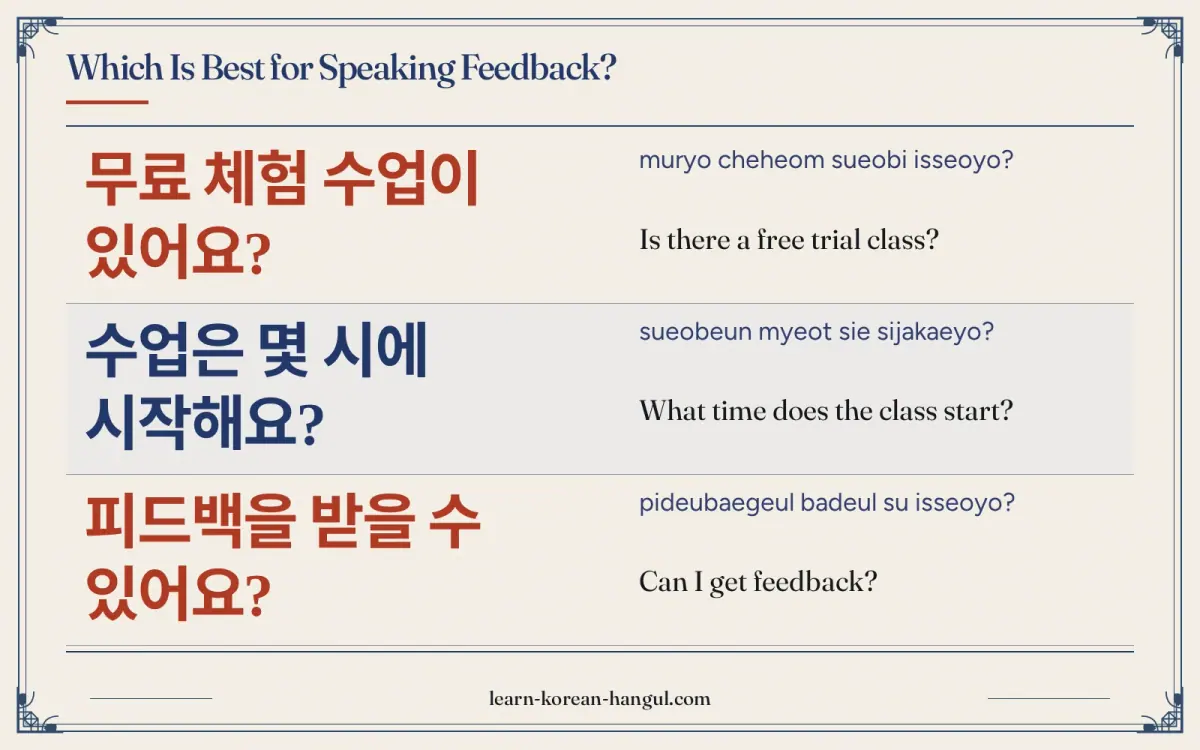
Here are three questions to ask a provider in Korean once you reach A2, which also give you real practice:
무료 체험 수업이 있어요?
muryo cheheom sueobi isseoyo?
Is there a free trial class?
수업은 몇 시에 시작해요?
sueobeun myeot sie sijakaeyo?
What time does the class start?
피드백을 받을 수 있어요?
pideubaegeul badeul su isseoyo?
Can I get feedback?
Notice that the polite ending 시작해요 is pronounced [시자캐요], because the ㄱ and ㅎ blend into an aspirated sound. The spelling does not show this.
Winner for speaking feedback: a small live group class, or a private tutor if you want more time to talk. See how to find a Korean tutor for that route.
Which Is Cheapest?
Cost depends on the provider, so this page gives no figures. In general:
| Format | Cost model | Why |
|---|---|---|
| Free or community class | No charge, or a small fee | Run by volunteers, groups or promotions |
| Self-paced course | One payment for the course, or a subscription | No live teacher, so it can be sold to many people |
| Live group class | A fee per course or per month | You pay for a teacher's time, shared among learners |
| Institution programme | A fee per term | Teacher team, placement and administration |
| Private tutor (for comparison) | A fee per lesson | One person's time |
Judge cost by what you receive, not by the price alone. A cheap course that you never finish is more expensive than a mid-priced class you attend. Work out the cost per hour of live teaching and per hour of feedback.
A simple way to compare. Take the price of a course and divide by the number of live hours. If a course has 24 live hours, divide the price by 24. Then ask how many of those hours you spend speaking. Do the same for a tutor's hourly price. The comparison is rough, but it shows whether a cheaper-looking option is better value.
Winner for lowest cost: self-paced courses and free classes. For the best value per hour of feedback, small group classes often compare well with private lessons, but check with your own sums.
Which Is Most Flexible?
Self-paced courses. You choose when to study and can pause for a week. The drawback is that nobody notices when you stop.
Live classes are the least flexible, because you must attend at set times in your time zone. Some providers offer recordings or a choice of times. Institution programmes are the most rigid, with a term and attendance rules, but they give structure that many learners need.
Ways to get flexibility without losing structure:
- Choose a live class with recordings for missed sessions.
- Choose a provider with several time slots a week.
- Use a self-paced course plus a fixed weekly meeting with a tutor or study partner.
- Set your own deadlines for a self-paced course, such as one unit per week.
Winner for flexibility: self-paced courses. For flexibility with feedback, a self-paced course plus a private tutor session.
Quality Signals
Whatever the format, look for the following.
| Signal | What it tells you |
|---|---|
| Placement test | The provider cares about putting you at the right level |
| Visible syllabus | You can see what you will learn and in what order |
| Trial class or sample lesson | You can test the teacher and the format |
| Named teachers with a short profile | You know who will teach you |
| Clear class size and speaking time | The provider is honest about feedback |
| Homework and feedback | There is learning outside class |
| Progress checks | Levels end with a test or review |
| Clear policies | Refunds, missed classes and transfers are written down |
Warning signs include no syllabus, no trial, promises of fluency in a few weeks and pressure to pay at once. Be careful with any course that makes big promises about speed. Language learning takes time, and honest providers say so.
Free Classes: What to Expect
Free classes exist and can be good. Expect the following.
- Level. Often beginner only, with a focus on the alphabet and first phrases.
- Size. Larger groups, so less speaking time.
- Feedback. Limited. Some are lectures with little interaction.
- Continuity. A free class may not run every term.
- Upsell. Some free classes lead to a paid course, which is fine if they are honest about it.
Good uses for free classes: testing whether you like live learning, learning Hangul, meeting other learners and filling gaps between paid courses. For free self-study material on this site, see the Korean courses section.
Examples of Providers by Type
These are types of provider and examples to check. Details change, so confirm them on each provider's own site.
- University language centres. Several universities in Korea run Korean language programmes for foreign learners, and some, such as the language institutes of Yonsei University and Sogang University, are widely known for their textbooks. Some offer online or short courses at times. Check what is open to international students and whether online options exist.
- King Sejong Institute. A network of Korean language and culture institutes supported by the Korean government, with centres in many countries. It is known to offer online learning as well as in-person classes. Entry rules, courses and fees vary by centre, so check the official site.
- Korean cultural centres abroad. Many countries have a Korean Cultural Centre that runs Korean classes, sometimes online. Check yours, and see Korean classes near me for finding in-person options.
- Private language schools. Some offer live online group classes in Korean. Compare them using the quality signals above.
- Self-paced course platforms. Large course platforms host Korean courses from different teachers. Quality varies, so read the syllabus and sample lessons.
The Formats in Detail
Each format below follows the same pattern: a verdict, a specs line, one honest drawback and who should choose or skip it. The details are general, so confirm them with the provider.
Live Group Classes
Verdict. The best format for most learners who want speaking practice and a routine.
Specs. Live video sessions at fixed times; a small group; a teacher who leads, corrects and sets homework; levels from beginner upward; usually sold as a course of several weeks or as a monthly plan.
Drawback. You move at the group's pace. If you are faster or slower than the others, the class can feel wrong, and missing a session means missing the content unless recordings exist.
Choose it if you want speaking time, a schedule that keeps you accountable and other learners to practise with. Skip it if your timetable changes every week.
Self-Paced Video Courses
Verdict. The most flexible and usually the cheapest way to get a structured path.
Specs. Pre-recorded lessons; study at any time; quizzes or exercises; progress tracked by the platform; sometimes a forum or messages to a teacher (check).
Drawback. Feedback is limited or absent. Without a teacher or a deadline, many learners stop, and speaking practice is easy to skip.
Choose it if you are self-motivated, have an unpredictable schedule or want to learn the basics cheaply. Skip it if you know you need a person to keep you going.
University and Institution Programmes
Verdict. The most structured route, with a full curriculum and trained teachers.
Specs. A term of several weeks, a placement test, set weekly hours, a textbook series, assessments and often a certificate of attendance or completion; offered by university language centres, King Sejong Institute centres, cultural centres and private schools.
Drawback. Higher cost, fixed dates and entry rules. Some programmes are for students in Korea only, and online availability changes.
Choose it if you want a full curriculum and are happy to follow a timetable. Skip it if you need to start tomorrow or pay little.
How to Run a Trial Class
A trial class tells you more than any description. Use it well.
- Prepare. Write your goal in one sentence and your level in one line.
- Join early. Test your sound and camera.
- Notice who talks. Count roughly how much time you speak. In a 60-minute class, 5 to 10 minutes of your own speaking is a good sign; 0 is a warning.
- Check the level. Was it too easy, too hard or about right?
- Check feedback. Did the teacher correct anyone? How?
- Look at the materials. Are they clear, and will you get them afterwards?
- Ask about the plan. What will the next four weeks cover?
- Write notes at once. Do this while your impression is fresh.
If you take trials in two formats, use the same checklist, then compare.
Questions to Ask a Provider
- What level will I be placed in, and how do you decide?
- How many learners are in a class, and how much time do I speak?
- Who teaches the class, and in what language do they explain?
- What do the weeks cover? May I see a syllabus?
- What homework is set, and who checks it?
- What happens if I miss a class?
- What is the refund and transfer policy?
- What certificate or record do I get at the end?
A provider that answers these clearly is more likely to run a good class.
Getting the Most from a Live Online Class
Live classes reward preparation.
- Prepare ten minutes before. Skim last week's notes and read the new vocabulary list if there is one.
- Speak early. The longer you wait in a call, the harder it is to start. Answer the first question.
- Take notes in Korean and in your own language. Write the corrections the teacher gives you.
- Ask for repeats. Use phrases such as 다시 한번 말해 주세요 (dasi hanbeon malhae juseyo, [다시 한번 말해 주세요], please say it once more) without worry.
- Review the same day. Spend ten minutes after class re-reading your notes. That small step saves hours later.
- Use the break between classes. Try one new sentence each day, spoken aloud.
Class, Tutor or App: How They Fit Together
You do not have to choose only one. Each tool does a different job.
| Tool | Does best | Weak at |
|---|---|---|
| Live class | Routine, group practice, a full curriculum | Individual pace and timing |
| Private tutor | Personal feedback and flexible focus | Cost per hour; no group |
| Self-paced course | Low cost, flexible, structured content | Feedback and motivation |
| Apps and flashcards | Daily vocabulary review | Speaking and explanation |
| Listening and media | Hearing real Korean | Structure and correction |
A sound combination for many learners is one live class or one self-paced course as the spine, flashcards for daily review, listening for the ear and a tutor session now and then for speaking and correction. The Korean tutor guide shows how to test a tutor, and the resources section lists the other tools.
Classes for Exam Goals
If your goal is an exam, choose a class that says so. TOPIK, the Test of Proficiency in Korean, is the standard exam, and its official site, topik.go.kr, gives dates, levels and rules. A class can help with exam technique, timing and writing practice, but it cannot replace past papers and mock tests. Ask a provider:
- Which TOPIK level does the course aim at?
- Does it include listening, reading and writing practice in exam format?
- Are there timed mock tests, and who marks the writing?
- Does the course date line up with an exam date you plan to sit?
A general conversation class is excellent for speaking but may not prepare you for the exam. The TOPIK section explains the exam in plain English and how to prepare.
A First-Month Plan for a New Live Class
Your first month sets your habits. A simple plan for a weekly 2-hour class follows.
- Week 1. Attend, take notes and write down five phrases you want to remember. Say them aloud twice a day.
- Week 2. Do all the homework. Ask one question in class.
- Week 3. Record yourself saying a short paragraph. Compare it with the class model.
- Week 4. Review the month. Count how many phrases you can say without notes, and tell the teacher what you most want to improve.
At the end of the month, decide whether the class is worth continuing. Look at three things: whether you speak more than before, whether you do the homework and whether you look forward to the lesson. If two of the three are yes, continue.
Which Should You Pick?
You want to speak and need a routine. Choose a small live group class and attend weekly.
Your schedule changes a lot. Choose a self-paced course and set weekly targets, then add a tutor for feedback now and then.
You want a full curriculum and a certificate. Choose an institution programme. If your goal is an official score, plan to sit TOPIK as well; see topik.go.kr for the official exam information and the TOPIK section for preparation.
You are on a tight budget. Use free classes, self-paced material and the free Korean courses on this site, then pay for feedback only when you need it.
You like one-to-one attention. Skip classes and find a Korean tutor.
You are not sure yet. Take a trial class in each of two formats and compare, using the quality signals above.
A Weekly Plan with a Live Class
Here is a plan for a learner in a 2-hour weekly live class who adds self-study.
| Day | Activity | Time |
|---|---|---|
| Monday | Live class | 120 min |
| Tuesday | Review notes and vocabulary | 30 min |
| Wednesday | Homework | 40 min |
| Thursday | Listening or reading | 30 min |
| Friday | Speaking practice: record yourself or practise with a partner | 30 min |
| Saturday | Light review of the week | 20 min |
| Total | 270 min |
That adds up to 120 + 30 + 40 + 30 + 30 + 20 = 270 minutes, or 4 hours and 30 minutes, a week. It is within the 4 to 6 hours that many learners find sustainable. If you can only manage 3 hours, shorten the self-study sessions rather than skip the class.
When a Class Is Not Working
Give a class four weeks, then judge it. Warning signs are no speaking time, no corrections, a level that is clearly wrong and a teacher who changes every week. Talk to the provider first, since a move to a different level or group can fix the problem. If it does not, ask about the transfer or refund policy you checked at the start, and try another format. Changing early costs less than staying for a whole term.
Common Mistakes When Choosing a Class
- Choosing the cheapest option and not finishing it. Completion matters more than price.
- Ignoring class size. A class of 25 is a lecture.
- Skipping the trial. You should see the teacher and the format before you pay.
- Joining at the wrong level. Take the placement test, and be honest. A class that is too hard or too easy wastes your time.
- Doing nothing between classes. A weekly class is not enough alone. Add review and homework.
- Expecting a certificate to mean fluency. It shows that you attended or passed a level, not that you can speak.
- Mixing too many courses. One main course, with tutoring or self-study as support, works better than four.
Next Steps
If you find that a class is not enough on its own, find a Korean tutor for speaking practice, or read about the tutors and classes hub to see the other options. For free structured lessons, start with the Korean courses on this site. The resources section covers apps, books, podcasts and media as well.
FAQ
Are free online classes worth it?
Free classes are worth it as a start, especially for the alphabet and first phrases, and as a way to test a teacher or a format. They usually offer less feedback, larger groups or limited levels. Use a free class to see if you like the format, then decide whether paying for feedback and structure would help you.
How big should a class be?
For speaking practice, smaller is better, because each learner gets more time to talk. A small group lets the teacher hear and correct you. Large classes can still teach grammar and vocabulary well but give less speaking practice. Ask the provider for the usual size and the amount of speaking time per learner.
Do I get a certificate?
Some schools and institutions give a certificate of attendance or level completion, and others do not. A certificate from a school is not the same as a TOPIK result. TOPIK scores come only from the official exam, and details are on topik.go.kr. Ask the provider what it gives, and whether it matters for your goal.
How many hours a week?
Many learners do well with 4 to 6 hours a week in total. That might be 2 hours of live class and 2 to 4 hours of homework and review. More is fine if you have the time, but steady weekly study beats occasional long sessions. A class of 2 hours with no homework is usually too little to make fast progress.