
italki Korean lessons are booked on an online marketplace where you choose between professional teachers and community tutors, compare their profiles and prices, and use a trial lesson to test a teacher before you commit. It suits learners who want choice and flexible times and who are willing to screen tutors themselves. This page explains how the platform works, what it does well, where it falls short and how it compares with other routes.
Key facts
- Marketplace model: you pick a tutor, and each tutor sets their own price and schedule.
- Professional teachers and community tutors are different labels, not a quality guarantee.
- Trial lessons help you test a teacher. Check the current terms on each profile.
- Quality varies, so screen and test.
- No affiliate links, no scores. Confirm prices and policies on the italki site.
Last updated: 2026-10-09.
italki Korean: the Essentials

Verdict. italki is a good fit for a learner who wants one-to-one Korean lessons with plenty of choice, flexible hours and the chance to test several teachers cheaply. It is a weaker fit for someone who wants a fixed curriculum, a school-style class or a guaranteed standard, because quality depends on the tutor you pick.
Personas.
| If you are... | Verdict |
|---|---|
| A beginner who wants a patient, English-speaking teacher | A good match. Filter for tutors who list beginner experience and test two |
| An intermediate learner who needs speaking practice | A good match. Many tutors offer conversation lessons |
| A TOPIK candidate | Possible. Look for tutors who list exam experience, and check the official exam facts on topik.go.kr |
| Someone who wants a school-style curriculum | Usually weaker. Consider Korean classes online |
| A learner on a very tight budget | Possible. Prices vary by tutor, and conversation exchange may cost less |
Everything below is a general description of how the platform works, based on how it presents itself. Features, prices and rules change, and this page does not claim hands-on testing of any account. Check the italki site for the latest.
What Is italki?
italki is an online marketplace for language lessons. Learners browse teacher profiles, pick a person, book a time and meet online by video. Korean is one of many languages offered. Because it is a marketplace, italki does not set one teaching method. Each tutor decides what to teach and how.
How a profile usually looks:
- a short introduction, sometimes with a video
- a label as a professional teacher or a community tutor
- languages taught and spoken
- lesson types, such as conversation, exam preparation or beginner Korean
- a price per lesson, and sometimes for packages
- reviews from past students
- open time slots
The two labels matter.
| Label | What it usually means | What to check |
|---|---|---|
| Professional teacher | A tutor who lists teaching experience or credentials | The details of the credentials, and whether they match your level |
| Community tutor | An informal tutor, often a native speaker, who may not have teaching training | A trial lesson, because skill varies widely |
Neither label is a guarantee. A community tutor can be an excellent teacher, and a professional can be a poor match for you. The label is only a starting point.
What Does It Do Well?
Choice. A marketplace gives you many teachers, from different countries and with different styles. You can filter by price, time and the languages they speak, and compare.
Trial lessons. Many tutors offer a trial lesson, often at a lower price or shorter length, so that you can test the fit before you commit. Terms differ by tutor.
Flexible times. Tutors set open slots across time zones, so you can often find a time in your evening or early morning. Times are generally shown in your own time zone.
Variety of lesson types. You can ask for conversation, grammar, exam preparation or beginner basics, and change focus.
A platform record. Reviews and lesson history in one place help you compare tutors and keep track of what you did.
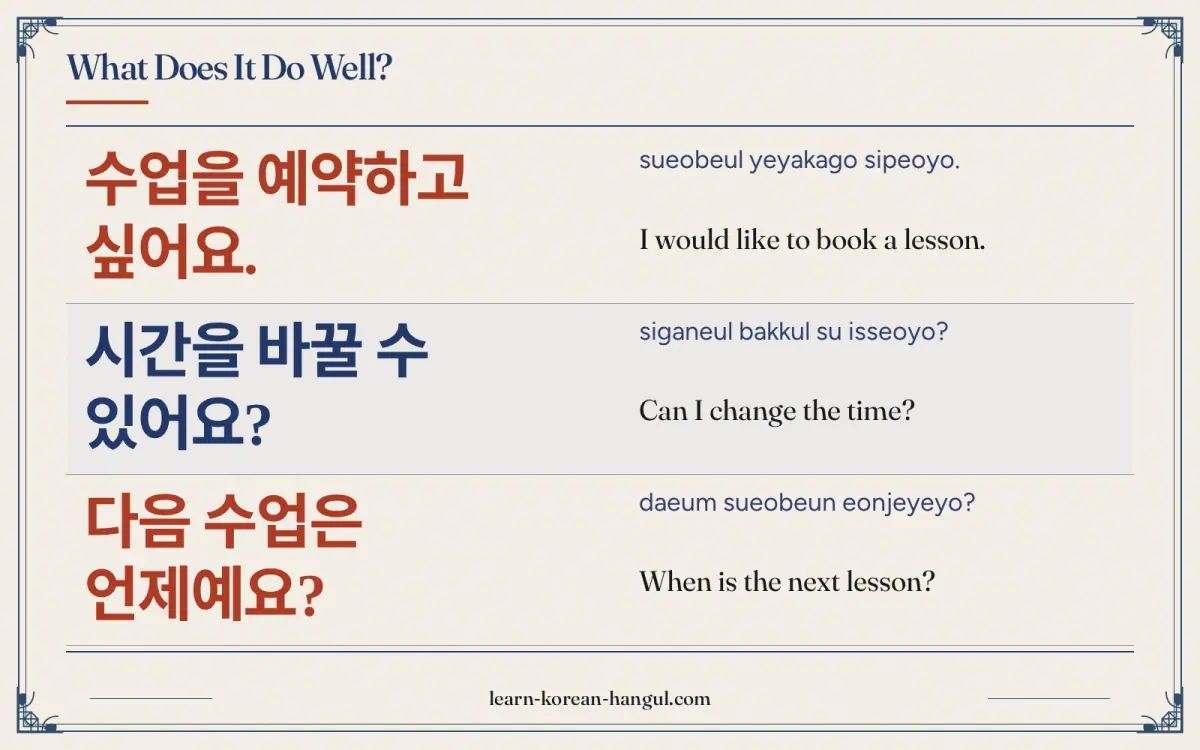
Here are three Korean sentences you can use when you book and follow up with a tutor.
수업을 예약하고 싶어요.
sueobeul yeyakago sipeoyo.
I would like to book a lesson.
시간을 바꿀 수 있어요?
siganeul bakkul su isseoyo?
Can I change the time?
다음 수업은 언제예요?
daeum sueobeun eonjeyeyo?
When is the next lesson?
Where Does It Fall Short?
Variable quality. The same strength that gives you choice also means you must screen. Some tutors are excellent, and some give little structure.
No fixed curriculum. A marketplace does not give you a set course. You or your tutor must build a plan, and some tutors do not.
Price differences. Prices differ a lot between tutors. A low price is not always a bad sign, and a high price is not always a good one.
Self-direction. You must set goals, choose materials and do homework. Without these, lessons drift into conversation.
Platform terms. Cancellation, refund and payment rules are set by the platform, and you must read them. They can change.
Time zones. Many Korea-based tutors work in Korean time. Korea is 9 hours ahead of UTC, so the best slots for you may be early or late in your day.
The honest drawback to remember: italki makes it easy to start and hard to know if a tutor is right until you try. Use the checklist in how to find a Korean tutor.
Price Range and Structure
Prices are set by each tutor, so there is no single italki price. The sections of the profile that matter:
- Price per lesson. Shown on the profile for a lesson of a set length. Compare tutors at the same length.
- Lesson length. Common options are around 30, 45 or 60 minutes, but this differs by tutor.
- Packages. Some tutors offer discounts when you buy several lessons at once. Buy a package only after a trial.
- Trial price. Often lower than the regular price. Check the exact terms on the profile.
- Extras. Materials and notes are sometimes included and sometimes charged.
Do the arithmetic before you book. If a tutor charges a given price for a 60-minute lesson and you take two lessons a week for six weeks, that is 12 lessons. Multiply the price by 12 and compare it with your budget from Step 1 of the tutor guide. This page gives no prices because they change and differ by tutor, so use the figures on the profile you are reading.
The Six Criteria at a Glance
The table below reads italki-style marketplaces against the six criteria, next to the main alternatives. The cells describe what to expect in general. Confirm the details for any specific tutor or school.
| Criterion | italki-style marketplace | Online class or school | Independent teacher |
|---|---|---|---|
| Teacher pool and specialties | Many teachers; specialties listed on profiles | The school's own team | One person |
| Price range and structure | Set by each tutor; per lesson or package | Set by the school; often per course | Agreed with the teacher |
| Trial lessons | Often offered; terms differ by tutor | Sometimes a free or low-cost first class | Usually by arrangement |
| Scheduling and time zones | Many open slots in many time zones | Fixed class times | Agreed with the teacher |
| Lesson tools | Platform classroom or external video app | School platform | Video app of your choice |
| Cancellation and refunds | Platform rules plus tutor policy | School policy | Personal agreement |
Winner by criterion, in plain terms: for choice and for trial lessons, the marketplace; for structure and a set curriculum, a school; for a personal plan built around you, a good independent teacher. No route wins on every line.
How to Read a Tutor Profile in Five Minutes
A profile gives you more signals than a price. Read it in this order.
- Headline and introduction (1 minute). Does the tutor say who they teach and how? "I teach beginners using short dialogues" is more useful than "I love languages".
- Lesson types (1 minute). Do they list conversation, exam preparation or beginner Korean? Match this to your goal.
- Languages (30 seconds). If you are a beginner, look for a tutor who can explain in a language you share. If you are B1 or above, Korean-only lessons may be fine.
- Reviews (1 minute). Read several written reviews, not just the average. Look for comments about preparation, punctuality, correction and homework. Treat a very small number of reviews with caution.
- Availability (30 seconds). Check that the open slots suit you at a steady time each week.
- Introduction video (1 minute), if there is one. Listen to how clearly the tutor speaks and whether they sound patient.
Then write down your three questions for the trial. A tutor who answers them clearly in the trial is a good candidate.
Questions to Ask in a Trial Lesson
Take a short list.
- "What would a typical lesson look like for me?"
- "How do you correct mistakes during conversation?"
- "What materials do you use, and do you send notes afterwards?"
- "How much homework do you suggest?"
- "How do you check progress after six weeks?"
- "What is your cancellation and rescheduling policy?"
Good answers are specific. "We will start with your goals, work from a short dialogue and I will send you a list of corrections after each lesson" is specific. "We will just talk" is not.
Making a Six-Week Block Work
A block is a short run of lessons with one tutor and one goal. A typical block has two lessons a week for six weeks, which is 12 lessons. If each lesson is 50 minutes, that is 12 × 50 = 600 minutes, or 10 hours of tutoring.
| Week | Lessons | Focus | Your homework |
|---|---|---|---|
| 1 | 2 | Goal, level check, basics | Record a self-introduction |
| 2 | 2 | First topic from your goal | 20 minutes of vocabulary review |
| 3 | 2 | Same topic, new patterns | Write five sentences |
| 4 | 2 | Role-play of a real situation | Re-record the introduction |
| 5 | 2 | Correct earlier mistakes | Write a short paragraph |
| 6 | 2 | Review and plan | Compare week 1 and week 6 recordings |
At the end, compare your recordings and your notes with your goal. Then decide whether to book a second block.
Good Practice on Any Platform
- Use the platform's tools for booking and messages. That keeps a record that the platform can see if there is a problem.
- Share only what you need. You do not need to give out personal contact details to take a lesson.
- Be on time and prepared. A tutor can only help with what you bring.
- Give honest, polite feedback. If a lesson was not useful, say so politely and ask for a change.
- Report problems through the platform. If a tutor behaves badly or does not follow the rules, use the platform's help pages.
Trial Lessons: How They Work
A trial lesson is a short, often cheaper first lesson with a tutor. Its purpose is to test the fit. Terms differ, so read the profile for the length, the price and any limit on how many trials you can book.
How to use a trial:
- Book trials with two or three tutors in the same week.
- Prepare a short self-introduction and one question about your goal.
- Use the same checklist each time: goal talk, level check, correction style, materials and homework.
- Write a few notes straight afterwards.
- Choose the tutor who taught you something concrete and left you with a plan.
If a tutor does not offer a trial, consider whether you want to commit without one. A short first lesson is a fair way to test.
Scheduling and Time Zones
Tutors list available slots, and you book one. Times are normally displayed in your time zone, but check the setting when you book.
- Book at a steady time. A regular slot builds habit.
- Leave a buffer. Join a few minutes early to test your sound and camera.
- Check changes of clocks. If your region or the tutor's region changes its clocks, lesson times can move by an hour.
- Know the rescheduling rules. Most tutors accept changes only within a certain window.
Lesson Tools
Lessons take place by video. Platforms offer a built-in classroom, and tutors may use external video apps instead. Typical features include video, chat, a shared whiteboard and file sharing. What matters:
- a stable connection and a headset
- the ability to share text so that the tutor can show Hangul and corrections
- a way to record or take notes, if the tutor allows it
- a backup plan if the connection fails, such as a phone call
Ask the tutor in the trial how they share text and send notes.
Cancellation and Refunds
This is the area where policy matters most. Rules are set by the platform and, in part, by the tutor, and they change, so read the current pages before you pay. Questions to answer:
- How late can you cancel without a charge?
- What happens if the tutor cancels or does not appear?
- What happens if there is a technical problem?
- When is payment released to the tutor?
- Who can you contact if there is a dispute?
Keep your messages and booking details. They help if you need to ask for help.
Common Mistakes When Using a Tutoring Marketplace
- Booking a large package after one good chat. Wait until you have had two or three lessons.
- Picking only by price or rating. A low price may mean less preparation, and a high rating may reflect friendliness more than teaching. Read the comments.
- Booking lessons with no goal. Without one, lessons become chat.
- Skipping the cancellation policy. Know the rules before you pay.
- Using lessons for everything. A tutor helps most with speaking, correction and planning. Reading, listening and vocabulary still need daily self-study. Use Korean conversation practice ideas and your own routine between lessons.
- Staying with a poor match. If three lessons give you nothing concrete, change tutors.
How italki Fits with Self-Study
Lessons work best when you arrive prepared. A simple weekly shape: two lessons of 50 minutes (100 minutes), two homework sessions of 20 minutes (40 minutes) and three self-study sessions of 20 minutes (60 minutes). That is 200 minutes, or 3 hours and 20 minutes, a week. Use the self-study sessions for the words and patterns your tutor flagged, and bring one question to each lesson. The tutor then spends lesson time on correction and speaking, which is what only a person can give.
Comparison with Alternatives
italki is one route among several. The table compares routes in general terms.
| Route | Choice of teachers | Structure | Typical strength | Typical drawback |
|---|---|---|---|---|
| italki-style marketplace | Wide | Set by each tutor | Flexibility and trials | Variable quality |
| Other tutoring marketplaces (for example Preply) | Wide | Set by each tutor | Similar model, different interface and terms | Same screening needed |
| Online classes and schools | Limited to the school | A set curriculum | Group structure, a teacher team | Fixed times, less personal |
| Independent teacher by referral | Narrow | Personal plan | Fit and trust | Hard to find and compare |
| Language exchange | Very wide | None | Free practice | No teaching, uneven feedback |
Marketplaces such as Preply work in a similar way, with their own terms, so check them with the same six criteria. For free practice instead, see Korean language exchange apps, and for self-study tools that train speaking, the Korean speaking apps guide. The page on Korean classes online covers group formats, and find a Korean tutor shows how to test any route.
Who It Suits
Choose italki if you want one-to-one lessons, you are happy to compare profiles and book trials, you can set your own goals and you want flexible hours.
Skip italki if you want a fixed curriculum and a class group, you dislike screening, you need an official certificate or you want free conversation only.
A middle route. Use the platform for a six-week block with one tutor, review your progress and then decide. That keeps your cost and risk low.
A Booking Checklist
Before you pay for lessons, go through this list.
- Your goal is written down.
- You have read three profiles, and the tutor has a clear level and lesson style.
- You have read the cancellation and refund pages.
- Your trial is booked at a time you can attend.
- You know your budget per month.
- You have a headset and a quiet space.
- You have a short self-introduction ready in Korean or English.
FAQ
Is italki free?
Joining and browsing are generally free, but lessons are paid. Each tutor sets their own price, so the cost depends on the person you choose and the lesson length. Some tutors offer discounted trial lessons or free introductory chats, and terms differ by tutor. Check the profile and the platform's help pages for current prices and offers.
Are italki tutors qualified?
Qualifications vary. The platform groups teachers as professional teachers, who list teaching credentials or experience, and community tutors, who are informal and may be native speakers without formal training. Neither label guarantees a good fit, so read the profile, watch the introduction video if there is one, and take a trial lesson before committing.
What if the tutor cancels?
Platform rules usually cover tutor cancellations, for example by letting you reschedule or return your credit, but details differ and change. Read the cancellation and refund pages before you book, and keep your booking messages. If a tutor cancels repeatedly, choose another and report the problem through the platform.
Can I get a refund?
Refund rules depend on the situation, such as a tutor not showing up, a technical problem or a change of plan on your side, and on timing. The platform publishes its current policy on its help pages. Read it before you pay, and do not assume a refund is automatic.