King Sejong Institute Korean courses are offered by Korean language and culture centres supported by the Korean government and located in many countries. The centres are called 세종학당 (Sejonghakdang). This page explains what they teach, how their levels work, who can join, how to find the nearest one and how they compare with other ways to study.
Key facts
- 세종학당 (Sejonghakdang, King Sejong Institute) is a network of Korean language and culture centres outside Korea, supported by the Korean government and run through the King Sejong Institute Foundation.
- Each centre sets its own timetable, fees and entry rules, so two centres in the same country can differ.
- The courses follow a standard curriculum that runs from beginner to advanced. Check your centre's page for the exact levels it offers.
- The official list of centres and the online courses is on the foundation's website, sejonghakdang.org.
- Fees are not given on this page, because they differ by centre and change over time.
Last updated: 2026-10-09.
King Sejong Institute Korean: the Essentials
A King Sejong Institute is a local school with a government-backed curriculum. It sits somewhere between a university course and a community class: the teachers and materials are set up for foreign learners, and the fees are often lower than at a private language school, though this varies by country. The institute is named after King Sejong (세종대왕), the king who is credited with creating Hangul in the 15th century.
The table shows the options side by side. Each row has one honest drawback.
| Option | Best at | Honest drawback |
|---|---|---|
| King Sejong Institute | A structured course with a standard curriculum, often at a modest fee | Availability depends on whether a centre is near you; popular classes can fill up |
| University language institute in Korea | Full-time intensive study for a term | You must live in Korea, and the cost of living adds to the fee |
| Local class from a school or college | Face-to-face teaching near home | Quality and level vary by teacher; see Korean classes near me |
| Online live class | Flexible times from anywhere | You need a quiet space, and a steady connection |
| Private tutor | Lessons built around your goals | The cost per hour is usually the highest |
| Self-study with free lessons | Free, flexible and at your own pace | No teacher to correct you; see Korean courses |
If you want a short answer, join a King Sejong Institute when one is within reach and you want a teacher, a fixed schedule and a clear level system. Choose another route when your timetable cannot match the class times, or when you need speaking practice more often than a weekly class provides.
How Did We Choose?
The page reads the institute against six criteria and compares it with the main alternatives. We give no scores, no star ratings and no affiliate links. We are not paid by any school. Everything about the institutes below is general, because each centre sets its own details. Check the centre's own page before you pay.
- Course levels and hours. How many levels are there, and how many hours does each level take? A level system tells you what to join next.
- Location and online options. Is there a centre near you, and does it offer online classes? Many learners will use an online course.
- Cost. What does the course cost, and how many hours does it cover? Divide the fee by the hours to compare.
- Textbooks used. Does the course follow a set book? A fixed book makes self-study at home easier.
- Certification. What do you receive at the end, and who recognises it? A certificate of completion is not the same as a test result.
- Teacher qualifications. What training do the teachers have? Ask the centre.
What Courses and Levels Does It Offer?
The institutes teach Korean from beginner to advanced, and many add culture classes such as cooking, K-pop dance or traditional crafts. The regular courses are described in levels: beginner 1 and 2 (초급, chogeup) and intermediate 1 and 2 (중급, junggeup). Some centres also run advanced (고급, gogeup) or other special courses, so the table shows advanced rows as well. A centre may not offer all levels, because it opens a class only when enough students sign up.
| Level (Korean) | Romanization | Rough match | What you can do |
|---|---|---|---|
| 초급 1 | chogeup 1 | A1 | Read Hangul, introduce yourself, order food |
| 초급 2 | chogeup 2 | A2 | Talk about daily life in simple past and future sentences |
| 중급 1 | junggeup 1 | B1 | Give opinions and explain reasons |
| 중급 2 | junggeup 2 | B1 to B2 | Follow longer conversations and read short articles |
| 고급 1 | gogeup 1 | B2 | Discuss social topics and write structured texts |
| 고급 2 | gogeup 2 | C1 | Handle formal and abstract language |
The 고급 rows apply only where a centre runs advanced classes. The "rough match" column is an editorial guide to the European level labels used on this site, not an official conversion. The official exam for Korean is TOPIK, run by NIIED, and its information is on topik.go.kr. A class level at an institute and a TOPIK level are different systems.
Hours differ by centre. A typical weekly class lasts a few hours and runs for a term of several weeks. Ask the centre for the total hours per level, because the total decides how much you will learn and how much the course costs per hour.
Most institutes place new students by a short level test or an interview. If you already know Hangul, say so, because a beginner class that starts with the alphabet may not suit you. The Korean in the box below is useful when you ask.
세종학당에서 한국어를 배워요.
sejonghakdangeseo hangugeoreul baewoyo.
I learn Korean at the King Sejong Institute.
저는 초급 수업을 신청하고 싶어요.
jeoneun chogeup sueobeul sincheonghago sipeoyo.
I want to apply for a beginner class.
수업은 일주일에 두 번 있어요.
sueobeun iljuire du beon isseoyo.
The class is twice a week.
How Do You Find a Centre?
You can find a centre in five steps, and the whole search takes about 30 minutes. The foundation's website, sejonghakdang.org, lists the centres by country and city, and it also hosts the online courses.
- Open the official site. Go to sejonghakdang.org and look for the list of institutes. You will know it worked when you see a country list or a map.
- Choose your country and city. Pick the centre closest to you, and note its timetable. Common mistake: choosing by name alone. Two centres in one country can offer different levels.
- Open the centre's own page. Look for the levels, schedule, fee, application dates and entry rules. If a page is not in English, a translation tool is usually enough for dates and prices.
- Contact the centre. Ask the six questions in the checklist below. A reply within a few days is a good sign.
- Apply and take the level test. Apply before the deadline, and take the test or interview if the centre asks for one. Common mistake: applying on the last day, when classes are full.
If no centre is within reach, the foundation's website also offers online options, so check it before you give up. For live online classes from other providers, see Korean classes online.
Checklist for the first email or call
- Which levels are open this term, and when do they start?
- How many hours are there in each level, and how many students are in a class?
- What is the fee, and does it include the textbook?
- Do you give a level test, and when?
- What certificate do students receive?
- What training do the teachers have?
Here is a short phrase for the email: 수업료가 얼마예요? (What is the class fee?), and for the phone: 레벨 테스트를 볼 수 있어요? (Can I take a level test?).
수업료가 얼마예요?
sueomnyoga eolmayeyo?
How much is the class fee?
레벨 테스트를 볼 수 있어요?
rebel teseuteureul bol su isseoyo?
Can I take a level test?
What Do You Pay, and How Do You Compare the Cost?
Fees are set by each centre, and some courses are free or low-cost. This page gives no figure, because a figure that is right in one country is wrong in another. Use a method instead: divide the fee by the number of lesson hours to get a cost per hour, then compare it with other options.
Worked example (made-up numbers for the sum only): a course costs 96 units of local currency for 24 lesson hours. The cost per hour is 96 ÷ 24 = 4 units. A private tutor who charges 20 units an hour is five times as costly, because 20 ÷ 4 = 5. Check whether the fee includes the textbook, whether there is a registration fee and whether you must buy a certificate.
Be careful when you compare. A cheaper course with 10 students gives you less speaking time than a dearer course with 4. Cost per hour tells you the price, not the value.
What Textbooks, Certificates and Teachers Should You Expect?
Many institutes use the 세종한국어 (Sejong Korean) textbook series, which was produced for the institute network, and some use local textbooks. Ask which book your class uses, because you can buy it and study ahead. A fixed book also makes it easier to move from one centre to another.
At the end of a course, an institute normally issues a certificate of completion (수료증, suryojeung). A certificate of completion shows that you attended and passed the course. It is not a Korean-language test result. If you need an official score for a university, a job or a visa, you take TOPIK, and the registration details are on topik.go.kr.
Teachers differ by centre. Many hold a Korean-language teaching qualification (한국어교원 자격), which the Korean government grants in grades, but the qualification a centre requires can vary. Ask what your teacher has studied and whether the class includes a native Korean speaker.
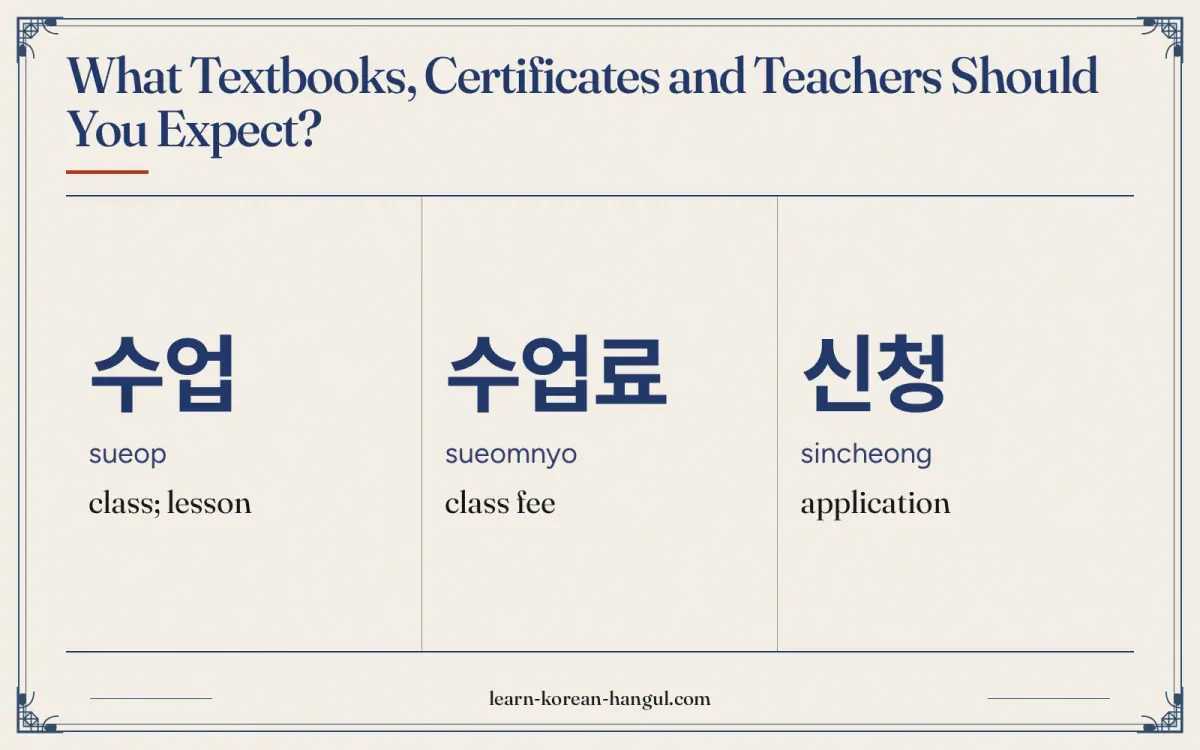
| Korean word | Romanization | Meaning |
|---|---|---|
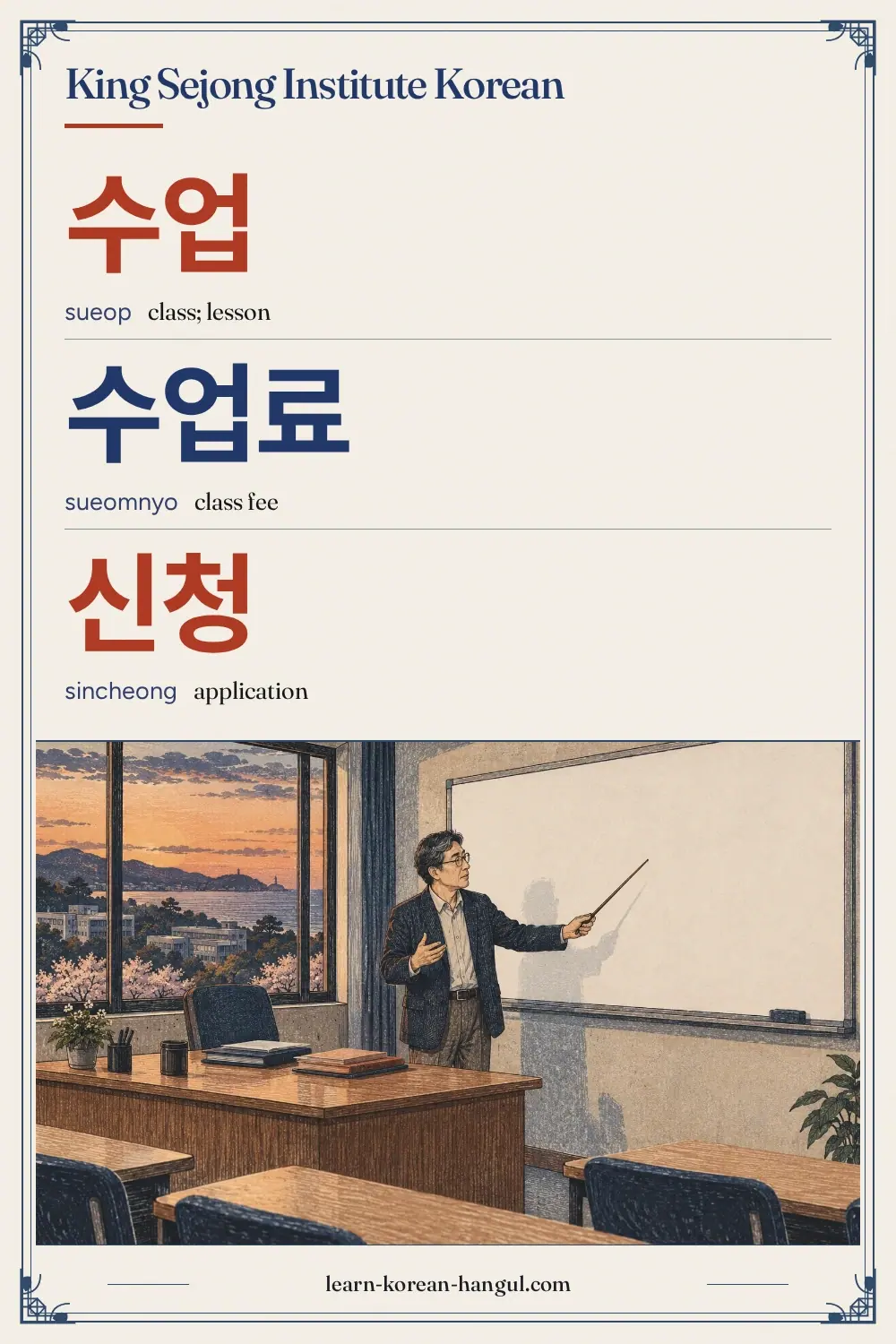
| 수업 | sueop | class; lesson |
| 수업료 | sueomnyo | class fee |
| 신청 | sincheong | application |
| 등록 | deungnok | registration |
| 교재 | gyojae | textbook |
| 수료증 | suryojeung | certificate of completion |
These words appear on registration pages, so they are worth learning before you apply. The 수업료 is said [수엄뇨] and 등록 is said [등녹], because ㄹ after a consonant other than ㄴ or ㄹ is said as ㄴ, and in 수업료 the ㅂ before it then becomes ㅁ.
How Does It Compare with Other Options?
The right choice depends on three things: where you live, how many hours a week you can study and what you need Korean for. The table scores nothing, but it sets out the typical differences.
| Criterion | King Sejong Institute | University institute in Korea | Online live class | Private tutor |
|---|---|---|---|---|
| Where | A local centre or online | In Korea only | Anywhere | Anywhere |
| Pace | Set by the centre, often weekly classes | Often daily classes | You choose a plan | You choose the pace |
| Group size | Group class | Group class | Group or one-to-one | One-to-one |
| Curriculum | Standard curriculum | Own curriculum | Varies | Built around you |
| Exam focus | Varies; ask the centre | Many offer TOPIK courses | Varies | Whatever you ask for |
| Main drawback | May not be near you | Costs time and money to move | Needs a good connection | Highest cost per hour |
Many learners combine two: a weekly institute class for structure and a tutor or an exchange partner for speaking. The Korean language exchange app page compares apps for the speaking part.
Does It Prepare You for TOPIK?
Some institutes run TOPIK preparation courses, and the standard curriculum covers the skills the exam tests, but a general course is not the same as exam training. TOPIK tests reading and listening (and writing at the higher levels) in a set format with time limits. Practice papers and timed drills matter as much as the course. The official source for the exam format, dates and registration is topik.go.kr.
If TOPIK is your goal, ask the centre three questions. Do you run a TOPIK preparation class? When does it start? Do you give mock tests? Then read how to prepare for TOPIK for a study plan that works alongside a class.
What Does a Term of Study Add up To?
A term of institute study adds up to fewer hours than most learners expect, so plan for several terms. Suppose a centre offers two classes of 2 hours a week for a 10-week term. That is 2 × 2 × 10 = 40 lesson hours per term. This site's editorial estimate for reaching A1 is 120 to 200 hours in total, which comes to 120 ÷ 40 = 3 terms at the low end and 200 ÷ 40 = 5 terms at the high end, if the lessons are the only study. Classes plus home study shorten that. The hours estimate is a guide, not an official figure, and your own pace may differ.
This is why home study matters. A class gives you a teacher, a schedule and a speaking partner, and your own sessions give you the repetition. A sensible pattern is one class hour for every two hours of self-study, with the self-study split into short sessions on most days.
What Happens in a Typical Class?
A typical group class follows a pattern of warm-up, new material, pair practice and homework, though each teacher sets the details. The teacher may start with a review of last week, introduce a grammar pattern with examples, and then ask you to practise in pairs. Many classes use mostly Korean from the first lessons, with help in the local language when needed, but ask the centre how much English or your own language it uses.
You can expect these things in a well-run class:
- A clear aim for the lesson, such as "ordering food" or "talking about your weekend".
- Short, repeated drills that you say aloud.
- Pair or small-group tasks, so that you speak to a classmate and not only to the teacher.
- Homework or a short quiz that checks last week's material.
- Feedback on pronunciation, since a teacher can hear mistakes that an app cannot.
If a class is all lecture and no speaking, the fee buys you less than a good video course would. A trial lesson tells you quickly.
How Should You Prepare before the First Class?
Prepare by learning to read Hangul and four classroom phrases, because the teacher will use Korean from day one. If you cannot read Hangul yet, start with the Korean alphabet lessons, which most learners can finish in a few short sessions. Then practise the phrases below. They let you ask for help in Korean on the first evening.
다시 한번 말해 주세요.
dasi hanbeon malhae juseyo.
Please say it once more.
잘 모르겠어요.
jal moreugesseoyo.
I am not sure. / I do not understand well.
숙제가 뭐예요?
sukjega mwoyeyo?
What is the homework?
Bring a notebook, a pen and the textbook if the centre named one. After the lesson, write down three new words and one sentence you can say, and review them the next day. The habit of a short review the day after a class helps more than a long review the night before the next one.
Many centres also run culture classes alongside language courses, such as cooking, traditional crafts or K-pop dance. They are a relaxed way to meet other learners and to hear Korean outside the textbook. Ask whether they are in Korean, in English or in your local language.
How Do You Read a Centre's Course Page?
A centre's course page lists the facts you need, but the facts are easy to misread. Read each field with the question beside it.
| Field on the page | Question to ask | Red flag |
|---|---|---|
| Level name | Which level matches mine, and is there a placement test? | No way to check your level |
| Schedule | Do the days and times fit every week of the term? | Times that clash with your work or time zone |
| Total hours | How many lesson hours are in the term? | Only "weekly class" with no total |
| Fee | What does the fee include, and is it per term or per month? | Extra fees that appear only at payment |
| Class size | How many students sit in one class? | No upper limit given |
| Start and end dates | When must I apply, and what happens if I miss the start? | Rolling dates with no deadline |
| Textbook | Do I buy the book separately? | No book named |
Write the answers in a small table of your own for each centre you consider, and compare cost per hour. If two centres are close, choose the one whose class size and schedule you can keep for the whole term.
What Should You Do after One Term?
After one term, check your progress against what you can do, not against the level name. Can you read Hangul without help? Can you have a two-minute conversation about your day? Can you understand a slow listening clip? If yes, move to the next level. If not, repeat the term or add a tutor or practice partner for the weak skill. Keep the habit going between terms with a short daily routine, because a break of two months can undo much of a term. The Korean courses pages here give a free plan for those gaps.
Who It Suits
The Beginner with a Centre Nearby
A centre close to home suits a beginner who wants a teacher and a routine. A weekly class gives you a reason to practise, and a level test keeps you out of a class that is too hard or too easy. Pair the class with the free lessons on this site between meetings.
The Learner with an Exam Goal
A learner who needs a TOPIK result should treat the institute as a base, and add timed practice. Ask whether the centre offers exam classes, and book the exam on topik.go.kr well before your deadline.
The Learner Who Needs Speaking Time
A group class gives each student only a few minutes of speaking per lesson. If speaking is your goal, add a tutor, an exchange partner or a conversation club, and use the class for grammar and structure.
The Learner Far from Any Centre
If no centre is within reach, start with the foundation's online options and free lessons. Add a live class when your budget allows, and use a course on this site for a plan.
What Are the Limits of the Institutes?
A King Sejong Institute is a good fit for many learners, but three limits are worth knowing before you apply.
- Availability. Not every city has a centre, and not every centre opens every level each term. Popular classes can fill up.
- Fixed schedule. Class times are set by the centre, which may not match a shift pattern or a time zone.
- Variation. Quality and class size differ between centres. Read the centre's own page, ask your questions and try a first lesson if you can.
An institute class also moves at the pace of the group. A fast learner may find it slow, and a learner who misses a week may feel behind. Plan to review at home: 20 minutes a day on five days gives you 100 minutes a week.
Common Mistakes When Choosing a Class
- Buying before asking. Ask about levels, hours and the level test first.
- Joining a level that is too high. Take the level test. A class above your level teaches you less.
- Treating a certificate as a test result. A certificate of completion is not a TOPIK score.
- Ignoring the timetable. A class you cannot attend every week is a wasted fee.
- Skipping homework. A weekly class gives you only a small part of the hours you need, so study between classes.
Ask the centre early, check the details on its own page and decide with the checklist above. When you search for King Sejong Institute Korean, start from the official site.
FAQ
Are King Sejong Institute courses free?
Not always. Each centre sets its own fees, and some courses are free or low-cost while others charge a fee that covers teachers and materials. The centre's own page lists the fee, and the foundation's website sejonghakdang.org lists the centres. Ask whether the textbook and any registration fee are included.
Do King Sejong Institutes offer online classes?
Many do, and the foundation also runs online learning on its website, sejonghakdang.org. Availability depends on the centre and the term. Check the centre's page for live online classes, and check the foundation's site for self-study courses. If you cannot attend a local centre, an online option is worth trying first.
Do King Sejong Institutes prepare students for TOPIK?
Some centres offer TOPIK preparation classes, and the standard curriculum covers the skills the exam tests. A general course is not exam training, so ask whether your centre runs mock tests. TOPIK is run by NIIED, and the official details are on topik.go.kr.
How do I enrol in a King Sejong Institute?
Find a centre on sejonghakdang.org, open the centre's own page and check which levels are open. Contact the centre with your questions, apply before the deadline and take the level test or interview if it asks for one. Rules and dates differ between centres, so follow the instructions on the centre's page.
Who can join a King Sejong Institute class?
Most centres welcome the general public, and many teach adults and teenagers. Entry rules such as age limits, residence or application dates differ between centres and between terms. Check the centre's page, and ask directly if the rules are not clear.