
How to Prepare for TOPIK

Prepare for TOPIK in five steps. They work for TOPIK I and TOPIK II, and each step has a page in this section.
- Choose a target. Decide between TOPIK I (Levels 1 and 2, cut scores 80 and 140 out of 200) and TOPIK II (Levels 3 to 6, cut scores 120, 150, 190 and 230 out of 300). The cut scores come from topik.go.kr, the official site of the National Institute for International Education (NIIED, 국립국제교육원).
- Fix a date. Count the weeks to the exam. A date turns "someday" into a schedule.
- Measure where you are. Sit one past paper early, under timing, and note the score for each section.
- Study daily and practise by section. Vocabulary and grammar every day, then listening, reading and, for TOPIK II, writing in timed blocks.
- Test and fix. Take full mock tests, log every error by cause, and spend the next week on the most common cause.
The best practice material is the official past papers, because they are real exam papers with answer keys. Writing needs the most lead time, because it carries a third of the TOPIK II total and improves more slowly than listening or reading. Start writing practice in the first week, not the last month.
The order matters less than the habit of repeating the loop of measure, study, test and fix. The next section helps you pick the plan that fits your starting point.
Which Plan Suits You?
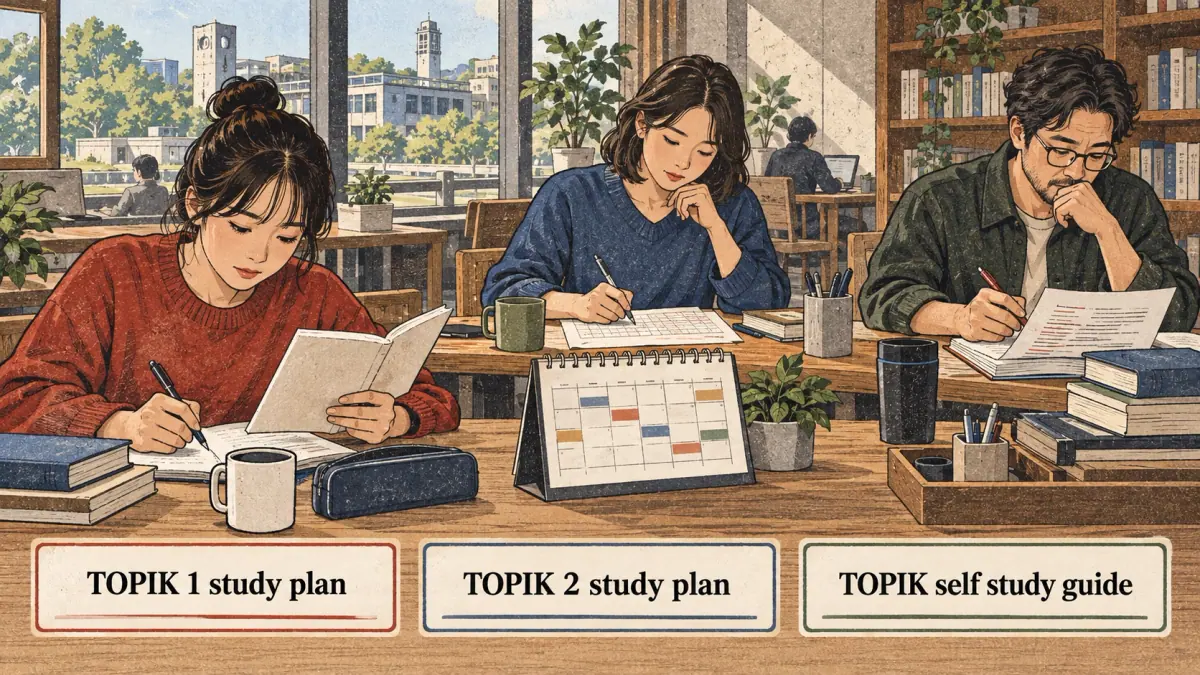
Pick the plan by your level and by how you like to study. The table gives one recommendation for each situation, and every plan page lists weekly goals and mock-test weeks.
| You are | Start with | Length and shape |
|---|---|---|
| A beginner aiming at TOPIK I | TOPIK 1 study plan | 8 weeks, 6 days a week, 45 minutes a day |
| Aiming at any level and want one schedule | TOPIK study plan | 12 weeks in three phases, 60 to 90 minutes a day |
| An intermediate learner aiming at Levels 3 to 6 | TOPIK 2 study plan | 16 weeks, 6 days a week, 90 minutes a day, with five timed mocks |
| Studying alone without a teacher | TOPIK self study guide | Materials, routine and feedback for writing |
| Unsure how much time you need | How long to study for TOPIK | Ranges by level and daily hours |
| Unsure how many words you need | TOPIK word counts | Estimates for every level, with how much to trust each |
A beginner who cannot yet read Hangul comfortably should learn the alphabet first and then start the 8-week plan, because the plans assume you can read.
How Much Time Will You Need?

Time depends on your starting level and your daily hours, and no official body publishes a study time for each level. The ranges below are editorial planning estimates for a learner with no special advantage, such as a related first language, who studies on most days. They come from the page on how long to study for TOPIK.
| Step | About 1 hour a day | About 2 hours a day |
|---|---|---|
| Zero to Level 1 | 3-6 months | 2-4 months |
| Zero to Level 2 | 6-12 months | 4-8 months |
| Level 2 to Level 3 | 4-8 months | 3-5 months |
| Level 3 to Level 4 | 6-12 months | 4-8 months |
| Level 4 to Level 5 | 9-18 months | 6-12 months |
| Level 5 to Level 6 | 12 months or more | 8-18 months |
Doubling your daily hours shortens the calendar but rarely halves it, because new words and grammar need time between reviews. Replace these estimates with your own numbers after two or three timed mocks.
What Does a Twelve-Week Timeline Look Like?

Count back from exam day and the work falls into three phases. This template matches the 12-week plan page and is an editorial suggestion, so shorten it from the front if you start late and keep the two full mocks.
| When | Phase | What you do |
|---|---|---|
| 12 to 9 weeks before | Foundation | Diagnostic paper, daily vocabulary and grammar, first listening and reading blocks |
| 8 to 5 weeks before | Skills | Timed section practice, writing drills for TOPIK II, an error log |
| 4 to 1 weeks before | Mocks | Full timed mocks, targeted fixes, light review of weak words |
| Exam week | Rest and logistics | Check your registration details and the test rules on topik.go.kr, sleep, no new material |
What Pages Are in This Subhub?
This subhub has nine pages. They fall into two groups, plans and practice. Start with a plan, then use the practice pages to test it.
Plans






Practice and Mistakes



Read the past papers guide before the mock test guide, because a mock is only as good as the paper you use. The common mistakes page is worth reading twice: once at the start, and again after your first mock.
What Does This Section Not Cover?
This section is about study, not about the exam rules. It does not explain the test format, registration, fees or test-centre rules, which have their own pages in the TOPIK exam guide. It also does not replace a teacher's feedback on writing, and the time ranges are estimates, not promises. For the section-level skills, see TOPIK listening and TOPIK reading.
Frequently Asked Questions
Where do I start preparing for TOPIK? Start by choosing a target level and an exam date, then sit one past paper under timing to see your score by section. That gives you a starting point and a deadline. Then pick the plan that matches your level: the TOPIK 1 plan for beginners or the 12-week plan for any level.
How long should I prepare? It depends on your starting level and daily hours. Editorial estimates are 3 to 6 months from zero to Level 1 and 6 to 12 months to Level 2, at about one hour a day. Higher levels take longer for each step. Use mock scores to replace the estimate with your own rate.
Are mock tests reliable? A mock is reliable when it uses an official past paper, official timing and the official answer key. Home-made or unofficial mocks can be too easy or too hard. Take a full mock about every four weeks early on and weekly in the last month, and compare scores with the cut scores for your target level.
Do I need a teacher? No, but writing is the hard part to do alone. You can pass TOPIK I with self-study using official papers, a course book and a vocabulary deck. For TOPIK II writing, get corrections from a teacher, a language exchange partner or a careful self-check list, because errors in your own writing are hard to see.
About this page. Last updated 2026-10-09. The Korean text on this page was machine-generated and reviewed and signed off by Min-ji Park on 15 October 2026. Romanization follows the Revised Romanization of Korean and is shown only as a learning aid. Study times are editorial estimates, not official figures.