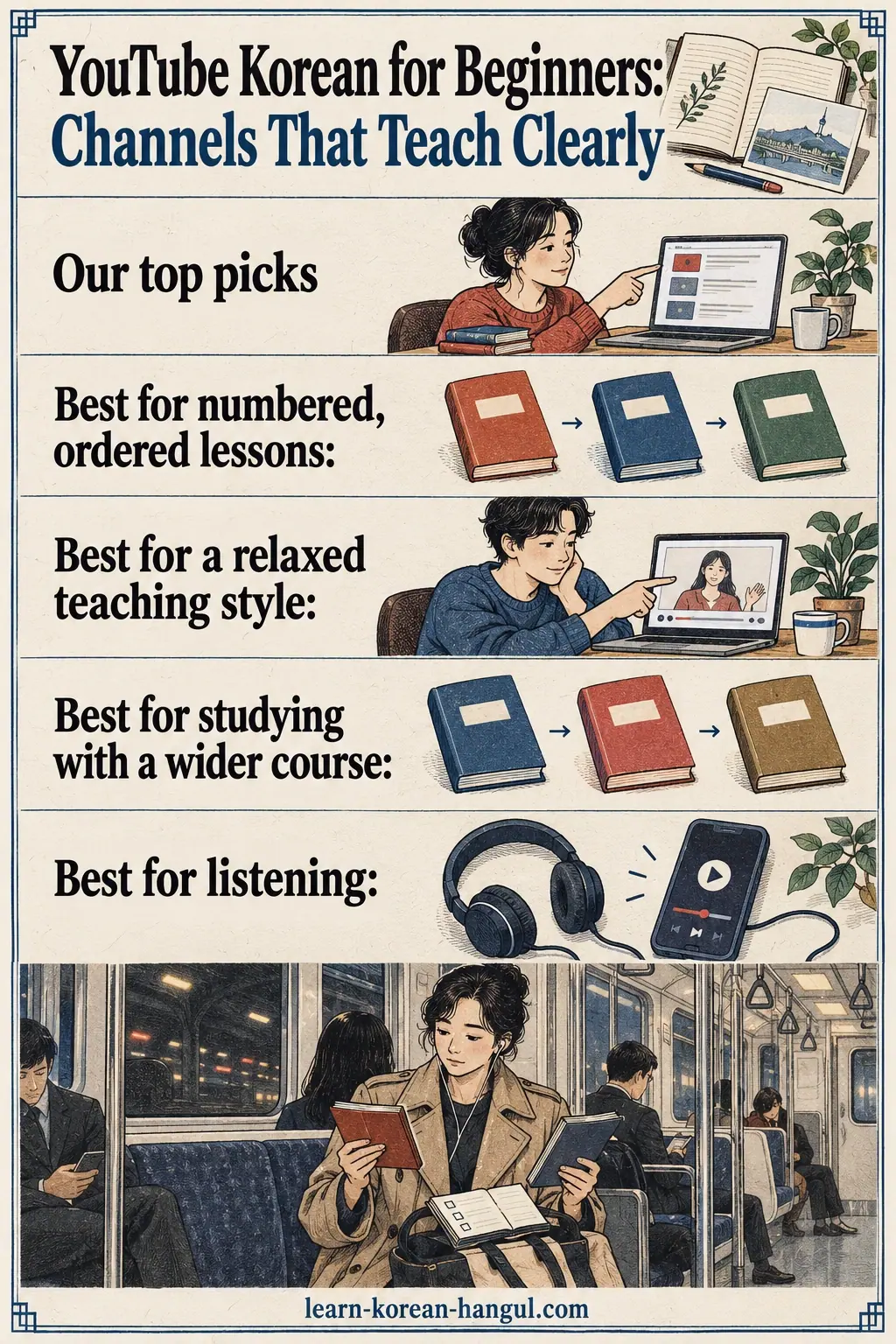
YouTube Korean for beginners works best with channels that teach in English, pause for explanations, show Hangul on screen and have a clear playlist order. This page compares five well-known lesson channels on six criteria, gives you a 30-second test for any channel, and ends with a weekly plan that mixes two lessons with one listening video.
Our top picks
- Best for numbered, ordered lessons: a channel with a numbered course behind it, such as Talk To Me In Korean or HowToStudyKorean.
- Best for a relaxed teaching style: a channel built around one host's explanations, such as Learn Korean with GO! Billy Korean or Korean Unnie.
- Best for studying with a wider course: KoreanClass101, whose videos sit beside a paid course.
- Best for listening: a slow Korean-language vlog or easy-Korean channel, once you can read Hangul.
Last updated: 2026-10-09.
YouTube Korean for Beginners: the Essentials
A beginner needs two kinds of video, and one channel rarely supplies both. A lesson channel explains Korean in English, step by step. A listening channel lets you hear real Korean at a speed you can follow. Start with one of each, and the table below helps you pick the lesson channel. Channels change: they pause, rename and delete videos, so check the channel page before you commit.
| Channel | Teaches in | Best at | Honest drawback |
|---|---|---|---|
| Talk To Me In Korean | English, with Korean examples | A large library of lessons arranged by level; see the Talk To Me In Korean review | You organise your own review; the free and paid parts differ |
| Learn Korean with GO! Billy Korean | English, with Korean examples | Friendly, informal explanations with playlists for beginners | The informal style and jokes can slow a lesson down |
| HowToStudyKorean | English | Grammar lessons in a numbered order that follows a free course | Grammar-heavy, with little listening practice |
| Korean Unnie | English, with Korean examples | A host-led style that mixes lessons and talk videos | You must pick the lesson playlists, because not every video is a lesson |
| KoreanClass101 | English | Short lessons that sit beside a wider course | Videos can promote the paid subscription |
If you want a short answer, pick the lesson channel whose first video you understand without effort, follow its beginner playlist in order, and add a listening channel after you can read Hangul. The other sections explain how to judge each criterion.
How Did We Choose?

Every channel here is read against the same six criteria. We give no scores, no star ratings and no affiliate links, and no channel pays to appear. Statements about a channel come from its public description and the way it presents its lessons, and the page does not claim that we have watched every video. Check the channel's playlists and About page for the current state.
- Teaching language. Does the host explain in English (or your language) while using Korean examples? At A1, explanations in Korean alone are too hard to follow.
- Structure. Is there an ordered playlist, with lesson 1 easy to find? A numbered course lets you see progress.
- Hangul on screen and subtitles. Are Korean words shown in Hangul, not only spoken? Are there accurate subtitles, uploaded by the creator?
- Pacing and clarity. Does the host stop to explain, repeat the key point and use simple words?
- Audio quality. Can you hear every syllable? Korean has sounds that learners need to hear clearly, such as the difference between ㄱ, ㅋ and ㄲ.
- Upload recency. Is the channel still active, and are the old videos still correct? An archive that stopped years ago can still teach well, but a lesson that mentions an old app or price may be out of date.
Which Channel Has the Clearest Structure?

The clearest structure belongs to the channel with a numbered course behind it. Talk To Me In Korean and HowToStudyKorean both organise lessons by level and number, and KoreanClass101 organises its series by level on its own site. A numbered course is easier to follow than a channel of separate videos, because the order is chosen for you.
Use the playlist-order test on any channel:
- Open the channel's Videos or Playlists tab.
- Look for a playlist with "beginner", "level 1" or "lesson 1" in its name.
- Count how long it takes you to find the first video. If it takes more than 30 seconds, the structure is weak.
- Check that the videos are numbered or named in an order, such as "Lesson 1, Lesson 2".
- Watch the first video. The host should say what you will learn and what comes next.
You will know it worked when you can name the first three lessons and what each teaches.
Common mistake: starting with the newest upload. New videos often assume you have seen the old ones. Start at lesson 1.
On this criterion, a numbered course wins over a host-led channel with loose playlists. A host-led channel may still teach well, but you must build your own order, and the Korean courses pages give a free order if you need one.
Which Has the Best Hangul Teaching?
The best Hangul teaching shows each letter on screen, says its sound, shows the stroke order and gives words to read. Look for a playlist about Hangul or the Korean alphabet, and watch the first five minutes. If the host only says the sounds out loud and never shows the letters, skip the video.
A short Hangul check for any video:
- Are the letters large enough to read on a phone?
- Does the video separate the consonants from the vowels?
- Does it show how to build a block, such as ㅂ + ㅏ = 바?
- Does it give you words to read, not only letters?
- Are there Korean subtitles that you can follow with Hangul skills?
Many learners watch a Hangul video once and then forget the letters. Pair the video with active reading. The Korean alphabet lessons here give you charts and practice, and the video gives you the voice. A video with Hangul on screen and a chart to read afterwards teaches more than either alone.
Which Is Best for Listening?
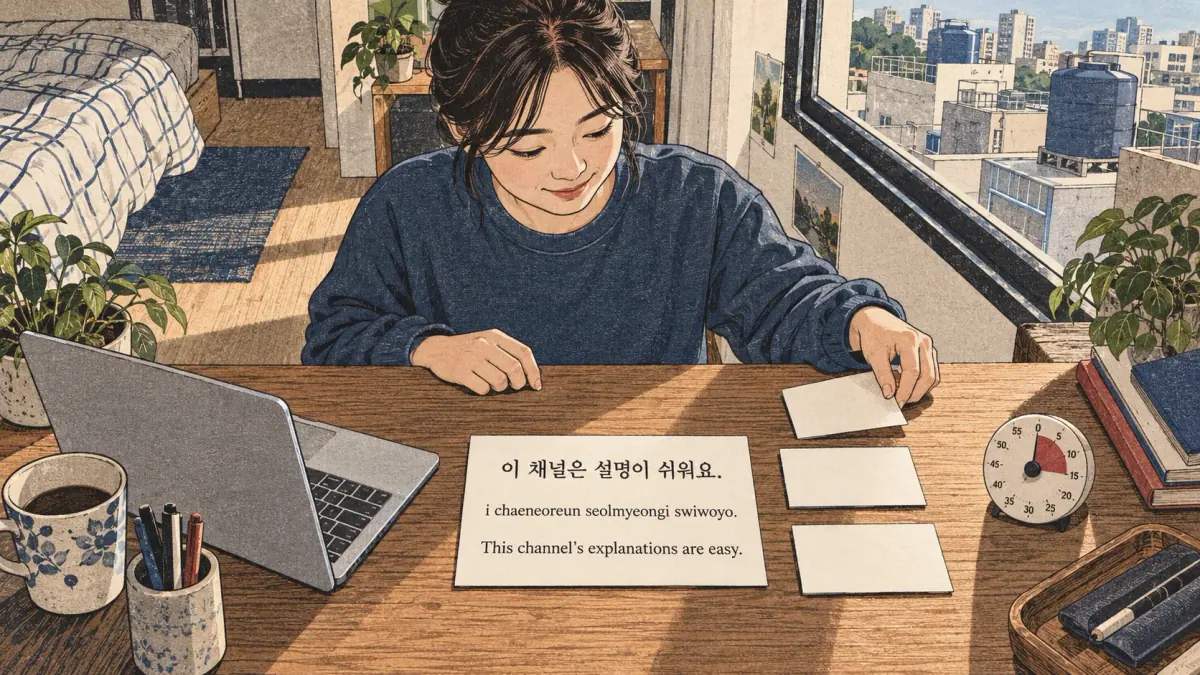
For listening, choose a channel where the host speaks Korean slowly about things you can see. Lesson channels give mostly English, so they provide little listening practice. Listening comes from videos in Korean: a slow vlog, an easy-Korean channel or a cooking video with on-screen text. Wait until you can read Hangul and know about 100 words, and then add one short listening video a day.
The ladder on the Korean YouTube channels page shows the order: lessons at A1 to A2, easy native content at B1, then vlogs, shows and news. At A2, a slow vlog with Korean subtitles is the best listening companion, because you can read what you hear.
Use these sentences to talk about what you watch.
이 채널은 설명이 쉬워요.
i chaeneoreun seolmyeongi swiwoyo.
This channel's explanations are easy.
자막을 켜요.
jamageul kyeoyo.
I turn on the subtitles.
다시 들을게요.
dasi deureulgeyo.
I will listen again.
천천히 따라 해요.
cheoncheonhi ttara haeyo.
I repeat slowly after the speaker.
What Does Each Channel Offer, and Who Is It For?
Each profile uses the same order: a one-line verdict, a specs line, a short description, one honest drawback and a choose-or-skip note.
Talk to Me in Korean: Best for a Numbered Course
Verdict: a large, ordered library for learners who like a friendly, spoken explanation. Specs: teaches in English with Korean examples; lessons arranged by level; a website and books beside the channel. It suits a learner who wants a ladder from the first lesson upward. The dedicated review covers what is free and what is paid. Drawback: it is a library and not a managed plan, so you must schedule your own review. Choose it if you like to hear an explanation and plan your own week. Skip it if you need daily reminders and quizzes.
Learn Korean with GO! Billy Korean: Best for a Relaxed Style
Verdict: an informal host who turns grammar into short, friendly lessons. Specs: teaches in English with Korean examples; beginner playlists; a conversational style. It suits a learner who is easily bored by textbooks and wants a host with personality. Drawback: jokes and side comments can stretch a short point into a long video. Choose it if you learn well from a friendly voice. Skip it if you want short, clipped lessons.
HowToStudyKorean: Best for Grammar in Order
Verdict: a structured grammar course in numbered units. Specs: teaches in English; lessons follow the order of a free online course that has its own website. It suits a learner who likes to see the whole plan and tick off units. Drawback: it is grammar-heavy, with little listening or speaking practice. Choose it if you like clear rules and a fixed order. Skip it if you want conversation first.
Korean Unnie: Best for a Host-Led Mix
Verdict: a host-led channel that mixes lessons with talk videos. Specs: teaches in English with Korean examples; lesson videos alongside lifestyle and Q&A content. It suits a learner who likes a personal channel and some culture along with grammar. Drawback: not every video is a lesson, so you must pick the lesson playlists yourself. Choose it if you enjoy a single host over time. Skip it if you need a strict curriculum.
KoreanClass101: Best beside a Wider Course
Verdict: short lessons from a language-learning company whose full course is a paid service. Specs: teaches in English; series arranged by level; lessons with Hangul on screen are common, but check each series. It suits a learner who wants to try the style before deciding on a paid course. Drawback: some videos exist partly to promote the subscription. Choose it if you want a course and want to preview it. Skip it if you want entirely free, ad-free study.
How Do You Search for Beginner Videos in Korean?

Searching in Korean shows videos made for Korean learners rather than only videos made in English. These five search phrases find the most useful beginner material. Type them into the YouTube search box with "A1" or "beginner" added if you need to narrow the list.
| Korean | Romanization | Meaning | Use it to find |
|---|---|---|---|
| 한글 배우기 | hangeul baeugi | learning Hangul | Hangul lessons |
| 한국어 기초 | hangugeo gicho | Korean basics | Basic lessons |
| 초급 한국어 | chogeup hangugeo | beginner Korean | Beginner playlists |
| 한국어 회화 | hangugeo hoehwa | Korean conversation | Dialogues and phrases |
| 발음 | bareum | pronunciation | Pronunciation tips |
The phrase 초급 한국어 is said [초급 한구거]. When you find a good video, subscribe, open the playlist and watch from the first lesson.
What Does a First Weekly Plan Look Like?

A weekly plan for a beginner takes about 80 minutes: two lessons, one listening video and a short review. The table adds up as 25 + 25 + 15 + 15 = 80 minutes.
| Day | What you do | Time |
|---|---|---|
| Day 1 | Lesson 1 from your chosen playlist; pause and say the phrases aloud | 25 min |
| Day 2 | Review: write five new words and say them | 15 min |
| Day 4 | Lesson 2; take notes on one pattern | 25 min |
| Day 6 | One short listening video, with Korean subtitles | 15 min |
Add the shadowing and word-logging habits from the how to learn Korean on YouTube method when you are ready to do more. Eighty minutes a week is a light start. Increase the time slowly, one new habit at a time.
You will know it worked when you can repeat the key phrases of last week's lesson without looking.
Common mistake: watching three lessons in a row on one day and none for the rest of the week. Spread lessons across the week, because memory needs time between sessions.
What Should the First Ten Videos Teach?
The first ten videos of a good beginner playlist should cover the same core topics in a sensible order, whichever channel you choose. Use the list as a map. If a playlist skips an item, or teaches it much later, that is worth noticing.
| Video | Topic | Where to practise it here |
|---|---|---|
| 1 | Why Hangul works, and how syllable blocks are built | Korean alphabet |
| 2 | Basic consonants and vowels | Korean alphabet |
| 3 | Reading simple words aloud | Reading Hangul |
| 4 | Greetings and a self-introduction | Learn Korean for beginners |
| 5 | Numbers and counting | Korean numbers |
| 6 | The polite ending -아/어요 | Korean grammar |
| 7 | Particles 이/가 and 은/는 | Korean particles guide |
| 8 | The object particle 을/를 and simple verbs | Korean grammar |
| 9 | Location words and the particles 에 and 에서 | Korean particles guide |
| 10 | Asking and answering simple questions | Korean conversation practice |
A playlist that reaches the polite ending by video 6 or 7 is moving at a healthy pace. A playlist that spends ten videos on the alphabet is slow, and one that starts with long grammar before you can read is too fast. Adjust: if a channel skips Hangul, learn it here first.
How Do You Watch a Lesson so That You Remember It?

Watching a lesson once and moving on teaches little. A lesson of 20 minutes works best as a five-part routine that takes about 35 minutes with the extra steps.
- Preview (2 minutes). Read the video's title and chapter list, and guess what it teaches.
- Watch with pauses (20 minutes). Pause after each new phrase and say it aloud twice.
- Write (5 minutes). Write three new words and one example sentence in a notebook.
- Replay (5 minutes). Replay the hardest part at 0.75 speed, using the speed control in the video's settings.
- Recall (3 minutes). Close the video and say what you learned in your own words, from memory.
The total is 2 + 20 + 5 + 5 + 3 = 35 minutes. YouTube's settings menu also lets you slow the speed, turn on captions and open a transcript when the creator provides one, and all three help a beginner. A transcript lets you read a sentence you did not catch.
You will know it worked when you can write the three words the next day without looking.
Common mistake: leaving the speed at normal when the host talks fast. A lesson at 0.75 speed gives your ear more time.
How Do You Spot a Lesson That Teaches Something Wrong?
Anyone can post a Korean lesson, so check what you learn. Four warning signs suggest you should look elsewhere or verify the claim.
- Romanization only. A lesson that never shows Hangul teaches a habit that you will have to unlearn. Revised Romanization is a learning aid, not a replacement for the letters.
- Rules without examples. A rule should come with at least three sentences. Without examples you cannot test it.
- Claims that Korean has no politeness or no grammar. Korean has verb endings for politeness and a full grammar system. Be careful with videos that call it "easy" with no detail.
- Pronunciation with no audio from a Korean speaker. If the host is not a fluent speaker, compare the video with a trusted audio source, such as the audio on this site or a dictionary.
When in doubt, check a word in a dictionary. The National Institute of Korean Language (국립국어원) publishes the Standard Korean Dictionary (표준국어대사전) and an open dictionary (우리말샘), which are reliable references. If two channels disagree, trust the one that matches the dictionary, and ask a teacher.
How Can You Compare Two Channels in 30 Minutes?

You do not need to trust any list, including this one. In half an hour you can compare two channels with the same task.
- Minutes 0 to 5: pick one topic you have not studied, such as the particle 이/가.
- Minutes 5 to 13: watch the first part of channel A's video on it and write down what you understood.
- Minutes 13 to 21: do the same with channel B.
- Minutes 21 to 27: close both and write three sentences with the particle.
- Minutes 27 to 30: check the sentences against a lesson page, and note which channel left you with fewer mistakes.
The eight-minute blocks are short on purpose. Repeat the test with a different topic the next day, so a lucky topic does not decide the result.
What Are the Limits of Learning from Videos?
Videos teach well but they cannot do everything. Four limits matter.
- No feedback. A video does not hear you. You can say a sentence wrongly for weeks without knowing it. Add a tutor, a class or an exchange partner for feedback. See find a Korean tutor and the Korean language exchange app page.
- Passive habit. It is easy to watch and feel productive while learning little. Pause, repeat and write.
- Uneven coverage. A channel may skip a topic, or teach it in a different order from another channel.
- Drift. Videos get old, and a host's views on what to learn may change. Check dates.
Video lessons are strongest as an explanation layer. Combine them with active practice, such as flashcards, speaking aloud and writing sentences. When a video makes you curious about a word, look it up in a dictionary rather than guessing.
Why Should Beginners Start with English-Led Lessons?
English-led lessons save time at A1, because you cannot yet understand a Korean explanation of Korean grammar. A host who explains in English can say in one sentence what a Korean-only channel needs ten minutes of gestures and repetition to show. The trade-off is that you hear less Korean. That is why this page pairs a lesson channel with a listening video once a week from the start. As your level rises, reverse the balance: by B1, most of your viewing should be in Korean, with Korean subtitles, and English-led lessons become a reference you visit for a hard pattern.
Which Should You Pick?
Pick by your situation, not by a ranking.
You want a clear path from lesson 1. Choose a channel with a numbered course and follow it in order.
You get bored easily. Choose a host-led channel with a style you enjoy, and keep each session to 25 minutes.
You like to see the whole plan. Choose a grammar course channel and tick off each unit as you finish.
You are thinking about a paid course. Watch the preview lessons of a course-linked channel first, and compare the paid plan with what free lessons already give you.
You want to hear Korean from day one. Add a slow Korean vlog after you can read Hangul, with Korean subtitles on.
Common Mistakes with Beginner Channels
- Watching without a plan. Open the playlist in order and decide the day for each lesson.
- Starting at the newest video. Start at lesson 1.
- Skipping Hangul. Read Hangul before relying on romanization, since romanization hides sounds.
- Subscribing to ten channels. Pick one lesson channel and one listening channel.
- Never speaking. Say each phrase aloud with the video.
If you remember one thing from this page, remember to choose a lesson channel by its first video. The best channel for YouTube Korean for beginners is the one you understand and actually return to each week.
FAQ
Which YouTube channel is best for learning Hangul?
Choose a video that shows each letter on screen, says its sound and builds syllable blocks. Open a few Hangul playlists and watch the first five minutes of each. The best one is the video you can follow without effort. Pair it with the Korean alphabet lessons on this site for charts and reading practice.
Can I learn Korean from videos alone?
You can learn a lot, but videos alone leave gaps. They give explanations and listening but no feedback on your speaking or writing. Add active practice, such as saying phrases aloud and writing sentences, and add a tutor, a class or an exchange partner when you want corrections.
Should I watch Korean lessons with subtitles?
Yes, at the start. English subtitles help you follow an explanation, and Korean subtitles help you connect sound to Hangul. As you improve, move from English to Korean subtitles, then try videos with none. Prefer subtitles uploaded by the creator, because automatic captions can split or misspell words.
How many videos should a beginner watch a day?
One lesson of about 20 to 25 minutes is enough on a study day, and three or four study days a week is a good start. Watch it twice if needed, say the phrases aloud and write down five words. More videos in one day teach less than the same time spread over the week.
How do I know if a channel is still worth following?
Check the channel's playlists for a clear order, look at how old the newest lessons are, and read the comments for recent questions. A channel that stopped uploading can still teach well if its lessons are timeless. Be careful with lessons that mention apps, prices or exam rules, because those change.