Before you start
| Item | Detail |
|---|---|
| Time | About 45 minutes a day for six weeks, roughly 30 hours |
| Difficulty | Moderate; the plan is simple but needs daily repetition |
| Cost | Free: a subtitled drama or podcast, a voice recorder and a notebook; a tutor is optional |
| Prerequisite | Roughly B1: you can read Hangul fast and use polite speech (see what B1 Korean looks like) |
Korean Learning Plateau: Why Does It Happen?
A Korean learning plateau happens because the methods that worked at beginner level stop producing visible gains. At beginner level, every lesson brings new words, and progress is easy to see. At intermediate level, you already know the most frequent words, so each new hour of the same material teaches less. Meanwhile the real language you meet is faster, less careful and fuller of endings than a textbook dialogue.
Three causes combine. First, diminishing returns: language use follows a steep frequency curve, so a small set of words covers most everyday speech, and each further word is rarer than the last. Second, invisible progress: improvement shifts from "I learned 20 new words" to "I understood a bit more of that scene", which is hard to notice. Third, a material gap: textbooks use clear, slow speech and short sentences, whereas dramas, podcasts and friends use contractions, dropped particles and long chains of connected clauses.
Not every flat stretch is a plateau. A hard week, a trip or a busy month can slow anyone, and the numbers usually recover by themselves. As a rule of thumb, treat it as a plateau when your own measures (a retell recording, a listening catch rate or a level-test score) have stayed flat for about three weeks while you kept studying. Fewer days of study explain a slow patch, and the same days with no gain point to the method.
A plateau is not a sign of low talent. It is a sign that the method must change from "learn more content" to "handle real input and produce more output". The next section shows how to find which skill has stalled.
Before You Start: Which Skill Has Stalled?
Most plateaus affect one skill more than the others, and the symptom tells you which. Read the table and note the row that sounds most like you. The step column shows where to concentrate.
| Symptom | Stalled skill | First fix | Step |
|---|---|---|---|
| You follow textbook audio but get lost in dramas | Listening speed and contractions | Shadow and transcribe short clips | 2 and 3 |
| You read slowly and look up almost every line | Vocabulary range | Graded stories and a daily five-word list | 2 |
| You understand but freeze when you must speak | Speaking fluency | One weekly session with feedback | 5 |
| Your sentences stay short, joined by 그리고 and 그래서 | Grammar range | Learn connective endings in context | 4 |
| You know the words but use them in the wrong register | Accuracy and style | Corrected writing and a tutor | 5 |
If two rows fit, start with the one that blocks you most in daily life. The six steps below run in order, but you can spend extra time on the step that matches your row.
Step 1: Measure Where You Are
Measure one skill in a way you can repeat. The action is to record a baseline in week one. Without a baseline, "I feel stuck" cannot be tested.
Do three checks, about 20 minutes each, on separate days:
- Retell test. Watch a three-minute clip of a drama or interview, then retell it in Korean for two minutes and record yourself. Save the recording.
- Listening test. Play a different one-minute clip once without subtitles. Write down every word you catch, then check with the subtitles and count the share you caught.
- Level check. Take the Korean level test and, if you plan to sit TOPIK, try a TOPIK II sample paper from the official site (topik.go.kr) as an outside benchmark. Treat the score as a reading of your current state, not as a goal.
You'll know it worked when you have one recording, one catch count and one test result written on a single page with today's date. The common mistake here is to skip the baseline because you "know" you are stuck. Feeling stuck is unreliable, and the numbers let you see change in week six.
Step 2: Switch to Native-Level Input
Replace most textbook listening with real Korean for at least 20 minutes a day. The action is to choose a drama, podcast or interview that you partly understand. The rule of thumb is that you catch most of the content but lose some, not that you catch almost nothing and not that you catch everything.
Use each short clip three times:
- First pass, no subtitles. Aim for the gist only.
- Second pass, Korean subtitles on. Pause to look up three words, no more.
- Third pass, no subtitles again. Notice what you now catch.
Choose material from a ladder, and move up when the current rung feels comfortable.
| Rung | Material | What it trains |
|---|---|---|
| 1 | Graded stories with audio | Vocabulary control and reading speed |
| 2 | Podcasts or videos made for learners | Clear speech at natural rhythm |
| 3 | Interviews and talk shows with Korean subtitles | Everyday vocabulary and turn-taking |
| 4 | Dramas and variety shows | Speed, contractions, slang and emotion |
| 5 | News and documentaries | Formal vocabulary and long sentences |
This routine follows the idea of comprehensible input: you learn most from language slightly above your level. Read more in comprehensible input. To bridge written Korean, add 10 minutes of graded Korean stories, which control vocabulary while the language stays natural.
You'll know it worked when the third pass feels easier than the first. A common mistake is to switch to English subtitles, which turns listening into reading. Use Korean subtitles, or none.
Step 3: Add Shadowing and Transcription
Shadowing and transcription train the ear and mouth directly. The action is to spend 10 minutes on three days a week on one short clip, alternating the two drills: shadowing one day, transcription the next.
Shadowing (10 minutes). Pick a 30-second clip. Play one sentence, then repeat it right after the speaker, copying rhythm and intonation. Start with the script in front of you, then try without it. See the Korean shadowing guide for full technique.
Transcription (10 minutes). Play the next 30 seconds, pause after each short phrase and type what you hear in Hangul. Then compare with the subtitles and mark every gap. The gaps show the sounds you cannot hear yet, such as particles that vanish in speech.
Real speech differs from the written form in predictable ways, and the table lists the most common ones.
| Written or slow form | Usually heard as | Meaning |
|---|---|---|
| 나는 | 난 | I (topic) |
| 뭐를 | 뭘 | what (object) |
| 그것은 | 그건 | that (topic) |
| 이것을 | 이걸 | this (object) |
Example: 난 이걸 몰랐어 means "I didn't know this", and both 난 and 이걸 are contractions. A fast sentence such as 뭐 하고 있어? ("What are you doing?") is also often shortened to 뭐 해? in speech. A learner who knows only the long forms cannot hear the short ones.
You'll know it worked when the number of gaps in your transcriptions falls over two or three weeks of clips at the same level. The common mistake is to transcribe long clips. Five minutes of one short clip repeated is better than 30 minutes of ten clips. For more ideas, see Korean listening strategies.
Step 4: Learn Intermediate Grammar in Context
Intermediate grammar adds patterns that link and shade ideas, and it is best learned from the sentences you meet in Step 2. The action is to collect two new patterns a week from your clips and write three sentences of your own for each.
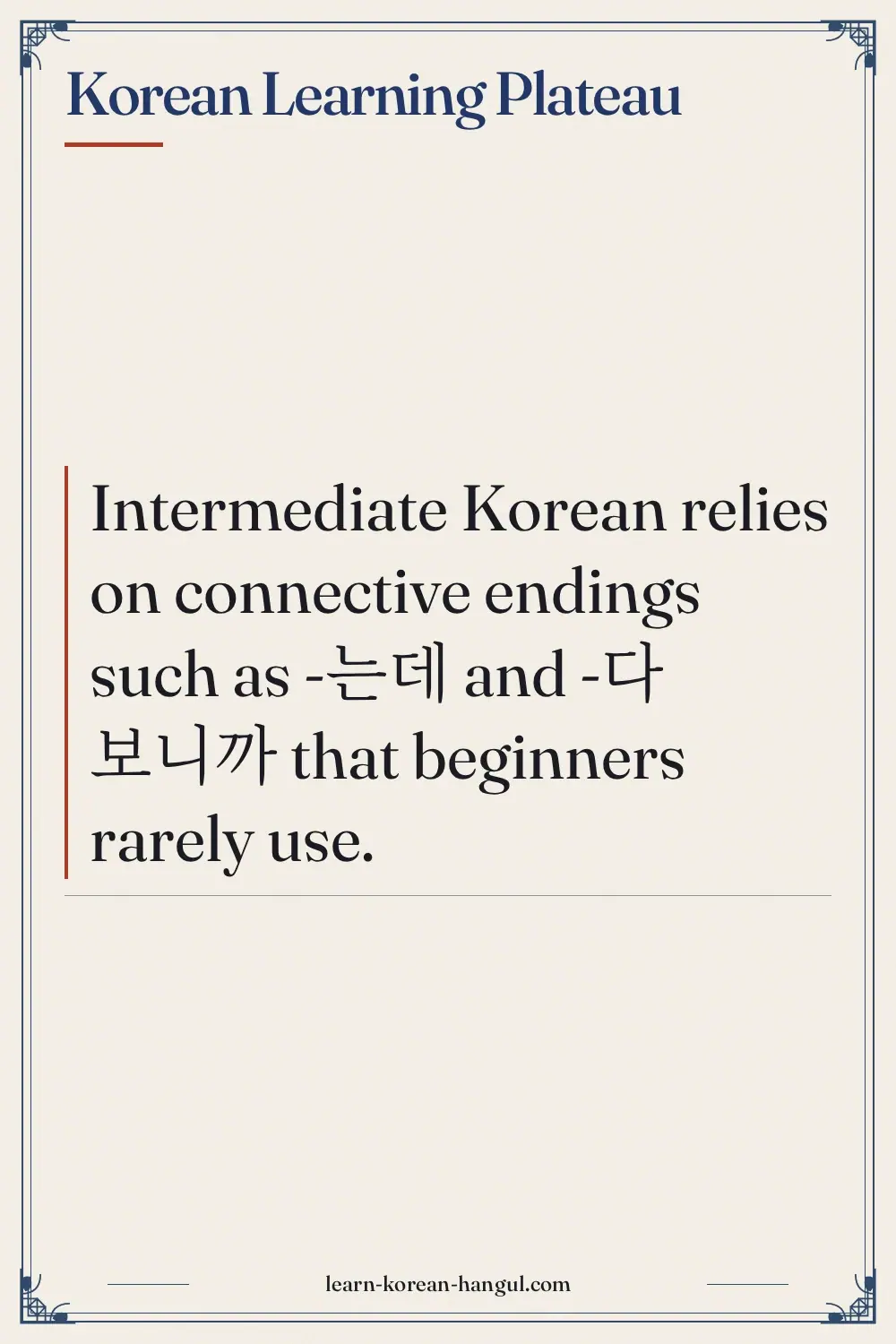
Start with endings that beginners rarely use:
| Pattern | Meaning | Example |
|---|---|---|
| -는데 | Background, contrast | 비가 오는데 우산이 없어요. (It is raining, and I have no umbrella.) |
| -다 보니까 | As I kept doing, I found | 한국 드라마를 매일 보다 보니까 이해가 늘었어요. (As I kept watching Korean dramas every day, my understanding grew.) |
| -(으)ㄹ까 봐 | Afraid that | 늦을까 봐 택시를 탔어요. (I took a taxi because I was afraid I would be late.) |
| -(으)ㄹ 뻔하다 | Almost did | 버스를 놓칠 뻔했어요. (I almost missed the bus.) |
The intermediate Korean grammar list groups more patterns by function. Keep a notebook with one page per pattern: the meaning, the line from the clip where you met it and your three sentences.
You'll know it worked when you hear the pattern in a new clip without looking for it. The common mistake is to study a long grammar list in order. Patterns you cannot hear in real Korean will not stay, so learn the ones that appear in your clips first.
Step 5: Speak with Feedback Every Week
Speaking needs a listener who answers and corrects. The action is to hold one 30-to-45-minute conversation a week with a tutor or an exchange partner, and to record it.
Prepare in advance. Choose one topic, write five questions and bring three patterns from Step 4 that you want to use. During the session, ask your partner to note three corrections, not a long list. Afterwards, listen to the recording once and write the three corrected sentences in your notebook. A language exchange is free, and a paid tutor gives more structured correction.
You'll know it worked when you use at least one new pattern from the notebook in conversation, even if imperfectly. The common mistake is to wait until grammar feels perfect. Output reveals gaps that input hides, so speak before you are ready.
Step 6: Re-Test after Six Weeks
Repeat the Step 1 checks and compare. The action is to redo the retell test with a new three-minute clip of similar difficulty, redo the one-minute listening test and take the level test again.
Compare three things: the length and smoothness of your retell, the share of words you caught, and the number of connective patterns you used without notes. Write the result next to the baseline. A modest change is a real result, because a plateau is a flat line, not a downward one.
You'll know it worked when at least one of the three measures has clearly moved. If none has, check your minutes: honest logs often show the plan was followed on half the days. Repeat the six weeks with the weakest step doubled. When you are ready to set a new target, review the Korean language levels and choose the next one.
What Does the Six-Week Plan Look Like on One Page?
The plan fits on one page, and the daily session is the same every day so you do not have to decide what to do. A 45-minute session splits into 20 minutes of native-level input (Step 2), 10 minutes of shadowing or transcription on three days a week (Step 3), 10 minutes of grammar in context (Step 4) and 5 minutes for the log. On non-drill days, the shadowing slot goes back to input.
| Week | Main focus | Checkpoint |
|---|---|---|
| 1 | Baseline (Step 1) and first clips (Step 2) | One recording, one catch count, one test score on a page |
| 2 | Input with three passes; first shadowing | You can shadow one 30-second clip with the script |
| 3 | Add transcription; first two grammar patterns | First transcription done and its gaps counted |
| 4 | First weekly conversation (Step 5) | You use one new pattern in speech |
| 5 | Keep all drills; raise the difficulty of the clips | You follow a clip from the next rung up |
| 6 | Re-test (Step 6) | Three measures compared with the baseline |
Keep the log short: the date, the minutes, one new thing you understood. A log that takes more than a minute will not last six weeks.
Why Do Beginner Materials Stop Working?
Beginner materials stop working because they teach the words you already know. A beginner course repeats the highest-frequency words and the simplest patterns on purpose. Once you know them, a new lesson of the same kind gives mostly review, and the rare words that would raise your level appear only once in a while.
The sound of the material also differs. Textbook audio is slow, clear and complete. Real speech drops syllables, merges words and uses contractions such as 난 and 뭘. A learner trained only on clear audio can pass a quiz and still lose a drama scene. The cure is the input switch in Step 2, which keeps the difficulty slightly above your level.
What If Only One Skill Is Stuck?
If only one skill is stuck, spend most of the plan on it and keep the others at maintenance. Maintenance means about 10 minutes a day on each other skill. Use the diagnosis table to choose.
- Listening stuck: double Steps 2 and 3, and halve Step 4.
- Speaking stuck: hold two sessions a week in Step 5, and use Step 3 shadowing to warm up.
- Grammar stuck: double Step 4, and write one short paragraph a day with the new patterns.
- Vocabulary stuck: add 10 minutes of graded reading and learn five words a day from it.
How Long Does a Plateau Usually Last?
The length of a plateau varies too much to give a reliable number, and no study can promise one. It depends on the daily hours, the type of practice and how early the stalled skill is found. What you can control is the length of the plateau you accept: if six weeks of this plan show no movement on any of the three measures, change the method, not only the hours.
Feeling no progress after a long time is common among intermediate learners. A feeling is not a measurement, though, so rely on the repeatable checks from Step 1. Tracking one skill shows change that an impression hides.
Common Mistakes and How to Fix Them
Six mistakes slow most plateau plans.
- Studying only new textbooks. More beginner content gives little new. Move to real input.
- Switching to English subtitles. This turns listening into reading. Use Korean subtitles or none.
- Passive viewing for hours. Watching without pausing or repeating adds exposure but little skill. Use short clips and the three-pass method.
- Skipping speaking. Understanding grows faster than speech, and the gap widens. Book the weekly session first.
- Chasing a TOPIK score as the goal. The test is a benchmark. Use it to measure, and do not let it narrow your practice to test drills. See what is TOPIK for the exam itself.
- Changing everything at once. If you change five things, you cannot tell which worked. Follow the plan for six weeks, then adjust.
If you want broader answers about how to learn Korean, browse the other Korean learning questions.
Frequently Asked Questions
Should I take a break when I hit a plateau?
A few days of rest is fine if you are tired, but a long break costs more than it saves at this level, because listening and recall fade quickly. If you are bored rather than tired, change the material instead of stopping. After any break, restart with a review-only week.
Do Korean podcasts help at intermediate level?
Yes, if you use them in short pieces. Choose a podcast with a transcript, listen once for the gist, once with the transcript and once again without it. Podcasts made for learners come first, and native podcasts follow when you catch most of a learner episode.
Can a tutor fix a plateau faster?
A tutor can find your gaps faster, especially in speaking, register and grammar choices, because a teacher hears errors you cannot. A tutor does not replace daily input, though. Listening and vocabulary growth still need your own hours, so combine one weekly lesson with the daily steps.
Is reading webtoons useful at B1?
Yes. Webtoons give short spoken-style sentences, slang and everyday dialogue with pictures as context, which helps B1 readers. They have no audio, so pair them with shadowing from a drama. Expect to look up many words at first, and limit lookups to five per page.