What is TOPIK? TOPIK is the Test of Proficiency in Korean, the official exam run by South Korea's National Institute for International Education that grades the Korean of non-native speakers in six levels. It has two separate tests, TOPIK I for levels 1-2 and TOPIK II for levels 3-6, and universities, employers and some visa routes use the result.
What Is TOPIK?

TOPIK is a standardised Korean language test for people whose first language is not Korean, and its result is a level from 1 (lowest) to 6 (highest). "Standardised" means every candidate in a session sits the same paper under the same rules, so a level 3 in Seoul means the same as a level 3 in Hanoi or Paris.
The Korean name is 한국어능력시험 (hangugeoneungnyeoksiheom), which means "Korean language ability test". It is pronounced [한구거능녁씨험].
The English acronym comes from the official English name, Test of Proficiency in Korean. People usually say it as one word, "TOH-pik". In conversation, learners name the test they took and the level they reached: "I have TOPIK II, level 4." In Korean, that level is written 4급 (sageup); 급 (geup) is the word for "level" or "grade".
Three things make TOPIK different from a classroom test:
- It measures, it does not teach. There is no official course book and no official word list. The test samples the Korean that people at each level can usually understand and produce.
- It reports a level, not a grade on a syllabus. You do not pass "Unit 5". You show how far your Korean goes.
- It is recognised by institutions. Korean universities, many employers and some immigration rules name TOPIK levels in their requirements.
That third point raises the next question: who stands behind the test, and why do institutions trust it?
Who Runs TOPIK and Why Does It Exist?
TOPIK is run by the National Institute for International Education (NIIED, 국립국제교육원), an agency under South Korea's Ministry of Education (교육부). NIIED writes and publishes the official guide, sets the schedule, runs registration in Korea and works with host organisations that run the test in other countries.
The name of the organiser is often shortened to NIIED in English. In Korean it is 국립국제교육원 (gungnipgukjegyoyugwon), pronounced [궁닙꾹쩨교유권].
TOPIK exists to give one shared measure of Korean ability. Before a common test, every university and employer had to judge applicants' Korean in its own way. A national test lets an admissions office in Busan read a certificate from an applicant abroad and know roughly what that person can do. The test was first held in 1997, and the current split into TOPIK I and TOPIK II dates from 2014.
The official source for every rule is the TOPIK website, topik.go.kr, which has Korean and English pages. Overseas, a local host organisation (often a Korean Education Centre, an embassy office or a university) runs the test day under NIIED's rules. This site is not connected to NIIED; it explains the test and points you to the official pages for anything that changes.
With the organiser clear, the next step is the structure of the test itself.
How Is TOPIK Organised?

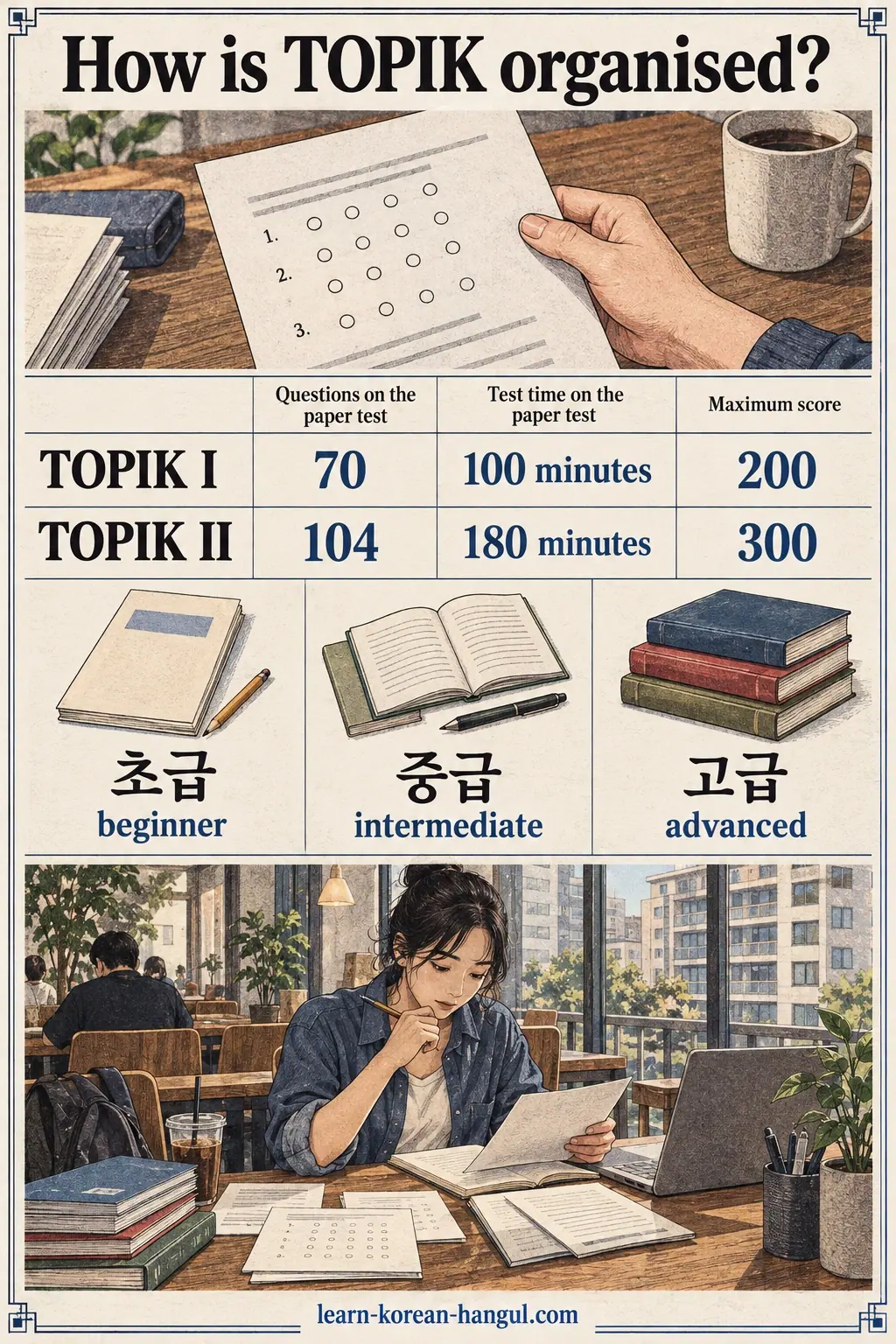
TOPIK is organised as two separate tests with six levels between them: TOPIK I covers levels 1-2 and TOPIK II covers levels 3-6. You register for one test, sit it once, and the total score on that test decides your level.
| Feature | TOPIK I | TOPIK II |
|---|---|---|
| Levels awarded | 1 (1급) and 2 (2급) | 3 (3급) to 6 (6급) |
| Korean label | 초급 (beginner) | 중급 (intermediate, levels 3-4) and 고급 (advanced, levels 5-6) |
| Sections | listening, reading | listening, writing, reading |
| Questions on the paper test | 70 | 104 |
| Test time on the paper test | 100 minutes | 180 minutes |
| Maximum score | 200 | 300 |
| Lowest level cut score | 80 (level 1) | 120 (level 3) |
| Highest level cut score | 140 (level 2) | 230 (level 6) |
The question counts and times above describe the paper-based test. The computer version, taken at a test centre, has its own counts and timing, which are set out on TOPIK exam format.
TOPIK I in One Paragraph
TOPIK I is the beginner test. It has 30 listening questions in 40 minutes and 40 reading questions in 60 minutes, all four-option multiple choice, in a single sitting. Texts are short and practical: signs, notices, text messages, short dialogues and simple paragraphs. A total of 80 out of 200 gives level 1, and 140 gives level 2. The full guide is in the TOPIK I section.
TOPIK II in One Paragraph
TOPIK II is the intermediate and advanced test. It has 50 listening questions in 60 minutes, 4 writing tasks in 50 minutes, and 50 reading questions in 70 minutes, split into two periods with a break. Texts include news, lectures, opinion pieces and literary extracts. A total of 120 out of 300 gives level 3, 150 gives level 4, 190 gives level 5 and 230 gives level 6. The full guide is in the TOPIK II section.
The Reason for Two Tests
TOPIK uses two tests so that each candidate meets questions near their own level. A beginner sitting a 300-point test full of academic passages would learn nothing from the experience, and an advanced learner would waste an hour on "What is this sign about?" Two tests keep both groups busy with questions that measure them well.
The cost of this design is a gap. A perfect TOPIK I score is still level 2, and a TOPIK II total below 120 earns no level at all, even if the candidate would easily reach level 2 on TOPIK I. Choosing the right test is therefore the first real decision, and the next section shows what the level you get actually means.
What Does a TOPIK Level Mean?

A TOPIK level is a band of total scores that NIIED links to a description of what a learner can do. It is not a pass or fail. You receive the highest level whose cut score your total reaches, and the score report shows each section score, the total and the level.
| Level | Cut score | Plain description (summary) |
|---|---|---|
| 1 | 80 / 200 | basic survival Korean: greetings, buying things, simple personal topics |
| 2 | 140 / 200 | everyday tasks such as using a bank or post office; short familiar texts |
| 3 | 120 / 300 | daily life without difficulty; basic social relationships; familiar public topics |
| 4 | 150 / 300 | public services and work-related basics; simple news and general articles |
| 5 | 190 / 300 | professional and academic Korean to some extent; formal and informal registers |
| 6 | 230 / 300 | professional and academic Korean with ease; few problems in most functions |
The descriptions above summarise the official level descriptors; the exact wording is in the guide on topik.go.kr, and TOPIK levels explains each level in detail with examples.
A worked example shows how a total turns into a level. A TOPIK II candidate scores listening 61, writing 42 and reading 58. The total is 161, which is at least 150 but below 190, so the result is level 4. If the same candidate had scored 115, the result would be no level, even though 115 points is a real achievement.
Two expert points follow from the scoring rules:
- There is no minimum per section. A strong reading score can carry a weak writing score. Targeted study of your weakest section is still the cheapest way to gain points.
- The level is what institutions read. Universities ask for "level 3" or "level 4", not "a total of 160". The section scores matter mainly to you, as a map for the next attempt.
How a raw total is calculated and how writing is marked are on TOPIK score. Once you know what a level means, the useful question becomes who actually needs one.
Who Needs TOPIK?

TOPIK is needed mainly by people who must prove their Korean to an institution: university applicants, scholarship candidates, job seekers in Korea and some visa applicants. Many learners also take it with no external need, as a personal milestone and a structured goal.
| Goal | Is TOPIK usually needed? | Level often asked (typical) | Who sets the rule |
|---|---|---|---|
| Korean-taught undergraduate degree | often yes | level 3 or 4 | each university |
| Graduation from a Korean university | sometimes | level 4 is common in some programmes | each university |
| Government scholarship (e.g. GKS) | sometimes; can earn extra credit | varies by programme | NIIED's scholarship notice |
| Office job with a Korean company | often helpful | level 4-6 for Korean-speaking roles | each employer |
| Some residence or job-seeking visas | can earn points or meet a rule | varies, changes over time | Korea Immigration Service |
| Factory, farm or fishing work under the Employment Permit System | no | EPS-TOPIK instead | the EPS programme |
| Personal goal or motivation | optional | any | you |
The levels in the table are typical patterns, not rules. Each institution sets and changes its own requirement, so the current notice of the university, employer or immigration office is the only reliable source. How to find and verify a requirement is on TOPIK requirements.
The personal-goal row deserves a note from experience. A fixed test date is one of the most effective study motivators available to self-taught learners. A learner who books TOPIK I for a date three months away usually studies more steadily than one who plans to "get better at Korean". The test also gives an outside check: if your mock scores and your real result agree, your self-assessment is trustworthy.
Who needs TOPIK also depends on which other tests exist, because several Korean tests sound alike but serve different purposes.
How Does TOPIK Compare with Other Korean Tests?

TOPIK is the general Korean proficiency test, but it is not the only Korean test in use. Three others are often confused with it: EPS-TOPIK, the KIIP assessments and the TOPIK speaking test. Each has a different purpose and a different organiser.
| Test or programme | Purpose | Organiser | Result |
|---|---|---|---|
| TOPIK (I and II) | general proficiency for study, work and personal goals | NIIED | levels 1-6, valid two years |
| TOPIK speaking test | speaking ability only | NIIED, under the TOPIK name | its own result, separate from TOPIK levels |
| EPS-TOPIK | Korean for foreign workers under the Employment Permit System | HRD Korea (Human Resources Development Service of Korea) | eligibility for the EPS job-seeker process |
| KIIP (사회통합프로그램) | integration course for residents, with Korean language and society stages | Ministry of Justice | completed stages and assessment results used in immigration |
| University placement tests | placing students in a language-institute class | each university | a class level at that school only |
The comparison above names the alternatives; it does not rank them. The tests are not substitutes for each other. An EPS-TOPIK result cannot replace TOPIK for university admission, and a TOPIK level is not an EPS-TOPIK result. The full side-by-side is on TOPIK vs EPS-TOPIK.
The speaking test is the newest member of the family and the most misunderstood. TOPIK I and TOPIK II have no speaking section at all, so a level 6 certificate says nothing official about your speaking. The separate speaking test has its own registration and sessions; check topik.go.kr for where it is currently held. Details are on the page about the TOPIK speaking test.
That gap is one of several things the main test does not measure, and knowing them prevents wrong expectations.
What Does TOPIK Not Test?
TOPIK does not test speaking, pronunciation, handwriting quality or Korean culture knowledge. TOPIK I does not test writing either. The test measures understanding of spoken and written Korean in all levels, plus written production in TOPIK II.
The limits matter in practice:
- No speaking. A candidate can reach level 4 with little speaking practice. Employers who need spoken Korean often add an interview in Korean.
- No pronunciation. Your accent is never assessed. Listening items do test whether you recognise standard pronunciation at natural speed.
- No writing in TOPIK I. Beginners are not asked to write anything; every answer is a choice among four options.
- No culture quiz. Texts mention Korean life, but questions test language, not facts about holidays or history.
- No official vocabulary list. Published "TOPIK word lists" are compiled by teachers and publishers from past papers. They are useful study tools, not official syllabuses.
An honest rule of thumb follows: a TOPIK level describes your receptive Korean (listening and reading) well, describes your writing reasonably at TOPIK II, and describes your speaking not at all. Plan your study to cover what you will need in real life, not only what the test measures.
With the scope clear, the remaining practical question is how the test is actually delivered.
How TOPIK Is Delivered: Paper, Computer and Test Centres
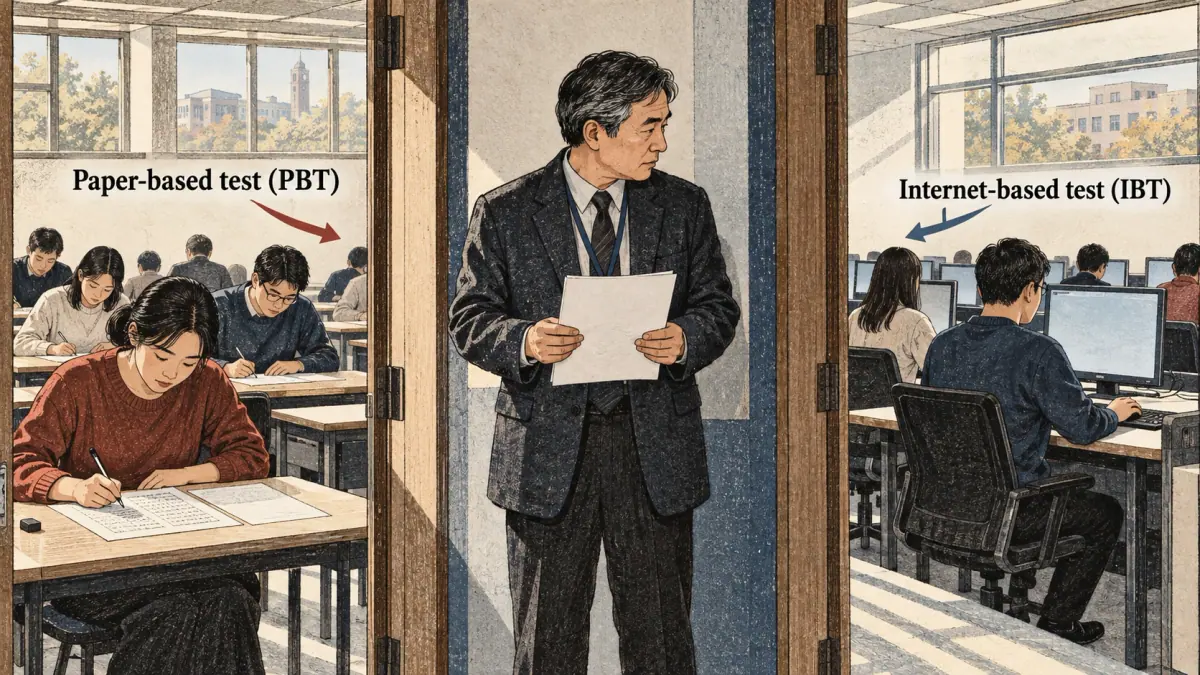
TOPIK is delivered in two formats: the paper-based test (PBT) and the internet-based test (IBT), which is taken on a computer at an approved test centre. Both lead to the same levels. Neither can be taken at home.
| Feature | Paper-based test (PBT) | Internet-based test (IBT) |
|---|---|---|
| Where | test centres in Korea and abroad | approved computer test centres, in fewer places |
| How you answer | marking an answer sheet; handwriting for TOPIK II writing | on screen; typed writing for TOPIK II |
| Levels | 1-6 | 1-6 |
| Format details | the classic structure in the table above | its own question counts and timing |
| Results | on the date set for the session | on the date set for the session, often sooner |
Sessions are spread across the year. The exact number of sessions, the countries that host each one and the fees change every year, so this page does not quote them. The current pattern and the yearly schedule are explained on TOPIK exam dates, and the computer format is described on TOPIK IBT.
After the test, results are announced on a published date and checked on topik.go.kr. The score report is valid for two years from the announcement date, after which most institutions ask for a new result. The validity rule, with a worked expiry date, is on does TOPIK expire.
Knowing how the test runs, you can plan your first steps.
How to Get Started with TOPIK
Getting started with TOPIK takes five steps, from choosing a test to sitting a timed mock. A learner who reads Hangul can complete the first four in about two weeks of light work.
- Decide why you are taking TOPIK. Write down the goal and, if there is one, the level an institution requires and its deadline. A university that needs level 3 by March sets a very different plan from a personal goal.
- Choose TOPIK I or TOPIK II. Take TOPIK I if you have studied for less than about a year or if a mock TOPIK II gives you under about 100 points. Take TOPIK II if you need level 3 or higher. The full decision is on difference between TOPIK 1 and 2.
- Try one official past paper. Download a past paper with its audio and answer key from topik.go.kr, sit it once without a timer and mark it. Your score shows the distance to your target.
- Pick a session and register. Check the schedule, register before the window closes and make sure the results date comes before any deadline you have. The steps are on TOPIK registration.
- Study to a plan and sit timed mocks. Train listening and reading every week, add writing for TOPIK II, and take at least two full timed mocks before test day.
You'll know you are ready when two timed mocks in a row land at least 10 points above your target cut score. The most common mistake at the start is skipping step 3: learners who never sit a real paper before registering often choose the wrong test.
Beginners can follow the TOPIK I section, which includes a format guide, word and grammar lists and an eight-week plan. Before planning, it is worth clearing up the beliefs that most often mislead first-time candidates.
Common Misconceptions about TOPIK
Learners often bring assumptions to TOPIK that come from other exams. Five are worth correcting before you register.
- "I must pass TOPIK I before TOPIK II." Not true. You can register for TOPIK II directly. Many learners with a year or more of study never sit TOPIK I.
- "A TOPIK certificate lasts for life." Not for institutions. A result is valid for two years from the announcement date; the certificate still exists, but most applications need a valid one.
- "TOPIK has a pass mark." There are cut scores for each level, not one pass mark. A total below the lowest cut score of your test means no level, not a "fail" in the usual sense.
- "Wrong answers cost points." Under the current rules, a wrong answer and a blank both score zero, so guessing never hurts. Check the current guide on topik.go.kr, as rules can change.
- "TOPIK is the test for working in a Korean factory." Workers under the Employment Permit System take EPS-TOPIK, a different test from a different organiser.
These corrections lead to the honest limits of this page and of the test itself.
What This Page Covers and Does Not
This page explains what TOPIK is: its organiser, its two tests and six levels, how levels are awarded, who uses it and what it leaves out. It does not list this year's dates, fees or test centres, because they change every year; those belong on topik.go.kr and on the TOPIK exam dates page. It does not reproduce official past papers, which are free on the official site.
The level descriptions here are summaries, and the requirement levels in the "who needs TOPIK" table are typical patterns, not promises. A university or immigration office may change its rule between your registration and your application. When this page and an official notice disagree, the official notice is correct.
Frequently Asked Questions
Is TOPIK the Same as KIIP?
No. TOPIK is a proficiency test run by NIIED that awards levels 1-6. KIIP, the Korea Immigration and Integration Program (사회통합프로그램), is a Ministry of Justice course for residents with Korean language and society stages. Some immigration routes accept either, but they are separate systems with separate registration and results.
Who Can Take TOPIK?
TOPIK is designed for people whose first language is not Korean, including overseas Koreans and foreign learners of any age. You do not need to live in Korea or study at a school. Check the eligibility statement in the current official guide on topik.go.kr, because the exact wording can change between years.
Is TOPIK Pass or Fail?
Not in the usual sense. Each level has a minimum total score, so your result is the highest level your total reaches, or no level if you score below 80 on TOPIK I or below 120 on TOPIK II. Institutions then ask for a level, such as level 3, rather than a pass.
What Is the Difference between TOPIK and EPS-TOPIK?
TOPIK measures general Korean for study, work and personal goals and awards levels 1-6. EPS-TOPIK is a separate test for people applying to work in Korea under the Employment Permit System, run by HRD Korea. The two results are not interchangeable, so choose the test that matches your goal.
Can TOPIK Be Retaken?
Yes. You can sit TOPIK as many times as you like by registering for another session, and there is no penalty for retaking. Each sitting produces its own score report. Most candidates simply use their best valid result, since institutions ask for one certificate that meets their level and validity rules.
What Is TOPIK: the Bottom Line
What is TOPIK, in two sentences? TOPIK is the official Test of Proficiency in Korean, run by NIIED under the Ministry of Education, with TOPIK I for levels 1-2 and TOPIK II for levels 3-6. Your total score decides your level, the result is valid for two years, and the test measures listening, reading and (in TOPIK II) writing, but not speaking.
If you need a level for study or work, check the exact requirement first, then choose your test. If you are taking TOPIK for yourself, sit one past paper this week and let the score choose for you. Continue with TOPIK levels to see what each level means in practice, or return to the TOPIK guide for every page in this section.