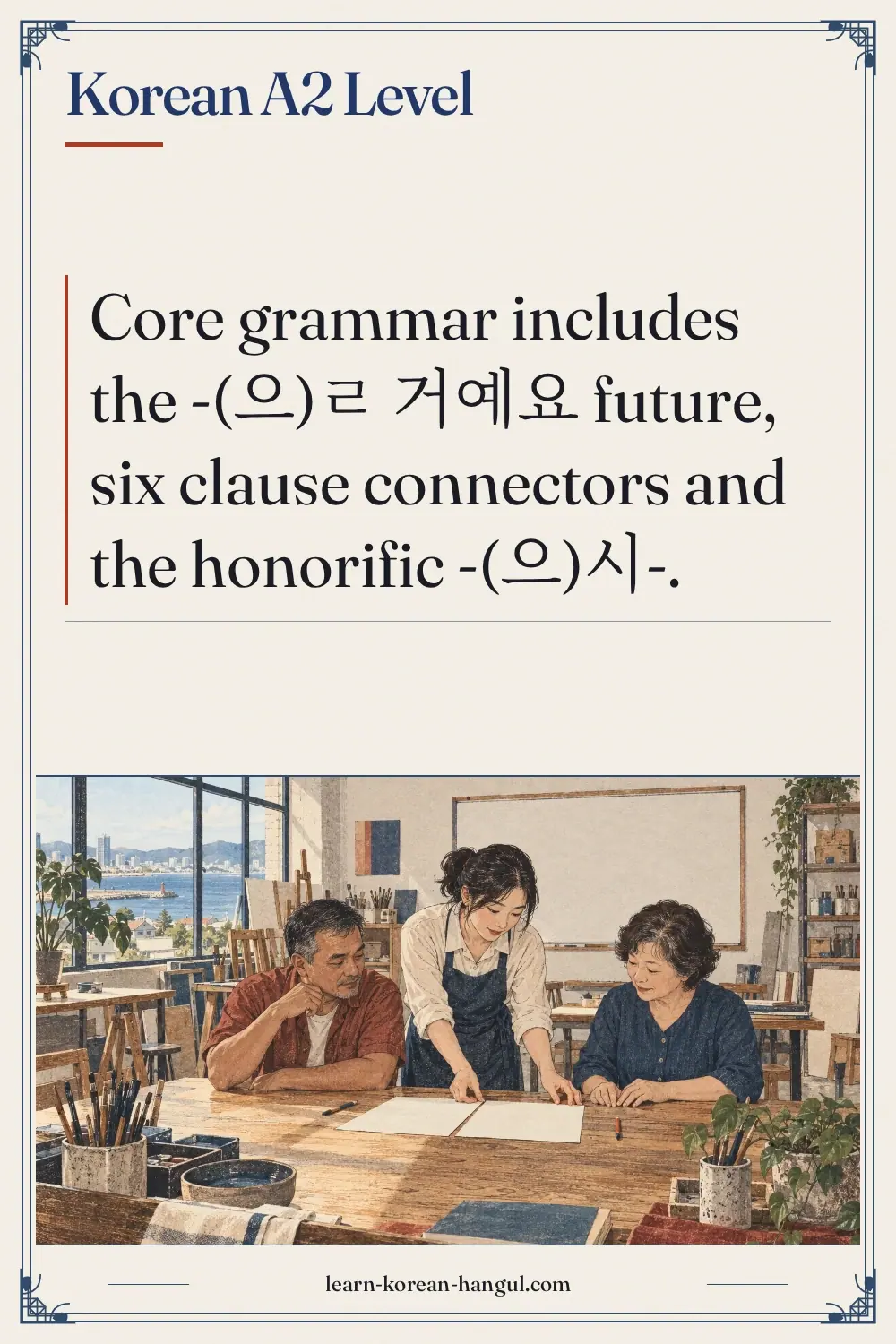
This page covers A2 only. For how A2 fits among all six bands, see the Korean language levels overview.
What Is Korean A2?
Korean A2 is a level of ability, not a test or a certificate. The CEFR is a scale published by the Council of Europe that describes language ability in six bands, and its descriptions are language-neutral. A2 sits above A1 (beginner) and below B1 (intermediate).
An A2 learner can understand and use frequent expressions on familiar topics: personal information, shopping, local places and work. The speaker can communicate in simple, routine exchanges and describe their background in simple terms. Speech is slow, errors are common, and the speaker often asks for repetition. In Korean, this means polite everyday speech, the 해요체 style, with some use of the more formal 합니다체 and the honorific marker -(으)시-.
One caution applies to every claim on this page. No official body issues a "Korean A2" certificate. The CEFR is a reference scale, and Korea's own systems use different labels, such as the TOPIK test levels and the numbered levels of the International Standard Curriculum for Korean from the National Institute of Korean Language (국립국어원). Mappings between them are approximate.
What Can You Do in Korean at A2?
At A2, you can complete short, predictable tasks in polite Korean. The checklist below uses "I can" statements. If you can do most of them without notes, you are working at A2. If several are missing, review the previous level (A1).
Speaking and interaction
- I can talk about plans for tomorrow or next week using -(으)ㄹ 거예요.
- I can describe what I did yesterday or last weekend in five simple past-tense sentences.
- I can make polite requests with -아/어 주세요.
- I can order food, ask the price and pay in a shop.
- I can ask for and understand simple directions and ask about transport.
- I can make or answer a simple phone call about a time or a booking.
Listening, reading and writing
- I can follow slow, clear speech about daily topics when the speaker repeats.
- I can read a short notice, a menu or a text message.
- I can write a short message or a few connected sentences about my day.
Example: asking for help with a window uses the request pattern. 창문 좀 열어 주세요 means "Please open the window."
How Does A2 Compare with TOPIK?
TOPIK I level 2 is the closest TOPIK range to A2, and the mapping is unofficial. TOPIK (Test of Proficiency in Korean) has two papers: TOPIK I covers levels 1 and 2, and TOPIK II covers levels 3 to 6. TOPIK I has a maximum of 200 points; the published cut scores are 80 for level 1 and 140 for level 2. Confirm current scores on the official TOPIK site (topik.go.kr) before relying on them.
| Scale | Label | Rough match to A2 |
|---|---|---|
| CEFR | A2 (elementary) | The reference point on this page |
| TOPIK | TOPIK I, level 2 (140-200 of 200) | Closest range, unofficial |
| NIKL standard curriculum | Level 2 | Roughly aligned, check the curriculum |
Treat the table as a guide. TOPIK I tops out at level 2, so a learner at A2 who wants a higher certificate must sit TOPIK II, a different paper that includes writing. Read how TOPIK scores levels before treating the two as equal, and see the page on TOPIK level 2 for the full answer to that single query.
With the level defined, the next question is what grammar it requires.
Grammar You Need for Korean A2
Korean A2 grammar adds the future, the clause connectors, ability, honorifics and counters to the A1 base of polite present and past. The inventory below is a working list; the beginner grammar list covers every A2 pattern named here.
| Pattern | Meaning | Example |
|---|---|---|
| -(으)ㄹ 거예요 | Future, plan | 내일 친구를 만날 거예요. (I will meet a friend tomorrow.) |
| -고 | And, and then | 밥을 먹고 커피를 마셨어요. (I ate, then drank coffee.) |
| -지만 | But | 한국어는 어렵지만 재미있어요. (Korean is hard but fun.) |
| -아서/어서 | Because, so | 비가 와서 집에 있었어요. (It rained, so I stayed home.) |
| -(으)니까 | Since, because | 시간이 없으니까 빨리 가요. (There is no time, so let's go quickly.) |
| -는데 | Background, contrast | 비가 오는데 우산 있어요? (It is raining; do you have an umbrella?) |
| -(으)면 | If, when | 시간이 있으면 같이 가요. (If you have time, let's go together.) |
| -(으)ㄹ 수 있다 | Can, ability | 한국어로 주문할 수 있어요. (I can order in Korean.) |
| -(으)시- | Honorific | 선생님이 책을 읽으세요. (The teacher is reading a book.) |
| Native counters | Counting things | 커피 두 잔 주세요. (Two cups of coffee, please.) |
Listen for the sound changes. In 만날 거예요, the written 거 is spoken with a tense sound [만날꺼예요]. In 어렵지만, the ㅈ becomes tense [어렵찌만], and in 읽으세요 the ㄺ is spoken [일그세요]. The spelling does not always show the sound, so the audio is part of the lesson.
The Six Connectors
The connectors -고, -지만, -아서/어서, -(으)니까, -는데 and -(으)면 turn single sentences into linked speech, and learners who stop at A1 often stall on them. This is the "connector wall": you know many words but cannot join clauses, so your speech stays in short blocks. Practise each connector with three of your own sentences. For example, with -아서/어서 you can write 피곤해서 일찍 잤어요 ("I was tired, so I slept early").
The honorific -(으)시- marks respect for the person you talk about. Most learners recognise it in listening, but they rarely produce it. Practise it on purpose by describing older relatives or teachers: 할머니께서 주무세요 ("Grandmother is sleeping"), where 주무세요 is the honorific form of "sleep".
Grammar needs words, so the next section turns to vocabulary.
Vocabulary at the A2 Stage
A typical A2 learner knows about 1,500 to 2,000 words, and this is a typical estimate, not a measured standard. Vocabulary sizes vary with the method, the learner and how words are counted, so treat the range as a rough marker. For a wider discussion, see how many Korean words you need.
At this stage, word groups matter more than the total:
- Daily life: food, shopping, transport, home, weather, time and dates.
- People and places: family, friends, work, school, city places.
- Actions and states: common verbs and adjectives, about 150 to 250 in total.
- Counters and numbers: both native (하나, 둘, 셋) and Sino-Korean (일, 이, 삼) number systems.
- Connectors and fillers: 그리고, 그래서, 그런데, 그러면.
Learn words inside sentences and review them on a schedule. A2 is the stage where many learners add Sino-Korean words such as 학교, 전화 and 시간, which appear in everyday speech. Because vocabulary grows quickly, a spaced-repetition routine becomes more important at A2 than at A1.
Words and grammar come together in the four skills, covered next.
Listening, Reading, Speaking and Writing Targets
At A2, each skill has a modest, specific target. The table sets a target for each, so you can aim practice at the weakest one.
| Skill | A2 target | Practice that helps |
|---|---|---|
| Listening | Follow slow, clear speech on daily topics; catch the main point of short announcements | Graded dialogues, slow podcasts with transcripts |
| Reading | Read short notices, menus, messages and simple stories | Graded stories, signs, text messages |
| Speaking | Handle routine exchanges; describe plans and the past in simple sentences | Language exchange, shadowing, role-play |
| Writing | Write short messages and a paragraph of 5 to 8 connected sentences | A daily three-sentence diary |
The skills develop at different speeds. Receptive skills (listening and reading) usually run ahead of productive skills (speaking and writing), so a learner may read a text that they could not have written. This gap is normal, and it is the reason to give output practice its own time.
Sample Tasks You Should Manage
Four short tasks test whether your A2 skills work together. Try each one without notes.
- Describe last weekend in five past-tense sentences, for example 토요일에 친구를 만났어요. 같이 영화를 봤어요.
- Ask a stranger for directions with the ability pattern: 길을 알려 주실 수 있어요? ("Could you tell me the way?")
- Order and count: 커피 두 잔 주세요, with the right counter.
- Read a short message such as 내일 저녁에 시간 있어요? 모레는 바빠요. ("Do you have time tomorrow evening? I'm busy the day after tomorrow.") and reply to it.
If you can do all four with only a few errors, you are working at A2. If one task fails, that task shows what to practise next.
How Long Does It Take to Reach A2?
Reaching Korean A2 typically takes 250 to 400 cumulative study hours, counted from zero, and the range is rough and depends on method and time. The range assumes regular study of lessons, listening and speaking, not one skill alone.
The assumptions matter:
- Classes versus self-study. A learner with a teacher and feedback may sit toward the lower end, and a self-learner without speaking practice may sit toward the upper end.
- Prior experience. Knowing Chinese helps with Sino-Korean vocabulary, and knowing Japanese also helps with word order and particles; neither removes the need to learn Korean grammar.
- Study quality. Active review and speaking use hours better than passive viewing.
The U.S. Foreign Service Institute (FSI) places Korean in Category IV, its hardest group for native English speakers, at about 88 weeks (2,200 class hours) of full-time training to reach professional working proficiency. A2 is a small part of that journey, which is why the hours to reach it are far lower. At one hour a day, 250 to 400 hours is about 8 to 13 months. At 30 minutes a day, it is about 17 to 27 months. These are arithmetic examples of the stated range, not predictions for any one learner.
Common Gaps at A2
Four gaps appear again and again at A2, and each has a simple fix. Finding yours early saves months of plateau.
| Gap | What it looks like | Fix |
|---|---|---|
| Connector wall | Short blocks; no linked speech | Write three sentences per connector |
| Honorific production | You hear -(으)시- but never say it | Describe older people aloud each day |
| Counters | Wrong counter or none | Learn 개, 명, 잔, 병 with objects |
| Irregular verbs | 듣다 spoken as 듣어요 | Learn the patterns, such as 듣다 to 들어요 |
A fifth gap is silence. Many A2 learners understand more than they say. Speaking sessions, such as an exchange or a tutor lesson, bring production up to the level of understanding. Another common problem is slow listening on real speech, which improves with daily graded audio.
Limits of Level Labels
Level labels are rough guides, and they cannot measure a person exactly. A2 describes a pattern of abilities, and a learner can sit at A2 in reading and A1 in speaking at once.
Three limits apply. First, the CEFR is a reference scale, and it does not come from a Korean standard, so Korean-specific features such as speech levels and particles are not directly described. Second, tests like TOPIK measure test performance, and a test score can differ from how you cope in a shop or on the phone. Third, self-assessment tends to be rough: learners often rate themselves too high on reading and too low on speaking. To check yourself, take the Korean level test and compare the result with the checklist on this page.
What Should You Study after A2?
After A2, the next goal is B1, and the main change is moving from set phrases to flexible, connected speech. A2 gives you patterns for routine tasks. B1 gives you the ability to explain, give reasons and handle unexpected turns.
When you pass most items on the checklist above, continue to B1, the next stage. Focus on four things:
- Add longer clauses with reasons and conditions.
- Learn reported speech, such as -다고 하다.
- Read short graded stories and articles for about 15 minutes a day.
- Hold five-minute conversations on familiar topics.
The Korean for Beginners course takes you through A2 material in order, and it is a sensible home base if you want a structured path. In short, Korean A2 means you can handle everyday tasks in slow, polite Korean, you link clauses with six connectors, and you are ready to build toward flexible, connected speech.
Frequently Asked Questions
Can I get an official Korean A2 certificate?
No official certificate carries the label "Korean A2". The CEFR is a reference scale, and Korean certificates use their own levels. The nearest official proof is TOPIK I level 2, issued by the test's administrators. Some schools and language centres issue their own A2 statements, but those depend on the school.
Is A2 enough for a job in Korea?
A2 is usually not enough for professional work, which tends to need B1 or B2 for daily tasks and higher for specialist roles. It does cover shopping, transport and simple social contact. Requirements differ by employer and visa type, so check the specific job or visa rule before you plan.
Which textbooks match Korean A2?
Look for the second level of a beginner series, often labelled level 2 or elementary 2, with audio, dialogues and the grammar listed above. Check the contents page for the future, connectors and honorifics. Textbook labels vary between publishers, so use the grammar list on this page as your reference.
How do I test my Korean speaking at A2?
Record yourself doing the four sample tasks, then listen back and mark errors. Better, do them with a tutor or an exchange partner, who can react and give feedback. Repeat the same recording after a month to see changes in speed, accuracy and the number of linked clauses.