What Is TOPIK Level 2?
TOPIK level 2 is the upper-beginner grade of the Test of Proficiency in Korean (TOPIK), the exam run by the National Institute for International Education (NIIED, 국립국제교육원) for people whose first language is not Korean. It sits at the top of TOPIK I, the beginner test, which awards only Level 1 and Level 2.
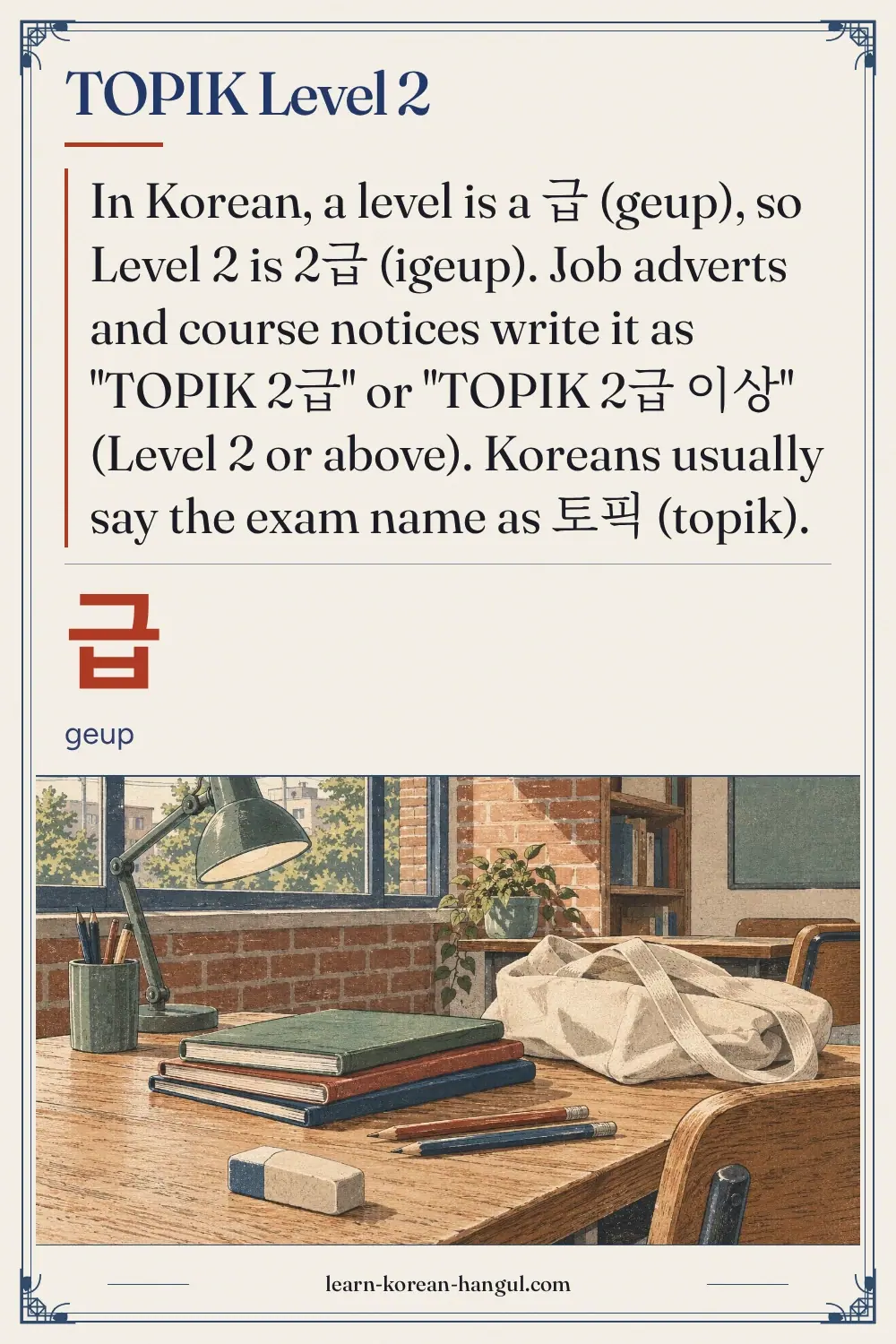
In Korean, a level is a 급 (geup), so Level 2 is 2급 (igeup). Job adverts and course notices write it as "TOPIK 2급" or "TOPIK 2급 이상" (Level 2 or above). Koreans usually say the exam name as 토픽 (topik).
Levels 1 and 2 together form the 초급 (chogeup) band, which means "beginner". Korean course books and language schools use the same word, so a class labelled 초급 2 is aimed at roughly this level.
A level is a score band, not a pass mark. Your TOPIK I total falls into one of three outcomes: no level, Level 1 or Level 2. Level 2 tells a school, an employer or yourself that you have finished the beginner stage. If you want the whole six-level system first, the TOPIK levels page explains it. The next question is the exact number that separates Level 2 from Level 1.
What Score Do You Need for TOPIK Level 2?
You need 140 or more out of 200 points on TOPIK I to get Level 2. A total from 80 to 139 gives Level 1, and anything below 80 gives no level. The cut scores are published by NIIED on the official TOPIK website (topik.go.kr); they have been stable for years, but confirm them in the test guide for your session.
| Level | Test | Cut score | Score range | Share of the test maximum |
|---|---|---|---|---|
| No level | TOPIK I | below 80 | 0-79 | under 40% |
| Level 1 | TOPIK I | 80 / 200 | 80-139 | 40% |
| Level 2 | TOPIK I | 140 / 200 | 140-200 | 70% |
| Level 3 | TOPIK II | 120 / 300 | 120-149 | 40% |
| Level 4 | TOPIK II | 150 / 300 | 150-189 | 50% |
| Level 5 | TOPIK II | 190 / 300 | 190-229 | about 63% |
| Level 6 | TOPIK II | 230 / 300 | 230-300 | about 77% |
The table shows one fact that surprises many learners: Level 2 needs 70% of the TOPIK I maximum, while Level 3 needs only 40% of the TOPIK II maximum. That does not make Level 3 easier. TOPIK II is a harder, three-section test, so 120 out of 300 there is a bigger achievement than 140 out of 200 on TOPIK I.
How the 140 Points Add Up
TOPIK I has two sections, listening and reading, each scored out of 100. The level comes from the total, so a strong section can carry a weaker one. On the paper test, listening has 30 questions in 40 minutes and reading has 40 questions in 60 minutes; the TOPIK 1 exam format page shows each question type.
Three worked totals show how the rule plays out:
- Balanced: 72 in listening + 70 in reading = 142. The result is Level 2.
- Uneven: 85 in listening + 55 in reading = 140. The result is still Level 2, exactly on the cut score.
- Close miss: 68 in listening + 67 in reading = 135. The result is Level 1, five points short.
Questions are not all worth the same number of points, so you cannot turn 140 points into a fixed number of correct answers. A practical rule of thumb is to aim for about three-quarters of the questions right in each section on your mock tests, which gives you a margin above 70%. The TOPIK score page explains how sections are marked and reported. Once the number is clear, the more useful question is what that number says about your Korean.
What Can You Do at TOPIK Level 2?
A TOPIK level 2 learner can carry out the everyday tasks of living in Korea with simple, polite Korean. NIIED's level description for Level 2, paraphrased here in plain English, covers these abilities, with the vocabulary size added as a common estimate:
- Daily-life functions: make phone calls, ask for favours and handle public places such as a post office or a bank.
- Vocabulary: understand and use roughly 1,500-2,000 words on personal and familiar topics (an estimate commonly cited by teachers and textbooks).
- Paragraphs: understand and produce short texts, a few connected sentences long, about familiar topics.
- Formal and informal: begin to tell formal situations from informal ones and choose language to match.
The sections below turn each ability into real sentences. Each one follows the same order: the situation, what a Level 2 learner can say, and what is still out of reach.
Using a Post Office or a Bank
At a post office, a Level 2 learner can say what they want to send and where, and follow the clerk's short questions about weight or contents.
이 소포를 미국에 보내고 싶어요.
i soporeul miguge bonaego sipeoyo.
I want to send this parcel to the US.
At a bank, the same learner can ask to open an account and give simple personal details. The softer ending -(으)ㄴ데요 in the next example is a polite way to start a request.
통장을 만들고 싶은데요.
tongjangeul mandeulgo sipeundeyo.
I'd like to open a bank account.
Still out of reach: explaining a complicated problem, such as a disputed charge, without help.
Making a Phone Call
A phone call is hard because there is no face or gesture to help. At Level 2, you can book, confirm a time and ask the speaker to repeat.
죄송하지만 다시 한번 말씀해 주세요.
joesonghajiman dasi hanbeon malsseumhae juseyo.
Sorry, could you say that again, please?
Still out of reach: following a fast call with several people or an automated menu with long instructions.
Making Plans with People
Level 2 learners can suggest, accept and refuse plans, which is the core of social life in any language.
내일 시간 있어요? 같이 영화 볼까요?
naeil sigan isseoyo? gachi yeonghwa bolkkayo?
Are you free tomorrow? Shall we see a film together?
Still out of reach: joking, teasing or keeping up with a group of friends talking casually.
Telling a Short Story
A Level 1 learner speaks in single sentences. A Level 2 learner starts to link them, using past tense and simple connecting endings such as -고 (and) and -아/어서 (and then, so).
어제 친구를 만나서 같이 밥을 먹었어요.
eoje chingureul mannaseo gachi babeul meogeosseoyo.
Yesterday I met a friend and we ate together.
Still out of reach: telling a long story with background, opinion and a conclusion, which is a Level 3-4 skill.
Telling Formal from Informal Korean
Level 2 is the first level whose description mentions formal and informal use. In practice, that means recognising the formal -(스)ㅂ니다 style used in announcements and introductions, and using the everyday polite -아/어요 style yourself.
안녕하십니까? 처음 뵙겠습니다.
annyeonghasimnikka? cheoeum boepgetseumnida.
Good day. Pleased to meet you. (formal)
Still out of reach: writing in the plain -ㄴ/는다 style used in essays, which first matters on TOPIK II. With the abilities mapped, the next step is to compare Level 2 with Level 1 and with Level 3.
How Does Level 2 Compare with Level 1 and Level 3?
Level 2 differs from Level 1 mainly in range: about twice the vocabulary, linked sentences instead of single ones, and public situations instead of only personal ones. Level 3 then adds social topics, writing and much longer audio and texts. The table compares the three levels side by side.
| Attribute | Level 1 | Level 2 | Level 3 |
|---|---|---|---|
| Test | TOPIK I | TOPIK I | TOPIK II |
| Cut score | 80 / 200 | 140 / 200 | 120 / 300 |
| Vocabulary (common estimate) | about 800 words | about 1,500-2,000 words | no widely used figure |
| Typical topics | self, family, food, weather | plus public places, plans, phone calls | plus social relationships and familiar social topics |
| Sentence range | single simple sentences | short connected paragraphs | longer paragraphs with linking endings |
| Speech styles | polite -아/어요 | polite plus formal recognition | polite, formal and plain written style |
| Writing tested | no | no | yes |
| Approximate CEFR | A1 | A2 | B1 |
The CEFR (Common European Framework of Reference for Languages) column is an approximation used by schools and learners. NIIED does not publish an official CEFR table, and sources disagree more at the higher levels than at Level 2.
Grammar a Level 2 Learner Usually Knows
The grammar behind Level 2 is the full beginner set: the main particles, the polite present, past and future, negation, wanting and ability, and five or six basic connecting endings. The TOPIK 1 grammar list groups these patterns with an example each. The TOPIK 1 vocabulary list does the same for words, grouped by topic. Knowing the content is one thing; how hard the test feels on the day is another.
How Hard Is TOPIK Level 2?
TOPIK level 2 is moderately hard for a beginner: it asks for 70% of the points on TOPIK I, so you cannot rely on easy early questions alone. Many candidates who reach Level 1 comfortably still miss Level 2 in the later questions, where the audio is longer and the reading texts are full paragraphs.
Three things make the jump from Level 1 to Level 2 harder than it looks:
- The later questions carry the level. The first questions in each section test single words and short replies. Level 2 depends on the later items: dialogues where you must find the main idea, and paragraphs where you must order sentences or fill a gap.
- Listening speed. The recordings are clear but natural. If you have studied only from text, the first timed listening practice usually scores far below your reading.
- Reading time. Forty questions in 60 minutes is 90 seconds a question on average, and the long paragraphs at the end take longer than that. Slow readers lose points by running out of time, not by not knowing the words.
A useful rule of thumb: if your timed mock scores sit between 120 and 135, your gap is usually speed, not knowledge, so more timed practice helps more than more new words. The difference between TOPIK 1 and 2 page explains why Level 2 learners usually should not jump to TOPIK II yet. With difficulty understood, the next section turns it into a plan.
How Do You Reach TOPIK Level 2?
You reach TOPIK level 2 by finishing beginner grammar and vocabulary, then training both sections under timed conditions until your mock totals sit above 140. A typical route has six steps.
- Finish Hangul and the polite present. Read Hangul at sight and form -아/어요 sentences with common verbs. You'll know it worked when you can read a short menu aloud without stopping.
- Build the beginner word base. Learn the core topic words for daily life, about 1,500 words over time. You'll know it worked when most words in a past-paper reading text are familiar.
- Learn the beginner grammar set. Cover particles, tenses, negation, -고 싶다, -(으)ㄹ 수 있다 and basic connectors. You'll know it worked when you can explain why a sentence uses 은/는 or 이/가.
- Train listening every day. Ten to fifteen minutes of beginner audio daily beats one long session a week. You'll know it worked when you can answer early listening items on the first hearing.
- Take a timed mock. Sit a full past paper under exam timing, then score it. A timed TOPIK mock test shows where the points are lost.
- Fix the weakest question types. Spend the next two weeks on the two question types that cost you the most points, then take another mock.
The common mistake at every step is to keep adding new material without timed practice. The full plan, with a week-by-week schedule, is on how to pass TOPIK 1.
How Long Does It Take to Reach Level 2?
Reaching TOPIK level 2 typically takes about a year of steady part-time study, but the range is wide. At Korean university language institutes, which usually run 10-week terms, students often finish the material for Level 2 after about two full-time terms. A learner studying a few hours a week alone may need longer. Your first language, your listening practice and your test strategy all move the number, so measure progress with timed mocks, not with months. Once you have the level, it is worth knowing what it is useful for.
What Is TOPIK Level 2 Useful For?
TOPIK level 2 is useful as proof that you have completed beginner Korean, and it is the level some programmes and employers ask for when only daily-life Korean is needed. It is rarely enough for study in Korean-taught degree programmes, which usually ask for Level 3 or 4.
| Goal | Is Level 2 usually enough? | What to check |
|---|---|---|
| Personal milestone | Yes | Nothing: the certificate shows the level |
| Placement at a language institute | Often helpful | The institute's placement rules |
| Korean-taught undergraduate degree | Usually not; Level 3 or 4 is typical | The university's admissions notice |
| Some exchange or short programmes | Sometimes | The programme's language rules |
| Jobs using simple Korean | Sometimes | The job advert |
| Visa or residency points that count TOPIK | Sometimes counts, rules vary | The current official notice |
Every row is typical, not a rule. Each university, programme and agency sets its own level, and rules change. The TOPIK requirements page goes through study, work and visa goals one at a time.
A result is valid for two years from the results announcement date. If you need the certificate for an application in two years' time, plan to retake the test or aim for a higher level. Saying you have the level in Korean is simple:
토픽 2급을 땄어요 (topik igeubeul ttasseoyo) means "I got TOPIK Level 2." The verb 따다 means to obtain a certificate or licence. The next section looks beyond Level 2.
What Comes after TOPIK Level 2?
After TOPIK level 2 comes Level 3, which you can only get by taking TOPIK II. TOPIK II is a separate test with three sections, listening, writing and reading, scored out of 300. The step from Level 2 to Level 3 is the largest jump in the TOPIK system, for three reasons:
- Writing appears. TOPIK II includes a writing section with two short gap-fill items and two compositions. Level 2 learners have usually never written a timed paragraph in the plain -ㄴ/는다 style.
- Texts get longer. TOPIK II listening has 50 questions and reading has 50, with interviews, short lectures and news-style texts.
- Topics turn social. Level 3 descriptions mention social relationships and familiar social topics, not only personal needs.
A safe rule: stay with TOPIK I until a full TOPIK II mock gives you about 120 points or more. Below that, TOPIK II gives no level at all, even if you are well above beginner. The TOPIK levels page describes Level 3 and the levels above it. Before you plan around Level 2, one honest limitation is worth stating.
What TOPIK Level 2 Does Not Show
TOPIK level 2 measures listening and reading on one test day. It says nothing about speaking or writing, because TOPIK I tests neither. Two learners with Level 2 can be very different: one may chat comfortably with friends, and another may freeze in conversation but read well.
The band is also wide. A candidate with 141 and a candidate with 198 both receive Level 2. If you are applying somewhere that cares about your actual ability, your section scores say more than the level. The certificate shows them.
TOPIK Level 2: the Bottom Line
TOPIK level 2 means 140 or more out of 200 on TOPIK I, the top of the beginner band, roughly A2. The two decision points are these. First, Level 2 is the right target if you need proof of beginner Korean or a milestone before intermediate study, but it is rarely enough for degree study. Second, your next certificate is Level 3 on TOPIK II, so start writing practice before you switch tests.
To see where Level 2 sits among the TOPIK I pages, return to the TOPIK I guide. If you are still working towards Level 1, start with TOPIK level 1.
Frequently Asked Questions
Is TOPIK Level 2 Good?
TOPIK level 2 is a good result for a beginner. It is the highest level the TOPIK I test can award, and it shows that you can handle everyday Korean in shops, banks and on the phone. It is not enough for Korean-taught degree programmes, which usually ask for Level 3 or higher.
How Long Does It Take to Reach TOPIK Level 2?
Reaching TOPIK level 2 typically takes about a year of steady part-time study, or two terms of full-time study at a Korean language institute. Your own time depends on hours per week, your first language and whether you practise listening daily. Track progress with timed mock tests rather than months.
Is TOPIK Level 2 Fluent?
No. TOPIK level 2 is upper-beginner Korean, roughly A2 on the European scale. You can get through daily tasks with simple, polite sentences, but you will struggle with fast conversation, news and work topics. Most people use the word fluent for Level 5 or Level 6.
What Jobs or Programmes Ask for Level 2?
Level 2 is asked for mainly by short programmes and entry-level roles: some exchange and language courses, some service jobs that use simple Korean, and some immigration point schemes that count TOPIK. Degree admission usually needs Level 3 or 4. Rules change, so always read the current notice.
Can I Get Level 2 with a Weak Reading Score?
Yes, if the total reaches 140. TOPIK I adds listening and reading, each out of 100, and the level comes from the total. A candidate with 80 in listening needs only 60 in reading. The official test guide on topik.go.kr states the current rule for each session, so check it.