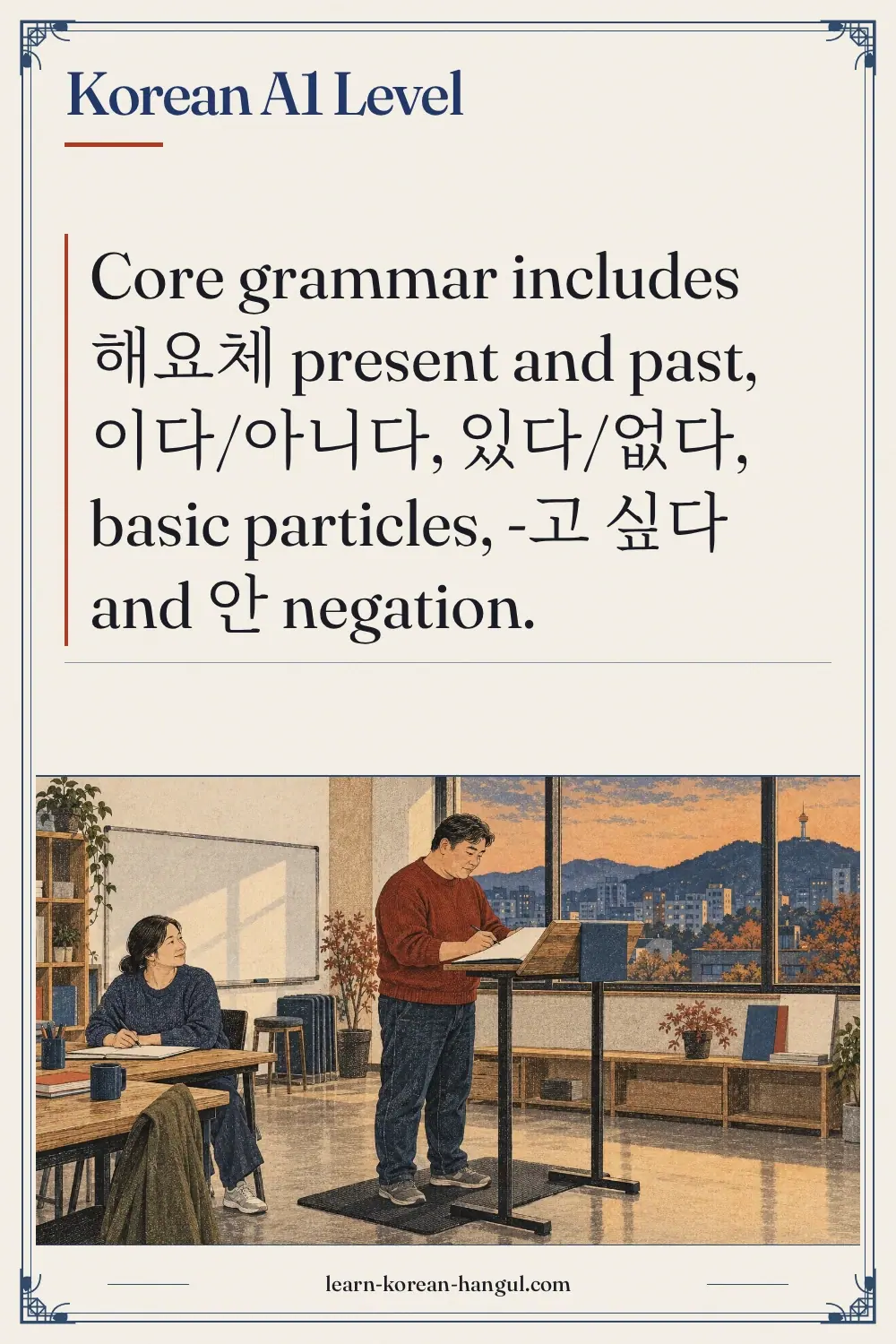
What Is Korean A1?
Korean A1 is the first CEFR band, the level of a basic user who can use Korean in simple, familiar situations. CEFR, the Common European Framework of Reference for Languages, is a scale published by the Council of Europe. Its A1 descriptors are language-neutral, so this page adds the Korean-specific checkpoints that matter most, such as Hangul reading speed and polite endings.
A1 is not the starting point of learning. Reading Hangul comes before it, which some descriptions skip. A learner who cannot yet read Hangul quickly is pre-A1, because every later lesson depends on reading. The Hangul course covers that gate in about a week.
What Can You Do in Korean at A1?
At A1 you can do the following in Korean, with slow speech and some repetition from the listener:
- read any Hangul word aloud, including words with final consonants, even if you do not know the meaning
- introduce yourself in 해요체: your name, country, job or study, and a simple reason for being in Korea
- order food and drinks, ask prices and understand a spoken number such as 오천 원 (5,000 won)
- ask where something is and understand short directions
- use present tense with particles 은/는, 이/가 and 을/를
- write a short self-introduction of three sentences
If you can do most of this list in a real conversation, not only from notes, you are at A1. The rest of the page explains each part.
How Does A1 Compare with TOPIK?
TOPIK I level 1 is the nearest exam result to A1, but the match is unofficial. TOPIK I has 200 points, split between reading and listening, and level 1 needs at least 80 points. Level 2 needs at least 140. So "TOPIK 1" covers scores of 80 to 139, which is a wide range.
TOPIK I has no speaking or writing section, so it cannot show the A1 skill of introducing yourself aloud. A learner can pass TOPIK 1 and still be unable to hold a short conversation. The reverse also happens. For the full scale, see the Korean language levels overview and the TOPIK hub.
Grammar You Need for Korean A1
Korean A1 grammar is about eight patterns that build simple polite sentences. They are listed below in the order most courses teach them. The list is a typical inventory; check it against your own course.
| Pattern | Example | Meaning |
|---|---|---|
| 해요체 present (-아요/어요) | 먹어요 | I/you/we eat |
| 해요체 past (-았어요/었어요) | 먹었어요 | ate |
| 이다 / 아니다 | 학생이에요 / 학생이 아니에요 | am a student / am not a student |
| 있다 / 없다 | 시간이 있어요 / 없어요 | have / do not have time |
| Topic and subject particles 은/는, 이/가 | 저는, 친구가 | as for me; the friend (subject) |
| Object and place particles 을/를, 에, 에서 | 밥을, 학교에, 집에서 | rice (object); to school; at home |
| -고 싶다 (want to) | 먹고 싶어요 | I want to eat |
| 안 negation | 안 먹어요 | I do not eat |
The core idea is that Korean puts the verb at the end and marks each noun with a particle. A particle is a short tag attached to a noun that shows its role, as 을/를 marks the object. Learn this one idea and the rest follows. The beginner grammar list gives all patterns in order with examples.
An expert tip: learn 이에요/예요 as one choice. After a consonant, use 이에요 (학생이에요). After a vowel, use 예요 (마리아예요). Choosing the wrong one is the most common beginner slip in introductions.
Vocabulary at the A1 Stage
A1 vocabulary is typically about 800 to 1,000 words, built mostly from high-frequency nouns, verbs and numbers. That figure is a typical estimate and not an official count; the how many Korean words you need page explains why counts vary.
Which words? The topics that appear in every A1 course:
- People and places: 사람, 친구, 가족, 집, 학교, 회사
- Food and shopping: 밥, 물, 커피, 가게, 돈, 얼마
- Time: 오늘, 내일, 지금, 시, 분
- Numbers: both Sino-Korean (일, 이, 삼) and native (하나, 둘, 셋)
- Core verbs: 하다, 가다, 오다, 먹다, 보다, 있다
Include loanwords such as 커피 and 택시: they cost little once you read Hangul. A learner who knows these topics can handle most A1 tasks.
Listening, Reading, Speaking and Writing Targets
A1 targets differ by skill, and the usual pattern is reading first and listening last. The table lists a typical target for each of the four skills.
| Skill | A1 target in Korean | Typical gap |
|---|---|---|
| Listening | Understand slow, clear, short phrases and numbers | Speech at normal speed is still too fast |
| Reading | Read any word aloud; understand signs, menus and short messages | Reading speed is slow, and batchim slows you down |
| Speaking | Introduce yourself; ask and answer simple questions | Long pauses, wrong particles |
| Writing | Write a three-sentence self-introduction | Spelling of final consonants |
Sample Tasks You Should Manage
Use these five tasks as a self-test. Do them aloud or on paper without notes, and mark each one.
- Read aloud: 가방 (bag), 학교 (school), 읽다 (to read). The last two are said [학꾜] and [익따].
- Introduce yourself in three sentences. A model: 안녕하세요. 저는 마리아예요. 저는 영국 사람이에요.
- Understand a price: you hear 오천 원. Say how much it is (5,000 won).
- Order: say 커피 한 잔 주세요 (one coffee, please).
- Ask where: say 화장실이 어디예요? (Where is the toilet?)
If you manage four or five, you are at A1. If you manage two or three, you are nearly there; review the weakest task and try again in a week. If you manage fewer, return to the Korean for Beginners course.
For a quick informal check, take the Korean level test.
What Does an A1 Conversation Sound Like?
An A1 conversation is short, polite and predictable, with each speaker using the patterns above. Here is a typical exchange between two people meeting for the first time. Every line uses only A1 grammar.
| Speaker | Korean | Meaning |
|---|---|---|
| A | 안녕하세요. 이름이 뭐예요? | Hello. What is your name? |
| B | 저는 마리아예요. 영국 사람이에요. | I am Maria. I am British. |
| A | 학생이에요? | Are you a student? |
| B | 네, 학생이에요. 한국어를 공부해요. | Yes, I am a student. I study Korean. |
| A | 한국어 공부 재미있어요? | Is studying Korean fun? |
| B | 네, 재미있어요. | Yes, it is fun. |
What the dialogue shows: yes/no questions are made by intonation alone (학생이에요? with a rising voice), the topic marker 는 appears once (저는), the object marker 를 appears once (한국어를), and the verbs end in -요. A learner who can say and understand this exchange without notes, at a natural pace, is at A1 for speaking.
How Do You Move from Pre-A1 to A1?
Move from pre-A1 to A1 by following seven steps in order, each with a clear exit check. The order matters because later steps use earlier ones.
- Read Hangul. Finish the Hangul course. Exit check: read ten unseen words aloud.
- Learn the sound rules that matter. Linking and final-consonant sounds, so that 한국어 is said [한구거] and not letter by letter. Exit check: read 국물 as [궁물].
- Memorise 30 survival phrases. Greetings, thanks, N 주세요. Exit check: order a drink aloud.
- Learn 이다 and the polite present. Exit check: say five sentences such as 저는 학생이에요.
- Add particles and 있다/없다. Exit check: describe where something is.
- Add the past tense, numbers and time. Exit check: say what you ate yesterday and the time.
- Review and listen daily. Slow audio and flashcards, 15 minutes a day, from step 3 onwards.
Most courses spend the largest share of A1 on steps 4 to 6, and the listening practice in step 7 is what converts knowledge into use. If a step feels stuck, stay on it for another week; moving on early leaves gaps that return later.
How Long Does It Take to Reach A1?
Reaching A1 typically takes 120 to 200 study hours for English speakers, including listening and review. This is a rough, method-dependent range. The range assumes a mix of self-study and some class or tutoring. A learner who studies only by reading may take longer to reach A1 listening.
| Daily study | Time to A1 (120-200 hours) |
|---|---|
| 30 minutes | 8-13 months |
| 1 hour | 4-7 months |
| 2 hours | 2-3 months |
Past learners vary widely. Hours spent on listening and speaking count more than hours spent reading about grammar, so quality matters as much as quantity. See how long Korean takes to learn for the wider picture.
Common Gaps at A1
Four gaps appear most often at A1, and each has a fix.
- Mixing the two number systems. Korean has Sino-Korean numbers (삼, 오, 십) and native numbers (셋, 다섯, 열). Time uses both: 세 시 (three o'clock) uses native, and 삼십 분 (thirty minutes) uses Sino-Korean. Prices use Sino-Korean: 삼천 원. Fix: learn each use as a set phrase.
- Slow reading with final consonants. Batchim blocks look crowded, and learners hesitate. Fix: read ten batchim words aloud daily until speed improves.
- Wrong particles. 은/는 and 이/가 are the hardest. Fix: learn each in five fixed sentences before using them freely.
- Mixing speech levels. A learner who has heard casual 먹어 in dramas may use it with a teacher or a stranger, where 먹어요 is expected. Fix: use -요 with everyone until you know the relationship allows casual speech.
Common Misconceptions about A1
Learners often assume A1 means more or less than it does. Four corrections:
- "A1 means I can have a conversation." A1 means short, predictable exchanges. Open conversation starts around B1.
- "A1 is just vocabulary." Vocabulary alone cannot make sentences. A1 includes the first grammar patterns, learned alongside the first few hundred words.
- "Passing TOPIK 1 proves A1." TOPIK I tests reading and listening only, so it cannot show speaking or writing.
- "A1 is easy, so I can skip it." Skipping A1 leaves gaps in particles and polite endings that return as errors at B1. A fast, thorough pass through A1 is better than a rushed one.
Limits of Level Labels
An A1 label does not prove you can speak Korean on a given day. It is a rough description of skills, and the TOPIK link is unofficial. Four limits matter:
- Uneven profiles. You may be A1 in speaking and A2 in reading, or the reverse.
- Different tests. CEFR is a scale, TOPIK is an exam; scores do not convert.
- Estimates. Hour and word ranges are typical, not measured for you.
- Context. A1 in a calm tutoring session is not A1 in a busy shop.
Use A1 as a checklist and a goal, and treat results from any test as a guide.
What to Study after A1
After A1, move to A2 by adding past and future plans, requests with -아/어 주세요 and longer sentences. The next page is the next level, which lists the A2 checklist. Keep growing vocabulary with the most common Korean words, and compare the whole ladder in the Korean language levels overview.
Anyone who has reached Korean A1 has crossed the hardest early gap, because the pattern of particles, endings and polite speech is now familiar.
Frequently Asked Questions
Can I get an official Korean A1 certificate?
Not from CEFR itself, because it is a scale, not an exam. Korea runs TOPIK, whose lowest result is level 1, and some schools issue their own placement or course certificates. TOPIK is not tied to CEFR by an official table, so a TOPIK 1 result only suggests A1.
Is A1 enough for a job in Korea?
Rarely. A1 handles simple, familiar exchanges, while most workplaces need B1 or above, and professional roles need more. A1 can be enough for a service job where English is also used, but check the employer and visa requirements. Treat A1 as the base for further study.
Which textbooks match Korean A1?
Look for beginner or "level 1" books from university language centres that cover Hangul, polite present and past, particles and numbers. Compare the contents with the grammar table on this page. A textbook that reaches the past tense and -고 싶다 by its final units typically covers A1.
Is finishing a Hangul course already A1?
No. Hangul is the gate to A1, not A1 itself. After a Hangul course you can read any word aloud, which is pre-A1. A1 adds the first sentences: 해요체, basic particles, numbers and everyday phrases. The Hangul course typically takes under two weeks, and A1 takes months.
How do I test my Korean speaking at A1?
Record yourself for one minute introducing yourself, ordering food and asking a price. Play it back and check each item against the five sample tasks on this page. For feedback, ask a tutor or a language-exchange partner to listen once. Speaking is the hardest A1 skill to judge alone.