This page covers how to study in a session, not what to study. For the order of lessons, follow a study plan and apply these habits inside it.
Which Korean Study Tips Change Results?
Seven habits change results more than any extra hour of study: recall first, learn sentences, keep notes in Hangul, read aloud, listen before reading, review on a schedule and keep one review-only day. Each one replaces a passive activity (re-reading, copying, scrolling) with an active one.
The habits come from two well-studied ideas in memory research. Retrieval practice means pulling an item out of memory instead of looking at it again. Spaced repetition means reviewing an item at growing gaps, such as one day, three days and a week, so it returns just before you would forget it. The table shows how the seven habits map to a 20-minute session.
| Step | Habit | Minutes in a 20-minute session | Replaces |
|---|---|---|---|
| 1 | Two minutes of recall | 2 | Re-reading yesterday's notes |
| 2 | Learn sentences, not single words | 5 | Long single-word lists |
| 3 | Keep notes in Hangul only | (during step 2) | Romanization columns |
| 4 | Read every example aloud | 3 | Silent reading |
| 5 | Listen before you read | 5 | Reading first, listening never |
| 6 | Review on a spaced schedule | 5 | Cramming the night before |
| 7 | One weekly review-only day | (once a week) | Adding new material every day |
Study tips alone do not replace a course or a plan. They make the time you already spend count for more, so the next section lists what you need before you begin.
Before You Start
Before you start, you need about 20 minutes, a notebook or a notes app, a flashcard tool with audio and the ability to read Hangul. The habits below assume you can sound out a Korean syllable. If you cannot yet, learn the script first with the Hangul in a week course, then return here.
| Item | Detail |
|---|---|
| Time | 20 minutes a day, six days a week (typical; adjust to your life) |
| Difficulty | Easy to start, hard to keep up: the effort is in doing the same thing daily |
| Cost | Free with paper or a free notes app and our free decks |
| Materials | Notebook, pen, a source of audio, a spaced-repetition flashcard tool |
| Prerequisite | Reading Hangul at a slow pace |
When a step says "play the audio", use the audio buttons on our lessons and decks, or any audio you trust.
With the materials ready, the first habit is the one that feels least like studying.
Step 1: Start Each Session with Two Minutes of Recall
Action: before you open any notes, write or say everything you remember from yesterday's session.
How: set a timer for two minutes. On a blank page, write the Korean words and sentences you remember, then open yesterday's notes and compare. Mark the gaps with a star. Do not fix the gaps yet; the stars show you what to review in Step 6.
Example: yesterday you learned 물 주세요 ("Water, please") and 화장실이 어디예요? ("Where is the restroom?"). Today you write both from memory. If you can write 물 주세요 but not the second sentence, the second sentence gets a star.
This habit is retrieval practice. In a widely cited set of experiments by Roediger and Karpicke (Psychological Science, 2006), students who took a recall test after reading a passage remembered more a week later than students who read the passage again. The experiments used English prose, not Korean, so treat the result as a general principle about memory rather than a measured Korean effect.
You'll know it worked when: you finish the two minutes with a list, even a short one, and at least one star.
Common mistake: peeking at the notes after ten seconds. A struggle to remember is the point, because the effort of retrieving strengthens the memory. A blank page is useful information.
Recall tells you what stuck, and the next habit decides what form new material should take.
Step 2: Learn Sentences, Not Single Words
Action: save each new word inside a short, useful sentence, and store the sentence as the unit you review.
How: pick a sentence you could really say, of three to six words. Write it in Hangul, then add the meaning in English. Learn the whole sentence as one piece. The page on memorizing Korean vocabulary explains card design in detail.
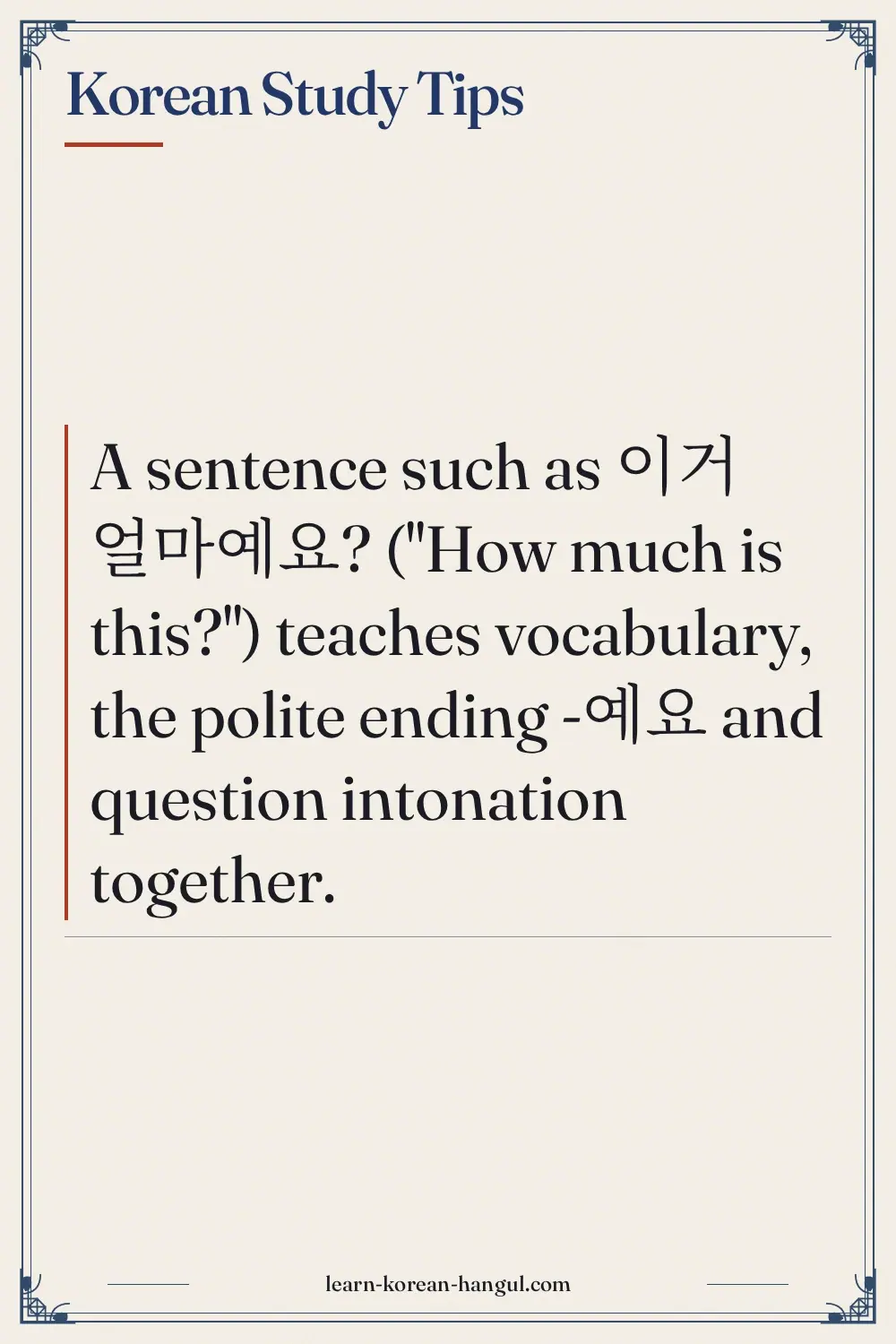
Example: instead of saving only 얼마 ("how much"), save 이거 얼마예요? ("How much is this?"). One sentence teaches the word 얼마, the pronoun 이거 ("this"), the polite ending -예요 and the intonation of a question, with the prominence on 얼마. You also get a line you can use in a shop.
Good sentence sources are sets of situation phrases. The Korean shopping phrases page has ready examples such as asking a price, so you can copy lines instead of inventing them. This habit has a name, sentence mining, explained below.
You'll know it worked when: you can say the sentence and swap one word, such as 이거 (this) for 저거 (that one over there).
Common mistake: saving a sentence that is too long or too rare. If you cannot imagine saying it this month, pick a simpler one.
Sentences need a place to live, and the next habit is how you write them down.
Step 3: Keep Notes in Hangul Only
Action: write every note in Hangul with a meaning, one example and a link to audio, and stop adding romanization after week two.
How: use four columns or four lines per entry, in this order: the Korean, the meaning, one example sentence, and an audio link or a tick mark showing you played the clip. Romanization is the spelling of Korean in Latin letters. The Revised Romanization system used in Korea is a useful bridge in the first days, but it hides the real spelling and the real sounds.
| Column | Entry |
|---|---|
| Korean | 얼마예요? |
| Meaning | How much is it? |
| Example | 이거 얼마예요? |
| Audio | Played, 3 times |
Example: write 학생 ("student") in Hangul with the meaning and the sentence 저는 학생이에요 ("I am a student"). If you want a hint for how to say it, write it once in brackets in the first two weeks and then stop. By week three, the Hangul should carry the sound alone.
You'll know it worked when: you can read last week's notes aloud without any Latin letters in them.
Common mistake: copying a romanization column forever. Romanization cannot show sounds such as the difference between ㄱ, ㅋ and ㄲ, so it trains the wrong habit. Treat it as scaffolding that you remove on a date.
Clean notes are only useful if you also say what is in them, which is the fourth habit.
Step 4: Read Every Example Aloud
Action: say each example sentence aloud at least three times before you move on.
How: read slowly the first time, at normal speed the second time and once more while looking away from the page. Aim for a steady rhythm; Korean syllables are of fairly even length, so avoid stressing one syllable the way English does.
Example: say 화장실이 어디예요? ("Where is the restroom?") three times. Notice that the written 화장실이 [화장시리] links the final ㄹ to the next syllable, so the spelling and the sound differ. Saying it aloud lets you meet the difference in your own mouth.
Reading aloud connects the letters you see to the movements your mouth makes. It also exposes the sentences you only think you know: if you stumble, you do not yet own it. For a full practice method, see Korean shadowing, where you copy audio line by line.
You'll know it worked when: you can say the sentence without stopping and without reading the romanization.
Common mistake: whispering or mouthing the words. Use your real voice at normal volume, in a private room if you must, so that you can hear yourself.
Saying words is half of pronunciation; hearing them before you read is the other half.
Step 5: Listen before You Read
Action: play the audio of a sentence before you look at its written form.
How: cover the Korean text, play the clip once or twice and try to repeat what you heard. Then uncover the text and compare. The order matters because it makes your ear form a guess before your eyes can help.
Example: play the clip for 물 주세요, cover the page and say what you heard. If you wrote 불 (bul, "fire") instead of 물 (mul, "water"), you have found a sound pair you cannot yet tell apart: ㅁ and ㅂ are different consonants. Check, repeat and move on.
This habit fixes a common problem. Learners who always read first never practise listening, so a real conversation sounds like noise. Even five minutes a day of listening with the text covered trains the ear.
You'll know it worked when: you repeat at least half of the short sentences correctly before reading them.
Common mistake: playing a clip ten times in a row. After three tries, look at the text. More repetitions without feedback cement errors.
Hearing and saying are active; the next habit makes sure you can still do both next week.
Step 6: Review on a Spaced Schedule
Action: review each sentence at growing gaps, and let a flashcard tool choose the dates.
How: add your sentence cards to a spaced-repetition tool. A common starting pattern is a review after one day, three days, seven days, fourteen days and thirty days, then longer. The exact gaps vary between tools, and none is proven best for every learner, so treat the pattern as an example. Spend five minutes a day answering the cards that are due, and say the answer aloud before flipping.
Spaced review is built into our Korean flashcards, which schedule cards and play audio on each one. Research summarised by Cepeda and colleagues (Psychological Bulletin, 2006) found that spreading study over time generally beats massing it into one session, which is why daily short reviews beat a weekly marathon.
Example: you added 이거 얼마예요? on Monday. The card returns on Tuesday, then Friday, then the Friday after that. If you answer wrongly on Friday, the tool brings it back sooner.
You'll know it worked when: the number of cards due each day stays steady instead of growing without limit.
Common mistake: adding twenty new cards a day. Each card creates many future reviews, so a big first week becomes a heavy fourth week. Start with five to ten new cards.
A card tool handles daily reviews, and a weekly pause handles everything else.
Step 7: Keep One Weekly Review-Only Day
Action: choose one day a week with no new material, and use it to repair weak spots.
How: spend the 20 minutes on three jobs: redo every starred item from your Step 1 recalls, re-read your notes aloud and write five new sentences that mix old words in new ways. Do not open the next lesson.
Example: on Saturday you gather the week's stars, find that you starred 화장실이 어디예요? twice and rebuild the sentence with another place word, such as 은행이 어디예요? ("Where is the bank?").
You'll know it worked when: on the review day, you can do Monday's sentences from memory.
Common mistake: letting the review day turn into a catch-up for missed lessons. Keep it for review. New material waits for Monday. For help turning the seven steps into a regular pattern, read the guide to self-study Korean methods.
The seven steps are complete, and three questions remain about how to use them.
What Is Sentence Mining in Korean?
Sentence mining is the habit of collecting whole sentences from real material, such as a lesson, a dialogue or a show, and storing them as study cards. You choose sentences that contain exactly one new element, so each card teaches one thing and uses words you already know.
A good mined sentence is short, natural and reusable. Take 커피 한 잔 주세요 ("One cup of coffee, please"). It teaches the word 잔 (a counter for cups), the object 커피 and the polite request 주세요 ("please give"). A bad mined sentence is a long line from a drama that contains six new words and a rare verb ending. Mine from materials slightly below your level and from phrase sets, then add one card at a time.
Why Do You Forget What You Studied?
Forgetting happens because memories fade unless they are used, and most study methods never ask you to use them. Re-reading feels easy and familiar, which tricks you into thinking you know the material. The test comes later, when you need the word in a conversation.
The three most common causes are specific. First, you reviewed too late, so the gap was already too long. Second, you reviewed by looking at the answer instead of recalling it. Third, you studied single words with no context, so the word had nothing to attach to. The fixes are Steps 1, 6 and 2. If you keep losing the same words, check your notes for a pattern. Some learners find that the lost words are all abstract nouns or all verbs, and a few concrete sentences about each solve it. For a catalogue of related errors, see the common study mistakes in learning mistakes.
How Do You Study with Only Ten Minutes?
With ten minutes, do recall, one review round and one aloud pass, and skip new material on the busiest days. The goal on a short day is to keep the habit and the memory alive, not to move forward.
| Minutes | Do this |
|---|---|
| 2 | Recall from yesterday (Step 1) |
| 5 | Answer the due cards aloud (Step 6) |
| 3 | Read two old sentences aloud (Step 4) |
Missing new material for a few days costs very little. Missing the habit for a few weeks costs a lot. A 10-minute day that you actually do is worth more than a 40-minute day that you plan and skip. If your weeks are often short on time, the 15-minute plan for busy people shows how to shrink a plan without dropping the habit.
Is Morning or Evening Study Better?
Neither time of day has a proven advantage for language learning, so choose the slot you can repeat. The best study time is the one tied to a fixed cue, such as after breakfast or on the commute.
There is a small, practical difference. A morning session suits new sentences and aloud practice because you are fresh and the room is quiet. An evening session suits review, because reviewing before sleep is convenient for many learners. Some people split the day: five minutes of cards in the morning and fifteen minutes of sentences at night. Pick one pattern for two weeks and keep it. Changing the time every few days is more harmful than any particular time.
Common Mistakes and How to Fix Them
Most failed study habits come from five mistakes, and each has a simple correction.
- Re-reading instead of recalling. Fix: start every session with the two-minute blank-page recall.
- Collecting words without sentences. Fix: store each new word inside a sentence you could say.
- Using romanization as a crutch. Fix: set a date, such as the end of week two, after which notes are Hangul only.
- Studying only silently. Fix: say every example three times aloud.
- Using five resources at once. Fix: follow the one-resource rule. Choose one course or textbook and one flashcard tool, and add nothing new for a month.
A sixth mistake is hard to see: measuring effort in hours instead of results. Track the number of sentences you can say from memory each Friday. If that number grows, the habits are working, whatever the clock says.
Putting the Korean Study Tips into One 20-Minute Session
A complete session built from these Korean study tips runs in a fixed order: recall, review, new sentences, aloud, listening. The order puts the hardest mental work first, when you are most alert, and ends with listening, which is the least tiring.
| Order | Minutes | Task | Step |
|---|---|---|---|
| 1 | 2 | Blank-page recall | 1 |
| 2 | 5 | Due flashcards, answered aloud | 6 |
| 3 | 5 | Learn two new sentences, notes in Hangul | 2 and 3 |
| 4 | 3 | Read the day's sentences aloud three times | 4 |
| 5 | 5 | Listen with the text covered | 5 |
Be honest about the limits. These habits improve how well you remember and say what you study. They do not supply feedback on your speaking or on your writing. For that you need a tutor or an exchange partner, covered in the pages on language exchange and online Korean tutors. They also cannot decide the order of your lessons; a plan does that.
Once the session works, the next step is to repeat it at a fixed time every day. Continue with the guide to build your daily routine around these habits.
Frequently Asked Questions
How many new words a day is too many?
Five to ten new sentences a day is a safe range for most beginners. Each new card returns many times in the following weeks, so a high number creates a review pile that grows faster than you can clear it. If your due cards exceed what fits in five to ten minutes, stop adding new cards until the pile shrinks.
Should I rewrite my notes by hand?
Handwriting helps when it makes you slow down and think about each letter, which suits the first weeks of Hangul. Copying whole pages without thinking adds little. Write by hand when you are learning to form letters, then switch to typing or card tools when speed matters more than letter shape.
Do study playlists or music help?
Music helps with mood and listening, but it is weak for study unless you focus on the words. Instrumental music can make a session feel pleasant. Songs in Korean are better used as a separate listening activity, with the lyrics open, than as background during a recall exercise that needs full attention.
How do I study Korean on my commute?
A commute suits listening and card review, because neither needs a desk. Play audio of sentences you already studied, repeat them quietly, and clear your due cards on your phone. Save new sentences and note-taking for a seated session, since writing in Hangul is slow on a moving train.