
- 01
Does Korean Learning for Busy People Work in 15 Minutes?
- 02
Before You Start
- 03
Step 1: Review for 5 Minutes
- 04
Step 2: Learn Something New in 7 Minutes
- 05
Step 3: Listen for 3 Minutes
- 06
Where Can You Find 15 Minutes?
If you have more time, compare this plan with all Korean study plans by time horizon. Everything below assumes an adult learner who starts from nothing and has no fixed study hour.
Does Korean Learning for Busy People Work in 15 Minutes?
Fifteen minutes a day works for steady progress on the basics, and it does not work for fast results. A daily 15-minute block adds up to about 91 hours in a year (15 minutes x 365 days = 5,475 minutes). That is enough to learn Hangul, build a first vocabulary of a few hundred words and understand simple phrases, as long as the minutes are used well.
Three ideas explain why short blocks are worth the effort:
- Microlearning means studying in very small units, such as one flashcard set or one short lesson section, instead of one long session.
- Distributed practice means spreading study over many days. Memory research going back to Hermann Ebbinghaus's forgetting curve shows that new material fades quickly without review, and that repeated, spaced contact slows the fading.
- Spaced repetition is a review schedule that shows a card again after a growing gap. A flashcard deck can run this schedule for you.
Time-on-task, the total number of minutes spent actually working on the language, still matters most. Short blocks beat no blocks, but 15 minutes a day will not match the pace of a learner who studies for an hour.
| Question | Short answer |
|---|---|
| Can 15 minutes a day teach Hangul? | Yes, in about 8 sessions plus a few reading sessions |
| How many hours is that in a year? | About 90 |
| Can it reach A1? | The first A1 skills in 6 to 9 months; full A1 takes longer |
| Is conversation realistic in 3 months? | No, but reading and basic phrases are |
| What is the one rule? | Never skip the daily review |
The U.S. Foreign Service Institute (FSI) places Korean in Category IV, its hardest group for native English speakers, at about 88 weeks (2,200 class hours) of full-time training to reach professional working proficiency. Ninety hours a year is a small fraction of that figure, so a busy learner should treat this plan as a foundation and expect a multi-year route to comfortable conversation. Results also vary with study method, the amount of listening and speaking, and the learner's other languages.
The plan has a short setup first, so the daily minutes go to study and not to searching for tools.
Before You Start
The 15-minute plan needs a phone, headphones and one free evening to set up. Check these items once and then leave them alone.
| Item | Detail |
|---|---|
| Time | 15 minutes a day, every day, in one block or three small ones |
| Difficulty | Beginner (A0 to the first A1 skills) |
| Cost | Free: all linked lessons, audio and decks cost nothing |
| Prerequisites | None; no earlier Korean needed |
| Tools | Phone, earphones, a flashcard deck, a notebook (optional) |
| Daily split | 5 minutes review, 7 minutes new, 3 minutes listening |
Do these five setup tasks before day 1:
- Open the Hangul flashcards on your phone and check that the audio plays through your earphones.
- Test the page on mobile data and, if you plan to study on a train, in airplane mode. If audio does not play without a connection, plan to use the listening step only where you have signal.
- Use the same phone and the same browser every day. Progress tools on this site save to the browser on one device, so switching devices can hide your history.
- Put a link to the lesson list on your home screen, so the first tap on each study block lands on the right page.
- Choose a cue for the habit: a fixed moment such as your first coffee or the train doors closing. A cue that you already do every day carries the new habit.
That last idea is called habit stacking: attaching a new small habit to one you already have. Once the cue is chosen, the first block can begin with review.
Step 1: Review for 5 Minutes
Action: open the deck and review every card that is due, for 5 minutes at most.
How: review comes first because forgotten items cost more to relearn than to refresh.
- Start with the cards the deck marks as due. Say each answer aloud, or in your head if you are on public transport, before flipping the card.
- Mark a card as "hard" if you hesitated for more than a couple of seconds, even if the answer was right.
- Stop when the timer ends, even if cards remain. Leftover cards will be due again tomorrow.
- In the first week, review the letters you learned the day before. After that, review words as well.
For example, a first review card might show 한글 (hangeul, the Korean alphabet) with audio, and your task is to say the word and its meaning before checking.
Keep new cards out of this block. A cap of 20 cards per review block keeps it near 5 minutes for most learners; a larger pile means the deck is giving you too many new cards.
You'll know it worked when: the 5 minutes end with the timer and not with a feeling of being rushed, and the "hard" pile shrinks over the week.
Common mistake: skipping review on a day with little time and doing only the new lesson. New material piles up on a weak base, and the next week feels harder. If only 5 minutes exist, spend all 5 on review.
Review keeps old items alive. The next 7 minutes add something new.
Step 2: Learn Something New in 7 Minutes
Action: study one small new item for 7 minutes: a Hangul lesson in the first weeks, then a few words and one sentence.
How: the first goal is Hangul, which is why the first 8 sessions follow the Hangul course in 15-minute chunks. The course runs over 7 days at a normal pace. Split each lesson across two blocks if one block is too short. A suggested split is below.
| Session | New material (7 minutes) | Review (5 minutes) |
|---|---|---|
| 1 | Basic vowels ㅏ ㅓ ㅗ ㅜ | None yet |
| 2 | More vowels ㅡ ㅣ ㅐ ㅔ | Session 1 |
| 3 | First basic consonants ㄱ ㄴ ㄷ ㄹ ㅁ | Sessions 1-2 |
| 4 | Basic consonants ㅂ ㅅ ㅇ ㅈ ㅎ | Sessions 2-3 |
| 5 | Building syllable blocks, such as 가 and 나 | Sessions 3-4 |
| 6 | Aspirated and tense consonants | Sessions 4-5 |
| 7 | Final consonants (batchim), the consonant at the bottom of a syllable block | Sessions 5-6 |
| 8 | Reading practice with whole words | Sessions 6-7 |
The grouping is a planning estimate, and the Hangul course lessons remain the source for each letter. A learner who needs 10 or 12 sessions has not failed; the dates of the plan simply move.
After Hangul, the 7-minute block becomes a vocabulary block. Learn 5 new words, each with audio, and one short sentence that uses one of them. For example:
- 사과 (sagwa) means "apple".
- 학교 (hakgyo) means "school", and it is pronounced [학꾜]: the ㄱ after a final ㄱ turns tense.
- 물 주세요 (mul juseyo) means "Water, please."
Romanization appears in brackets and parentheses only as a temporary aid. By the second week, read the Hangul and look at the Latin letters only if you are stuck.
You'll know it worked when: by the end of week 2, you can read a short word you have never seen before, slowly but without help, and by the end of week 8 you know about 100 words.
Common mistake: adding extra new items because the first 7 minutes felt easy. Five new words a day is about 35 words a week, and each one will return in review. A larger number overloads Step 1 within days.
New items need sound attached from the start, so the final block is listening.
Step 3: Listen for 3 Minutes
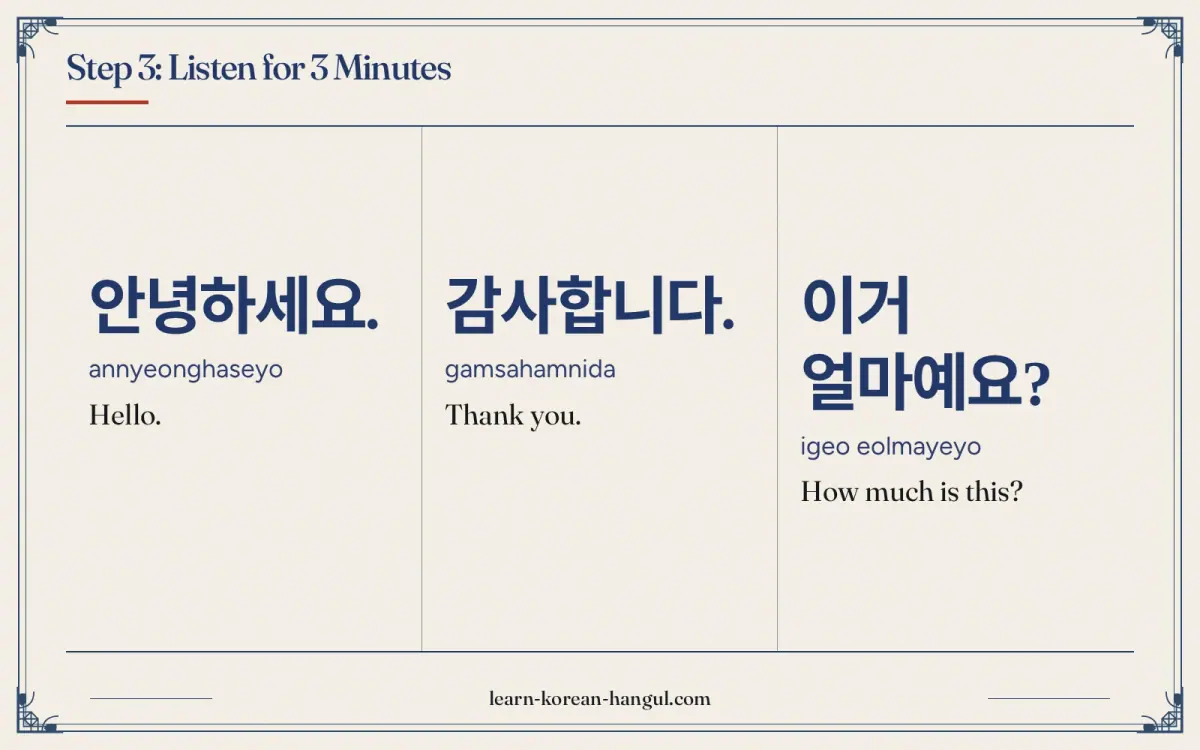
Action: spend 3 minutes listening to the day's new words and phrases, with your eyes off the screen if you can.
How: the aim is to connect sound to meaning, not to follow native-speed speech.
- Replay the 5 new words from Step 2 once each.
- Play one common phrase twice, then say it aloud with the audio.
- Twice a week, use a short listening drill on similar sounds instead, to train your ear on contrasts such as plain, tense and aspirated consonants.
The phrases below suit the first weeks, because each one is a complete, useful sentence.
| Korean | Romanization (aid) | Meaning |
|---|---|---|
| 안녕하세요. | annyeonghaseyo | Hello. |
| 감사합니다. | gamsahamnida | Thank you. |
| 이거 얼마예요? | igeo eolmayeyo | How much is this? |
Use it as a model, then compare with other sources as your ear develops.
You'll know it worked when: you can hear a phrase from your list in a new voice and recognise it without reading.
Common mistake: treating listening as the block to drop. Listening usually lags behind reading, so a learner who skips it can read Hangul well and still not understand a simple spoken sentence. Even 3 minutes a day prevents the gap from growing.
With the three blocks defined, the practical question is when to fit them in.
Where Can You Find 15 Minutes?
Fifteen minutes appear in most days as three small gaps: commute, waiting time and lunch. The micro-slot map below assigns each block of the plan to a gap where it fits.
| Slot | Block | Minutes | What you need |
|---|---|---|---|
| Commute or walk | Listening: audio only | 3 | Earphones |
| Queue, waiting room or coffee line | Review: up to 20 flashcards | 5 | Phone |
| Lunch break | One micro-lesson section | 7 | Phone or laptop |
If the day has one free block, do the standard order (review, new, listening). If the day is split, keep review before the new lesson, because the new lesson is easier when the old items are fresh.
Three situations come up often:
- Full-time job: attach the plan to a fixed cue, as in the setup, and place review in the morning when attention is highest.
- Children at home: use the three 5-minute pieces. A flashcard set while a child eats, a listening block on the walk to school, and a new item after bedtime all count.
- Too tired after work: do review only. A 5-minute review keeps the habit alive and keeps old items from fading, which is better than a skipped day.
The only requirement is that a day with study is never empty. Skipped days are the next topic, because they decide the real pace.
How Long Will Progress Take at This Pace?
At 15 minutes a day, the first A1 skills typically take 6 to 9 months, and a year of daily study gives about 90 hours. The numbers below are planning estimates, not measurements.
| Minutes a day | Hours in a year | What it typically supports |
|---|---|---|
| 5 | About 30 | Hangul and a few phrases, if review stays daily |
| 10 | About 60 | Hangul plus a small vocabulary in a year |
| 15 | About 90 | The first A1 skills in 6 to 9 months |
| 20 | About 120 | A1 material in under a year |
| 30 | About 180 | Approaches the A1 range of the 3-month plan within about 6 months |
The 6-to-9-month figure refers to the first A1 skills: reading Hangul, understanding a few hundred common words and using a few simple present-tense sentences. The full A1 coverage of the 3-month plan assumes about 90 hours, so a 15-minute learner needs close to a year to cover the same material, and comfortable A1 use, with extra listening and review, typically takes 120 to 200 hours. See how long it takes to learn Korean for the wider picture, and what A1 means to check the target skills.
Missed days change the pace more than the daily length does. A learner who studies 15 minutes on 5 days a week gets about 65 hours a year, not 90. Plan for the missed days and add the weekend bank described below.
What Does a 12-Week Plan Look Like?
A 12-week plan with 15-minute blocks finishes Hangul in the first two weeks and ends with about 150 words. The weekly targets below are typical figures for this plan.
| Week | New material | Words learned (total) | Listening focus |
|---|---|---|---|
| 1 | Hangul sessions 1-4: vowels and basic consonants | 0 | Letter sounds |
| 2 | Hangul sessions 5-8: syllables, final consonants, reading | 10 | Short words |
| 3 | First 15 everyday words | 25 | Greetings |
| 4 | 15 words, including numbers 1 to 10 | 40 | Numbers |
| 5 | 15 words, simple nouns | 55 | Shop phrases |
| 6 | 15 words and the phrase 이거 얼마예요? | 70 | Prices |
| 7 | 15 words, family and people | 85 | Names and titles |
| 8 | 15 words, plus a review of weeks 3-7 | 100 | Replay weeks 3-7 |
| 9 | 15 words, food and drinks | 115 | Ordering |
| 10 | 15 words, places | 130 | Directions |
| 11 | 15 words, daily actions | 145 | Short sentences |
| 12 | 5 words, review of weeks 9-11 and a self-check | 150 | Replay weeks 9-11 |
The word totals are a planning target. Use the list as a template and replace the topics with the words you need for your own life.
After week 8, the outcome is Hangul plus about 100 words, from roughly 14 hours of study (8 weeks x 7 days x 15 minutes). At that point, a learner can read signs and menus slowly and recognise a handful of spoken phrases.
What to Drop and What to Keep
A short plan needs a short list of priorities. Drop what takes a lot of time and returns little at this stage, and keep what makes the other minutes work.
| Drop for now | Why | Keep always | Why |
|---|---|---|---|
| Handwriting practice | Slow, and reading comes first | Daily review | Prevents forgetting |
| Grammar deep-dives | Need long, focused blocks | Audio with every new word | Builds the ear from day 1 |
| Switching apps or decks | Setup costs minutes | One short phrase a day | Gives real use early |
| Perfectionist pronunciation drills | Better after a few hundred words | The same time cue | Holds the habit |
Handwriting and long grammar explanations are good activities later. They are the first things to cut when time is short, and they can return when the daily time grows.
A weekend "bank" session helps when weekdays go wrong. Add one 45-minute session on Saturday or Sunday: 15 minutes of review, 20 minutes of the next lesson and 10 minutes of listening. The bank covers about three missed days of new material, but it does not replace daily review, because spacing is the point of daily review.
What If 15 Minutes Is Too Much or Too Little?
The plan scales down to 10 minutes and up to 30 without changing its order. Review always comes first, new material second, listening last.
| Daily time | Review | New | Listening | Hours in a year |
|---|---|---|---|---|
| 10 minutes | 4 | 4 | 2 | About 60 |
| 15 minutes | 5 | 7 | 3 | About 90 |
| 30 minutes | 8 | 15 | 7 | About 180 |
On a 10-minute day, learn 3 words, not 5. On a 30-minute day, add a second short lesson section and one longer listening clip. When your regular free time grows past 30 minutes, the Korean study routine gives a longer daily structure, and the 30-day plan may suit a short trip.
Common Mistakes When Time Is Short
Short sessions fail in predictable ways. The list below names the six most common ones and the repair for each.
- Skipping review to save time. Result: forgotten words and a harder next week. Fix: spend the whole block on review when time is short.
- Adding too many new cards. Result: a review pile that no longer fits in 5 minutes. Fix: cap new cards at 5 a day.
- Studying only on weekends. Result: long gaps between contacts and heavy forgetting. Fix: add even a 5-minute weekday review to the weekend session.
- Using romanization as a crutch. Result: reading never becomes automatic. Fix: after week 2, cover the Latin letters.
- Waiting for a perfect study time. Result: a missed day becomes a missed week. Fix: pick two backup slots, such as lunch and bed.
- Judging progress by feeling. Result: a sense of failure at 15 minutes. Fix: tick off each day in the checklist and count the weeks.
Expert tip: when a day is a write-off, do the 3-minute listening block only. It takes almost no effort, and it protects the daily streak that makes the next day easier. When you are ready for more structure, read the guide to self-study methods for small time slots.
The Bottom Line for Korean Learning for Busy People
Korean learning for busy people succeeds when review is daily, the new item is small and listening never disappears. Fifteen minutes a day gives about 90 hours a year, which is enough for Hangul, a first vocabulary and the first A1 skills, and it is not enough for fluency. Keep the cue, keep the order, and adjust the length of the block, not the order of the steps.
To go further, move to the Korean study routine when you gain time, or to the one-year plan when you can give about an hour a day. The Korean flashcards hub collects the decks and lessons this plan uses.
Lesson Review
Frequently Asked Questions
Is 10 minutes a day worth it?
Yes, if the 10 minutes are used well and happen every day. A split of 4 minutes review, 4 minutes new and 2 minutes listening gives about 60 hours a year. Progress is slower than at 15 minutes, so Hangul takes more than 8 sessions, but daily contact still beats long, rare sessions.
Which tasks fit a commute?
Audio tasks fit best: replaying the day's words, repeating a phrase aloud softly and listening to short sound drills. Flashcard review also works on a phone if you can hold it. Avoid new Hangul lessons on a crowded train, because reading new letters needs close attention to the screen.
Can I study only on weekends instead?
You can, but progress is slower and less stable. Two weekend sessions of 45 minutes give about 78 hours a year if you never miss, yet the long gaps let words fade. Add a 5-minute weekday review to hold what the weekend session teaches.
Should I use an app or this site?
Either works if the daily order stays the same: review, new, listening. This site gives free lessons, audio and decks in one place, which saves setup minutes. An app helps if it schedules reviews for you and works offline. Do not switch tools every week, because switching costs study time.