What you will be able to do after this page
- Choose 하다 or 되다 for 12 or more nouns and explain the difference (do vs become or be done).
- Use 을/를 with 하다 verbs and 이/가 with 되다 verbs.
- Say feelings with 되다, as in 기대돼요 (I look forward to it) and 걱정돼요 (I am worried).
- Spot the five mistakes learners make most often, including 됬어요.
Before you start: read Korean hada verbs explained, because this lesson assumes you know that noun + 하다 makes a verb. Time: about 35 minutes. Level: B1.
What Is the Difference between Hada and Doeda?
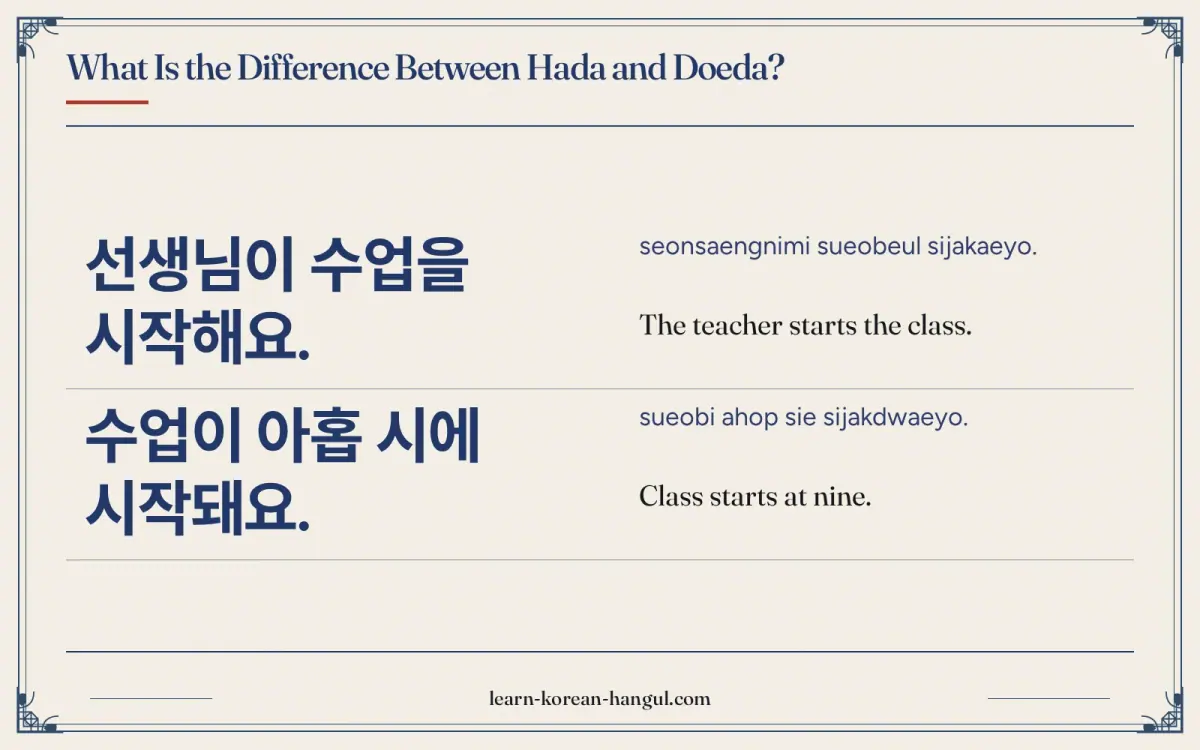
하다 (hada) is the verb "to do", and 되다 (doeda) is the verb "to become". When you attach them to the same noun, the pair differs in who is in charge. With 하다, there is a doer, and the doer acts on something: 선생님이 수업을 시작해요 (The teacher starts the class). With 되다, the noun itself is the subject and something happens to it: 수업이 아홉 시에 시작돼요 (Class starts at nine).
The difference shows up in two places: the verb and the particles. A particle is a short word attached to a noun that marks its job. A noun before 하다 usually has the object particle 을/를, because it is the thing someone does something to. A noun before 되다 has the subject particle 이/가, because it is the thing that changes.
| 하다 | 되다 | |
|---|---|---|
| Meaning | do; carry out | become; happen; be done |
| Who acts? | A person or group does it | Nobody is named, or it happens by itself |
| Particle on the noun | 을/를 (object) | 이/가 (subject) |
| Example | 문제를 해결해요. | 문제가 해결돼요. |
| English | I solve the problem. | The problem gets solved. |
선생님이 수업을 시작해요.
seonsaengnimi sueobeul sijakaeyo.
The teacher starts the class.
수업이 아홉 시에 시작돼요.
sueobi ahop sie sijakdwaeyo.
Class starts at nine.
Both verbs come from the same Sino-Korean noun 시작 (a start). Sino-Korean means built from Chinese-derived syllables, and these nouns are the main source of 하다 and 되다 verbs. The lesson on hada verbs explains the 하다 side. For 되다, the point is that the verb works like the English "be done" or "get done", so it is close to a passive. The grammar of that is in -되다 passive 하다 verbs. This page is about the vocabulary choice: which verb fits the meaning you want.
Which 20 Nouns Take Both 하다 and 되다?
Here are 20 nouns that take both verbs. For each one, the table shows the polite present of both verbs, then what each means. The polite present is the everyday -요 style, and it is the form you will say most.
| # | Noun | Revised Romanization | 하다 verb | Meaning of 하다 | 되다 verb | Meaning of 되다 |
|---|---|---|---|---|---|---|
| 1 | 시작 | sijak | 시작해요 | to start (something) | 시작돼요 | to start; to begin (by itself) |
| 2 | 준비 | junbi | 준비해요 | to prepare (something) | 준비돼요 | to be ready; to be prepared |
| 3 | 해결 | haegyeol | 해결해요 | to solve (something) | 해결돼요 | to be solved; to work out |
| 4 | 변경 | byeongyeong | 변경해요 | to change (something) | 변경돼요 | to be changed |
| 5 | 완성 | wanseong | 완성해요 | to complete (something) | 완성돼요 | to be completed |
| 6 | 결정 | gyeoljeong | 결정해요 | to decide (something) | 결정돼요 | to be decided |
| 7 | 연결 | yeongyeol | 연결해요 | to connect (something) | 연결돼요 | to be connected |
| 8 | 사용 | sayong | 사용해요 | to use (something) | 사용돼요 | to be used |
| 9 | 발견 | balgyeon | 발견해요 | to discover; to find (something) | 발견돼요 | to be found; to turn up |
| 10 | 취소 | chwiso | 취소해요 | to cancel (something) | 취소돼요 | to be cancelled |
| 11 | 번역 | beonyeok | 번역해요 | to translate (something) | 번역돼요 | to be translated |
| 12 | 포함 | poham | 포함해요 | to include (something) | 포함돼요 | to be included |
| 13 | 연기 | yeongi | 연기해요 | to postpone (something) | 연기돼요 | to be postponed |
| 14 | 완료 | wallyo | 완료해요 | to finish; to complete (something) | 완료돼요 | to be finished; to be complete |
| 15 | 확인 | hwagin | 확인해요 | to check; to confirm (something) | 확인돼요 | to be confirmed |
| 16 | 예약 | yeyak | 예약해요 | to book; to reserve (something) | 예약돼요 | to be booked; to be reserved |
| 17 | 인정 | injeong | 인정해요 | to acknowledge; to recognise (someone or something) | 인정돼요 | to be recognised |
| 18 | 생각 | saenggak | 생각해요 | to think (about) | 생각돼요 | to seem; to come to mind |
| 19 | 기대 | gidae | 기대해요 | to look forward to; to expect (something) | 기대돼요 | to feel excited; to be looked forward to |
| 20 | 걱정 | geokjeong | 걱정해요 | to worry about (someone or something) | 걱정돼요 | to feel worried |
Look at the polite forms: every 하다 verb ends in 해요 and every 되다 verb ends in 돼요. 돼요 is the contraction of 되어요, so the vowel ㅚ + ㅓ becomes ㅙ. Writers confuse 돼요 with 되요 all the time, and the 돼요 vs 되요 lesson gives a simple test. For the past tense, use 됐어요, not 됬어요: the past of 되다 is 되었어요, shortened to 됐어요. The sounds also change. 시작돼요 is said [시작뙈요] because a final ㄱ tenses the next ㄷ, and in 됐어요 [돼써요] the ㅆ moves onto the next syllable. Revised Romanization does not show the tensing, so 시작돼요 is sijakdwaeyo, and 됐어요 is dwaesseoyo.
How Do the Pairs Sound in Sentences?
Each pair has a 하다 sentence with a doer and a 되다 sentence where the noun is the subject. The Korean is on the left of each row and the English is in brackets. Read both sentences of a pair together, then listen.
| # | 하다 sentence (a doer) | 되다 sentence (the noun is the subject) |
|---|---|---|
| 1 | 선생님이 수업을 시작해요. (The teacher starts the class.) | 수업이 아홉 시에 시작돼요. (Class starts at nine.) |
| 2 | 엄마가 저녁을 준비해요. (Mom prepares dinner.) | 저녁이 준비됐어요. (Dinner is ready.) |
| 3 | 친구가 문제를 해결해요. (My friend solves the problem.) | 문제가 해결됐어요. (The problem has been solved.) |
| 4 | 회사가 계획을 변경해요. (The company changes the plan.) | 계획이 변경됐어요. (The plan was changed.) |
| 5 | 화가가 그림을 완성해요. (The painter completes the painting.) | 그림이 완성됐어요. (The painting is finished.) |
| 6 | 우리가 날짜를 결정해요. (We decide the date.) | 날짜가 결정됐어요. (The date has been decided.) |
| 7 | 직원이 인터넷을 연결해요. (The staff member connects the internet.) | 인터넷이 연결됐어요. (The internet is connected.) |
| 8 | 저는 이 방을 사용해요. (I use this room.) | 이 말은 자주 사용돼요. (This word is often used.) |
| 9 | 아이가 열쇠를 발견해요. (The child finds the key.) | 열쇠가 발견됐어요. (The key was found.) |
| 10 | 손님이 예약을 취소해요. (The customer cancels the reservation.) | 비행기가 취소됐어요. (The flight was cancelled.) |
| 11 | 번역가가 책을 번역해요. (The translator translates the book.) | 그 책이 한국어로 번역됐어요. (That book was translated into Korean.) |
| 12 | 이 가격은 세금을 포함해요. (This price includes tax.) | 아침 식사가 포함돼요. (Breakfast is included.) |
| 13 | 회사가 회의를 연기해요. (The company postpones the meeting.) | 회의가 연기됐어요. (The meeting was postponed.) |
| 14 | 직원이 작업을 완료해요. (The staff member finishes the task.) | 다운로드가 완료됐어요. (The download is complete.) |
| 15 | 직원이 예약을 확인해요. (The staff member checks the reservation.) | 예약이 확인됐어요. (The reservation is confirmed.) |
| 16 | 저는 방을 예약해요. (I book a room.) | 방이 예약됐어요. (The room is booked.) |
| 17 | 선생님이 제 실력을 인정해요. (The teacher recognises my skill.) | 제 실력이 인정됐어요. (My skill was recognised.) |
| 18 | 저는 그렇게 생각해요. (I think so.) | 그렇게 생각돼요. (It seems so to me.) |
| 19 | 저는 여행을 기대해요. (I look forward to the trip.) | 여행이 기대돼요. (I am excited about the trip.) |
| 20 | 엄마가 아이를 걱정해요. (Mom worries about the child.) | 아이가 걱정돼요. (I am worried about the child.) |
Notice three things in the pairs. First, every 하다 sentence has a person (선생님, 엄마, 저) and an object with 을/를. Second, every 되다 sentence has no person: the thing (수업, 문제, 예약) takes 이/가 and the verb describes its state. Third, 되다 often hides the doer on purpose. When a hotel tells you 예약이 확인됐어요, the message is the result, and the doer does not matter.
How Do You Choose between 하다 and 되다?
Ask these three questions in order. Stop at the first one that gets a clear answer.
- Do you want to name the doer, or say what a person does on purpose? Use 하다, with 을/를 on the object. 저는 방을 예약해요. (I book a room.)
- Do you describe a thing that changes, finishes or is available, and the doer does not matter? Use 되다, with 이/가 on the thing. 방이 예약됐어요. (The room is booked.)
- Is it a feeling that comes to you? Use 되다 when the feeling arrives without your choice: 여행이 기대돼요 (I am excited about the trip), 아이가 걱정돼요 (I am worried about the child). Use 하다 when you stress your own attitude or action: 저는 여행을 기대해요 (I look forward to the trip), 엄마가 아이를 걱정해요 (Mom worries about the child).
The test works because Korean marks the doer clearly. English sometimes hides it: "The meeting was postponed" and "They postponed the meeting" are both normal. In Korean, the first is 회의가 연기됐어요 and the second is 회사가 회의를 연기해요. If you mix the particles, the sentence becomes wrong, not just odd.
| Situation | Choose | Example |
|---|---|---|
| You make a booking | 하다 | 호텔을 예약해요 |
| The hotel tells you the booking is made | 되다 | 예약이 확인됐어요 |
| You change the plan yourself | 하다 | 계획을 변경해요 |
| You report that the plan changed | 되다 | 계획이 변경됐어요 |
| A feeling you cannot help | 되다 | 시험이 걱정돼요 |
| A worry you act on | 하다 | 시험을 걱정해요 |
What Do the Groups of Pairs Teach?
Pairs about Work and Results (시작, 준비, 해결, 변경, 완성, 결정, 연결, 완료)
These are the most regular pairs. The 하다 verb is a task and the 되다 verb is its result. 문제를 해결하다 is the work of solving a problem, and 문제가 해결되다 is the news that it is over. In notices, 되다 is the usual choice because the writer reports a state: 다운로드가 완료됐어요 (The download is complete), 인터넷이 연결됐어요 (The internet is connected).
Pairs about Plans and Bookings (취소, 연기, 확인, 예약, 포함)
These appear in travel, hotels and shops. Staff use 하다 for what they do and 되다 for what they tell you: 예약을 확인해요 (I check the reservation) and 예약이 확인됐어요 (The reservation is confirmed). 포함 is the one to watch. 가격에 세금이 포함돼요 means "tax is included in the price", and 이 가격은 세금을 포함해요 means "this price includes tax". Learners usually need the 되다 version.
Pairs about Things and Words (사용, 번역, 발견)
Here 되다 gives the English "is used", "is translated" and "was found". 이 말은 자주 사용돼요 (This word is often used) is how you describe a word or tool in general. It does not say who uses it. Use 하다 when a person uses something: 저는 이 방을 사용해요.
Pairs about Thoughts and Feelings (생각, 기대, 걱정, 인정)
These pairs behave differently, because a feeling is not a passive. 생각하다 means to think about something deliberately, and 생각되다 means that an idea comes to you: 그렇게 생각돼요 (It seems so to me). 기대되다 and 걱정되다 are the normal ways to say "I look forward to it" and "I am worried". The thing you feel about takes 이/가: 여행이 기대돼요, 아이가 걱정돼요. Textbooks for beginners often teach only 걱정하다, but Korean speakers use 걱정돼요 all the time.
여행이 기대돼요.
yeohaengi gidaedwaeyo.
I am excited about the trip.
아이가 걱정돼요.
aiga geokjeongdwaeyo.
I am worried about the child.
그렇게 생각돼요.
geureoke saenggakdwaeyo.
It seems so to me.
Which Nouns Take Only One of the Two Verbs?
Not every noun takes both. Many 하다 nouns have no 되다 partner, because the action is something only a person can do. 공부하다 (study), 운동하다 (exercise), 요리하다 (cook) and 사랑하다 (love) are 하다 only. Some nouns go the other way: 당선되다 (to be elected) is used with the thing that happens to the person, and there is no matching 당선하다 in everyday use. Check the dictionary entry before you build a new pair. The Korean hada verbs hub lists the 하다 side.
One more use of 되다 is different. 되다 on its own means "to become" and takes a noun with 이/가: 의사가 돼요 (I become a doctor; the noun you become takes 이/가). This is the plain verb, not a noun + 되다 pair. The other plain meaning is "to be OK" or "to be allowed", as in 지금 돼요? (Is it OK now?). Dictionary pages for both verbs are on the site: 하다 and 되다.
What Mistakes Do Learners Make with Hada vs Doeda?
| Wrong | Right | Why |
|---|---|---|
| 문제가 해결해요 | 문제가 해결돼요 | A problem cannot do the solving, so the noun needs 되다. |
| 저는 약속을 취소됐어요 | 저는 약속을 취소했어요 | 약속을 is an object that you act on, so use 하다 in the past: 취소했어요. |
| 걱정을 돼요 | 아이가 걱정돼요 / 아이를 걱정해요 | Pick the feeling (되다 with 이/가) or the attitude (하다 with 을/를). |
| 됬어요 | 결정됐어요 | The past of 되다 is 됐어요 (되었어요), and 됬 is never correct. |
| 예약을 확인돼요 | 예약이 확인돼요 / 예약을 확인해요 | The noun and the particle must match the verb: 을/를 with 하다, 이/가 with 되다. |
One caution on style: 시작하다 can be used without an object, so you will hear 수업이 시작해요. Many Korean speakers say it. The safer choice for a learner is 수업이 시작돼요, which no one will correct. Most other 하다 verbs need an object, so treat 시작 as a special case.
Quick Check: Eight Questions
Choose the best answer, then read the explanation.
Practice · 8
Which sentence means "The problem has been solved"?
Show answer
문제가 해결됐어요
The problem is the subject (이/가) and nobody is named, so use 되다.
Which sentence means "I book a room"?
Show answer
저는 방을 예약해요
A doer (저는) acts on the room (방을), so use 하다.
How do you say "I am worried about the child" as a feeling that comes to you?
Show answer
아이가 걱정돼요
A feeling that arrives takes 되다, and the thing you feel about takes 이/가.
What is the correct past form of 되다?
Show answer
됐어요
되었어요 is shortened to 됐어요.
Breakfast is included. Which sentence is right?
Show answer
아침 식사가 포함돼요
The meal is the subject and the verb says its state, so use 되다.
Which particle usually marks the noun before 하다?
Show answer
을/를
The thing a person does something to takes the object particle.
Which verb means "to be postponed"?
Show answer
연기돼요
연기되다 is the 되다 verb for postponed.
Which 하다 verb has no everyday 되다 partner?
Show answer
공부하다
공부하다 (study) is a 하다-only verb.
What Should You Learn after Hada vs Doeda?
Next, learn the polite present 돼요 in 돼요 vs 되요, because it is the form you will write most. For the full grammar of the passive with -되다, go to passive and causative verbs. If you want more practice with noun + 하다 verbs, return to Korean hada verbs explained.
What this page does not cover. It does not cover suffix passives such as 열리다, -아지다/-어지다 passives such as 만들어지다, causative 시키다, or how 되다 works in the pattern -게 되다. Those have their own lessons.
About this page. Last updated 2026-10-09. The Korean text and example sentences were drafted with AI assistance and cross-checked with the site's rule-based conjugation engine; a Korean reviewer checks every lesson before it is marked as reviewed.
Frequently Asked Questions
What Is the Difference between Hada and Doeda in Korean?
하다 means to do, and 되다 means to become or be done. With the same noun, 하다 has a doer and an object with 을/를: 문제를 해결해요 (I solve the problem). 되다 has the thing as the subject with 이/가: 문제가 해결돼요 (The problem gets solved).
Can I Use 되다 with Any 하다 Noun?
No. Only nouns whose action can happen without a named doer take 되다. 공부하다, 운동하다 and 요리하다 take only 하다, and 당선되다 (to be elected) takes only 되다. Check a dictionary before you form a new pair, and learn the 20 pairs on this page first.
Why Do Koreans Say 걱정돼요 Instead of 걱정해요?
걱정되다 describes a worry that comes to you without effort: 아이가 걱정돼요 (I am worried about the child). 걱정하다 stresses the act of worrying about someone, as in 엄마가 아이를 걱정해요. Both are correct, and 걱정돼요 is very common in daily speech.
Is It 돼요 or 되요?
돼요 is correct. It is the contraction of 되어요, so the ending 어 joins 되 to make 돼. 되요 is a spelling error. A quick test: replace the verb with 하다. If 해요 fits, write 돼요.
Is 되다 Always a Passive?
No. After a noun it often works like a passive, as in 예약이 확인됐어요. On its own it means to become (의사가 돼요) or to be OK (지금 돼요?). With feeling nouns it means that the feeling arises in you, as in 기대돼요.