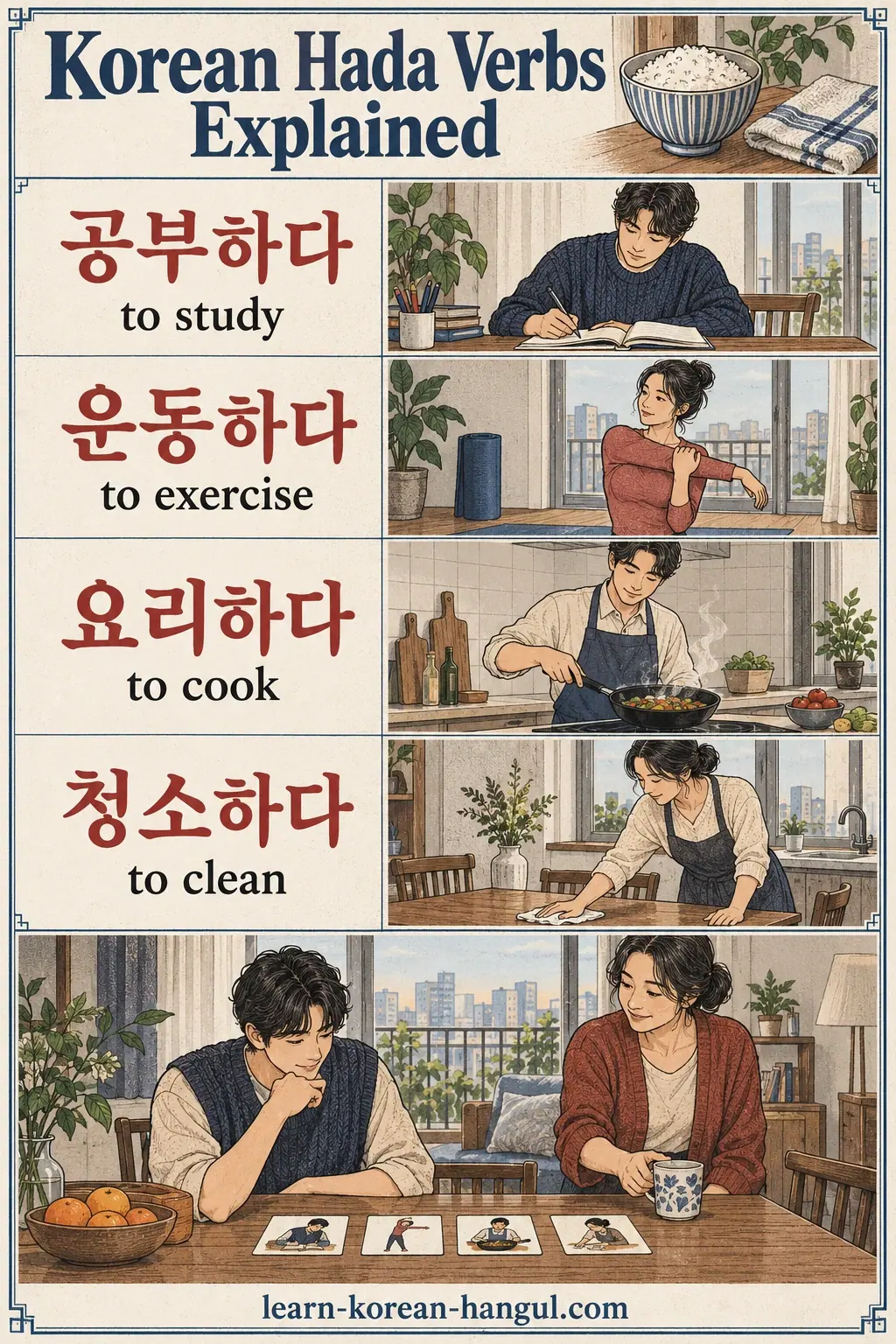
What you will be able to do after this lesson
- Turn 10 nouns into 하다 verbs and conjugate them.
- Decide when to write 공부를 해요 and when to write 공부해요.
- Tell a 하다 verb from a 하다 adjective with one test.
- Explain why 좋아하다 (to like) is not the same word as 좋다 (to be good).
Before you start: read How Korean verbs work. Time: about 30 minutes. Level: A1.
Korean Hada Verbs Explained: What Is a 하다 Verb?

A 하다 verb (하다 동사, hada dongsa) is a verb made by attaching 하다 to a noun that names an action. 하다 on its own is a full verb meaning "to do" (숙제를 하다, "to do homework"). When it is attached to a noun, it works as a suffix that creates a new verb.
| Noun | Meaning | 하다 verb | Meaning | Polite present |
|---|---|---|---|---|
| 공부 | study | 공부하다 | to study | 공부해요 |
| 운동 | exercise | 운동하다 | to exercise | 운동해요 |
| 일 | work | 일하다 | to work | 일해요 |
| 요리 | cooking | 요리하다 | to cook | 요리해요 |
| 청소 | cleaning | 청소하다 | to clean | 청소해요 |
| 전화 | phone call | 전화하다 | to call | 전화해요 |
| 사랑 | love | 사랑하다 | to love | 사랑해요 |
| 생각 | thought | 생각하다 | to think | 생각해요 [생가캐요] |
| 말 | speech | 말하다 | to speak | 말해요 |
| 쇼핑 | shopping | 쇼핑하다 | to shop | 쇼핑해요 |
Revised Romanization (RR) writes hada as the dictionary form and gongbuhaeyo for 공부해요. RR is a reading aid, and the Hangul forms are what you learn.
The noun never changes. Only 하다 conjugates, and it does so in one fixed way. The next section shows the build process step by step.
How Do You Build a Verb with Noun + 하다?

You build a verb by attaching 하다 to the noun with no space, then conjugating 하다 as usual. The process has three steps.
- Take a noun that names an action. 운동 (exercise).
- Attach 하다 without a space. 운동 + 하다 = 운동하다.
- Conjugate 하다. The stem is 운동하. The polite present is 운동해요, the past is 운동했어요, the formal present is 운동합니다.
| Dictionary form | Polite present | Polite past | Formal present | Future (polite) |
|---|---|---|---|---|
| 공부하다 | 공부해요 | 공부했어요 | 공부합니다 | 공부할 거예요 |
| 운동하다 | 운동해요 | 운동했어요 | 운동합니다 | 운동할 거예요 |
| 청소하다 | 청소해요 | 청소했어요 | 청소합니다 | 청소할 거예요 |
| 전화하다 | 전화해요 | 전화했어요 | 전화합니다 | 전화할 거예요 |
| 요리하다 | 요리해요 | 요리했어요 | 요리합니다 | 요리할 거예요 |
Two annotated examples show the pattern in sentences:
- 매일 운동해요. (maeil undonghaeyo.) = I exercise every day. Parts: 매일 "every day", 운동 "exercise", 해요 "do" (polite present).
- 한국어를 공부해요. (hangugeoreul gongbuhaeyo.) = I study Korean. Parts: 한국어를 "Korean" (object), 공부해요 "study" (polite present).
The rule that makes this work, why 하다 becomes 해요, is explained in 하다 to 해요. Meanwhile, a question that every learner meets next is whether the noun and 하다 can be pulled apart.
Can You Put a Particle between the Noun and 하다?

Yes, with action nouns you can insert the object particle 을/를 between the noun and 하다, and the meaning stays the same. 공부를 해요 means the same as 공부해요. The split form treats the noun as the object of the full verb 하다 ("do study").
The split is possible for action nouns and not possible for adjective bases:
| Phrase | Natural? | Reason |
|---|---|---|
| 공부를 해요 | yes | 공부 is an action noun |
| 운동을 해요 | yes | action noun |
| 일을 해요 | yes | 일 means work |
| 청소를 해요 | yes | action noun |
| 전화를 해요 | yes | action noun |
| 쇼핑을 해요 | yes | action noun |
| 요리를 해요 | yes | action noun |
| 사랑을 해요 | rarely | possible, but 사랑해요 is far more common |
| 조용을 해요 | no | 조용 is a quality, not an action |
| 깨끗을 해요 | no | 깨끗 is a quality, not an action |
| 피곤을 해요 | no | 피곤 is a state, not an action |
Splitting lets you place other particles after the noun. 도 means "also" and 는 adds contrast:
- 공부도 해요. = I also study.
- 공부는 했어요. = I did study (but something else did not happen).
It also changes word order in a useful way. Both 매일 운동해요 and 매일 운동을 해요 are correct. You can also put an adverb before 하다 after splitting: 운동을 열심히 해요 ("I exercise hard").
Do not use two object markers in the same sentence. Write 한국어를 공부해요 ("I study Korean") or 한국어 공부를 해요 ("I do Korean study"), but not 한국어를 공부를 해요. The verb has one object, and the object marker 을/를 appears once. The marker itself is taught in object particle 을/를. The sentence order that makes this work is the pattern in Korean SOV sentence pattern.
The split test also exposes a second kind of 하다 word, so the next section sorts them out.
Are All 하다 Words Verbs?

No, many 하다 words are adjectives. Korean has three kinds of 하다 in total:
| Kind | Example | Role of 하다 | Takes 을/를 split? |
|---|---|---|---|
| Full verb | 숙제를 하다 (do homework) | the main verb "do" | not applicable |
| Verb suffix | 공부하다 (study) | makes a verb from an action noun | yes |
| Adjective suffix | 깨끗하다 (be clean) | makes an adjective from a quality noun | no |
Adjectives built with 하다 include:
- 조용하다 (be quiet) → 조용해요
- 깨끗하다 (be clean) → 깨끗해요 [깨끄태요]
- 피곤하다 (be tired) → 피곤해요
- 유명하다 (be famous) → 유명해요
- 행복하다 (be happy) → 행복해요
- 필요하다 (be necessary) → 필요해요
The conjugation is identical for verbs and adjectives, so you do not need to know the type to build 해요. You need the type for two reasons: the split with 을/를, and the modifier form before a noun. Use this one test.
| Test | 하다 verb | 하다 adjective |
|---|---|---|
| Present-tense modifier before a noun | 하는 | 한 |
| Example | 공부하는 학생 (a student who studies) | 조용한 학생 (a quiet student) |
If 하는 sounds right for the present, the word is a verb. If 한 is the only present form, it is an adjective. (Verbs also have 한, but it means the past: 공부한 학생 is "a student who studied".) Both kinds of base can be ordinary nouns: 사랑 (love) gives the verb 사랑하다, while 행복 (happiness) gives the adjective 행복하다. The type depends on the meaning of the finished word.
Next comes a group of 하다 verbs that you can build on your own.
How Do Loanwords Become 하다 Verbs?

Loanwords (외래어, oeraeeo) become verbs by taking 하다, which is how Korean adds new verbs for new activities. Korean does not conjugate the borrowed word. It borrows the noun and lets 하다 do the verb work.
| Loanword noun | Verb | Meaning |
|---|---|---|
| 샤워 | 샤워하다 | to take a shower |
| 쇼핑 | 쇼핑하다 | to shop |
| 데이트 | 데이트하다 | to go on a date |
| 클릭 | 클릭하다 | to click |
| 다운로드 | 다운로드하다 | to download |
| 로그인 | 로그인하다 | to log in |
The same trick works with Sino-Korean nouns (한자어, hanjaeo), which are words built from Chinese-origin roots. 공부 (study), 운동 (exercise), 전화 (telephone) and 청소 (cleaning) all belong to this group. Rule of thumb: Sino-Korean and borrowed nouns take 하다 very often, while native Korean nouns rarely do. The common exceptions are 일하다 (work), 말하다 (speak), 사랑하다 (love) and 이야기하다 (tell a story). More are in Sino-Korean vocabulary and Konglish and loanwords. A longer list is on the page verbs ending in 하다.
Two verbs look related but are not built the same way, as the next section shows.
What Is the Difference between 좋아하다 and 좋다?

좋아하다 is a verb meaning "to like", and 좋다 is an adjective meaning "to be good". 좋아하다 is not noun + 하다. It is the adjective 좋다 with the pattern -아/어 하다, which turns a feeling adjective into a verb.
| 좋다 | 좋아하다 | |
|---|---|---|
| Part of speech | adjective | verb |
| Meaning | be good, be pleasing | like, be fond of |
| Particle on the thing liked | 이/가 | 을/를 |
| Example | 사과가 좋아요. = Apples are good (I like apples). | 사과를 좋아해요. = I like apples. |
| Polite present | 좋아요 [조아요] | 좋아해요 [조아해요] |
The same pattern works for other feelings:
- 싫다 (be disliked) → 싫어하다 (dislike): 저는 비를 싫어해요 [시러해요]. = I dislike rain.
- 무섭다 (be scary) → 무서워하다 (fear)
The main difference is the object marker. A verb takes 을/를 on its object, and an adjective takes 이/가 on its subject. Choosing between them is a basic skill because it changes the grammar of the whole sentence.
What If 하다 Does Not Sound Right?
If 하다 does not fit, the noun may need 되다 (to become, to be done) instead. 하다 expresses an active action, and 되다 expresses something that happens or is done to the thing.
| With 하다 (someone does it) | With 되다 (it gets done) |
|---|---|
| 시작하다 = start (something) | 시작되다 = begin, be started |
| 완성하다 = complete (something) | 완성되다 = be completed |
Example: 수업을 시작해요 means "I start the class", and 수업이 시작돼요 means "the class begins". The pairs are covered in 하다 vs 되다. Rule of thumb: if no one is doing the action, try 되다.
Which Mistakes Do Learners Make with 하다 Verbs?
Learners make five common mistakes, and each one comes from treating 하다 as a normal regular stem or as a free suffix.
| Wrong | Correct | Cause |
|---|---|---|
| 공부하요 | 공부해요 | 하다 never takes 아요 or 요 alone; the polite present is 해요 |
| 공부 해요 (in careful writing) | 공부해요 or 공부를 해요 | write 하다 attached, or split with 을/를; a bare space reads as a dropped 를, which is fine in casual speech but not the standard written form |
| 한국어를 공부를 해요 | 한국어를 공부해요 | two object markers for one verb |
| 조용을 해요 | 조용해요 | adjective bases do not split |
| 먹하다 | 먹다 | 하다 attaches to nouns, not to verb stems |
An expert insight: the noun part of a 하다 verb is still a full noun, so it can be used alone. 공부가 재미있어요 means "Studying is fun", and 운동이 필요해요 means "Exercise is necessary". The same word 공부 is therefore both the action name and the thing you do, which is why 공부를 해요 sounds natural and why learners often hear both forms in one conversation.
Practice
Try each task before you check the answers.
- Build the 하다 verb from 요리, 청소, 샤워 and 전화, and give each polite present.
- Rewrite 공부해요 with 을/를.
- Which is natural: 조용을 해요 or 조용해요?
- Which test word fits 조용: 하는 or 한?
- Choose 좋아요 or 좋아해요: 저는 한국 음식을 ___ ("I like Korean food").
- Fix the error: 한국어를 공부를 해요.
Practice · 4
Polite present of 청소하다
Show answer
청소해요
Natural phrase
Show answer
조용해요
I like Korean food: 저는 한국 음식을 ___
Show answer
좋아해요
Present-tense modifier test for 공부하다
Show answer
공부하는
Answers to the Practice
- 요리하다 → 요리해요; 청소하다 → 청소해요; 샤워하다 → 샤워해요; 전화하다 → 전화해요.
- 공부를 해요.
- 조용해요. 조용 is a quality, so it does not split.
- 한 (조용한 학생). 조용하다 is an adjective.
- 좋아해요. The object 한국 음식을 takes the verb 좋아하다.
- 한국어를 공부해요 or 한국어 공부를 해요. Use one object marker.
If you missed an answer, return to the section named in its topic. Then try the list on verbs ending in 하다 for more practice.
What to Learn Next
Korean hada verbs explained in one rule: attach 하다 to a noun, conjugate 하다 as 해요, and split the noun with 을/를 only when it names an action. The next lesson is 하다 to 해요, which explains why 하다 becomes 해요 and how the rule covers every verb ending in 하다. For more verbs of this type, use verbs ending in 하다.
This lesson covers structure and splitting. It does not give a complete word list, the full contrast with 되다, or the tense meanings of the verbs. Negation of 하다 verbs, such as 공부 안 해요, is taught in negating 하다 verbs. The forms follow standard written Korean as described by the National Institute of Korean Language (국립국어원), and the bracketed pronunciations are standard Seoul approximations.
Frequently Asked Questions
What is a 하다 verb? A 하다 verb is a verb built from a noun plus 하다 (to do), such as 공부하다 (to study) from 공부 (study). The noun names the action and 하다 turns it into a verb. The same pattern builds 하다 adjectives, such as 조용하다 (to be quiet). All of them conjugate like 하다: 해요, 했어요, 합니다.
Can I put 을/를 before 하다? Yes, with action nouns. 공부를 해요 means the same as 공부해요, and 운동을 해요 means the same as 운동해요. The split form lets you add words such as 도 or 는 after the noun. It does not work with adjective bases, so 조용을 해요 is wrong. Never use two object markers: 한국어를 공부를 해요 is wrong.
How many 하다 verbs are there? Too many for one fixed list, because new ones appear whenever a Sino-Korean or borrowed noun needs a verb. 샤워하다, 쇼핑하다 and 클릭하다 are examples built from loanwords. Learners usually meet the common ones by topic. A separate page lists many verbs that end in 하다, so you can practise them in groups.
Are all 하다 words verbs? No. Many 하다 words are adjectives. 공부하다 and 운동하다 are verbs, but 조용하다, 깨끗하다 and 피곤하다 describe states and are adjectives. A quick test is the present-tense modifier: verbs use 하는 (공부하는 학생) and adjectives use 한 (조용한 학생). Both groups conjugate the same way in the polite present.
How do I conjugate a 하다 verb? Replace 하다 with 해요 for the polite present: 공부하다 becomes 공부해요. The past is 했어요 (공부했어요) and the formal present is 합니다 (공부합니다). The noun part never changes. This works because 하 takes the ending 여요, and 하 + 여 contracts to 해, the rule explained in the lesson on 하다 to 해요.