What you'll learn
- Name the stem of any dictionary verb or adjective.
- Sort a stem into vowel, consonant or ㄹ type by looking at its spelling.
- Choose between 가면 and 먹으면, or between 갑니다 and 먹습니다.
- Explain why the stem 하 gives 해요 and not 하아요.
- Work backwards from a conjugated form to its stem.
Prerequisites: you know that dictionary verbs end in 다, as shown in the Korean verb base form. Time: about 25 minutes.
The first section gives the definition and the rule for finding the stem.
What Is a Verb Stem in Korean?
A verb stem (어간, eogan) is the fixed front part of a Korean verb or adjective, the part that carries its meaning. Endings (어미, eomi) attach after it. In 먹었어요 the stem is 먹, which means "eat". The pieces 었 and 어요 are endings that add "past" and "polite".
The stem is the answer to a practical question: what do I attach the ending to? In English you add -ed to "walk" to make "walked". In Korean you add 었 to the stem 먹 to make 먹었어요. The stem is the equivalent of "walk" in the English example, with one difference: Korean stems cannot stand alone as words, so you only ever see them in front of an ending.
Verbs and adjectives both have stems. The adjective 크다 ("to be big") has the stem 크, and the verb 가다 ("to go") has the stem 가. Both then take the same endings. The next section gives the steps for finding a stem.
How Do You Find the Stem?

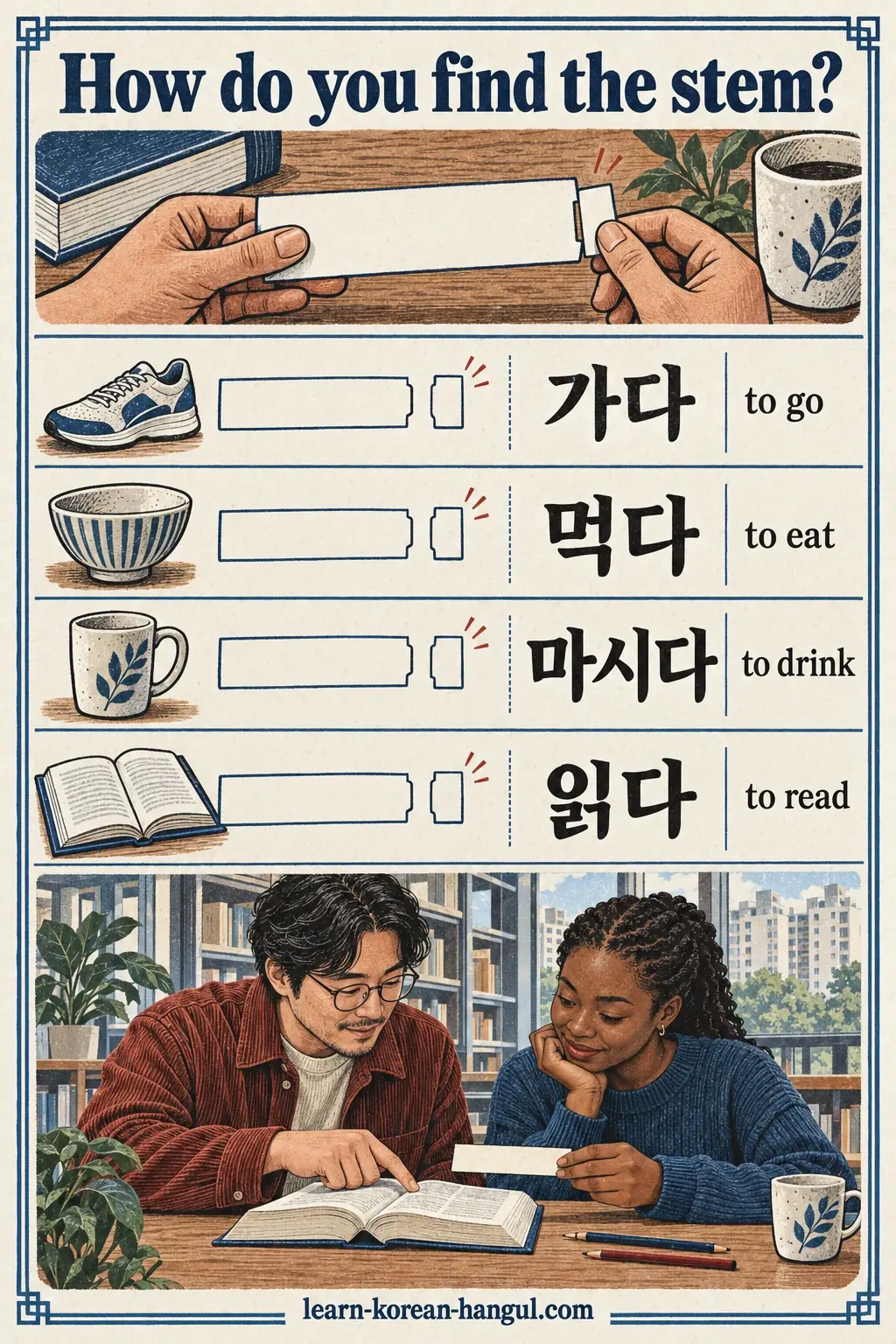
To find the stem, remove the final 다 from the dictionary form. Everything left is the stem. The method works for verbs, adjectives, 하다 words and the copulas.
| Dictionary form | Meaning | Remove 다 | Stem |
|---|---|---|---|
| 가다 | to go | 가다 → 가 | 가 |
| 먹다 | to eat | 먹다 → 먹 | 먹 |
| 마시다 | to drink | 마시다 → 마시 | 마시 |
| 읽다 | to read | 읽다 → 읽 | 읽 |
| 살다 | to live | 살다 → 살 | 살 |
| 하다 | to do | 하다 → 하 | 하 |
| 공부하다 | to study | 공부하다 → 공부하 | 공부하 |
| 크다 | to be big | 크다 → 크 | 크 |
| 좋다 | to be good | 좋다 → 좋 | 좋 |
| 예쁘다 | to be pretty | 예쁘다 → 예쁘 | 예쁘 |
| 있다 | to exist | 있다 → 있 | 있 |
| 만들다 | to make | 만들다 → 만들 | 만들 |
| 기다리다 | to wait | 기다리다 → 기다리 | 기다리 |
| 이다 | to be (copula) | 이다 → 이 | 이 |
| 아프다 | to be sick | 아프다 → 아프 | 아프 |
The table has 15 examples. The stem is not defined by its position: it is simply everything before 다. For a multi-syllable word such as 기다리다 the stem is 기다리. You'll know it worked when you can say the stem aloud and it ends where the dictionary form's 다 begins. The full method, with a drill, is in the Korean verb base form. The last sound of the stem is the next thing to check.
Vowel Stems and Consonant Stems

A stem is either a vowel stem or a consonant stem, depending on whether its last syllable block has a final consonant (batchim). A vowel stem has no batchim: 가, 사, 마시. A consonant stem has a batchim: 먹, 읽, 좋, 살. The test uses the spelling you see, not the sound you hear.
| Stem type | Test | Examples | Dictionary forms |
|---|---|---|---|
| Vowel stem | last block has no batchim | 가, 사, 마시, 크, 하 | 가다, 사다, 마시다, 크다, 하다 |
| Consonant stem | last block has a batchim | 먹, 읽, 좋, 있, 입 | 먹다, 읽다, 좋다, 있다, 입다 |
| ㄹ stem (special consonant stem) | last batchim is ㄹ | 살, 만들, 알, 길 | 살다, 만들다, 알다, 길다 |
A common confusion is that the batchim of a stem is pronounced differently from its spelling. The stem 읽 ends in the two-letter final cluster ㄺ. In the dictionary form only the ㄱ is heard, 읽다 [익따], but before a vowel ending both letters are heard: 읽어요 [일거요]. The spelling of the stem stays 읽 in both. The test "does the last block have a batchim?" gives a stable answer, while listening for the sound does not. The sound rules are in batchim pronunciation. The next section shows why the difference matters.
Which Endings Add 으 after a Consonant Stem?

Endings written with (으) add the linking vowel 으 (a bridge vowel, 매개모음) after a consonant stem, and drop it after a vowel stem. The ending is written with (으) in a grammar book to show this: -(으)면 means -면 after a vowel stem and -으면 after a consonant stem.
The reason is simple to hear. Two consonants meeting (먹 + ㅁ) are hard to say, so Korean inserts the neutral vowel ㅡ between them. After a vowel stem there is no clash, so nothing is inserted.
Twelve common endings follow this pattern:
| # | Ending | Meaning | After vowel stem 가 | After consonant stem 먹 |
|---|---|---|---|---|
| 1 | -(으)면 | if | 가면 | 먹으면 [머그면] |
| 2 | -(으)니까 | because | 가니까 | 먹으니까 [머그니까] |
| 3 | -(으)세요 | please / honorific | 가세요 | 먹으세요 [머그세요] |
| 4 | -(으)ㄴ | that (past, verb) | 간 | 먹은 [머근] |
| 5 | -(으)ㄹ 거예요 | will | 갈 거예요 | 먹을 거예요 [머글꺼예요] |
| 6 | -(으)ㄹ까요? | shall we? | 갈까요 | 먹을까요 [머글까요] |
| 7 | -(으)러 | in order to | 가러 | 먹으러 [머그러] |
| 8 | -(으)려고 | intending to | 가려고 | 먹으려고 [머그려고] |
| 9 | -(으)ㄹ게요 | I will (promise) | 갈게요 | 먹을게요 [머글께요] |
| 10 | -(으)면서 | while | 가면서 | 먹으면서 [머그면서] |
| 11 | -(으)ㅂ시다 | let's (formal) | 갑시다 | 먹읍시다 [머급씨다] |
| 12 | -(으)ㄹ 수 있다 | can | 갈 수 있다 | 먹을 수 있다 [머글쑤 읻따] |
Not every ending has a 으 form. Endings that start with a consonant and do not have a (으) in their name attach directly to any stem, whatever its type:
| Ending | Meaning | After 가 | After 먹 |
|---|---|---|---|
| -고 | and | 가고 | 먹고 |
| -지만 | but | 가지만 | 먹지만 |
| -지요 / -죠 | right? | 가지요 | 먹지요 |
| -네요 | I see | 가네요 | 먹네요 |
| -거나 | or | 가거나 | 먹거나 |
| -기 | -ing (noun) | 가기 | 먹기 |
Endings that start with a vowel, such as 아요 and 어요, do not use 으 either. They follow vowel harmony instead: 가 + 아요 → 가요, and 먹 + 어요 → 먹어요. That is the topic of the present tense recipe.
The formal pair works the same way as the 으 endings. Formal speech uses -ㅂ니다 after a vowel stem and -습니다 after a consonant stem: 갑니다 and 먹습니다. The two forms are one ending in two shapes, covered in Korean formal speech. One consonant stem group breaks the pattern, and that comes next.
ㄹ Stems and the ㄹ Drop

An ㄹ stem is a stem whose last letter is ㄹ, such as 살 (from 살다, "to live") or 만들 (from 만들다, "to make"). It behaves differently from other consonant stems in two ways: it never adds 으, and it drops the ㄹ before the letters ㄴ, ㅂ and ㅅ.
| Ending | 살다 (stem 살) | What happened |
|---|---|---|
| -(으)면 | 살면 | no 으 added; ㄹ stays |
| -(으)ㄹ 거예요 | 살 거예요 | ㄹ merges with the ending's ㄹ |
| -(으)ㄹ까요? | 살까요 | no 으 added |
| -(으)려고 | 살려고 | no 으 added |
| -(으)니까 | 사니까 | ㄹ drops before ㄴ |
| -ㅂ니다 | 삽니다 | ㄹ drops before ㅂ |
| -(으)세요 | 사세요 | ㄹ drops before ㅅ |
The ㄹ drop is regular for every ㄹ stem, so 만들다 gives 만듭니다 and 만드세요 in the same way. Some textbooks call it an irregular class, and others treat it as a regular sound rule. The lesson on ㄹ irregular teaches it fully. The vowel endings (아요, 어요) do not trigger the drop, so 살아요 and 만들어요 keep the ㄹ. The next section covers the only vowel stem that needs special care.
Why Is 하 a Special Stem?

The stem 하 is a vowel stem, but it follows its own rule before 아/어 endings. Most stems pick 아 or 어 by vowel harmony. The stem 하 takes 여 instead, and 하 + 여 contracts to 해. So 하다 gives 해요, not 하아요.
| Ending type | Rule | 하다 | 가다 (comparison) |
|---|---|---|---|
| 아/어 ending | 하 + 여 → 해 | 해요, 했어요 | 가요, 갔어요 |
| Consonant ending | no change | 하고, 하면, 합니다 | 가고, 가면, 갑니다 |
| 으 ending | like any vowel stem | 하세요, 할 거예요 | 가세요, 갈 거예요 |
Only the 아/어 endings need the special rule, and every 하다 word copies it: 공부하다 → 공부해요, 좋아하다 → 좋아해요. The full explanation is in 하다 to 해요. The next section works backwards from a conjugated form to the stem.
Recovering the Stem from a Conjugated Form

To recover the stem from a conjugated verb, remove the ending you hear and keep the stem. This is the skill you need for dictionary look-ups. The stem boundary stays visible in the spelling of most forms, so 먹어요 and 먹으세요 both show 먹.
| Heard form | Remove | Stem | Dictionary form | Note |
|---|---|---|---|---|
| 먹었어요 | 었어요 | 먹 | 먹다 | consonant stem; boundary is visible |
| 갔어요 | 았어요 (merged) | 가 | 가다 | 가 + 았 merge into 갔 |
| 아파요 | 아요 (and a dropped ㅡ) | 아프 | 아프다 | the stem's ㅡ vanished before 아 |
| 마셨어요 | 었어요 (merged) | 마시 | 마시다 | 시 + 었 merge into 셨 |
| 읽어요 | 어요 | 읽 | 읽다 | both letters of ㄺ are heard before the vowel |
Two of the five rows involve a stem that is not visible in full. In 갔어요 the ending 았 sits inside the same block as the stem's vowel, and in 아파요 the stem's last vowel ㅡ has disappeared. When the answer is unclear, add 다 to your guess and test whether that dictionary word exists and means what you expect. The next section lists the beliefs that most often block this skill.
Common Misconceptions
Learners often hold four beliefs about stems that cause errors.
- "The stem is the first syllable." Actually the stem is everything before 다. The stem of 기다리다 is 기다리, and the stem of 공부하다 is 공부하.
- "The stem never changes." Actually irregular verbs change their stem before some endings: 듣 becomes 들 in 들어요, and 쓰 loses ㅡ in 써요. The dictionary stem is the starting point, not a promise.
- "A consonant stem always needs 으." Actually only endings that start with a consonant and carry (으) need it. Endings such as -고 and 어요 never add it, and ㄹ stems skip it altogether.
- "A batchim is always pronounced as written." Actually a stem-final batchim can sound different in the dictionary form. The stem 읽 is still spelled 읽 even though 읽다 sounds like [익따].
Practice comes next, so you can check whether the four ideas have stuck.
Practice
Try each item before reading the key.
- Name the stem of 앉다 and say whether it is a vowel, consonant or ㄹ stem.
- Write "if you go" with 가다 and "if you sit" with 앉다, using -(으)면.
- Write "because I live" with 살다 and -(으)니까.
- Write the polite request "please read" with 읽다 and -(으)세요.
- Write "I will do" with 하다 and -(으)ㄹ 거예요.
- What is the dictionary form of 갔어요?
Answer key
- 앉, a consonant stem (the batchim is the two-letter final cluster ㄵ).
- 가면 and 앉으면.
- 사니까 (the ㄹ drops before ㄴ).
- 읽으세요.
- 할 거예요.
- 가다.
If you missed item 3, reread the ㄹ section. If you missed item 5, reread the 하 section. Both are small but frequent rules.
What Should You Learn after the Korean Verb Stem?
After the Korean verb stem, learn the endings that attach to it. The next lesson, Korean verb endings, sorts endings into four families and shows their order. For practice, use the verb stem list, which gives 60 stems sorted by type. To put a stem to work, follow the present tense recipe.
What this lesson does not cover. It does not teach irregular verbs, honorific forms or the full set of endings. About this page. Last updated 2026-10-09. The Korean text, spoken forms and audio on this page were machine-generated and reviewed and signed off by Min-ji Park on 15 October 2026. Romanization follows the Revised Romanization of Korean and is shown only as a learning aid.
Frequently Asked Questions
What is the stem of 먹다? The stem of 먹다 is 먹. Remove the final 다 and keep the rest. Because 먹 ends in the consonant ㄱ, it is a consonant stem. That is why 먹다 takes 으 before endings such as -(으)면 and -(으)세요 (먹으면, 먹으세요) but no 으 before 어요 (먹어요).
How do I know whether a stem ends in a vowel? Look at the last syllable block of the stem. If the block has a final consonant under it, the stem is a consonant stem, as in 먹 or 읽. If the block has no final consonant, the stem is a vowel stem, as in 가, 사 or 마시. The test uses spelling, not sound.
What is the stem of an adjective? The stem of an adjective is found the same way as a verb stem: remove 다. The adjective 크다 has the stem 크, and 좋다 has the stem 좋. Adjective stems are sorted into vowel, consonant and ㄹ stems exactly like verb stems, and they take the same endings.
Do stems ever change? Yes, in irregular verbs. The dictionary stem 듣 becomes 들 before a vowel (들어요), and 쓰 loses its ㅡ (써요). These changes follow fixed classes. Regular verbs such as 먹다 and 가다 keep their stem unchanged, apart from the 으 added by some endings.
Is the stem the first syllable of the verb? No. The stem is everything before 다, so it can be one syllable (먹) or several (기다리, 공부하). Taking only the first syllable gives a wrong stem: 기 instead of 기다리. Always remove just the final 다 and keep the rest.