
What Is Korean Verb Conjugation?

Korean verb conjugation (활용, hwaryong) is the attachment of endings to a verb or adjective stem. The dictionary form always ends in 다. Remove 다 and you have the stem, such as 먹 from 먹다 (to eat). One stem produces many forms:
| Form | Example | Meaning |
|---|---|---|
| Polite present | 먹어요 | eat(s) |
| Past | 먹었어요 | ate |
| Future | 먹을 거예요 | will eat |
| Formal | 먹습니다 | eat(s), formal |
| Casual | 먹어 | eat(s), to a friend |
Korean does not change verbs for the subject. The form 먹어요 serves "I eat", "you eat" and "they eat". What changes is the ending, which tells the listener the tense and how polite you are. Adjectives take the same endings, so one section covers both. The first thing to decide is which form your sentence needs.
Which Conjugation Form Do You Need?
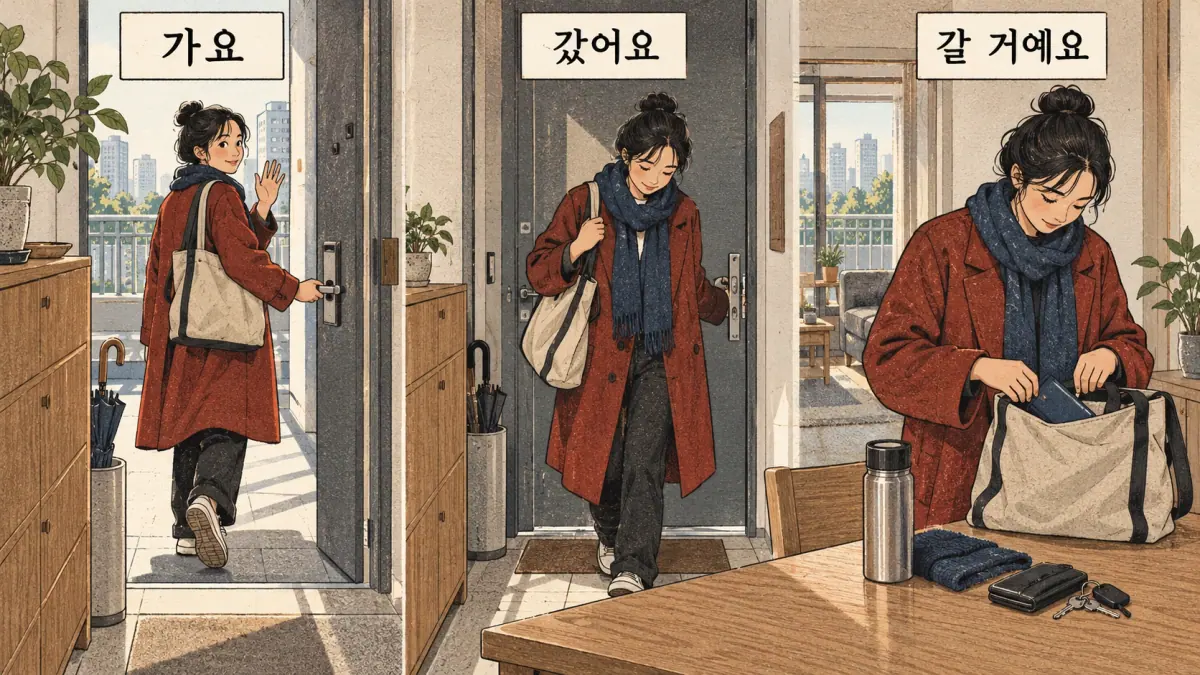
Choose the form from your goal. The table maps each goal to a form and to the lesson that teaches it.
| I want to... | Form | Example | Start here |
|---|---|---|---|
| say what I do or am doing | polite present | 가요 | how to conjugate verbs in the present tense |
| say what I did | past | 갔어요 | past tense conjugation |
| say what I will do | future | 갈 거예요 | future tense conjugation |
| speak politely to a stranger or teacher | polite present | 가요 | polite present conjugation |
| read the news or give a speech | formal | 갑니다 | formal conjugation |
| talk to a close friend | casual | 가 | casual conjugation |
| find the stem of a verb | stem | 가 from 가다 | verb stems |
| check a form I built | any | any | Korean verb conjugator |
If your goal is not in the table, read the overview first. It explains the whole system on one page.
What Is the Shared Three-Step Model?
Every lesson in this section reuses the same three steps, so learning them once helps with every form.
- Find the stem. Remove 다: 먹다 → 먹.
- Choose the vowel. Many endings start with 아 or 어, and the last stem vowel chooses between them (ㅏ or ㅗ gives 아, others give 어).
- Add the ending and contract. Attach the ending that sets tense and politeness, and merge the vowels if the stem ends in a vowel: 가 + 아요 = 가요.
Child pages use the same numbering. A lesson on the past tense, for example, only changes step 3: 아요/어요 becomes 았어요/었어요. Every form on this page starts from the stem, so begin with the foundations.
Foundations: Verb Stems and How Conjugation Works

Two pages teach the groundwork that every other form needs.
- Verb stems. Find the stem, understand why every dictionary verb ends in 다, and learn which endings attach to it, with a list of 60 stems. Start here before any other form.
- How Korean conjugation works. Explains the whole conjugation system on one page: dictionary form, stem, vowel harmony, contraction and the endings that carry tense, politeness and mood. It is the best first lesson if you have never conjugated a Korean verb.
With the foundations in place, the polite present is next.
Polite Present Conjugation

The polite present is the most useful single form, so it has its own subhub with nine lessons. It teaches the recipe, the 아/어 choice and every contraction rule, from 가요 to 돼요.
- Polite present conjugation. How to make the 해요체 present: the 아요/어요 choice, every contraction rule and the 하다 exception. Open it to find the exact lesson for your verb, or begin with the present tense recipe, which turns any regular verb into the polite present in three steps.
The present form leads straight into the other tenses and styles.
Past, Future, Formal and Casual Forms

Four lessons build the remaining core forms from the same stem.
- How to conjugate Korean verbs in the past tense. Builds the past form with -았/었/했- from the stem, shows every contraction (갔, 봤, 마셨, 썼, 됐) and the past of irregular verbs in all speech levels.
- How to conjugate Korean verbs in the future tense. Forms the future and guess with -(으)ㄹ 거예요 and -겠-, covers stems that take ㄹ or 을, irregular stems, and the four ways Korean talks about the future.
- Formal Korean conjugation: -ㅂ니다 and -습니다. Builds the formal polite style (합쇼체) with -ㅂ니다 and -습니다, and covers ㄹ stems, irregular stems, questions, past and imperatives.
- Casual Korean conjugation (banmal). Drops 요 from the polite present, adds the special forms (야, 아니야) and shows what changes in questions, requests and the past.
All four assume the polite present, so finish that lesson first. When you need a quick lookup rather than a lesson, charts help.
Conjugation Charts
Conjugation charts show many forms at once. Use them to look up a pattern, not to learn it.
- Conjugation charts. Read a chart, print a one-page sheet and look up 50 verbs in five forms. A chart is fastest when you already know the three steps and need to confirm a form.
Charts are a reference tool, while the difficulty of the lessons depends on the form.
How Hard Is Korean Conjugation?
Korean conjugation is mostly regular, and it is hard in a few specific places. The ratings below are editorial judgements for a typical English-speaking beginner, not measurements.
| Form | Editorial difficulty | Why |
|---|---|---|
| Polite present | easy | one recipe, a few contractions |
| Contractions | medium | seven patterns to recognise |
| Past | medium | adds the ㅆ syllable and irregular forms |
| Future | medium | stems with ㄹ, ㄷ and ㅂ change |
| Formal | easy | two endings, chosen by the last sound |
| Casual | easy | polite form without 요, plus the copula |
For a longer answer, including comparisons with Spanish and French, read Is Korean conjugation hard?, which also offers a two-week study plan.
What Are Quick Answers to Common Conjugation Questions?
Three questions come up most often in searches, and each has a one-line answer.
- Does Korean have conjugation? Yes, verbs and adjectives take endings, but they never change for person, number or gender. See how Korean conjugation works.
- Are Korean verbs conjugated? Yes. Every verb in a sentence takes an ending, even the plain written style that ends in 다.
- How does Korean conjugation work? Find the stem, choose the vowel, add the ending. The overview page runs these steps on 가다, 먹다 and 하다.
Where Can You Look up One Verb?

Single-verb pages list every form of one verb with audio. Eight regular verbs are a good start:
- 가다 (to go): every form on its gada conjugation page.
- 오다 (to come): every form on its oda conjugation page.
- 먹다 (to eat): every form on its meokda conjugation page.
- 마시다 (to drink): every form on its masida conjugation page.
- 보다 (to see, watch): every form on its boda conjugation page.
- 읽다 (to read): every form on its ikda conjugation page.
- 자다 (to sleep): every form on its jada conjugation page.
- 일어나다 (to wake up): every form on its ireonada conjugation page.
Verbs that break the pattern are in Korean irregular verbs, and the meaning of tenses, not their forms, is in Korean tenses.
Korean verb conjugation is easiest in order: stem, polite present, past, future, then formal and casual, with irregular classes as needed. This hub does not teach the forms itself, and its difficulty ratings are editorial. Forms follow standard written Korean as described by the National Institute of Korean Language (국립국어원).
Frequently Asked Questions
What is Korean conjugation? Korean conjugation (활용) is the process of attaching endings to a verb or adjective stem to show tense, politeness and mood. The stem is the dictionary form without 다, and the ending is the part that changes. For example, 먹다 gives 먹어요 (polite present), 먹었어요 (past) and 먹습니다 (formal).
Which form should I learn first? Learn the polite present (-아요/-어요) first. It is the form you will hear and use most often with strangers, teachers and shop staff. After it, learn the past tense, then the future, then the formal and casual styles. The stems lesson comes before all of them, because every form starts from the stem.
Is Korean conjugation hard? It is easier than Spanish or French in one respect: Korean never changes a verb for person, number or gender. The harder parts are choosing among speech levels and learning a small set of irregular classes. A dedicated lesson compares the difficulty honestly and suggests a study plan.
Where are the irregular verbs? Irregular verbs have their own subhub, because the exceptions fall into seven classes: ㅂ, ㄷ, ㅅ, 르, ㅎ, ㅡ and ㄹ. Each conjugation lesson here keeps a short table of exceptions and links to the matching class page. The regular patterns on this page come first, since most verbs follow them.