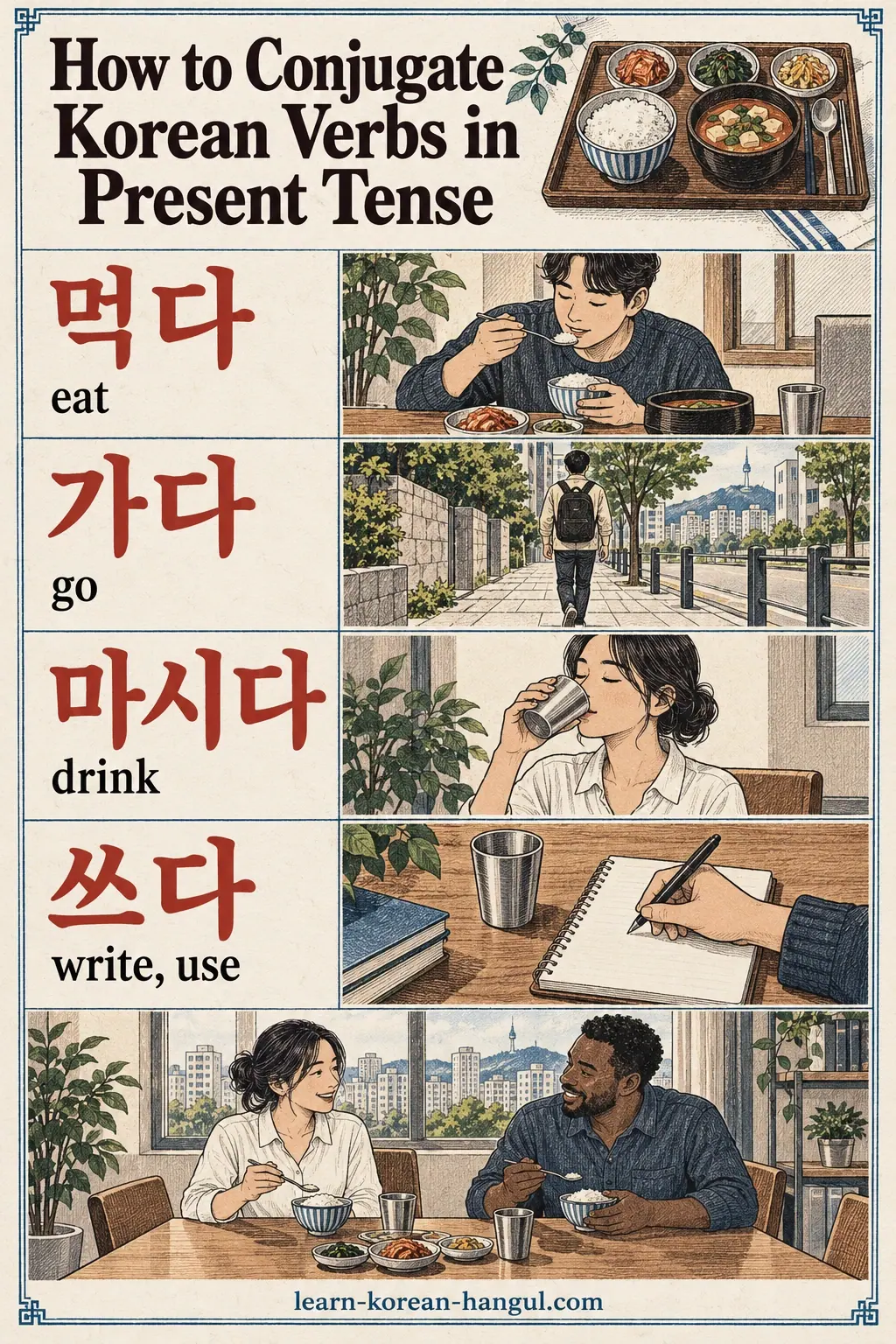
What you will be able to do after this lesson
- Find the stem of any dictionary-form verb or adjective by removing 다.
- Choose 아요 or 어요 by looking at one vowel only.
- Contract the result correctly: 가요, 와요, 마셔요, 써요, 해요.
- Name the step that produced each change, and fix six common wrong forms.
Before you start: read what a verb stem is and Korean verb endings first. Time: about 30 minutes. Level: A1.
How to Conjugate Korean Verbs in Present Tense: What Are the Three Steps?
The polite present is built in three steps that always run in the same order. The dictionary form is the form you find in a dictionary, such as 먹다 (to eat). It always ends in 다.
- Remove 다. 먹다 becomes the stem 먹.
- Choose 아요 or 어요. Read the last vowel of the stem. ㅏ or ㅗ gives 아요. Any other vowel gives 어요. 하다 gives 해요.
- Contract if the stem ends in a vowel. When the stem's last letter is a vowel, the vowel of the ending merges with it or drops, so 가 + 아요 is written 가요.
Here is the recipe on three verbs:
| Dictionary form | Step 1: stem | Step 2: ending | Step 3: contraction | Polite present |
|---|---|---|---|---|
| 먹다 (to eat) | 먹 | 어요 (vowel ㅓ) | none, because 먹 ends in a consonant | 먹어요 [머거요] (meogeoyo) |
| 가다 (to go) | 가 | 아요 (vowel ㅏ) | 가 + 아 drops one 아 | 가요 (gayo) |
| 하다 (to do) | 하 | 여요 (special) | 하 + 여 becomes 해 | 해요 (haeyo) |
먹다
| Form | Korean | Romanization | Rule |
|---|---|---|---|
| Polite present | 먹어요 | meogeoyo | 먹 + 어요 (last vowel ㅓ), no contraction |
Revised Romanization (RR), the official Latin-letter system of South Korea, appears in parentheses as a reading aid only. Learn the Hangul forms.
The polite present is the safest default form for beginners. It is polite enough for strangers, shop staff and teachers, and it is not stiff. The reason it is the safe default is explained in polite speech.
Step 1 is the easiest, so the next section starts there and then moves to the step that needs real attention.
Step 1: How Do You Find the Stem?

You find the stem by removing the final 다 of the dictionary form. The stem (어간, eogan) is the part that carries the meaning. The ending (어미, eomi) is the part that carries tense and politeness.
- 먹다 → 먹 (eat)
- 가다 → 가 (go)
- 좋다 → 좋 (be good)
- 공부하다 → 공부하 (study)
Check: after removing 다 you must have at least one syllable block left. Every Korean verb and adjective in a dictionary ends in 다, so this step never fails for regular words. The stem is what steps 2 and 3 work on.
Once you hold the stem, the real decision begins.
Step 2: How Do You Choose 아요 or 어요?

Look at the last vowel of the stem and nothing else. If it is ㅏ or ㅗ, add 아요. If it is any other vowel, add 어요. This pairing of like vowels is called vowel harmony (모음조화, moeumjohwa). The full theory is in vowel harmony; this page needs only the working rule.
| Last stem vowel | Ending | Example | Polite present |
|---|---|---|---|
| ㅏ | 아요 | 만나다 (to meet) | 만나요 |
| ㅗ | 아요 | 좋다 (to be good) | 좋아요 [조아요] |
| ㅓ | 어요 | 먹다 (to eat) | 먹어요 [머거요] |
| ㅜ | 어요 | 웃다 (to laugh) | 웃어요 [우서요] |
| ㅣ | 어요 | 읽다 (to read) | 읽어요 [일거요] |
| ㅡ | look one syllable back | 아프다 (to be sick) | 아파요 |
Only the last vowel counts, even when earlier vowels differ. 기다리다 contains ㅏ in the syllable 다, but its stem 기다리 ends in ㅣ, so it takes 어요: 기다려요. In the same way, the stem 좋 has ㅗ as its last vowel, so it takes 아요: 좋아요.
What If the Last Vowel Is ㅡ?
A stem ending in ㅡ looks one syllable back. If the syllable before it has ㅏ or ㅗ, use 아요. Otherwise use 어요. The ㅡ then drops out.
- 아프다 (to be sick): the stem 아프 has 아 before ㅡ, so 아파요 (apayo).
- 바쁘다 (to be busy): 바 has ㅏ, so 바빠요 (bappayo).
- 예쁘다 (to be pretty): 예 has ㅖ, which is not ㅏ or ㅗ, so 예뻐요 (yeppeoyo).
- 슬프다 (to be sad): 슬 has ㅡ, so 슬퍼요 (seulpeoyo).
- 쓰다 (to write) and 크다 (to be big) have only one syllable, so no earlier vowel exists and the default 어 applies: 써요 (sseoyo), 커요 (keoyo).
This ㅡ drop is treated as an irregular class in many textbooks, and it is taught in full in ㅡ irregular.
What about 하다?
하다 does not follow the ㅏ rule. It takes the older ending 여요, and 하 + 여 contracts to 해. So 하다 gives 해요, and every verb or adjective that ends in 하다 does the same: 공부하다 → 공부해요, 피곤하다 → 피곤해요. The special rule is in 하다 to 해요.
With the ending chosen, the last step cleans up the vowels.
Step 3: When Do You Contract the Vowels?

You contract when the stem ends in a vowel, because writing both vowels would give two vowels in a row. If the stem ends in a consonant, nothing contracts: 먹 + 어요 = 먹어요. The contraction map has seven patterns:
| Stem ends in | Merge | Result | Example |
|---|---|---|---|
| ㅏ | 아 is dropped | ㅏ | 가 + 아요 = 가요 |
| ㅓ or ㅕ | 어 is dropped | ㅓ or ㅕ | 서 + 어요 = 서요 |
| ㅗ | ㅗ + ㅏ merge | ㅘ | 오 + 아요 = 와요 |
| ㅜ | ㅜ + ㅓ merge | ㅝ | 배우 + 어요 = 배워요 |
| ㅣ | ㅣ + ㅓ merge | ㅕ | 마시 + 어요 = 마셔요 |
| ㅐ or ㅔ | 어 is dropped | ㅐ or ㅔ | 보내 + 어요 = 보내요 |
| ㅚ (되) | 되 + 어 merge | 돼 | 되 + 어요 = 돼요 |
Two further cases appear above: the ㅡ drop (쓰 + 어요 = 써요) and 하 + 여 = 해. Each pattern has its own lesson: vowel dropping, 하다 to 해요 and the other pages listed at the end of this one.
The recipe is now complete, so the next section runs it on 40 words and logs which step changed each form.
What Do 40 Verbs and Adjectives Look Like in the Polite Present?
The table below shows 40 common verbs and adjectives. The last column names the steps that changed the form. "Step 2 only" means the ending was added with no contraction.
| # | Dictionary form | Meaning | Polite present | What changed |
|---|---|---|---|---|
| 1 | 먹다 | eat | 먹어요 [머거요] | Step 2 only: ㅓ → 어요 |
| 2 | 읽다 | read | 읽어요 [일거요] | Step 2 only: ㅣ → 어요 |
| 3 | 입다 | wear | 입어요 [이버요] | Step 2 only: ㅣ → 어요 |
| 4 | 있다 | exist, have | 있어요 [이써요] | Step 2 only: ㅣ → 어요 |
| 5 | 없다 | not exist | 없어요 [업써요] | Step 2 only: ㅓ → 어요 |
| 6 | 웃다 | laugh, smile | 웃어요 [우서요] | Step 2 only: ㅜ → 어요 |
| 7 | 좋다 | be good | 좋아요 [조아요] | Step 2 only: ㅗ → 아요 |
| 8 | 앉다 | sit | 앉아요 [안자요] | Step 2 only: ㅏ → 아요 |
| 9 | 받다 | receive | 받아요 [바다요] | Step 2 only: ㅏ → 아요 |
| 10 | 많다 | be many | 많아요 [마나요] | Step 2 only: ㅏ → 아요 |
| 11 | 살다 | live | 살아요 [사라요] | Step 2 only: ㅏ → 아요 |
| 12 | 알다 | know | 알아요 [아라요] | Step 2 only: ㅏ → 아요 |
| 13 | 가다 | go | 가요 | Step 3: 가 + 아 drops one 아 |
| 14 | 사다 | buy | 사요 | Step 3: 사 + 아 drops one 아 |
| 15 | 자다 | sleep | 자요 | Step 3: 자 + 아 drops one 아 |
| 16 | 서다 | stand | 서요 | Step 3: 서 + 어 drops one 어 |
| 17 | 만나다 | meet | 만나요 | Step 3: 나 + 아 drops one 아 |
| 18 | 싸다 | be cheap | 싸요 | Step 3: 싸 + 아 drops one 아 |
| 19 | 오다 | come | 와요 | Step 3: ㅗ + ㅏ = ㅘ |
| 20 | 보다 | see, watch | 봐요 | Step 3: ㅗ + ㅏ = ㅘ |
| 21 | 배우다 | learn | 배워요 | Step 3: ㅜ + ㅓ = ㅝ |
| 22 | 주다 | give | 줘요 | Step 3: ㅜ + ㅓ = ㅝ |
| 23 | 마시다 | drink | 마셔요 | Step 3: ㅣ + ㅓ = ㅕ |
| 24 | 기다리다 | wait | 기다려요 | Step 3: ㅣ + ㅓ = ㅕ |
| 25 | 가르치다 | teach | 가르쳐요 | Step 3: ㅣ + ㅓ = ㅕ, written 쳐 |
| 26 | 쓰다 | write, use | 써요 | Step 3: ㅡ drops, one-syllable stem takes 어 |
| 27 | 크다 | be big | 커요 | Step 3: ㅡ drops, one-syllable stem takes 어 |
| 28 | 아프다 | be sick | 아파요 | Step 2 looks back to 아 (ㅏ); step 3: ㅡ drops |
| 29 | 바쁘다 | be busy | 바빠요 | Step 2 looks back to 바 (ㅏ); step 3: ㅡ drops |
| 30 | 예쁘다 | be pretty | 예뻐요 | Step 2 looks back to 예 (not ㅏ/ㅗ); step 3: ㅡ drops |
| 31 | 슬프다 | be sad | 슬퍼요 | Step 2 looks back to 슬 (ㅡ); step 3: ㅡ drops |
| 32 | 하다 | do | 해요 | Step 2: 여요; step 3: 하 + 여 = 해 |
| 33 | 공부하다 | study | 공부해요 | Step 2: 여요; step 3: 하 + 여 = 해 |
| 34 | 좋아하다 | like | 좋아해요 [조아해요] | Step 2: 여요; step 3: 하 + 여 = 해 |
| 35 | 피곤하다 | be tired | 피곤해요 | Step 2: 여요; step 3: 하 + 여 = 해 |
| 36 | 보내다 | send | 보내요 | Step 3: 내 + 어 drops 어 |
| 37 | 지내다 | spend time | 지내요 | Step 3: 내 + 어 drops 어 |
| 38 | 되다 | become | 돼요 | Step 3: 되 + 어 = 돼 |
| 39 | 쉬다 | rest | 쉬어요 | Step 2 only: ㅟ → 어요 |
| 40 | 맛있다 | be delicious | 맛있어요 [마시써요] | Step 2 only: ㅣ → 어요 |
Listen to all 40 forms. Each clip plays only when you press it.
Rows 1 to 12 show why step 3 matters: stems that end in a consonant never contract. Rows 13 to 38 end in a vowel and contract. Row 39 is the exception to watch: 쉬 ends in ㅟ, which has no contraction, so 쉬어요 keeps both vowels. Row 40, 맛있다, ends in a consonant like rows 1 to 12. A useful rule of thumb: if you can hear two vowels in a row in the full form (가아요), a contraction is usually waiting.
The table lists only words whose polite present follows the recipe. That includes the ㅡ stems in rows 26 to 31 and the ㄹ stems 살다 and 알다, whose ㄹ drops only before ㄴ, ㅂ and ㅅ, not before 아요. Words such as 듣다, 덥다 and 모르다 change their stem before the ending, and they belong to Korean irregular verbs.
Now that the forms are clear, it helps to know what the finished form can mean.
Do Adjectives Use the Same Recipe?
Yes, adjectives use exactly the same three steps. Korean adjectives are sometimes called descriptive verbs, because they conjugate like verbs. Compare:
| Type | Dictionary form | Polite present | Meaning |
|---|---|---|---|
| Verb | 먹다 | 먹어요 | eats |
| Adjective | 좋다 | 좋아요 | is good |
| Adjective | 크다 | 커요 | is big |
| Adjective | 많다 | 많아요 | is many |
The one place verbs and adjectives part ways is the modifier form. A verb needs 는 to modify a noun (먹는 사람, the person who eats), while an adjective uses ㄴ/은 (큰 집, a big house). That is a different lesson; the present polite form is identical.
Why Can the Same Form Mean Present, Habit and near Future?

The polite present has no dedicated future or habit marker, so context and time words decide the meaning. Korean calls the form 현재형 (present form), but it covers more ground than English "-s".
- Current action: 지금 먹어요. = I am eating now.
- Habit: 매일 커피를 마셔요. = I drink coffee every day.
- Fact: 서울은 커요. = Seoul is big.
- Near future: 내일 학교에 가요. = I am going to school tomorrow.
- Suggestion: 같이 가요. = Let's go together.
Look for a time word such as 지금 (now), 매일 (every day) or 내일 (tomorrow). The meaning of the present tense in sentences is taught in Korean present tense, and the page on korean present tense uses covers habits, facts and the near future in depth. This page stays with the recipe.
How Do You Ask a Question?

You ask a question by using the same polite form with rising intonation. No word changes. In writing, the question mark shows it.
- 가요. (falling) = I am going.
- 가요? (rising) = Are you going?
- 뭐 먹어요? = What are you eating? The question word 뭐 (what) already marks the question.
The audio pair 가요 and 가요? shows the pitch difference. If your question sounds like a statement, raise the pitch on the last syllable. Question words such as 뭐, 어디 (where) and 언제 (when) help listeners even before the final pitch.
Which Wrong Forms Do Learners Produce?
Learners produce six wrong forms again and again, and each one comes from skipping or misreading one step.
| Wrong form | Correct form | Step that went wrong |
|---|---|---|
| 먹아요 | 먹어요 | Step 2: ㅓ is not ㅏ or ㅗ, so the ending is 어요 |
| 좋어요 | 좋아요 | Step 2: the last vowel ㅗ is a bright vowel, so the ending is 아요 |
| 하어요 | 해요 | Step 2: 하다 takes 여, and step 3 makes 해 |
| 가어요 | 가요 | Step 3: ㅏ takes 아요, and the extra vowel drops |
| 되요 | 돼요 | Step 3: 되 + 어 contracts to 돼 |
| 쓰어요 | 써요 | Step 3: the vowel ㅡ drops before 어 |
Diagnose by step, not by memory. Ask: "Did I choose from the last vowel? Did I contract the vowels?" That habit corrects errors you have never seen before.
Practice
Try each task before you open the answers.
- Conjugate 입다 (to wear) into the polite present.
- Conjugate 보다 (to see) into the polite present.
- Conjugate 마시다 (to drink) into the polite present.
- Conjugate 아프다 (to be sick) into the polite present.
- Conjugate 공부하다 (to study) into the polite present.
- Conjugate 보내다 (to send) into the polite present.
- Fix the error: 쓰어요.
- Fix the error: 먹아요.
Practice · 4
Polite present of 입다
Show answer
입어요
Polite present of 보다
Show answer
봐요
Polite present of 마시다
Show answer
마셔요
Polite present of 아프다
Show answer
아파요
Answers to the Practice
- 입어요 [이버요]. The stem 입 ends in ㅣ, so the ending is 어요.
- 봐요. The stem 보 ends in ㅗ, so the ending is 아요, and ㅗ + ㅏ merge into ㅘ.
- 마셔요. The stem 마시 ends in ㅣ, so the ending is 어요, and ㅣ + ㅓ merge into ㅕ.
- 아파요. The stem 아프 ends in ㅡ; the syllable before it has ㅏ, so the ending is 아요 and ㅡ drops.
- 공부해요. The 하다 rule gives 해요.
- 보내요. The stem ends in ㅐ, so 어 is dropped.
- 써요. The vowel ㅡ drops, and the single-syllable stem takes 어.
- 먹어요 [머거요]. The last vowel ㅓ gives 어요.
If you missed more than two, reread the step named in each answer. Then check your own forms with the Korean verb conjugator.
What to Learn Next
Now that you know how to conjugate Korean verbs in present tense, learn why the choice of 아 or 어 works the way it does. The best next lesson is vowel harmony in conjugation, which explains step 2 in full, including the ㅂ-irregular 와 forms. After that, past tense conjugation builds the past from the same stem with one change: 아요/어요 becomes 았어요/었어요.
This lesson does not cover irregular classes, the honorific -(으)세요 or the formal and casual styles. Those have their own pages, and the whole section is mapped on Polite Present Conjugation. The forms here follow standard written Korean and the rules of the National Institute of Korean Language (국립국어원), and the bracketed pronunciations are standard Seoul approximations; the audio clips are the final reference.
Frequently Asked Questions
How do I conjugate a Korean verb in the present tense? Remove 다 from the dictionary form to get the stem. Add 아요 if the last stem vowel is ㅏ or ㅗ, and 어요 for every other vowel. If the stem ends in a vowel, contract the two vowels. Examples: 먹다 becomes 먹어요, 가다 becomes 가요, and 하다 becomes 해요.
How do I know whether to use 아요 or 어요? Look only at the last vowel of the stem. ㅏ and ㅗ choose 아요, as in 좋아요 and 만나요. Every other vowel chooses 어요, as in 먹어요 and 마셔요. Two exceptions need care: 하다 takes 여, which gives 해요, and ㅡ stems check the vowel one syllable earlier.
What is the present tense of 하다? The polite present of 하다 (to do) is 해요. The stem 하 takes the special ending 여요, and 하 + 여 contracts to 해. The same rule works for every verb or adjective ending in 하다, so 공부하다 becomes 공부해요 and 피곤하다 becomes 피곤해요.
Is 먹아요 correct? No. The correct form is 먹어요 [머거요]. The stem 먹 ends in the vowel ㅓ, which is not ㅏ or ㅗ, so it takes 어요. Learners who write 먹아요 usually add 아요 to every stem. Check the last vowel first, then choose the ending.
Do adjectives use the same present tense form? Yes. Korean adjectives (descriptive verbs) take the same polite present ending as action verbs. 좋다 becomes 좋아요, 크다 becomes 커요, and 예쁘다 becomes 예뻐요. The difference appears later, when an adjective modifies a noun, because a verb uses 는 (먹는 사람) but an adjective uses ㄴ or 은 (큰 집).
Does the polite present tense mean future? It can. For fixed plans Korean often uses the present with a time word, so 내일 가요 means 'I am going tomorrow'. A time word such as 내일 (tomorrow) shows the future meaning. Without one, the same form means a current action, a habit or a fact.