
What you'll learn
- Attach the right form of 이다 to any noun in polite, formal, casual, past and question forms.
- Conjugate 아니다 ("not to be") in the same five slots.
- Introduce yourself with 저는 마이클이에요 or 저는 수지예요.
- Avoid the three most common spelling errors: 이예요, 아니예요 and 친구이에요.
Prerequisites: you know when to use 이다 rather than 있다 or an adjective, as explained in 이다 vs 있다, and you can spot a final consonant (받침) in a Hangul block. Time: about 25 minutes.
The first section gives the whole system in one table.
What Are the Forms of 이다?
The forms of 이다 come in pairs: one for nouns that end in a consonant and one for nouns that end in a vowel. Only the formal forms are shared. The table below uses 학생 ("student", ends in ㅇ) and 의사 ("doctor", ends in ㅏ).
| Slot | After a consonant | After a vowel | Example (consonant) | Example (vowel) |
|---|---|---|---|---|
| Polite present | 이에요 | 예요 | 학생이에요 | 의사예요 |
| Polite question | 이에요? | 예요? | 학생이에요? | 의사예요? |
| Formal present | 입니다 | 입니다 | 학생입니다 [학쌩임니다] | 의사입니다 [의사임니다] |
| Formal question | 입니까? | 입니까? | 학생입니까? | 의사입니까? |
| Casual present | 이야 | 야 | 학생이야 | 의사야 |
| Polite past | 이었어요 | 였어요 | 학생이었어요 [학쌩이어써요] | 의사였어요 [의사여써요] |
| Formal past | 이었습니다 | 였습니다 | 학생이었습니다 | 의사였습니다 |
| Casual past | 이었어 | 였어 | 학생이었어 | 의사였어 |
| Plain (written) | 이다 | 다 or 이다 | 학생이다 | 의사다 / 의사이다 |
이다
| Form | Korean | Romanization | Rule |
|---|---|---|---|
| Polite present | 이에요 / 예요 | ieyo / yeyo | consonant + 이에요; vowel + 예요 |
| Formal present | 입니다 | imnida | same after every noun |
| Casual present | 이야 / 야 | iya / ya | consonant + 이야; vowel + 야 |
| Polite past | 이었어요 / 였어요 | ieosseoyo / yeosseoyo | 이 + 었 contracts to 였 after a vowel |
- Look at the last letter of the noun.
- 이다 attaches without a space.
Every form in the table was cross-checked with the site's rule-based conjugation engine. The same ending covers every person: 저는 학생이에요 ("I am a student"), 그 사람은 학생이에요 ("That person is a student") and 우리는 학생이에요 ("We are students") all end in 이에요. The next section explains how to pick between the two columns.
When Do You Use 이에요 and When 예요?
Use 이에요 when the noun's last Hangul block has a final consonant (받침), and 예요 when it ends in a vowel. 예요 is the contraction of 이에요: after a vowel, the 이 of 이다 merges with 에요. So 의사 + 이에요 becomes 의사예요.
| Noun | Last block | Final sound | Polite form | English |
|---|---|---|---|---|
| 책 | 책 | consonant ㄱ | 책이에요 [채기에요] | It's a book. |
| 사람 | 람 | consonant ㅁ | 사람이에요 [사라미에요] | It's a person. |
| 물 | 물 | consonant ㄹ | 물이에요 [무리에요] | It's water. |
| 친구 | 구 | vowel ㅜ | 친구예요 | It's a friend. |
| 커피 | 피 | vowel ㅣ | 커피예요 | It's coffee. |
| 버스 | 스 | vowel ㅡ | 버스예요 | It's a bus. |
| 케이크 | 크 | vowel ㅡ | 케이크예요 | It's a cake. |
Look at 버스 and 케이크. In English, "bus" and "cake" end in consonant sounds, but in Hangul both end in the vowel ㅡ, so they take 예요. Always judge by the Hangul spelling, not by the English word. In the same way, the question words 뭐 ("what") and 누구 ("who") end in vowels: 뭐예요? and 누구예요?
When a noun ends in a consonant, that consonant moves onto the vowel 이 in speech, a sound change called liaison (연음). The Standard Pronunciation Rules (표준 발음법) of the National Institute of Korean Language (국립국어원) describe it: 책이에요 is said [채기에요]. The full pattern with many more examples is taught in 이에요/예요 to be, so this page focuses on the other forms.
Worked Example: Introducing Yourself
To say your name, put 저는 ("as for me") first, then the name, then the form of 이다 that matches the name's last block.
- Write the name in Hangul. Michael is 마이클; Suji is 수지.
- Check the last block. 클 ends in ㄹ, a consonant. 지 ends in ㅣ, a vowel.
- Choose the form. 마이클 takes 이에요; 수지 takes 예요.
- Build the sentence. 저는 마이클이에요. 저는 수지예요.
You'll know it worked when you can say the name and the ending as one smooth word: [마이크리에요]. The question that prompts this answer is 이름이 뭐예요? ("What is your name?"), where 뭐 takes 예요. For full self-introductions with greetings and set phrases, see introduce yourself in Korean.
Names and the 이 That Koreans Add
Korean speakers often add a friendly suffix 이 to a first name that ends in a consonant, especially in casual speech: 민준 becomes 민준이. That suffix changes the noun's last sound to a vowel, so you may hear both 민준이에요 (name + 이에요) and 민준이예요 (민준이 + 예요). Both follow the rule; they simply treat the name differently. When you introduce yourself, use your plain name with the standard form. The next section moves from polite speech to the formal and casual levels.
Korean Ida Conjugation in Formal and Casual Speech

Korean ida conjugation has three everyday speech levels: polite (이에요/예요), formal (입니다) and casual (이야/야). A speech level is the politeness built into a sentence ending. The meaning stays the same; only the relationship with the listener changes.
| Level | After a consonant | After a vowel | When to use it |
|---|---|---|---|
| Formal (합쇼체) | 학생입니다. | 의사입니다. | presentations, news, interviews, first meetings at work |
| Polite (해요체) | 학생이에요. | 의사예요. | most daily conversation with strangers and colleagues |
| Casual (해체, 반말) | 학생이야. | 의사야. | close friends, family, younger people who invited it |
The formal 입니다 never changes after a vowel: 의사입니다 is correct, and there is no form "의사ㅂ니다". It is pronounced [임니다], because ㅂ before ㄴ becomes [ㅁ]. The formal style is explained across all verbs in formal conjugation, and the casual level in casual conjugation. Use casual 이야/야 only with people who speak casually to you, because 반말 with a stranger can sound rude.
Questions with 이다
Questions with 이다 use the same forms as statements in polite and casual speech, with a rising tone. The formal level has a separate question ending, 입니까.
| Level | Question | English |
|---|---|---|
| Polite | 학생이에요? / 의사예요? | Are you a student? / a doctor? |
| Formal | 학생입니까? / 의사입니까? | Are you a student? / a doctor? |
| Casual | 학생이야? / 의사야? | You a student? / a doctor? |
The formal question 입니까 is heard in announcements and interviews, while daily questions use the polite form. Next comes the past.
How Do I Say "It Was" in Korean?

To say "it was" or "was" with a noun, use 이었어요 after a consonant and 였어요 after a vowel. 였어요 is the contraction of 이었어요: after a vowel, 이 + 었 merges into 였. So "I was a student" is 학생이었어요, and "I was a doctor" is 의사였어요.
| Noun | Polite past | Spoken | Formal past | Casual past |
|---|---|---|---|---|
| 학생 | 학생이었어요 | [학쌩이어써요] | 학생이었습니다 | 학생이었어 |
| 선생님 | 선생님이었어요 | [선생니미어써요] | 선생님이었습니다 | 선생님이었어 |
| 의사 | 의사였어요 | [의사여써요] | 의사였습니다 | 의사였어 |
| 친구 | 친구였어요 | [친구여써요] | 친구였습니다 | 친구였어 |
어제는 일요일이었어요 means "Yesterday was Sunday." 그 사람은 제 친구였어요 means "That person was my friend." The pattern is the same consonant/vowel choice as in the present, which makes the past easy once the present is solid. The page on 이었어요/였어요 past of 이다 explains the past in longer sentences and stories. The negative side of 이다 follows the same logic.
Conjugating 아니다

아니다 is the negative of 이다: it means "not to be". Unlike 이다, it is a separate word, so it has a space before it, and the noun takes the subject particle 이/가. Its stem 아니 ends in a vowel, but 아니다 does not have two columns: every form is fixed.
| Slot | Form | Spoken | RR (aid) | Example |
|---|---|---|---|---|
| Polite present | 아니에요 | [아니에요] | anieyo | 학생이 아니에요. |
| Formal present | 아닙니다 | [아님니다] | animnida | 의사가 아닙니다. |
| Formal question | 아닙니까? | [아님니까] | animnikka | 학생이 아닙니까? |
| Casual present | 아니야 | [아니야] | aniya | 그거 내 거 아니야. |
| Polite past | 아니었어요 | [아니어써요] | anieosseoyo | 거짓말이 아니었어요. |
| Formal past | 아니었습니다 | [아니어씀니다] | anieotseumnida | 사실이 아니었습니다. |
아니다
| Form | Korean | Romanization | Rule |
|---|---|---|---|
| Polite present | 아니에요 | anieyo | 아니 + 에요 |
| Formal present | 아닙니다 | animnida | 아니 + ㅂ니다 |
| Casual present | 아니야 | aniya | 아니 + 야 |
| Polite past | 아니었어요 | anieosseoyo | 아니 + 었어요 |
- The noun before 아니다 takes 이/가.
In casual speech, 아니야 often shortens to 아냐, and the past 아니었어요 can contract to 아녔어요 in writing. Learn 아니에요 and 아니었어요 first; they are the forms you will need to produce.
How Do I Say "Is Not a Student" in Korean?
To say "is not a student", use the frame N이/가 아니에요: 학생이 아니에요. Choose 이 after a consonant and 가 after a vowel, exactly like the subject particle. "I'm not a doctor" is therefore 의사가 아니에요.
A common pattern pairs the negative and the positive: 저는 학생이 아니에요. 회사원이에요. ("I'm not a student. I'm an office worker.") The particle is often dropped in speech (학생 아니에요), but the space stays. The next section looks ahead to forms you will meet in your first grammar lessons.
What Other Forms of 이다 Will You Meet Soon?
Beyond the sentence endings, 이다 has modifier and connective forms that join clauses. You will meet four of them in your first months: 인 before a noun, 인데 for background, 이라서 for reasons and 이고 for "and". They follow the same consonant/vowel logic where they have two forms.
| Form | After a consonant | After a vowel | Example | English |
|---|---|---|---|---|
| Modifier "who is" | 인 | 인 | 학생인 친구 | a friend who is a student |
| Past modifier | 이었던 | 였던 | 의사였던 사람 | a person who was a doctor |
| Background "is, and/but" | 인데 | 인데 | 학생인데 바빠요. | I'm a student, and I'm busy. |
| Reason "because it is" | 이라서 | 라서 | 주말이라서 사람이 많아요. | It's the weekend, so there are many people. |
| "and" | 이고 | 고 | 저는 학생이고 동생은 의사예요. | I'm a student and my sibling is a doctor. |
| "if it is" | 이면 | 면 | 내일이면 좋겠어요. | Tomorrow would be good. |
The honorific form 이세요 / 세요 is used to say what a respected person is: 선생님이세요? ("Are you a teacher?", said politely to someone you respect), 어머니세요? Each of these forms has its own grammar lesson; this table is a preview, not the full rule. Before practice, the next section collects the spelling traps.
Spelling Traps: 이예요, 아니예요 and 친구이에요
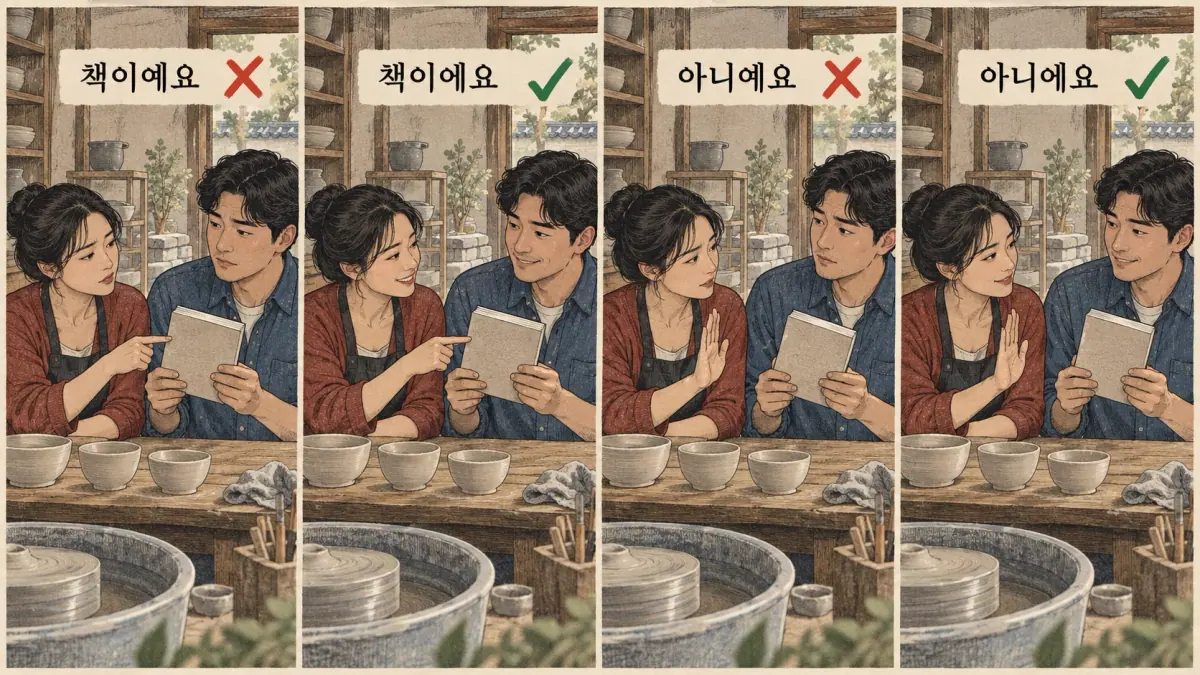
Three spelling errors appear in learner writing and in native text messages alike. Each breaks the rule that 예요 belongs only after a vowel and only as a contraction of 이 + 에요.
| Correct | Error | Why |
|---|---|---|
| 책이에요 | 책이예요 | After a consonant, the form is 이에요; 이예요 adds an extra 이 sound. |
| 아니에요 | 아니예요 | 아니다 has the stem 아니 + 에요; there is no 이 to contract. |
| 친구예요 | 친구이에요 | After a vowel, standard spelling uses the contracted 예요. |
The 아니예요 error is the most frequent, because 아니 ends in a vowel and learners reach for 예요. But 예요 is a contraction of the copula 이 + 에요, and 아니다 contains no copula 이. The National Institute of Korean Language answers this question often in its public guidance: 아니에요 (or the shorter 아녜요) is correct, and 아니예요 is not.
Learners often assume 이에요 means "it is" by itself. Actually 이에요 needs a noun in front; 이에요 alone is not a sentence. Learners often put a space before 이에요. Actually 이다 is attached: 학생이에요, never 학생 이에요. An honest limit: the uncontracted 친구이에요 is rare and sometimes seen in careful writing, but learner materials treat 친구예요 as the form to use, and this page does the same.
Practice
Fill in the correct form, then check the answer key.
- 저는 회사원( ). (polite, 회사원 = office worker)
- 이건 우유( ). (polite, 우유 = milk)
- 저는 김민수( ). (formal)
- 그거 내 가방( ). (casual)
- 어제는 토요일( ). (polite past)
- 그 사람은 가수( ). (polite past, 가수 = singer)
- 저는 학생( ) 아니에요. (particle)
- Correct the error: 저는 의사가 아니예요.
- Correct the error: 이건 책이예요.
- Translate: "What is this?" (이거 = this, 뭐 = what)
Practice · 8
Fill in the polite form: 저는 회사원( ).
Show answer
이에요
회사원 ends in the consonant ㄴ, so it takes 이에요. 이예요 adds an extra 이 and is a spelling error.
Fill in the polite form: 이건 우유( ).
Show answer
예요
우유 ends in a vowel, so the 이 of 이다 contracts: 우유예요.
Which form is correct for "It's a bus"?
Show answer
버스예요
In Hangul 버스 ends in the vowel ㅡ, so it takes 예요. Judge by the Hangul spelling, not the English word.
What is the formal present of 의사 + 이다?
Show answer
의사입니다
The formal 입니다 is the same after every noun, so it does not change after a vowel. 의사예요 is the polite form.
Which spelling is correct for "I'm not a doctor"?
Show answer
저는 의사가 아니에요.
아니다 has the stem 아니 + 에요; it contains no copula 이 to contract, so 아니예요 is wrong.
Fill in the polite past: 그 사람은 가수( ).
Show answer
였어요
After a vowel, 이 + 었 contracts to 였, so 가수 takes 였어요. 이에요 is present tense.
Fill in the casual form: 그거 내 가방( ).
Show answer
이야
가방 ends in a consonant, so the casual form is 이야; 야 follows a vowel, and 입니다 is formal.
Which particle goes in the gap: 저는 학생( ) 아니에요?
Show answer
이
The noun before 아니다 takes 이/가; 학생 ends in a consonant, so it takes 이.
Answer key
- 회사원이에요. 2. 우유예요. 3. 김민수입니다. 4. 가방이야. 5. 토요일이었어요. 6. 가수였어요. 7. 학생이 아니에요. 8. 저는 의사가 아니에요. 9. 이건 책이에요. 10. 이거 뭐예요? 뭐 ends in a vowel, so it takes 예요.
If you missed items 1 to 4, return to the consonant/vowel table. If you missed 8 or 9, reread the spelling traps.
What Should You Learn after 이다 Conjugation?
After 이다 conjugation, learn past tense conjugation, which builds the past of every verb with 았/었/했 and shows contractions such as 갔, 봤, 마셨, 썼 and 됐. You already know one past form, 이었어요/였어요, so the new pattern will look familiar. To review how 이다 differs from 있다, return to 이다 vs 있다.
What this page does not cover. It does not cover the honorific system in full, the quotation forms (이라고, 라고), or 이다 after numbers in counting. Korean ida conjugation is the base for all of them. About this page. Last updated 2026-10-09. The Korean text, spoken forms and audio on this page were machine-generated and reviewed and signed off by Min-ji Park on 15 October 2026. Romanization follows the Revised Romanization of Korean and is shown only as a learning aid.
Frequently Asked Questions
What is the formal form of 이에요? The formal form of 이에요 and 예요 is 입니다, pronounced [임니다]. Unlike the polite forms, 입니다 is the same after every noun: 학생입니다 and 의사입니다. The formal question is 입니까?, as in 학생입니까? Use the formal level for presentations, interviews, announcements and first meetings at work.
What is the casual form of 이에요? The casual form is 이야 after a consonant and 야 after a vowel: 학생이야, 의사야. It belongs to 반말, the casual speech level used with close friends, family and younger people who invited it. The casual past is 이었어 or 였어. With strangers or older people, stay with 이에요 and 예요.
Is it 아니에요 or 아니예요? The correct form is 아니에요. 아니다 has the stem 아니, and the polite ending 에요 attaches directly: 아니 + 에요. The form 예요 is a contraction of the copula 이 + 에요, and 아니다 has no copula 이 to contract, so 아니예요 is a spelling error. The shorter 아녜요 is also accepted.
Does 이다 change for I, you, he and they? No. 이다 changes only for the noun's last sound, the speech level and the tense, never for the person. 저는 학생이에요, 너는 학생이야 and 그들은 학생이에요 use the same pattern for "I am", "you are" and "they are". English needs am, is and are; Korean needs one ending.
How do I say "it will be" with 이다? Use 일 거예요, pronounced [일꺼예요], for "it will be" or "it is probably": 내일은 금요일일 거예요, "Tomorrow will be Friday." It is the same after consonants and vowels: 학생일 거예요, 의사일 거예요. The negative is 아닐 거예요, "it probably isn't", as in 학생이 아닐 거예요.