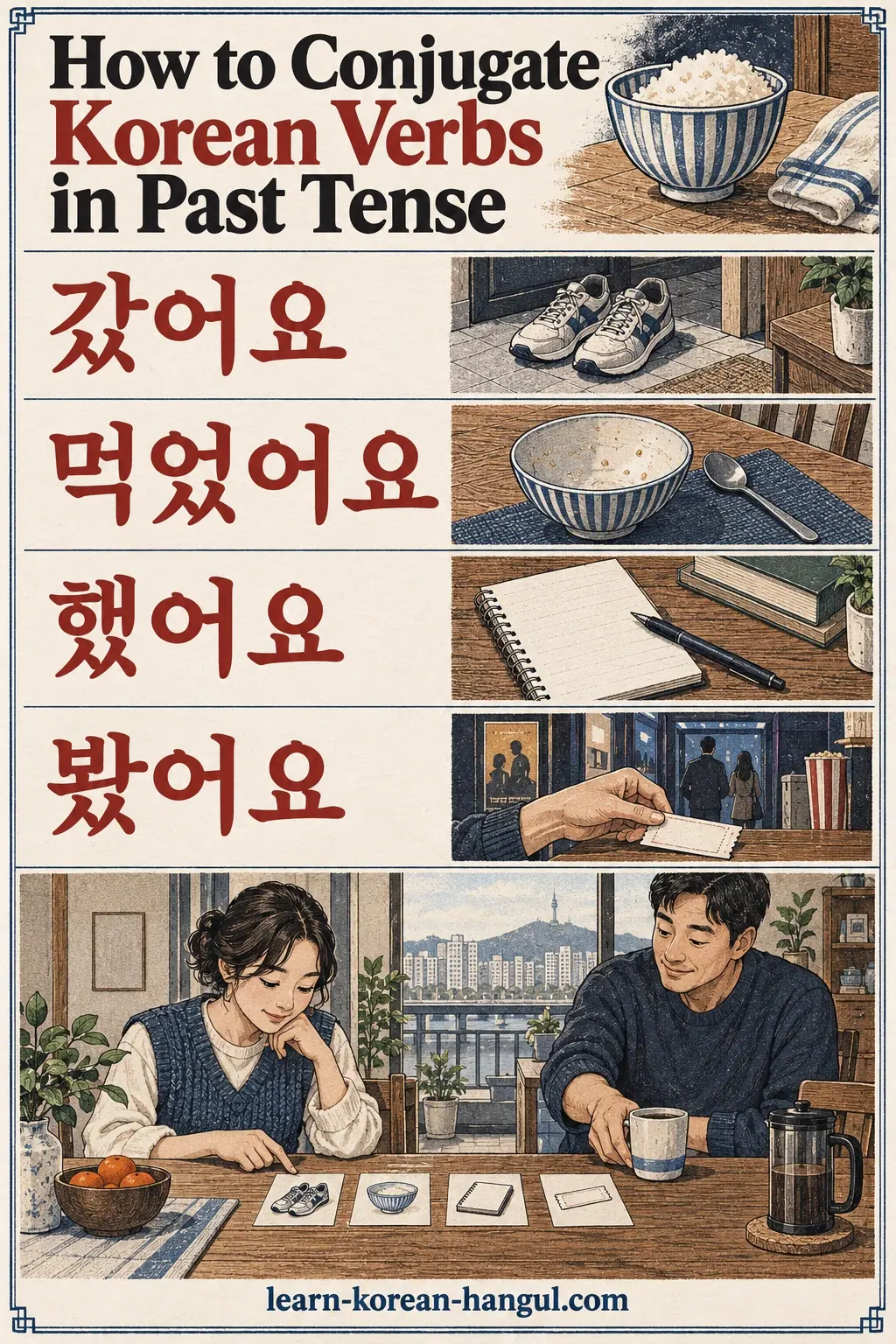
What you will be able to do after this lesson
- Form the polite past of regular verbs and adjectives, including 갔어요, 봤어요, 마셨어요 and 썼어요.
- Give the polite, formal and casual past forms of one verb.
- Form the past of irregular verbs such as 들었어요, 더웠어요 and 몰랐어요, and say which rule applies.
- Choose 이었어요 or 였어요 for 이다 and form the past of 있다 and 아니다.
Before you start: read the present tense recipe, because this lesson reuses its three steps. Time: about 30 minutes. Level: A1.
How to Conjugate Korean Verbs in past Tense: What Are the Three Steps?

The past tense uses the same three steps as the present, and only step 2 and the ending change. The polite present ends in 아요/어요. The polite past ends in 았어요/었어요.
- Find the stem. Remove 다 from the dictionary form: 가다 → 가.
- Choose 았, 었 or 했. ㅏ or ㅗ as the last stem vowel gives 았. Any other vowel gives 었. 하다 gives 했.
- Fuse the vowels. If the stem ends in a vowel, the vowel and 았/었 merge into one syllable that ends in ㅆ: 가 + 았 = 갔. Then add 어요.
A first look at three verbs:
| Dictionary form | Stem | Choice | Fusion | Polite past |
|---|---|---|---|---|
| 가다 (go) | 가 | 았 (ㅏ) | 가 + 았 = 갔 | 갔어요 [가써요] (gasseoyo) |
| 먹다 (eat) | 먹 | 었 (ㅓ) | none, 먹 ends in a consonant | 먹었어요 [머거써요] (meogeosseoyo) |
| 하다 (do) | 하 | 했 | 하 + 였 = 했 | 했어요 [해써요] (haesseoyo) |
Revised Romanization (RR) in parentheses is a reading aid only. The Hangul spelling is the form to learn.
The ending 았/었 is a small piece called a pre-final ending (선어말 어미). It places the event or state in the past. The past form is the same for every subject: 갔어요 can mean "I went", "you went", "she went" or "they went", and context shows who. The first step is simply the stem, so the next section moves straight to the decision that matters.
Step 1: How Do You Find the Stem?

You find the stem by removing the final 다, exactly as in the present tense. The stem carries the meaning, and the endings carry the tense. For example:
- 가다 → 가
- 먹다 → 먹
- 마시다 → 마시
- 공부하다 → 공부하
For regular verbs this step never fails. For irregular verbs the stem itself changes before 았/었, and that comes in a later section. With the stem in hand, the vowel decides the rest.
Step 2: How Do You Choose 았, 었 or 했?
You choose from the last vowel of the stem, with the same vowel harmony as in the present. ㅏ and ㅗ give 았. Every other vowel gives 었. 하다 gives 했. The full logic is in vowel harmony in conjugation.
The table shows ten verbs with present and past side by side. Only one thing changes between the two columns: 아요/어요 becomes 았어요/었어요.
| Dictionary form | Meaning | Polite present | Polite past |
|---|---|---|---|
| 가다 | go | 가요 | 갔어요 [가써요] |
| 오다 | come | 와요 | 왔어요 [와써요] |
| 보다 | see, watch | 봐요 | 봤어요 [봐써요] (bwasseoyo) |
| 먹다 | eat | 먹어요 | 먹었어요 [머거써요] |
| 마시다 | drink | 마셔요 | 마셨어요 [마셔써요] (masyeosseoyo) |
| 쓰다 | write | 써요 | 썼어요 [써써요] (sseosseoyo) |
| 주다 | give | 줘요 | 줬어요 [줘써요] |
| 되다 | become | 돼요 | 됐어요 [돼써요] |
| 좋다 | be good | 좋아요 | 좋았어요 [조아써요] |
| 하다 | do | 해요 | 했어요 [해써요] |
The ㅡ stems follow the look-back rule from the present: 바쁘다 gives 바빴어요 (the vowel before ㅡ is ㅏ, so 았), and 예쁘다 gives 예뻤어요 (the vowel before ㅡ is ㅖ, so 었). One-syllable ㅡ stems take 었: 쓰다 → 썼어요, 크다 → 컸어요.
Now the part that surprises beginners: the vowel and the marker fuse.
Step 3: How Do the Vowels Fuse into the ㅆ Syllable?
When a stem ends in a vowel, the vowel and 았/었 fuse into one syllable whose final consonant is ㅆ. Writing both would give two vowels in a row (가았어요), and Korean spelling shortens that. The contracted spelling is the standard one for everyday writing. A stem that ends in a consonant, such as 먹, has nothing to fuse, so 먹었어요 stays whole.
| Stem + marker | Fusion | Note |
|---|---|---|
| 가 + 았 | 갔 | same vowel, one is dropped |
| 서 + 었 | 섰 | same vowel, one is dropped |
| 오 + 았 | 왔 | ㅗ + ㅏ merge into ㅘ |
| 보 + 았 | 봤 | ㅗ + ㅏ merge into ㅘ |
| 배우 + 었 | 배웠 | ㅜ + ㅓ merge into ㅝ |
| 주 + 었 | 줬 | ㅜ + ㅓ merge into ㅝ |
| 마시 + 었 | 마셨 | ㅣ + ㅓ merge into ㅕ |
| 기다리 + 었 | 기다렸 | ㅣ + ㅓ merge into ㅕ |
| 쓰 + 었 | 썼 | ㅡ drops |
| 크 + 었 | 컸 | ㅡ drops |
| 되 + 었 | 됐 | ㅚ + ㅓ merge into ㅙ, written 됐 |
| 하 + 였 | 했 | 여 contracts to 해 |
| 보내 + 었 | 보냈 | 어 drops after ㅐ |
| 먹 + 었 | 먹었 | no fusion, the stem ends in a consonant |
The ㅆ at the end of the fused syllable is a final consonant (받침, batchim). When a vowel follows, it moves over to start the next syllable: 갔어요 is pronounced [가써요], and 먹었어요 is pronounced [머거써요]. Write by form, not by sound. Learners who write what they hear produce 가써요 or 먹어써요, and both are wrong.
Some fused forms have a full alternative. 되었어요 and 하였어요 are acceptable in formal writing, and 됐어요 and 했어요 are the usual spoken and written forms. 마시었어요 is grammatical but rare; use 마셨어요. 쓰었어요 is wrong, because the ㅡ of 쓰 always drops: 썼어요.
The same fusion rules govern the present, so the contraction pages such as vowel dropping apply here too. Once the polite past is clear, the style can change.
How Do the past Forms Look in Polite, Formal and Casual Speech?

The past marker 았/었 stays the same in every style, and only the final ending changes. The polite style ends in 어요, the formal style in 습니다, and the casual style drops 요 and ends in 어.
| Dictionary form | Polite (해요체) | Formal (합쇼체) | Casual (해체) |
|---|---|---|---|
| 가다 | 갔어요 | 갔습니다 | 갔어 |
| 먹다 | 먹었어요 | 먹었습니다 | 먹었어 |
| 하다 | 했어요 | 했습니다 | 했어 |
| 마시다 | 마셨어요 | 마셨습니다 | 마셨어 |
| 보다 | 봤어요 | 봤습니다 | 봤어 |
| 쓰다 | 썼어요 | 썼습니다 | 썼어 |
| 좋다 | 좋았어요 | 좋았습니다 | 좋았어 |
| 되다 | 됐어요 | 됐습니다 | 됐어 |
가다
| Form | Korean | Romanization | Rule |
|---|---|---|---|
| Polite past | 갔어요 | gasseoyo | 가 + 았 = 갔, then 어요 |
| Formal past | 갔습니다 | gasseumnida | 갔 + 습니다 |
| Casual past | 갔어 | gasseo | 갔 + 어 |
Use the polite style with strangers, shop staff and teachers, the formal style in news, speeches and announcements, and the casual style with close friends and family. A question changes the ending only: 갔어요? (polite), 갔습니까? (formal), 갔어? (casual). The meaning and use of these styles are explained in Korean speech levels. The plain past used in writing, such as 갔다, is taught in plain past -았다/었다.
Everything so far assumed a regular stem. The irregular verbs need an extra step before the choice.
How Do Irregular Verbs Form the past Tense?

Irregular verbs form the past tense by applying their class rule to the stem first and then adding 았/었 by the last vowel. The class rule changes or drops the final sound of the stem, and then the usual choice applies.
| Class | Dictionary form | Polite present | Polite past | What happens |
|---|---|---|---|---|
| ㄷ | 듣다 (listen) | 들어요 | 들었어요 [드러써요] | ㄷ → ㄹ before a vowel |
| ㄷ | 걷다 (walk) | 걸어요 | 걸었어요 | ㄷ → ㄹ |
| ㅂ | 덥다 (be hot) | 더워요 | 더웠어요 [더워써요] | ㅂ → 우, then 었 |
| ㅂ | 춥다 (be cold) | 추워요 | 추웠어요 | ㅂ → 우, then 었 |
| ㅂ | 돕다 (help) | 도와요 | 도왔어요 | ㅂ → 오 (only 돕다 and 곱다), then 았 |
| ㅅ | 낫다 (get better) | 나아요 | 나았어요 | ㅅ drops |
| ㅅ | 짓다 (build, name) | 지어요 | 지었어요 | ㅅ drops |
| 르 | 모르다 (not know) | 몰라요 | 몰랐어요 [몰라써요] | 르 → ㄹ라 |
| 르 | 부르다 (call, sing) | 불러요 | 불렀어요 | 르 → ㄹ러 |
| ㅎ | 빨갛다 (be red) | 빨개요 | 빨갰어요 [빨개써요] | ㅎ drops, ㅏ becomes ㅐ |
| ㄹ | 살다 (live) | 살아요 | 살았어요 [사라써요] | no change before 아/어 |
| ㅡ | 아프다 (be sick) | 아파요 | 아팠어요 [아파써요] | ㅡ drops, look back |
Example sentences with annotations:
- 어제 날씨가 추웠어요. (eoje nalssiga chuwosseoyo.) = It was cold yesterday. Parts: 어제 "yesterday", 날씨가 "the weather" (subject), 추웠어요 "was cold" (춥 → 추우, 우 + 었 → 웠, + 어요).
- 노래를 들었어요. (noraereul deureosseoyo.) = I listened to a song. Parts: 노래를 "a song" (object), 들었어요 "listened" (듣 → 들, + 었어요).
Three points keep this table simple:
- Apply the class first, then the vowel. 모르다 becomes 몰라 and then 몰랐어요. The vowel before the change decides 았 or 었.
- Never keep the dictionary stem. 듣었어요 and 덥었어요 are wrong. The correct forms are 들었어요 and 더웠어요.
- ㄹ stems are almost regular here. The ㄹ change appears before ㄴ, ㅂ and ㅅ endings, not before 았/었.
Each class has its own lesson, collected in Korean irregular verbs. Next come two verbs that behave differently from every verb so far.
What Is the past of 이다, 있다 and 아니다?
The past of 이다 (to be) is 이었어요 after a noun ending in a consonant and 였어요 after a noun ending in a vowel. The past of 있다 (to exist) is 있었어요, the past of 없다 is 없었어요, and the past of 아니다 (not to be) is 아니었어요.
| Dictionary form | Context | Polite past | Meaning |
|---|---|---|---|
| 이다 | after a consonant | 학생이었어요 | I was a student |
| 이다 | after a vowel | 의사였어요 | I was a doctor |
| 있다 | any | 있었어요 [이써써요] | there was, I had |
| 없다 | any | 없었어요 [업써써요] | there was not, I did not have |
| 아니다 | any | 아니었어요 | it was not |
이다 is a copula (a linking word), and 있다 is an existential verb. Both take the usual endings, but 이다 attaches directly to a noun. The full conjugation is in 이다 conjugation, and the combined 이었어요/였어요 forms are taught in past of 이다.
Do Adjectives Have a past Tense?

Yes, adjectives have a past tense with the same endings as verbs. The past of an adjective describes a state that held at an earlier time, or a change into that state. Compare:
| Adjective | Present | Past | Reading |
|---|---|---|---|
| 좋다 (be good) | 좋아요 | 좋았어요 | it was good |
| 춥다 (be cold) | 추워요 | 추웠어요 | it was cold |
| 피곤하다 (be tired) | 피곤해요 | 피곤했어요 | I was tired, or I got tired |
| 바쁘다 (be busy) | 바빠요 | 바빴어요 | I was busy |
The form 피곤했어요 can mean both "I was tired" and "I got tired", and context chooses. This is why adjectives are not tense-less in Korean. The present form of adjectives is covered in adjective present tense in Korean.
How Do You Say "Did Not" in the Past?
You say "did not" by adding 안 before the verb or by using -지 않았어요. Both keep 았/었 on the verb.
- 안 갔어요. = I did not go.
- 가지 않았어요. = I did not go (a little more formal).
- 안 먹었어요. = I did not eat.
- 먹지 않았어요. = I did not eat.
The full set of negative patterns is in Korean negation. A related slot is the honorific -(으)시-, which sits before 았/었: 가다 becomes 가셨어요 ("went", said respectfully about someone). Do not mix this up with the plain past 갔어요.
Which Mistakes Do Learners Make in the past Tense?

Learners make eight common mistakes, and each one has a quick fix.
| Wrong form | Correct form | Cause |
|---|---|---|
| 먹어써요 | 먹었어요 | writing by sound instead of spelling 었 |
| 가았어요 | 갔어요 | skipping the fusion |
| 하았어요 | 했어요 | using 아 for 하다; it takes 였 |
| 배우았어요 | 배웠어요 | choosing 았 after ㅜ; only ㅏ and ㅗ take 았 |
| 듣었어요 | 들었어요 | keeping the ㄷ stem |
| 덥었어요 | 더웠어요 | keeping the ㅂ stem |
| 모르았어요 | 몰랐어요 | skipping the 르 change |
| 쓰었어요 | 썼어요 | skipping the ㅡ drop |
Beyond forms, there is a more distant past called -았었-, as in 먹었었어요. It describes a situation that no longer holds. That form is explained on its own page, past perfect -았었-, and is not needed for this lesson.
Practice
Write the polite past of each word. Answers follow.
- 사다 (buy)
- 마시다 (drink)
- 입다 (wear)
- 쓰다 (write)
- 공부하다 (study)
- 듣다 (listen)
- 춥다 (be cold)
- 모르다 (not know)
- 학생 (student) + 이다
- Fix the error: 먹어써요
Practice · 4
Polite past of 사다
Show answer
샀어요
Polite past of 마시다
Show answer
마셨어요
Polite past of 듣다
Show answer
들었어요
Polite past of 춥다
Show answer
추웠어요
Answers to the Practice
- 샀어요 [사써요]. The stem 사 ends in ㅏ, so 사 + 았 = 샀.
- 마셨어요 [마셔써요]. 마시 + 었 fuses into 마셨.
- 입었어요 [이버써요]. The stem 입 ends in a consonant, so nothing fuses.
- 썼어요. The ㅡ drops, and the one-syllable stem takes 었.
- 공부했어요. The 하다 rule gives 했.
- 들었어요. The ㄷ-irregular changes ㄷ to ㄹ first.
- 추웠어요. The ㅂ-irregular changes ㅂ to 우, and 추우 + 었 gives 추웠.
- 몰랐어요. The 르-irregular gives 몰라, and then 았.
- 학생이었어요. 학생 ends in a consonant, so the copula is 이었어요.
- 먹었어요. Spell 었 even though it sounds like 어써.
If you missed more than two, return to the step named in the answer. You can also check any form with the Korean verb conjugator.
What to Learn Next
Now that you know how to conjugate Korean verbs in past tense, the next form to learn is the future. Future tense conjugation builds -(으)ㄹ 거예요 and -겠- from the same stem. To understand what the past marker means in a sentence, read Korean past tense and past tense -았/었-. This page teaches the mechanics of forming the past, and those pages explain its meaning and use.
This lesson does not cover the meaning of the past tense, the retrospective -더-, or honorific past forms beyond a pointer. If you want to compare with the present first, return to the present tense recipe. The forms follow standard written Korean as described by the National Institute of Korean Language (국립국어원), and the bracketed pronunciations are standard Seoul approximations.
Frequently Asked Questions
How do I conjugate Korean verbs in the past tense? Remove 다 to find the stem. Add 았 if the last stem vowel is ㅏ or ㅗ, 었 for other vowels, and 했 for 하다. Fuse a vowel-final stem with 았/었 into one syllable, then add 어요. So 가다 becomes 갔어요, 먹다 becomes 먹었어요, and 하다 becomes 했어요.
What is the past tense of 가다? The polite past of 가다 (to go) is 갔어요 [가써요]. The stem 가 ends in ㅏ, so it takes 았, and 가 + 았 fuses into 갔. The formal past is 갔습니다 and the casual past is 갔어. The wrong spelling 가았어요 is never used.
What is the past tense of 하다? The polite past of 하다 (to do) is 했어요 [해써요]. The stem 하 takes the old ending 였, and 하 + 였 fuses into 했. Every 하다 verb and adjective works the same way, so 공부하다 becomes 공부했어요 and 피곤하다 becomes 피곤했어요. The formal form is 했습니다.
How do I make the past tense of irregular verbs? Apply the irregular change to the stem first, then add 았/었 by the last vowel. For example, 듣다 becomes 들어 and then 들었어요, 덥다 becomes 더우 and then 더웠어요, and 모르다 becomes 몰라 and then 몰랐어요. Never keep the dictionary stem, as in 듣었어요.
Do adjectives have a past tense? Yes. Korean adjectives take the same past endings as verbs. 좋다 becomes 좋았어요 ('it was good'), 춥다 becomes 추웠어요 ('it was cold'), and 피곤하다 becomes 피곤했어요 ('I was tired' or 'I got tired'). The past of an adjective describes a state that held earlier.
What is the past tense of 이다? The polite past of 이다 (to be) is 이었어요 after a noun ending in a consonant, as in 학생이었어요, and 였어요 after a noun ending in a vowel, as in 의사였어요. The negative copula 아니다 becomes 아니었어요. Both are covered in the lesson on 이다 conjugation.