What you'll learn
- Conjugate 듣다, 걷다, 묻다 (ask), 깨닫다, 싣다 and 알아듣다 in the polite present, the past and the -(으)면 form.
- Keep 닫다, 받다, 믿다 and 얻다 regular.
- Tell 묻다 "ask" from 묻다 "bury" and 걷다 "walk" from 걷다 "roll up".
- Hear why 들어요 sounds like [드러요].
Prerequisites: you can build the polite present of a regular verb and know the idea of an irregular class from how to recognize irregular verbs. Time: about 25 minutes.
The first section defines the class and shows how small it is.
What Is the Korean ㄷ Irregular?

The Korean ㄷ irregular (ㄷ 불규칙, digeut bulgyuchik) is a small, closed group of verbs whose stem ends in ㄷ and whose ㄷ turns into ㄹ before a vowel. "Closed" means no new words join it, so once you know the list, you know the class. The stem is the dictionary form minus 다: the stem of 듣다 is 듣.
The class is tiny but busy. Of the 474 verbs and adjectives in this site's verb dictionary, only 6 are ㄷ-irregular: 듣다 (listen, hear), 걷다 (walk), 묻다 (ask), 깨닫다 (realize), 싣다 (load) and 알아듣다 (understand by hearing). Two of them, 듣다 and 걷다, are among the first verbs a beginner uses every day.
Every one of these words is a verb. Adjectives ending in -ㄷ다, such as 곧다 ("to be straight"), are regular. The complete word list, with links to each dictionary entry, is on the ㄷ irregular verbs hub.
With the class defined, the next section shows the change itself.
The Rule: ㄷ Changes to ㄹ before a Vowel
The rule has one move: replace the final ㄷ of the stem with ㄹ, then add the ending as usual. Vowel harmony still applies after the change, so a stem with ㅏ or ㅗ takes 아 and the others take 어: 깨닫다 → 깨달아요, 듣다 → 들어요.
Worked Example: 듣다 → 들어요
Follow the four steps for the polite present of 듣다.
- Remove 다. 듣다 → 듣.
- Check the ending. -아요/-어요 starts with a vowel, so the rule applies.
- Replace ㄷ with ㄹ. 듣 → 들.
- Add the ending by vowel harmony. The stem vowel is ㅡ, so add 어요: 들 + 어요 → 들어요 (deureoyo).
You'll know it worked when the stem in your answer ends in ㄹ and the ending is written separately as 어요 or 아요. A common slip at step 4 is to merge the syllables into 드러요; that is how the word sounds, not how it is spelled.
듣다
| Form | Korean | Romanization | Rule |
|---|---|---|---|
| Polite present | 들어요 | deureoyo | ㄷ → ㄹ before a vowel |
| Polite past | 들었어요 | deureosseoyo | ㄷ → ㄹ before 었 |
| If (-(으)면) | 들으면 | deureumyeon | ㄷ → ㄹ before the linking 으 |
| Future | 들을 거예요 | deureul geoyeyo | ㄷ → ㄹ before -(으)ㄹ |
| And (-고) | 듣고 | deutgo | consonant ending: no change |
| Formal present | 듣습니다 | deutseumnida | consonant ending: no change |
- ㄷ irregular: final ㄷ becomes ㄹ before an ending that starts with a vowel
Like every irregular class, the ㄷ change depends on the ending, which the next section sorts.
Which Endings Trigger the Change?
Every ending that starts with a vowel triggers the change, and that includes the linking vowel 으 in -(으)면, -(으)니까, -(으)ㄹ and -(으)ㄴ. Unlike the ㅂ class, the 으 stays: 듣 + 으면 = 들으면. Endings that start with a consonant keep the ㄷ.
| Ending | First sound | 듣다 | 걷다 | Change? |
|---|---|---|---|---|
| -아요/-어요 | vowel | 들어요 | 걸어요 | yes |
| -았/었- (past) | vowel | 들었어요 | 걸었어요 | yes |
| -(으)면 (if) | vowel 으 | 들으면 | 걸으면 | yes |
| -(으)ㄹ 거예요 (future) | vowel 으 | 들을 거예요 | 걸을 거예요 | yes |
| -(으)세요 (please) | vowel 으 | 들으세요 | 걸으세요 | yes |
| -고 (and) | consonant | 듣고 | 걷고 | no |
| -습니다 (formal) | consonant | 듣습니다 | 걷습니다 | no |
| -는 (before a noun) | consonant | 듣는 | 걷는 | no |
| -지만 (but) | consonant | 듣지만 | 걷지만 | no |
ㄷ Verbs before a Noun
Before a noun, the ㄷ verbs split by tense. The present modifier -는 starts with a consonant, so the ㄷ stays: 듣는 음악, "the music I listen to". The past modifier -(으)ㄴ and the future modifier -(으)ㄹ start with the linking 으, so the ㄷ becomes ㄹ.
| Verb | Present -는 | Past -(으)ㄴ | Future -(으)ㄹ |
|---|---|---|---|
| 듣다 | 듣는 음악 | 들은 음악 | 들을 음악 |
| 걷다 | 걷는 길 | 걸은 길 | 걸을 길 |
| 묻다 (ask) | 묻는 질문 | 물은 질문 | 물을 질문 |
어제 들은 노래가 좋았어요 means "The song I heard yesterday was good." This one table explains a mistake that even intermediate learners make: writing 들는 for the present or 듣은 for the past. Now that the endings are clear, the next section gives the whole verb list.
The ㄷ-Irregular Verb List
The six verbs below are the ones a learner needs, shown in four forms. Because the class is closed, this table is close to complete for everyday Korean.
| Verb | Meaning | Polite present | Polite past | If -(으)면 | Future |
|---|---|---|---|---|---|
| 듣다 | listen, hear | 들어요 | 들었어요 | 들으면 | 들을 거예요 |
| 걷다 | walk | 걸어요 | 걸었어요 | 걸으면 | 걸을 거예요 |
| 묻다 | ask | 물어요 | 물었어요 | 물으면 | 물을 거예요 |
| 깨닫다 | realize | 깨달아요 | 깨달았어요 | 깨달으면 | 깨달을 거예요 |
| 싣다 | load (cargo) | 실어요 | 실었어요 | 실으면 | 실을 거예요 |
| 알아듣다 | understand (by ear) | 알아들어요 | 알아들었어요 | 알아들으면 | 알아들을 거예요 |
Two rarer members are worth recognizing. 붇다 ("to swell, to go soggy") gives 라면이 불었어요, "The ramyeon has gone soggy", a sentence Koreans say often. 일컫다 ("to call, to name") appears in formal writing. A beginner can learn them later. Knowing the list is only useful if you can also spot the words that are not on it, which is the next section.
Which ㄷ Verbs Are Regular?

Most verbs ending in -ㄷ다 are regular and keep the ㄷ before every ending. The four you will meet first are 닫다 ("to close"), 받다 ("to receive"), 믿다 ("to believe") and 얻다 ("to get"). The table pairs each with an irregular verb so the difference is visible.
| Irregular | Polite present | Regular look-alike | Polite present |
|---|---|---|---|
| 듣다 (listen) | 들어요 | 받다 (receive) | 받아요 [바다요] |
| 걷다 (walk) | 걸어요 | 닫다 (close) | 닫아요 [다다요] |
| 묻다 (ask) | 물어요 | 믿다 (believe) | 믿어요 [미더요] |
| 깨닫다 (realize) | 깨달아요 | 얻다 (get) | 얻어요 [어더요] |
| 싣다 (load) | 실어요 | 쏟다 (spill) | 쏟아요 [쏘다요] |
A dictionary can settle any doubt in seconds. In 표준국어대사전, the entry for an irregular verb lists its key conjugated forms next to the headword, for example 들어, 들으니 and 듣는 for 듣다, while a regular verb such as 받다 shows 받아 and 받으니 with the ㄷ intact. Checking the form before 아/어 is the fastest test.
No spelling rule separates the two groups, so the practical method is to learn the six irregular verbs and treat every other -ㄷ다 verb as regular until a dictionary says otherwise. The list of all such traps across the classes is in regular verbs that look irregular. Two verbs sit on both sides of the line, as the next section shows.
Why Are 묻다 and 걷다 Tricky?
묻다 and 걷다 are tricky because each spelling is two different verbs: one sense is ㄷ-irregular and the other is regular. The conjugated form tells you which meaning is intended, so a wrong form changes the meaning, not just the grammar.
| Spelling | Sense | Class | Polite present | Example |
|---|---|---|---|---|
| 묻다 | ask | irregular | 물어요 | 길을 물었어요. (I asked the way.) |
| 묻다 | bury | regular | 묻어요 | 땅에 묻었어요. (I buried it in the ground.) |
| 걷다 | walk | irregular | 걸어요 | 공원을 걸었어요. (I walked in the park.) |
| 걷다 | roll up | regular | 걷어요 | 소매를 걷었어요. (I rolled up my sleeves.) |
Context nearly always settles it: you ask a person or a question, but you bury an object; you walk somewhere, but you roll up sleeves or trouser legs. 묻다 also has a third, regular sense, "to be stained": 옷에 커피가 묻었어요, "Coffee got on my clothes." The next section explains why the ㄷ change is so easy to miss when you only listen.
How Does the ㄷ Irregular Sound?
The ㄷ irregular is almost invisible to the ear because of liaison, the rule that moves a final consonant to the start of the next syllable when that syllable begins with a vowel. 들어요 is pronounced [드러요]: the ㄹ slides forward and is said as a flap, close to the English "dd" in "ladder".
| Written | Spoken | What happens |
|---|---|---|
| 들어요 | [드러요] | ㄹ moves forward (liaison) |
| 걸었어요 | [거러써요] | ㄹ moves forward |
| 듣고 | [듣꼬] | ㄷ kept; ㄱ becomes tense |
| 듣는 | [든는] | ㄷ kept in writing, said as ㄴ before ㄴ |
| 듣습니다 | [듣씀니다] | ㄷ kept; ㅅ becomes tense |
The practical result: if you hear [드러요] and write it down, the spelling you need is 들어요, not 드러요 or 듣어요. The sound rule is taught on its own page, Korean liaison. The next section puts the verbs into everyday sentences.
Korean ㄷ Irregular Explained in Five Sentences

The five sentences below cover the situations where the ㄷ irregular comes up most: music, walking, asking, understanding and moving things.
- 음악을 들어요. "I listen to music."
- 매일 공원을 걸어요. "I walk in the park every day."
- 길을 몰라서 물어봤어요. "I didn't know the way, so I asked."
- 선생님 말을 다 알아들었어요. "I understood everything the teacher said."
- 차에 짐을 실었어요. "I loaded the bags into the car."
Sentence 3 uses 물어보다, which joins 묻다 with 보다 ("try") and is the everyday way to say "ask". Sentence 4 shows the difference between 알아듣다, understanding speech you hear, and 이해하다, understanding an idea in general. The next section lists the errors these sentences help you avoid.
Common Misconceptions
Four beliefs cause most ㄷ-irregular errors.
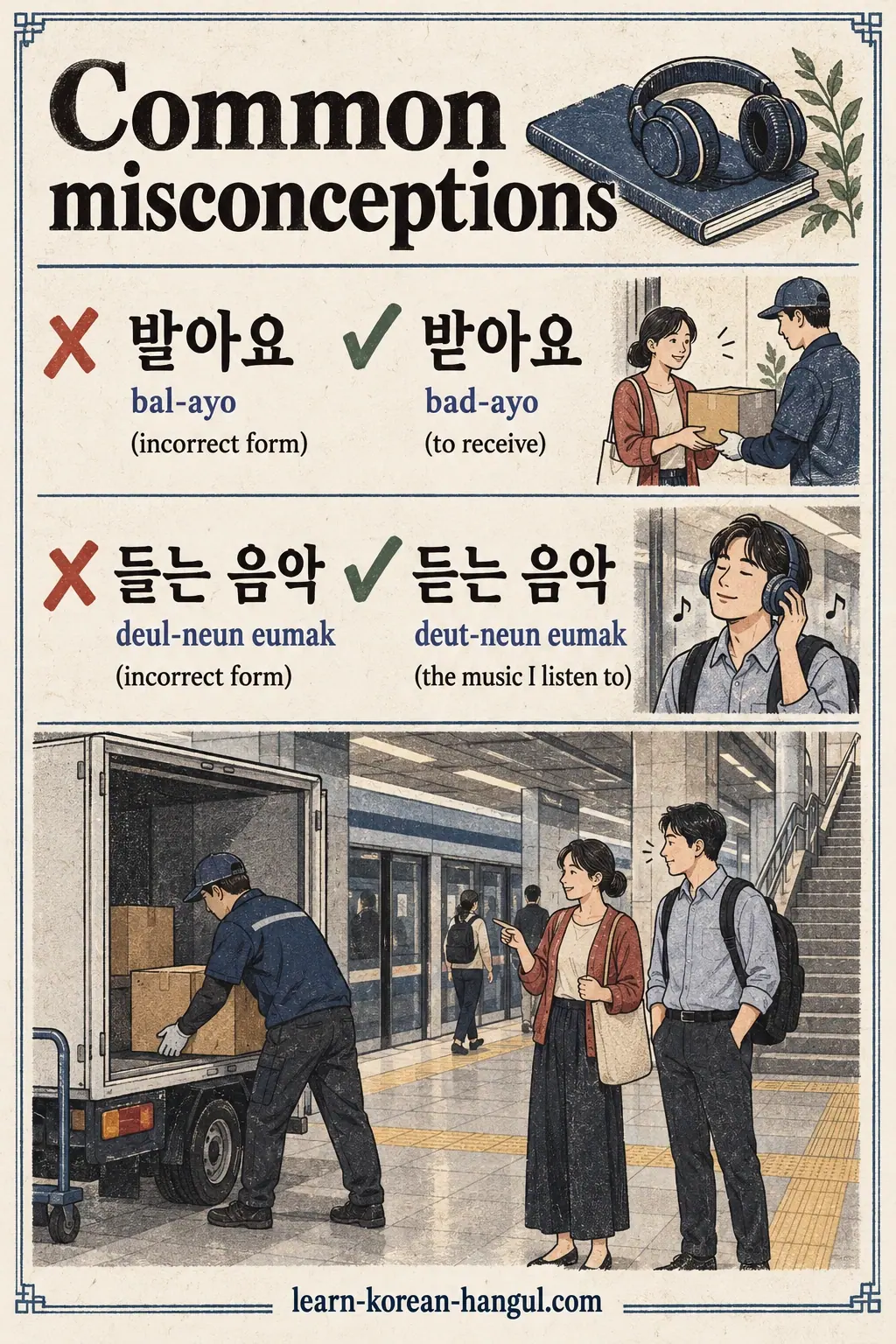
- Learners often treat every -ㄷ다 verb as irregular. Actually most are regular. Wrong: 발아요, 달아요 (for 닫다). Right: 받아요, 닫아요.
- Learners often drop the 으 after ㄹ. Actually the ㄷ class keeps the linking 으. Wrong: 들면 (for "if I listen"). Right: 들으면.
- Learners often change ㄷ before -는. Actually -는 starts with a consonant. Wrong: 들는 음악. Right: 듣는 음악.
- Learners often spell by ear. Actually the spoken [드러요] is written 들어요.
An honest limit: this page covers the verbs a learner needs and names the rare ones, but it does not list every archaic or dialect ㄷ verb. If a verb is not in the table above, check its entry in 표준국어대사전 or try it in the Korean verb conjugator, which refuses to guess for words outside its reviewed list.
Practice: 8 Items
Give the form asked for. Answers follow.
- 듣다, polite past
- 걷다, -(으)면
- 받다, polite present
- 묻다 (ask), polite present
- 닫다, polite past
- 듣다, + -고
- 깨닫다, polite past
- 걷다, before 사람 (present)
Practice · 8
What is the polite past of 듣다 (to listen)?
Show answer
들었어요
Before a vowel ending such as 었, the final ㄷ becomes ㄹ. [드러] is only the sound; the spelling is 들.
What is the -(으)면 form of 걷다 (to walk)?
Show answer
걸으면
ㄷ becomes ㄹ before the linking 으, and unlike the ㅂ class, the 으 stays.
What is the polite present of 받다 (to receive)?
Show answer
받아요
받다 is a regular look-alike: its ㄷ never changes, and the ㅏ stem takes 아요.
묻다 means "ask" in 길을 ___. Which polite present is right?
Show answer
물어요
묻다 "ask" is ㄷ-irregular (물어요); 묻어요 belongs to the regular homograph "bury".
How do you say "the music I listen to" (present)?
Show answer
듣는 음악
The present modifier -는 starts with a consonant, so the ㄷ stays. 들은 음악 is the past: "the music I listened to".
What is the polite past of 깨닫다 (to realize)?
Show answer
깨달았어요
ㄷ becomes ㄹ, and vowel harmony still applies: the ㅏ stem takes 았.
How do you say "listen and ..." with 듣다 + -고?
Show answer
듣고
-고 starts with a consonant, so the ㄷ is kept.
Which statement about ㄷ-irregular words is true?
Show answer
Among common words they are all verbs; ㄷ adjectives such as 곧다 are regular
The class is small and closed (듣다, 걷다, 묻다, 깨닫다, 싣다, 알아듣다), and the change happens only before vowels.
Answer key
| # | Answer | Why |
|---|---|---|
| 1 | 들었어요 | ㄷ → ㄹ before 었 |
| 2 | 걸으면 | ㄷ → ㄹ; the 으 stays |
| 3 | 받아요 | regular look-alike |
| 4 | 물어요 | ㄷ → ㄹ (the "ask" sense) |
| 5 | 닫았어요 | regular look-alike |
| 6 | 듣고 | consonant ending, no change |
| 7 | 깨달았어요 | ㄷ → ㄹ; ㅏ stem takes 았 |
| 8 | 걷는 사람 | -는 starts with a consonant |
If you got 7 or 8 right, the class is yours. Errors on items 3 and 5 mean the regular look-alikes need one more pass.
What Should You Learn after the ㄷ Irregular?
With the Korean ㄷ irregular explained, the next step is the irregular verbs chart, which puts this class beside the other six so you can compare the changes. If a new verb ending in ㄷ appears in your reading, use the two tests in how to recognize irregular verbs to check it.
What this page does not cover. It does not cover the other irregular classes (ㅂ, ㅅ, 르, ㅎ, ㅡ, ㄹ) or the full set of sound-change rules. About this page. Last updated 2026-10-09. The Korean text and conjugated forms were drafted with AI assistance and cross-checked with the site's rule-based conjugation engine; the Korean reviewer checks every lesson before publication. Romanization follows the Revised Romanization of Korean and is only a learning aid.
Frequently Asked Questions
What is the past tense of 듣다? The polite past of 듣다 ("to listen, to hear") is 들었어요 (deureosseoyo). The ㄷ becomes ㄹ before 었, so 듣 + 었어요 gives 들었어요. The formal past is 들었습니다 and the casual past is 들었어. 어제 그 노래를 들었어요 means "I listened to that song yesterday."
Is 받다 a ㄷ irregular verb? No. 받다 ("to receive") is regular, so the ㄷ never changes: 받아요, 받았어요, 받으면. Learners sometimes write 발아요 by analogy with 듣다. The same is true of 닫다 ("to close"), 믿다 ("to believe") and 얻다 ("to get"), which are among the most frequent regular verbs ending in -ㄷ다.
How do I say "I walk every day" in Korean? Say 매일 걸어요 (maeil georeoyo). 걸어요 is the polite present of the ㄷ-irregular verb 걷다 ("to walk"), whose ㄷ becomes ㄹ before 어요. To say you walk to a place, add 에: 학교에 걸어서 가요, "I walk to school", literally "I go to school by walking."
Are there any ㄷ-irregular adjectives? Not among common words. The ㄷ-irregular words a learner meets are all verbs: 듣다, 걷다, 묻다, 깨닫다, 싣다 and 알아듣다, plus rarer verbs such as 붇다. Adjectives that end in -ㄷ다, such as 곧다 ("to be straight"), are regular: 곧아요. So a ㄷ adjective can safely be treated as regular.
Why do Koreans often say 물어봐요 instead of 물어요? 물어보다 combines 묻다 ("to ask") with 보다 ("to try"), and it is the everyday way to say "ask". It sounds softer than 물어요 and is used for requests: 선생님께 물어보세요, "Ask the teacher." The first part still shows the ㄷ irregular: 묻 + 어 becomes 물어.