
What Is the ㅡ Irregular in Korean?

The ㅡ irregular is a class of words whose stem-final vowel ㅡ disappears when an ending that starts with 아 or 어 is added. The stem is the word minus 다, so the stem of 쓰다 is 쓰. Add 어요 and the ㅡ drops: ㅆ + 어 = 써, so 쓰 + 어요 = 써요 (sseoyo). Before any other ending the ㅡ stays: 쓰고, 쓰면, 씁니다.
Only the 아/어 endings trigger the drop: the polite present (-아요/어요), the past (-았/었어요) and the because form (-아서/어서). That is one difference from the ㅂ, ㄷ and ㅅ classes, which change before every vowel. The lesson Korean ㅡ irregular verbs teaches the rule step by step with 20 common words, the four non-standard forms to avoid (잠궈요, 담궈요, 치뤄요, 들려요) and a 10-item practice set. The next question is the one this class adds: which of 아 and 어 to use.
How Do You Choose 아 or 어?

The vowel of the syllable before the dropped ㅡ chooses 아 or 어. If that vowel is ㅏ or ㅗ, the ending is 아. For any other vowel, it is 어. If there is no earlier syllable, as in the one-syllable stems 쓰, 크 and 끄, the ending is 어. This is the usual rule of vowel harmony, applied to the syllable that survives.
| Stem | Syllable before ㅡ | Its vowel | Ending | Polite present |
|---|---|---|---|---|
| 바쁘 | 바 | ㅏ | 아 | 바빠요 |
| 아프 | 아 | ㅏ | 아 | 아파요 |
| 나쁘 | 나 | ㅏ | 아 | 나빠요 |
| 배고프 | 고 | ㅗ | 아 | 배고파요 |
| 모으 | 모 | ㅗ | 아 | 모아요 |
| 따르 | 따 | ㅏ | 아 | 따라요 |
| 예쁘 | 예 | ㅖ | 어 | 예뻐요 |
| 슬프 | 슬 | ㅡ | 어 | 슬퍼요 |
| 기쁘 | 기 | ㅣ | 어 | 기뻐요 |
| 쓰, 크, 끄 | none | none | 어 | 써요, 커요, 꺼요 |
Notice two details. In 배고프다, the syllable right before ㅡ is 고, not 배, so ㅗ chooses 아: 배고파요. In 모으다, the ㅡ is the 으, and the earlier syllable 모 chooses 아: 모아요. Vowel harmony is explained in full in vowel harmony. With the choice clear, the word list follows.
Which Words Are ㅡ Irregular?
The site's verb dictionary has 13 ㅡ irregular entries: 4 action verbs and 9 adjectives, from 12 different spellings. The two entries spelled 쓰다 are different words, "to write, use, wear, spend" and "to be bitter", and both give 써요. The table shows the polite present, the past, the if form and the form before a noun, so you can see the ㅡ survive when no 아/어 follows.
| Dictionary form | Meaning | Polite present | Polite past | If (-(으)면) | Before a noun (present) |
|---|---|---|---|---|---|
| 쓰다 | write, use, wear (a hat), spend | 써요 | 썼어요 | 쓰면 | 쓰는 |
| 쓰다 | be bitter | 써요 | 썼어요 | 쓰면 | 쓴 |
| 끄다 | turn off | 꺼요 | 껐어요 | 끄면 | 끄는 |
| 모으다 | gather, save | 모아요 | 모았어요 | 모으면 | 모으는 |
| 따르다 | pour, follow | 따라요 | 따랐어요 | 따르면 | 따르는 |
| 크다 | be big | 커요 | 컸어요 | 크면 | 큰 |
| 아프다 | be sick, hurt | 아파요 | 아팠어요 | 아프면 | 아픈 |
| 나쁘다 | be bad | 나빠요 | 나빴어요 | 나쁘면 | 나쁜 |
| 예쁘다 | be pretty | 예뻐요 | 예뻤어요 | 예쁘면 | 예쁜 |
| 슬프다 | be sad | 슬퍼요 | 슬펐어요 | 슬프면 | 슬픈 |
| 기쁘다 | be glad | 기뻐요 | 기뻤어요 | 기쁘면 | 기쁜 |
| 배고프다 | be hungry | 배고파요 | 배고팠어요 | 배고프면 | 배고픈 |
| 바쁘다 | be busy | 바빠요 | 바빴어요 | 바쁘면 | 바쁜 |
Group the words by type to learn them faster.
- Action verbs: 쓰다, 끄다, 모으다, 따르다. They take an object: 편지를 써요 (I write a letter), 불을 꺼요 (I turn off the light).
- Feelings and states: 아프다, 슬프다, 기쁘다, 배고프다, 바쁘다. They describe how you feel or what you are doing.
- Qualities: 크다, 나쁘다, 예쁘다, 쓰다 (bitter).
The ㅡ-irregular adjectives that end in -프다 or -쁘다 form a family: 아프다, 슬프다, 배고프다, 바쁘다, 나쁘다, 예쁘다, 기쁘다. Once you know one, you know the pattern for all of them. The audio below gives the polite past of the most common ones.
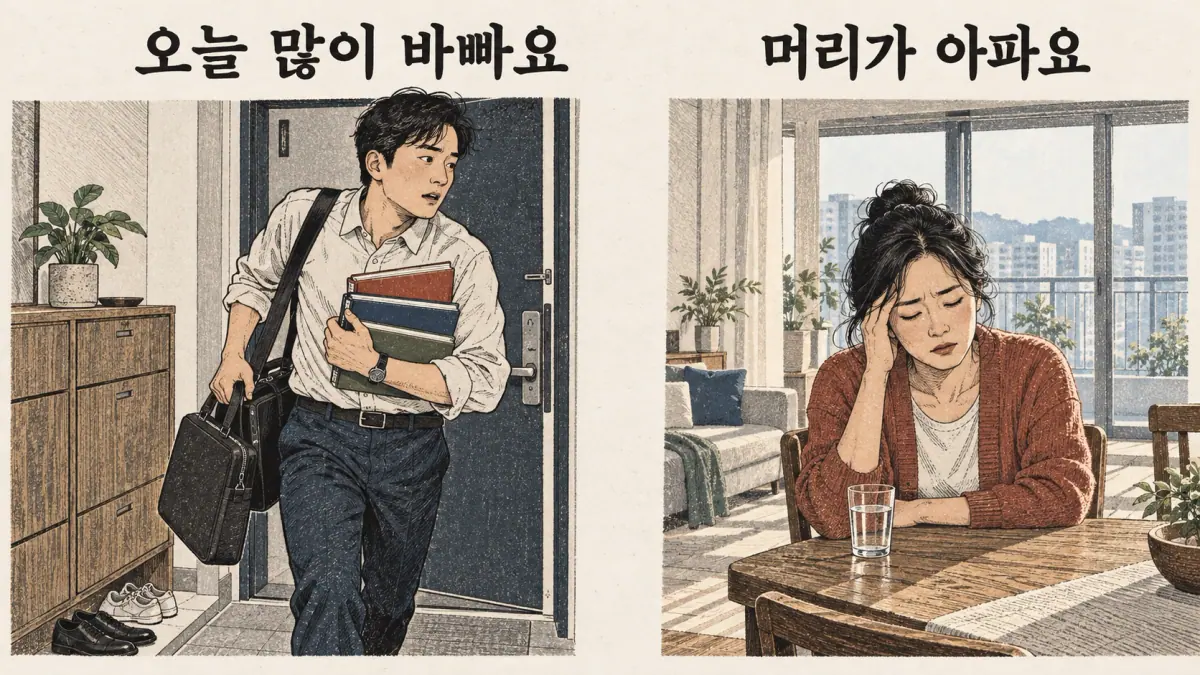
Two phrases show the forms in a sentence: 오늘 많이 바빠요 (I am very busy today) and 머리가 아파요 (I have a headache). They also bring up a common confusion about the letter 으.
Is the ㅡ Drop the Same as the Linking 으?
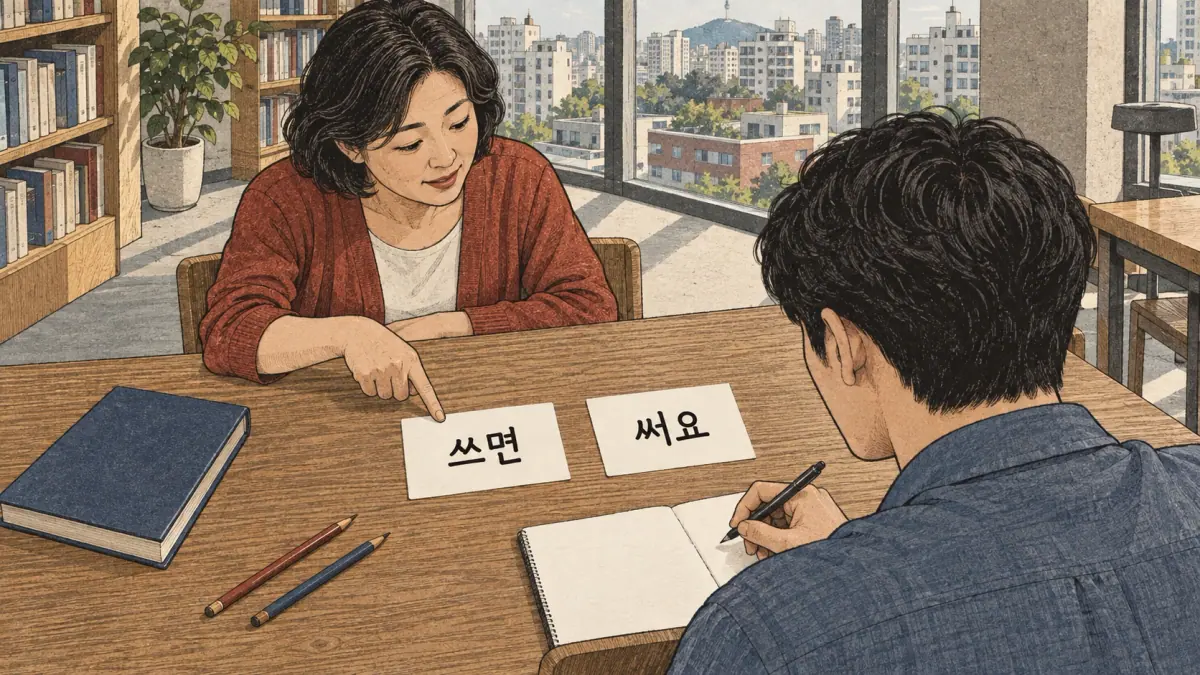
No. The ㅡ drop is a change in the stem, while the 으 in -(으)면 and -(으)세요 is a linking vowel that belongs to the ending and appears only after consonant stems. Because 쓰 ends in a vowel, the linking 으 is simply left out, so 쓰 + (으)면 gives 쓰면, not 쓰으면.
| Stem type | Ending -(으)면 | Result | What happens |
|---|---|---|---|
| Consonant stem 먹 | 먹 + 으면 | 먹으면 | linking 으 is needed |
| Vowel stem 가 | 가 + 면 | 가면 | linking 으 is left out |
| ㅡ stem 쓰 | 쓰 + 면 | 쓰면 | ㅡ stays; no 아/어 follows |
| ㅡ stem 쓰 | 쓰 + 어요 | 써요 | ㅡ drops before 어 |
The linking vowel is explained in Korean verb endings. For this class, the test is what comes next: if the ending starts with 아 or 어, the stem's ㅡ is dropped; with anything else, it stays. Beyond that confusion, some words only look like members of the class.
Which Words Only Look Like ㅡ Words?

Verbs ending in 르 are the main false friends, because they do not all behave alike. The word 따르다 is a ㅡ-drop word, so it gives 따라요 with no doubled ㄹ. The word 모르다 is a 르 irregular word, so it gives 몰라요 with a doubled ㄹ. The two groups look alike in the dictionary form, and the verb list decides.
| Word | Class | Polite present | Why |
|---|---|---|---|
| 따르다 | ㅡ drop | 따라요 | ㅡ drops, no extra ㄹ |
| 모르다 | 르 irregular | 몰라요 | ㄹ doubles |
| 부르다 | 르 irregular | 불러요 | ㄹ doubles |
| 치르다 | ㅡ drop | 치러요 | ㅡ drops, no extra ㄹ |
| 들르다 | ㅡ drop | 들러요 | ㅡ drops, no extra ㄹ |
Words like 치르다 (to pay; to hold an exam) and 들르다 (to stop by) are not in the site's verb dictionary yet but follow the same ㅡ-drop rule. The 르 words are on the 르 irregular hub. 담그다 (to pickle; to soak) and 잠그다 (to lock) are further ㅡ-drop verbs: 담가요 and 잠가요.
Korean school grammar (학교문법) treats the ㅡ drop (으 탈락) as a regular rule, because it applies to every stem that ends in ㅡ. Learner books often list it as an irregular class, and this site does the same. Both views give the same forms. To see the whole system, open the Korean irregular verbs hub.
Where Do the ㅡ Words Appear in Context?
Many of the ㅡ words are the first adjectives for feelings and states. The page Korean physical state adjectives shows 아프다 and 배고프다 in sentences.
Dictionary pages list every form of a word, with audio and example sentences:
- 쓰다 (to write): sseuda conjugation
- 끄다 (to turn off): kkeuda conjugation
- 모으다 (to gather/save): moeuda conjugation
- 따르다 (to pour/follow): ttareuda conjugation
- 아프다 (sick; painful): apeuda conjugation
- 나쁘다 (bad): nappeuda conjugation
- 크다 (big): keuda conjugation
- 쓰다 (bitter): bitter in Korean
To practise the ㅡ irregular verbs in Korean, say each polite present in the list aloud and name the vowel that chose its ending: 바빠요 (바, ㅏ), 예뻐요 (예, ㅖ), 써요 (no earlier syllable).
Frequently Asked Questions
Why is 쓰다 써요 and not 쓰어요? Because the stem-final ㅡ always drops before 아 or 어. The ㅆ then joins the vowel to make 써. There is no earlier syllable, so the ending is 어. Spelling the long form 쓰어요 is an error. The same happens with 크다 (커요) and 끄다 (꺼요).
Which ㅡ irregular words should I learn first? Start with 쓰다, 크다, 아프다, 바쁘다 and 예쁘다, which appear in the first weeks of lessons. Then add 나쁘다, 슬프다, 기쁘다, 배고프다 and the verbs 끄다 and 모으다. The -프다 and -쁘다 words form a family, so one rule covers seven adjectives, and the 아/어 choice is the only detail to check.
Is the ㅡ drop a regular rule? In Korean school grammar, yes: the 으 탈락 applies to every stem ending in ㅡ, so it counts as regular. Learner books usually list it with the irregular classes, since the basic 아/어 recipe does not predict it. The forms are the same in every book. Only the label differs.
Is 따르다 a 르 irregular word? No. 따르다 (to pour, to follow) is a ㅡ-drop word, so it gives 따라요 with a single ㄹ. A 르 irregular word like 모르다 doubles the ㄹ: 몰라요. Both end in 르, so learners must check the list. 치르다 (치러요) and 들르다 (들러요) also follow the ㅡ-drop rule.
Does the ㅡ drop before every ending? No. The ㅡ drops only before 아 or 어. Before any other ending it stays: 쓰고 (write and), 쓰면 (if I write), 씁니다 (formal), 큰 (the form before a noun). That is why the class is easier to track than ㅂ or ㄷ, which change before every vowel.