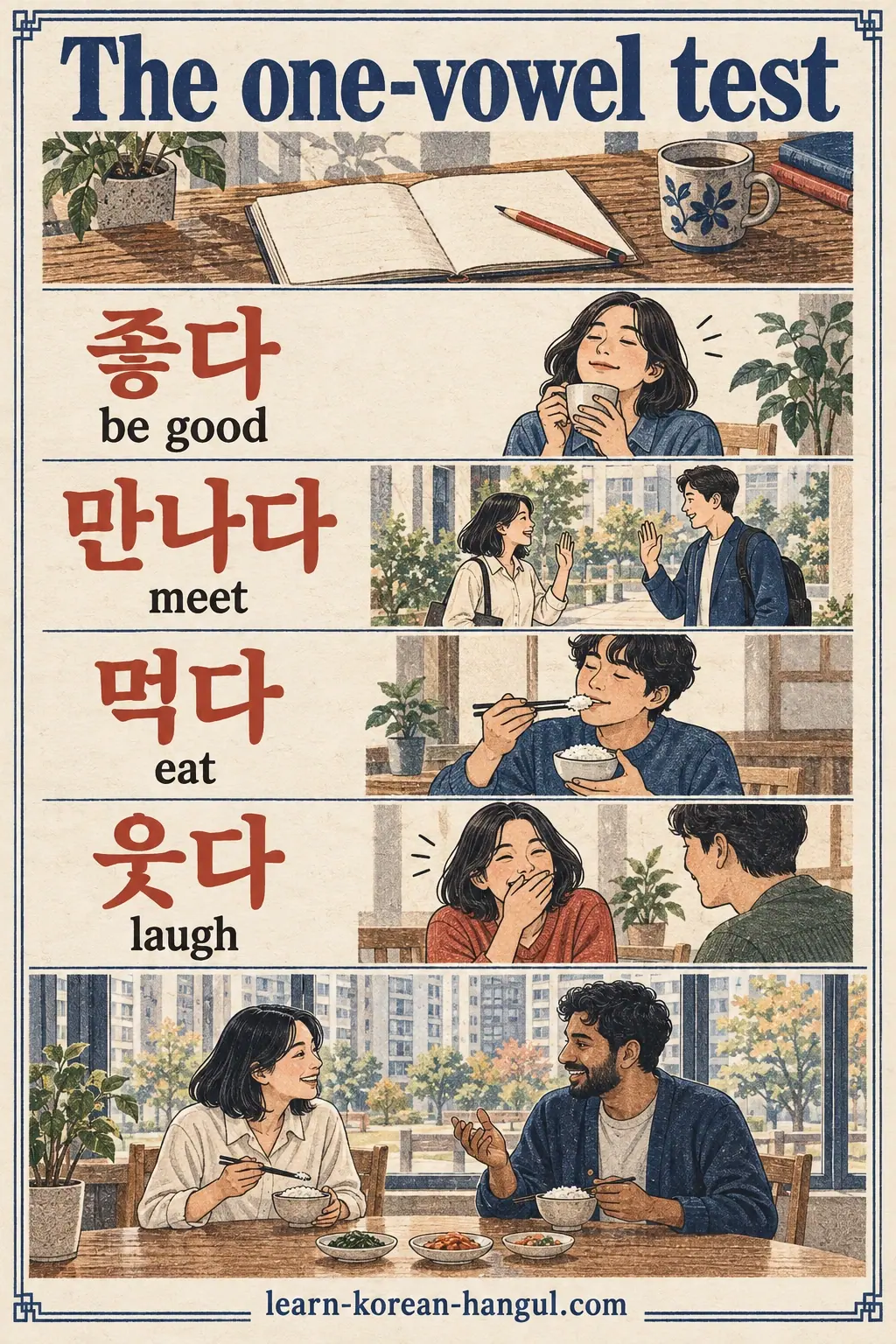
What you will be able to do after this lesson
- Predict whether each of the 10 practice stems takes 아 or 어 by checking one vowel.
- Explain the three exceptions: 하다 and 여, ㅡ stems, and 돕다 and 곱다.
- Spot and fix wrong pairs such as 좋어요 and 먹아요.
- Apply the same choice to the past tense and to other 아/어 endings.
Before you start: read the present tense recipe, because this lesson expands its step 2. Time: about 25 minutes. Level: A1.
What Is Korean Verb Vowel Harmony?
Korean verb vowel harmony is the habit of matching the vowel of an ending to the vowel of the stem. Korean calls it 모음조화 (moeumjohwa). Stems whose last vowel is "bright" (양성 모음, yangseong moeum) take 아, and stems with any other last vowel, the "dark" ones (음성 모음, eumseong moeum), take 어.
- 좋 has the bright vowel ㅗ, so 좋 + 아요 = 좋아요 [조아요] ("is good").
- 먹 has the dark vowel ㅓ, so 먹 + 어요 = 먹어요 [머거요] ("eats").
The labels "bright" and "dark" come from traditional grammar and describe sound families, not volume or colour. You do not need to memorise them. For verbs, the practical rule is much shorter: ㅏ and ㅗ give 아, and everything else gives 어.
The ending itself is introduced in how Korean conjugation works. The next section turns the rule into a test you can run in two seconds.
The One-Vowel Test

The one-vowel test asks a single question about the stem: is its last vowel ㅏ or ㅗ? Follow these steps for any regular verb or adjective.
- Remove 다 to get the stem (먹다 → 먹).
- Find the last vowel in the stem, which is the vowel of its last syllable block (먹 → ㅓ).
- If it is ㅏ or ㅗ, add 아요. If not, add 어요.
- If the stem ends in a vowel, contract (가 + 아요 = 가요).
Six contrasts show the test at work:
| Dictionary form | Last stem vowel | Group | Polite present |
|---|---|---|---|
| 좋다 (be good) | ㅗ | 아 | 좋아요 [조아요] |
| 만나다 (meet) | ㅏ | 아 | 만나요 |
| 먹다 (eat) | ㅓ | 어 | 먹어요 [머거요] |
| 웃다 (laugh) | ㅜ | 어 | 웃어요 [우서요] |
| 읽다 (read) | ㅣ | 어 | 읽어요 [일거요] |
| 기다리다 (wait) | ㅣ | 어 | 기다려요 |
Only the last vowel counts. 기다리다 has ㅏ in its second syllable, but the stem 기다리 ends in ㅣ, so the ending is 어요. In the same way 만나다 takes 아요 because its last stem syllable 나 has ㅏ. The earlier vowels are never checked, with one exception for ㅡ that follows below.
With the test in hand, the next table covers every vowel a stem can end in.
Which Stem Vowels Take 아요 and Which Take 어요?
Two stem vowels take 아요, and the rest take 어요, with ㅡ as the single vowel that looks back. The table lists ten vowels and one real verb for each.
| Last stem vowel | Ending | Example verb | Polite present | Note |
|---|---|---|---|---|
| ㅏ | 아요 | 만나다 | 만나요 | 아 drops after ㅏ |
| ㅗ | 아요 | 좋다 | 좋아요 | closed syllable, no contraction |
| ㅗ | 아요 | 오다 | 와요 | ㅗ + ㅏ merge into ㅘ |
| ㅓ | 어요 | 먹다 | 먹어요 | no contraction |
| ㅜ | 어요 | 배우다 | 배워요 | ㅜ + ㅓ merge into ㅝ |
| ㅡ | look back | 아프다 | 아파요 | ㅡ drops; see next section |
| ㅣ | 어요 | 마시다 | 마셔요 | ㅣ + ㅓ merge into ㅕ |
| ㅐ | 어요 | 보내다 | 보내요 | 어 usually drops after ㅐ (보내어요 is also correct) |
| ㅔ | 어요 | 세다 | 세요 | 어 usually drops after ㅔ (세어요 is also correct) |
| ㅚ | 어요 | 되다 | 돼요 | 되 + 어 merge into 돼 |
| ㅟ | 어요 | 쉬다 | 쉬어요 | no contraction in standard usage |
One rare vowel joins the 아 group: ㅑ, found in 얇다 (be thin), gives 얇아요 [얄바요], and Hangul Orthography Article 16 lists 얇아 with the ㅏ and ㅗ stems. Notice also that ㅐ, ㅔ, ㅚ and ㅟ look like a mix of bright and dark vowels, but in verb endings they all take 어. The old labels do not help here, and the working rule does. The form 세요 has a twin: 세다 (to count) and the honorific ending -세요 sound identical, and context tells them apart.
Each contraction in the last column has its own lesson, starting with vowel dropping (ㅏ and ㅓ stems). The one vowel marked "look back" needs a closer look first.
Does a Final Consonant Change the Choice?
No, a final consonant (받침, batchim) never changes the choice. Only the vowel of the last syllable counts, so ignore anything written below it. The consonant simply stays in place and moves on to the ending in speech.
| Dictionary form | Last syllable | Vowel | Polite present |
|---|---|---|---|
| 높다 (be high) | 높 | ㅗ | 높아요 [노파요] |
| 작다 (be small) | 작 | ㅏ | 작아요 [자가요] |
| 짧다 (be short) | 짧 | ㅏ | 짧아요 [짤바요] |
| 멀다 (be far) | 멀 | ㅓ | 멀어요 [머러요] |
| 넓다 (be wide) | 넓 | ㅓ | 넓어요 [널버요] |
| 늦다 (be late) | 늦 | ㅡ | 늦어요 [느저요] |
Look at the last row. 늦 has the vowel ㅡ, but the stem ends in a consonant, so the ㅡ does not drop and no earlier syllable is checked: 늦어요, not 늦아요. The look-back rule in the next section applies only when the stem ends in the vowel ㅡ itself.
What Do You Do with Stems That End in ㅡ?

For a stem ending in ㅡ, look at the vowel of the syllable before ㅡ. If that vowel is ㅏ or ㅗ, use 아요. Otherwise use 어요. In both cases ㅡ drops out. A stem with only one syllable has no earlier vowel, so it takes 어요.
| Dictionary form | Stem | Vowel before ㅡ | Ending | Polite present |
|---|---|---|---|---|
| 아프다 (be sick) | 아프 | ㅏ | 아요 | 아파요 |
| 바쁘다 (be busy) | 바쁘 | ㅏ | 아요 | 바빠요 |
| 나쁘다 (be bad) | 나쁘 | ㅏ | 아요 | 나빠요 |
| 배고프다 (be hungry) | 배고프 | ㅗ | 아요 | 배고파요 |
| 모으다 (collect, save) | 모으 | ㅗ | 아요 | 모아요 |
| 예쁘다 (be pretty) | 예쁘 | ㅖ | 어요 | 예뻐요 |
| 슬프다 (be sad) | 슬프 | ㅡ | 어요 | 슬퍼요 |
| 기쁘다 (be glad) | 기쁘 | ㅣ | 어요 | 기뻐요 |
| 쓰다 (write) | 쓰 | none | 어요 | 써요 |
| 크다 (be big) | 크 | none | 어요 | 커요 |
A quick memory aid: 아프다 and 바쁘다 sound like their forms (아파요, 바빠요) because the bright vowel ㅏ repeats. Many textbooks list this ㅡ drop as an irregular class, and ㅡ irregular teaches it in full.
ㅡ stems are the main surprise for the 아/어 choice. The next surprise is a pair of verbs that look irregular but follow a separate rule.
와 and 워 in ㅂ-Irregular Verbs

The forms 와 and 워 come from the ㅂ-irregular class, where the final ㅂ of the stem turns into 우 before a vowel. The 우 then merges with 아 or 어. This looks like vowel harmony, but the result is fixed by the spelling rules: 돕다 and 곱다 take 와, and every other ㅂ-irregular verb takes 워, even after ㅏ, as in 가깝다 → 가까워요.
| Dictionary form | Stem | Change | Polite present |
|---|---|---|---|
| 돕다 (help) | 돕 | ㅂ → 우, then ㅗ stem takes 아: 도우 + 아 | 도와요 |
| 곱다 (be pretty, delicate) | 곱 | ㅂ → 우, ㅗ stem takes 아 | 고와요 |
| 덥다 (be hot) | 덥 | ㅂ → 우, ㅓ stem takes 어 | 더워요 |
| 춥다 (be cold) | 춥 | ㅂ → 우, ㅜ stem takes 어 | 추워요 |
| 쉽다 (be easy) | 쉽 | ㅂ → 우, ㅟ stem takes 어 | 쉬워요 |
| 어렵다 (be hard) | 어렵 | ㅂ → 우, ㅕ stem takes 어 | 어려워요 |
Of all ㅂ-irregular verbs, only 돕다 and 곱다 take 와. Every other ㅂ-irregular verb takes 워. Do not use 와/워 as a guide for regular verbs: the regular verb 입다 gives 입어요, not 이워요. The whole class is in ㅂ irregular.
Past forms follow the same split: 도왔어요 and 고왔어요 against 더웠어요 and 추웠어요.
Why Is 하다 an Exception?

하다 is an exception because it takes the ending 여요 instead of 아요, even though its vowel is ㅏ. The 하 + 여 pair contracts into 해, giving 해요. The rule covers every verb and adjective that ends in 하다.
- 하다 → 해요 (do)
- 공부하다 → 공부해요 (study)
- 따뜻하다 → 따뜻해요 (be warm)
By the ㅏ rule you would expect 하아요, but no Korean writes it. The 여 ending is a historical survivor. 하다 to 해요 gives the full rule, the past form 했어요 and the formal form 합니다.
Vowel Harmony in the past Tense and Other Endings

Vowel harmony applies to the past tense with the same split. The past marker is 았 after ㅏ or ㅗ and 었 after every other vowel, and 하다 gives 했. The same choice runs through every 아/어 ending, not only the polite present.
| Stem | Polite present | Past (polite) | With -서 ("because", "and then") |
|---|---|---|---|
| 좋 | 좋아요 | 좋았어요 | 좋아서 |
| 먹 | 먹어요 | 먹었어요 | 먹어서 |
| 오 | 와요 | 왔어요 | 와서 |
| 공부하 | 공부해요 | 공부했어요 | 공부해서 |
Example sentences:
- 비가 와서 집에 있어요. = It is raining, so I stay home.
- 어제 밥을 많이 먹었어요. = I ate a lot yesterday.
The full past-tense recipe is in past tense conjugation, so this lesson only needs the vowel choice. The next section asks how much of the system survives in modern Korean.
Vowel Harmony in Modern Korean

Vowel harmony is still used, but in a reduced form. Linguists describe older Korean as applying vowel harmony more widely than modern Korean does. Today it mainly survives in the 아/어 choice and in sound-symbolic words (onomatopoeia and mimetic words). That tells learners where to look and where not to: do not expect harmony in everyday nouns or particles.
Sound-symbolic pairs show the old idea at work. Bright vowels give a lighter, smaller impression, and dark vowels give a heavier, bigger one:
| Bright form | Dark form | Typical feeling |
|---|---|---|
| 졸졸 | 줄줄 | a thin trickle of water vs a heavier flow |
| 반짝 | 번쩍 | a small twinkle vs a bigger flash |
You will meet more pairs in Korean onomatopoeia. For now treat them as a preview that explains why the same vowel idea exists in vocabulary.
Wrong Forms That Break Vowel Harmony
Six wrong forms account for most errors in the 아/어 choice. Each one fails a specific test.
| Wrong | Correct | Why the wrong form fails |
|---|---|---|
| 좋어요 | 좋아요 | the last stem vowel ㅗ is bright, so the ending is 아요 |
| 먹아요 | 먹어요 | the last stem vowel ㅓ is dark, so the ending is 어요 |
| 마샤요 | 마셔요 | ㅣ takes 어 and merges into ㅕ, never ㅑ |
| 만너요 | 만나요 | the stem ends in ㅏ, so 아 is added and then dropped |
| 바뻐요 | 바빠요 | the vowel before ㅡ is ㅏ, so use 아요 |
| 예빠요 | 예뻐요 | the vowel before ㅡ is ㅖ, so use 어요 |
If a form feels wrong, rerun the one-vowel test before you guess.
Practice
Choose 아요 or 어요, then write the polite present. Answers follow.
- 앉다 (sit)
- 웃다 (laugh)
- 읽다 (read)
- 만나다 (meet)
- 바쁘다 (be busy)
- 슬프다 (be sad)
- 쓰다 (write)
- 배우다 (learn)
- 돕다 (help)
- 춥다 (be cold)
Answers to the Practice
- 앉아요 [안자요]. The last vowel ㅏ gives 아요.
- 웃어요 [우서요]. The last vowel ㅜ gives 어요.
- 읽어요 [일거요]. The last vowel ㅣ gives 어요.
- 만나요. The last vowel ㅏ gives 아요, and the extra 아 drops.
- 바빠요. The vowel before ㅡ is ㅏ, so 아요, and ㅡ drops.
- 슬퍼요. The vowel before ㅡ is ㅡ, so 어요, and ㅡ drops.
- 써요. A one-syllable ㅡ stem takes 어요, and ㅡ drops.
- 배워요. The last vowel ㅜ gives 어요, and ㅜ + ㅓ merge into ㅝ.
- 도와요. This is one of the two ㅂ-irregular verbs that take 와.
- 추워요. A ㅂ-irregular verb that takes 워.
What to Learn Next
Korean verb vowel harmony reduces to one question: is the last stem vowel ㅏ or ㅗ? If yes, use 아요. If no, use 어요, and remember three exceptions: ㅡ stems look back, 하다 takes 여, and only 돕다 and 곱다 take 와. Next, learn how two vowels combine in vowel dropping (ㅏ and ㅓ stems), and then 하다 to 해요.
This page does not cover the full ㅂ and ㅡ irregular classes, honorific endings or the formal and casual styles. The historical note is a short summary, and the sound-symbolic pairs are only a preview. Forms follow standard written Korean as described by the National Institute of Korean Language (국립국어원), and the bracketed pronunciations are standard Seoul approximations.
Frequently Asked Questions
Which vowels take 아요? Two common stem vowels take 아요: ㅏ and ㅗ, plus the rare ㅑ of 얇다. Examples are 만나요 (from 만나다) and 좋아요 (from 좋다). Every other final stem vowel takes 어요, including ㅓ, ㅜ, ㅡ, ㅣ, ㅐ and ㅔ. For stems ending in ㅡ, look at the syllable before it instead.
Why is it 먹어요 and not 먹아요? The stem 먹 has the vowel ㅓ as its last vowel, and ㅓ belongs to the dark group that takes 어요. Using 아요 here would break vowel harmony. Test every verb with one question: is the last stem vowel ㅏ or ㅗ? If not, the ending is 어요.
How do I choose for a stem ending in ㅡ? Look at the vowel one syllable earlier. If it is ㅏ or ㅗ, use 아요, so 바쁘다 gives 바빠요. If it is anything else, use 어요, so 예쁘다 gives 예뻐요. If the stem has only one syllable, such as 쓰다 or 크다, use 어요: 써요, 커요.
Does vowel harmony apply to the past tense? Yes. The past marker uses the same split: 았 after ㅏ or ㅗ and 었 after other vowels, giving 좋았어요 and 먹었어요. The other 아/어 endings, such as -아서/어서 and -아도/어도, follow the same choice. 하다 gives 했어요 in the past.
Is vowel harmony still used in modern Korean? Yes, but in a reduced form. Modern Korean keeps vowel harmony mainly in the 아/어 choice for verb endings and in sound-symbolic words such as 졸졸 and 줄줄. Older Korean applied harmony more widely, so learners need not look for it in everyday nouns or particles.