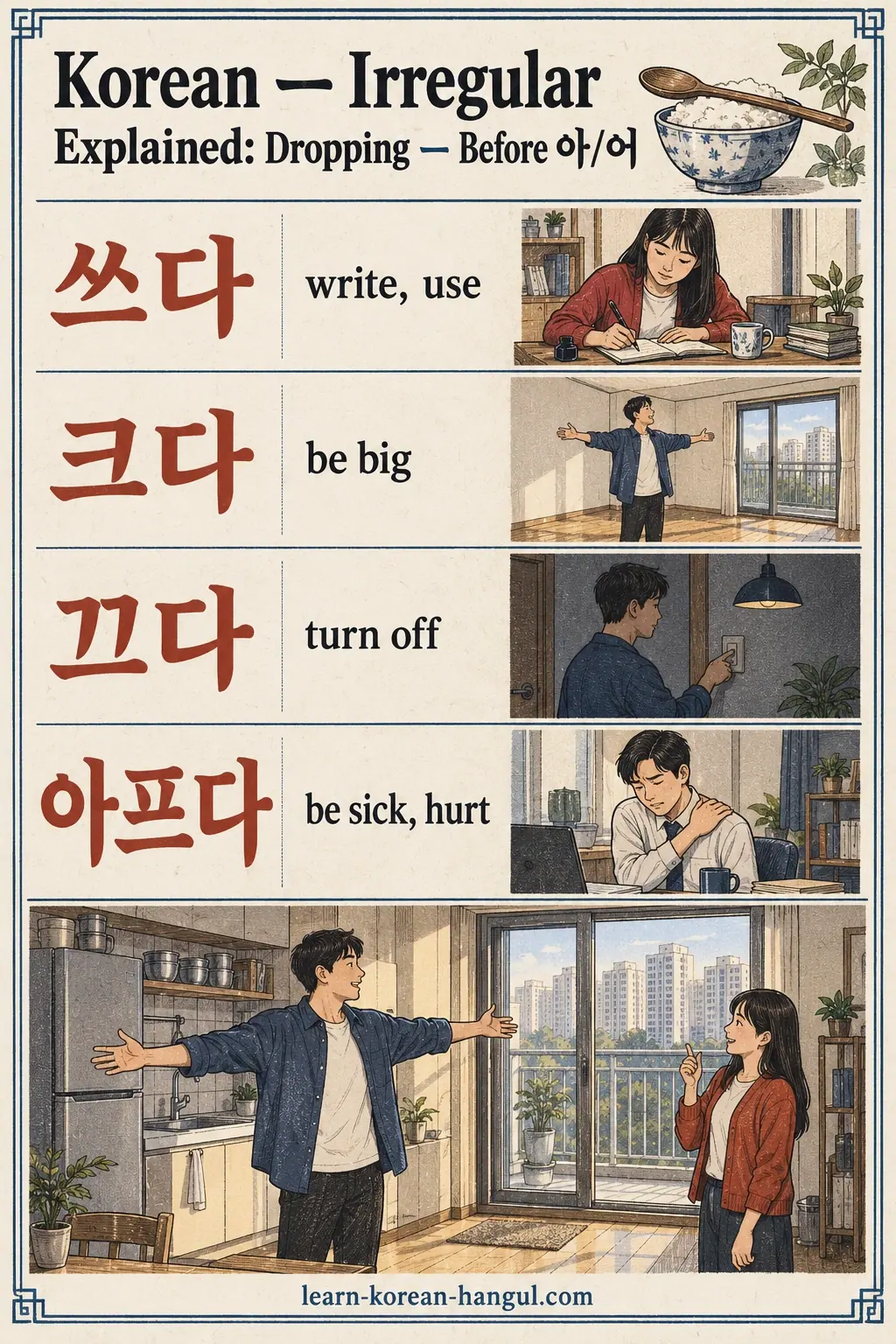
What you'll learn
- Conjugate 쓰다, 크다, 바쁘다, 예쁘다, 아프다, 슬프다 and 따르다 in the polite present and the past.
- Choose 아 or 어 by looking at the syllable before the ㅡ.
- Explain why 쓰면 has no 으 and why 큰 keeps its ㅡ.
- Avoid four forms that even Korean speakers get wrong: 잠궈요, 담궈요, 치뤘어요, 들렸어요.
Prerequisites: you know vowel harmony, the rule that picks 아요 or 어요 from the stem's last vowel. Time: about 30 minutes.
The first section defines the class and explains its two names.
What Is the Korean ㅡ Irregular?

The Korean ㅡ irregular is the group of verbs and adjectives whose stem ends in the vowel ㅡ and loses that ㅡ before an ending that starts with 아 or 어. A stem is the dictionary form minus 다, so the stem of 바쁘다 is 바쁘, which ends in ㅡ. In English-language textbooks the class is called the ㅡ irregular or "ㅡ drop".
Korean school grammar (학교 문법) gives it a different label. It calls the change 으 탈락 ("ㅡ deletion") and counts it as a regular rule, because every stem ending in ㅡ behaves the same way, with no exceptions. Both views describe the same forms. This site uses "ㅡ irregular" so that learners can find it next to the other classes, and notes the school label here so a Korean textbook will not surprise you.
The class matters because it holds many first-week adjectives. Of the 474 words in this site's verb dictionary, 13 are ㅡ words, including 크다 (big), 아프다 (sick), 바쁘다 (busy), 예쁘다 (pretty) and 나쁘다 (bad). The full list is on the ㅡ irregular words hub. The next section shows the drop step by step.
The Rule: ㅡ Drops before 아/어
The rule has two moves. First, the ㅡ at the end of the stem disappears, leaving its consonant without a vowel. Second, that consonant joins the ending 아 or 어 to form a new syllable. Nothing else in the word changes.
Worked Example: 바쁘다 → 바빠요
Follow the five steps for the polite present of 바쁘다 ("to be busy").
- Remove 다. 바쁘다 → 바쁘.
- Check the ending. -아요/-어요 starts with 아/어, so the rule applies.
- Drop the ㅡ. 바쁘 → 바ㅃ.
- Look one syllable back. The syllable before the ㅡ is 바, whose vowel is ㅏ, so choose 아.
- Join the consonant to the ending. ㅃ + 아요 → 빠요, giving 바빠요 (bappayo).
You'll know it worked when the result has the same number of syllables as the stem plus 요, and the consonant of the dropped syllable (here ㅃ) starts the new one. The common mistake at step 4 is to look at the ㅡ itself, which would always give 어 and produce the wrong form 바뻐요.
바쁘다
| Form | Korean | Romanization | Rule |
|---|---|---|---|
| Polite present | 바빠요 | bappayo | ㅡ drops; 바 has ㅏ → 아 |
| Polite past | 바빴어요 | bappasseoyo | ㅡ drops before 았 |
| Because (-아서/어서) | 바빠서 | bappaseo | ㅡ drops before 아서 |
| If (-(으)면) | 바쁘면 | bappeumyeon | vowel stem + 면: no drop |
| Before a noun | 바쁜 | bappeun | vowel stem + ㄴ: no drop |
| Formal present | 바쁩니다 | bappeumnida | vowel stem + ㅂ니다: no drop |
- ㅡ drop: a stem-final ㅡ disappears before an ending that starts with 아 or 어
Step 4 is where most errors happen, so the next section turns it into a reliable test.
How Do You Choose 아 or 어 after the Drop?

Look at the syllable before the ㅡ, not at the ㅡ itself. If that syllable's vowel is ㅏ or ㅗ, add 아. If it is any other vowel, add 어. This is ordinary vowel harmony, applied one syllable further back because the ㅡ is about to vanish.
| Word | Syllable before ㅡ | Its vowel | Ending | Result |
|---|---|---|---|---|
| 바쁘다 | 바 | ㅏ | 아 | 바빠요 |
| 아프다 | 아 | ㅏ | 아 | 아파요 |
| 배고프다 | 고 | ㅗ | 아 | 배고파요 |
| 모으다 | 모 | ㅗ | 아 | 모아요 |
| 예쁘다 | 예 | ㅖ | 어 | 예뻐요 |
| 슬프다 | 슬 | ㅡ | 어 | 슬퍼요 |
| 기쁘다 | 기 | ㅣ | 어 | 기뻐요 |
배고프다 shows why "one syllable back" matters: the word starts with 배 (ㅐ), but the syllable right before the ㅡ is 고 (ㅗ), so the answer is 배고파요. Words with no syllable before the ㅡ need their own rule, which comes next.
One-Syllable Stems: 쓰다, 크다, 끄다
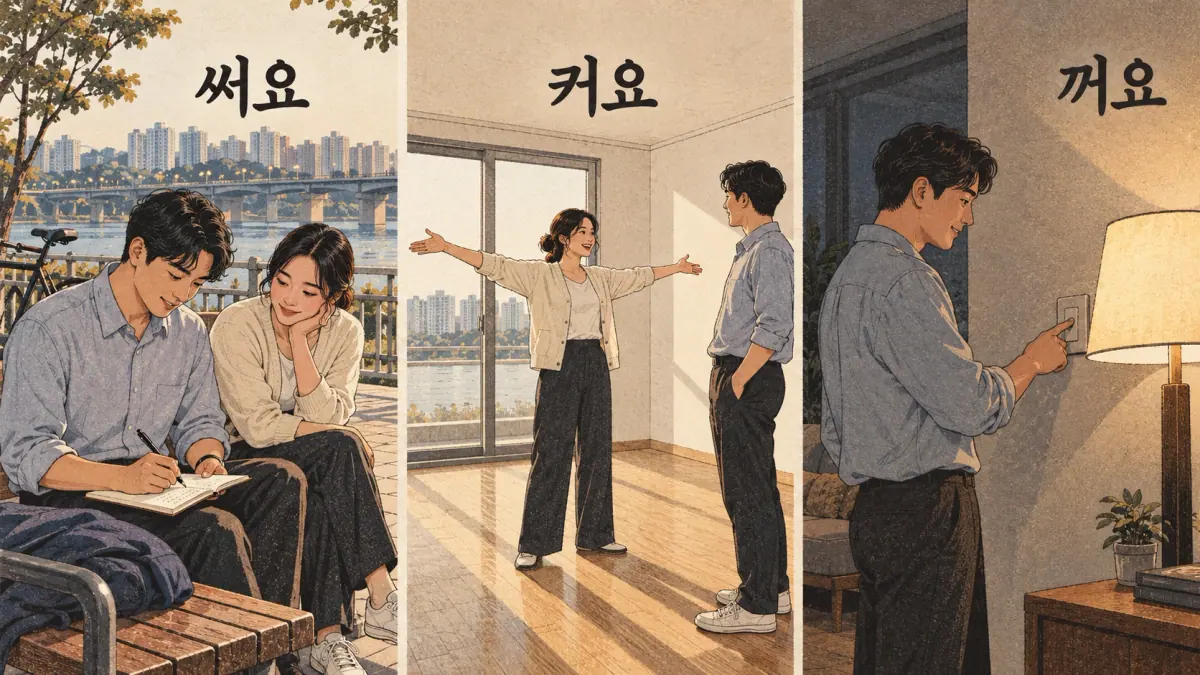
A one-syllable stem such as 쓰 has no earlier syllable to look at, so it always takes 어. After the ㅡ drops, only the first consonant is left, and it joins 어 directly.
| Word | Meaning | Polite present | Past |
|---|---|---|---|
| 쓰다 | write, use | 써요 | 썼어요 |
| 크다 | be big | 커요 | 컸어요 |
| 끄다 | turn off | 꺼요 | 껐어요 |
| 뜨다 | float, open (eyes) | 떠요 | 떴어요 |
| 트다 | sprout, crack | 터요 | 텄어요 |
The last clip, 불 좀 꺼 주세요, means "Please turn off the light." It uses the bare 꺼 form before 주세요, which follows the same drop. With both cases covered, the next section shows the whole class at once.
Korean ㅡ Irregular Explained in 20 Common Words
The table gives 20 everyday ㅡ words with the polite present, the polite past and the form before a noun. Verbs take -는 before a noun and adjectives take -(으)ㄴ; neither ending starts with 아/어, so the ㅡ stays in that column.
| Word | Meaning | Polite present | Polite past | Before a noun |
|---|---|---|---|---|
| 쓰다 | write, use | 써요 | 썼어요 | 쓰는 |
| 쓰다 | be bitter | 써요 | 썼어요 | 쓴 |
| 크다 | be big | 커요 | 컸어요 | 큰 |
| 끄다 | turn off | 꺼요 | 껐어요 | 끄는 |
| 뜨다 | float | 떠요 | 떴어요 | 뜨는 |
| 아프다 | be sick, hurt | 아파요 | 아팠어요 | 아픈 |
| 바쁘다 | be busy | 바빠요 | 바빴어요 | 바쁜 |
| 나쁘다 | be bad | 나빠요 | 나빴어요 | 나쁜 |
| 고프다 | be hungry (배가) | 고파요 | 고팠어요 | 고픈 |
| 배고프다 | be hungry | 배고파요 | 배고팠어요 | 배고픈 |
| 가쁘다 | be out of breath | 가빠요 | 가빴어요 | 가쁜 |
| 예쁘다 | be pretty | 예뻐요 | 예뻤어요 | 예쁜 |
| 슬프다 | be sad | 슬퍼요 | 슬펐어요 | 슬픈 |
| 기쁘다 | be glad | 기뻐요 | 기뻤어요 | 기쁜 |
| 따르다 | follow, pour | 따라요 | 따랐어요 | 따르는 |
| 모으다 | collect, save | 모아요 | 모았어요 | 모으는 |
| 담그다 | soak, pickle | 담가요 | 담갔어요 | 담그는 |
| 잠그다 | lock | 잠가요 | 잠갔어요 | 잠그는 |
| 치르다 | pay, take (an exam) | 치러요 | 치렀어요 | 치르는 |
| 들르다 | drop by | 들러요 | 들렀어요 | 들르는 |
Three verbs at the bottom end in 르 but are not 르 irregulars: 따르다, 치르다 and 들르다 only lose the ㅡ. A true 르 irregular such as 모르다 also doubles the ㄹ (몰라요). Compare 따라요 with 몰라요 and the difference is one extra ㄹ. The past and noun forms deserve a closer look, which is the next section.
ㅡ Words in the past and before Nouns
In the past tense the ㅡ drops before 았/었, exactly as before 아요/어요, so the past is the present form with ㅆ added: 바빠요 → 바빴어요, 써요 → 썼어요. If you can make the present, you can make the past.
Before a noun the ㅡ stays, because the endings -(으)ㄴ and -는 begin with a consonant after a vowel stem:
- 큰 집 "a big house"
- 바쁜 날 "a busy day"
- 예쁜 옷 "pretty clothes"
- 슬픈 영화 "a sad film"
- 편지를 쓰는 사람 "a person writing a letter"
어제 많이 바빴어요 means "I was very busy yesterday."
How Do ㅡ Words Work with -아서 and -아도?
ㅡ words drop the ㅡ before every connective that starts with 아/어, so the step you learned for 요 carries over unchanged. The table shows the three connectives beginners use most.
| Connective | Meaning | Example | Translation |
|---|---|---|---|
| -아서/어서 | because, so | 바빠서 못 가요. | I'm busy, so I can't go. |
| -아도/어도 | even if | 아파도 학교에 가요. | I go to school even when I'm sick. |
| -아/어 주세요 | please (for me) | 이름을 써 주세요. | Please write your name. |
The noun forms and these connectives raise a natural question about the 으 in other endings, which the next section answers.
Why Is the 으 in -(으)면 Not Part of the Rule?
The 으 in -(으)면 is a linking vowel that belongs to the ending, not to the stem, and it appears only after a consonant: 먹 + 으면 = 먹으면. After a vowel stem such as 쓰, the ending is simply -면: 쓰 + 면 = 쓰면. Nothing drops, and the ㅡ you see in 쓰면 is the stem's own vowel.
| Word | Stem | Ending used | Result | What happened |
|---|---|---|---|---|
| 먹다 | 먹 (consonant) | -으면 | 먹으면 | linking 으 added |
| 쓰다 | 쓰 (vowel ㅡ) | -면 | 쓰면 | nothing dropped |
| 쓰다 | 쓰 (vowel ㅡ) | -어요 | 써요 | stem ㅡ dropped |
| 아프다 | 아프 (vowel ㅡ) | -니까 | 아프니까 | nothing dropped |
The ㅡ rule therefore applies to one family of endings only: those that start with 아/어 (-아요/-어요, -았/었-, -아서/어서, -아도/어도, -아/어 주세요). Every other ending leaves the stem whole. The forms in the next section show what happens when speakers apply the wrong rule.
Standard Forms That Native Speakers Often Get Wrong
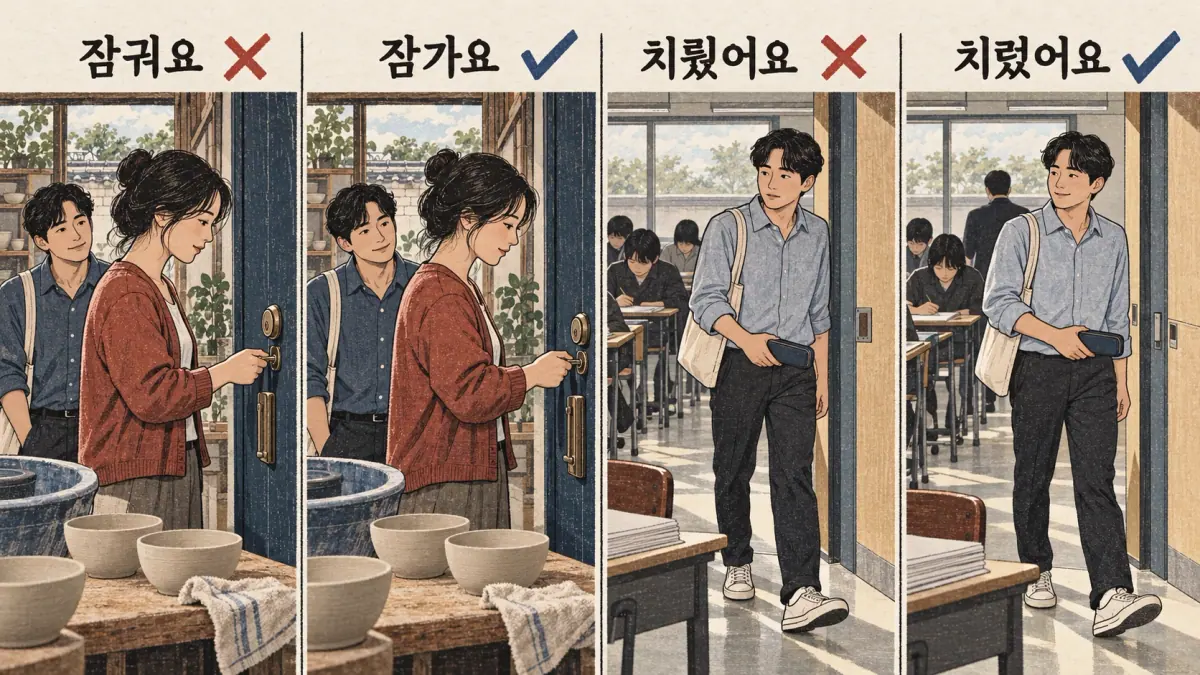
Four ㅡ verbs have non-standard spoken forms that you will hear and see online. The standard forms follow the ㅡ rule; the spoken ones borrow 워 or an extra syllable by analogy with other verbs.
| Verb | Standard (follow this) | Common non-standard form |
|---|---|---|
| 잠그다 (lock) | 잠가요, 잠갔어요 | 잠궈요, 잠궜어요 |
| 담그다 (pickle, soak) | 담가요, 담갔어요 | 담궈요, 담궜어요 |
| 치르다 (pay, take an exam) | 치러요, 치렀어요 | 치뤄요, 치뤘어요 |
| 들르다 (drop by) | 들러요, 들렀어요 | 들려요, 들렸어요 |
Use the standard forms in writing, in tests such as TOPIK and anywhere spelling matters. 들렸어요 is especially confusing, because it is the correct past of a different verb, 들리다 ("to be heard"). The misconceptions below collect the remaining traps.
Common Misconceptions
Three beliefs cause most ㅡ errors.
- Learners often choose 아/어 from the ㅡ itself. Actually the syllable before it decides. Wrong: 바뻐요, 아퍼요. Right: 바빠요, 아파요.
- Learners often drop ㅡ before every ending. Actually only 아/어 endings trigger it. Wrong: 써면, 커니까. Right: 쓰면, 크니까.
- Learners often treat 따르다 as 르 irregular. Actually it follows the ㅡ rule. Wrong: 딸라요. Right: 따라요.
An honest limit: this page treats the ㅡ rule alone. Some verbs combine it with another change, such as the 르 irregular (모르다 → 몰라요) or the 러 irregular (푸르다 → 푸르러요), and those are taught on their own pages. If you are unsure which applies, run the word through the Korean verb conjugator.
Practice: 10 Items
Give the polite present unless another form is asked for. Answers follow.
- 크다
- 예쁘다
- 나쁘다
- 아프다, polite past
- 쓰다, -(으)면
- 슬프다, before 노래 ("song")
- 모으다
- 잠그다
- 기쁘다, polite past
- 배고프다
Practice · 8
What is the polite present of 크다 (to be big)?
Show answer
커요
A one-syllable ㅡ stem has no earlier syllable to look at, so the ㅡ drops and the ending is always 어.
What is the polite present of 바쁘다 (to be busy)?
Show answer
바빠요
The syllable before the ㅡ is 바, with ㅏ, so after the drop the ending is 아.
What is the polite present of 예쁘다 (to be pretty)?
Show answer
예뻐요
The syllable before the ㅡ is 예 (ㅖ), which is not ㅏ or ㅗ, so the ending is 어.
What is the polite present of 배고프다 (to be hungry)?
Show answer
배고파요
Look one syllable back from the ㅡ: 고 has ㅗ, so the ending is 아, even though the word starts with 배.
What is the -(으)면 form of 쓰다 (to write)?
Show answer
쓰면
Only 아/어 endings trigger the drop; after a vowel stem the ending is simply -면.
How do you say "a sad song" with 슬프다 before 노래?
Show answer
슬픈 노래
-(으)ㄴ does not start with 아/어, so the ㅡ stays and ㄴ attaches to the vowel stem.
Which is the standard polite present of 잠그다 (to lock)?
Show answer
잠가요
The ㅡ drops and the syllable before it, 잠, has ㅏ, so the ending is 아. 잠궈요 is a common non-standard spoken form.
What is the polite past of 기쁘다 (to be glad)?
Show answer
기뻤어요
The ㅡ drops before 었, and 기 (ㅣ) takes 어, so the past is 기뻤어요.
Answer key
| # | Answer | Why |
|---|---|---|
| 1 | 커요 | one-syllable stem → 어 |
| 2 | 예뻐요 | 예 (ㅖ) → 어 |
| 3 | 나빠요 | 나 (ㅏ) → 아 |
| 4 | 아팠어요 | ㅡ drops before 았 |
| 5 | 쓰면 | vowel stem + 면; no drop |
| 6 | 슬픈 노래 | ㅡ stays before ㄴ |
| 7 | 모아요 | 모 (ㅗ) → 아 |
| 8 | 잠가요 | 잠 (ㅏ) → 아; not 잠궈요 |
| 9 | 기뻤어요 | 기 (ㅣ) → 어 |
| 10 | 배고파요 | 고 (ㅗ) → 아 |
If you got 8 or more right, you can apply the rule to any new ㅡ word. Errors on items 2 and 10 mean step 4 of the worked example needs another look.
What Should You Learn after the ㅡ Irregular?
With the Korean ㅡ irregular explained, compare it with the other classes in the irregular verbs chart, especially the 르 class, which builds on this rule. To check an unfamiliar verb, use the decision tree in how to recognize irregular verbs.
What this page does not cover. It does not cover the 르, 러 or ㄹ classes or the full vowel-contraction rules. About this page. Last updated 2026-10-09. The Korean text and conjugated forms were drafted with AI assistance and cross-checked with the site's rule-based conjugation engine; the Korean reviewer checks every lesson before publication. Romanization follows the Revised Romanization of Korean and is only a learning aid.
Frequently Asked Questions
Why is 쓰다 써요? 쓰다 ("to write, to use") has a one-syllable stem, 쓰, that ends in ㅡ. Before 어요 the ㅡ drops, leaving ㅆ, which joins 어 to make 써요 (sseoyo). With no earlier syllable to look at, a one-syllable stem always takes 어. The same steps give 커요 from 크다 and 꺼요 from 끄다.
Why is 예쁘다 예뻐요 and not 예빠요? The choice of 아 or 어 depends on the syllable before the ㅡ, which in 예쁘다 is 예. Its vowel ㅖ is not ㅏ or ㅗ, so the ending is 어: 예쁘 → 예ㅃ + 어요 → 예뻐요. By contrast, 바쁘다 has 바 before the ㅡ, with ㅏ, so it takes 아: 바빠요.
What is the past tense of 아프다? The polite past of 아프다 ("to be sick, to hurt") is 아팠어요 (apasseoyo). The ㅡ drops before 았, and 아 is chosen because the syllable before the ㅡ is 아. 어제 많이 아팠어요 means "I was very sick yesterday." The formal past is 아팠습니다 and the casual past is 아팠어.
Is it 잠가요 or 잠궈요? The standard form is 잠가요, from 잠그다 ("to lock"). The ㅡ drops and the syllable before it, 잠, has ㅏ, so the ending is 아: 문을 잠가요, "I lock the door." The spoken form 잠궈요 is common but non-standard, and so is 담궈요 for 담가요 from 담그다 ("to pickle, to soak").
Is 르 irregular the same as ㅡ irregular? No. A 르 irregular verb such as 모르다 drops ㅡ and also adds an extra ㄹ: 몰라요. An ㅡ-drop verb ending in 르, such as 따르다 or 들르다, only drops ㅡ: 따라요, 들러요. 따르다, 치르다 and 들르다 are the main 르 stems that follow the ㅡ rule.