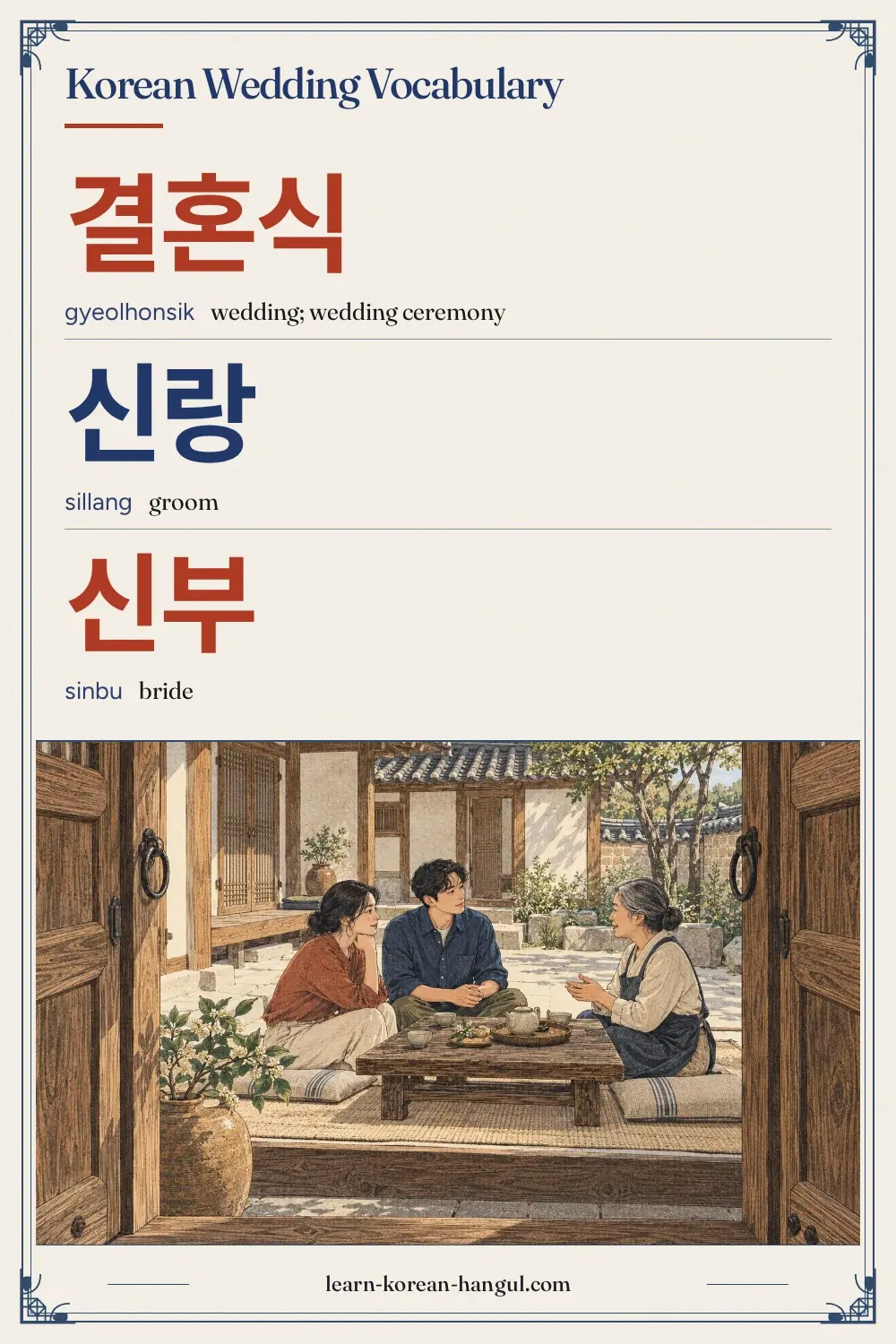
Korean Wedding Vocabulary at a Glance
Korean wedding vocabulary is useful the first time a Korean friend hands you a 청첩장, a wedding invitation. Most weddings today are held in a 예식장, a wedding hall, in a ceremony that lasts less than an hour. Many couples also hold a traditional greeting called 폐백 in hanbok. Nearly all of the words are Sino-Korean, which is why the same syllables keep returning: 혼 means marriage, 식 means ceremony, and 신 means new. This page holds 35 words in five groups.
| Group | Words | Use |
|---|---|---|
| Engagement and preparation | 8 | Talking about plans before the wedding |
| The ceremony | 8 | Naming the people and things at the wedding |
| Guests and gifts | 7 | Going to a wedding as a guest |
| The traditional wedding (폐백) | 6 | Naming the traditional greeting |
| Newlywed words | 6 | Talking about married life |
The list belongs to Korean Culture Words, and the next list in the sequence, Korean Funeral Vocabulary, covers the other main family ceremony. For what to say to the couple, see the celebration phrases. The next section says where to start.
Which Wedding Words Should You Learn First?
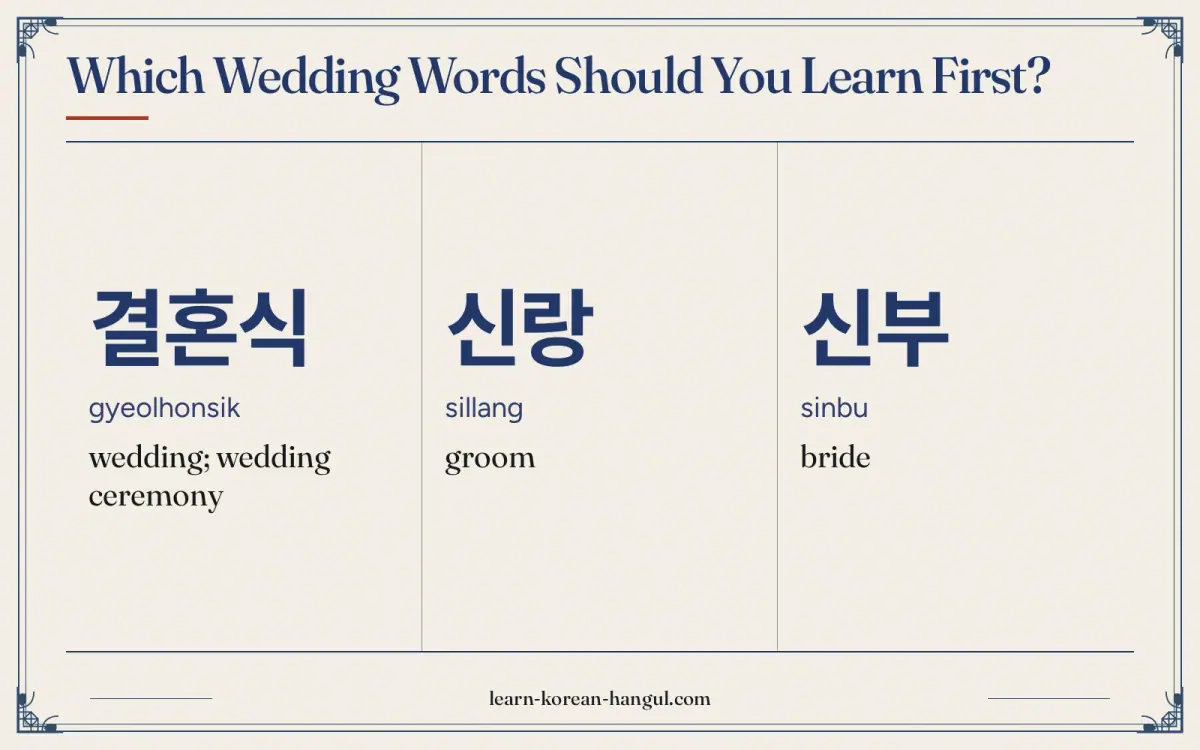
Learn 결혼, 결혼식, 청첩장, 신랑, 신부 and 축하 first. They are the words you will actually hear, because they are the words on an invitation. The guest and gift words matter most on the day itself, because the first thing a guest does is give 축의금.
- Day one. The six starter words, plus 남편 and 아내.
- Day two. The planning words 약혼, 청혼, 상견례, 예물, 혼수 and 예단, plus 예식장, 주례 and 사회자.
- Day three. The rest of the ceremony and the guest words: 웨딩드레스, 부케, 하객, 축의금, 봉투, 축가, 피로연 and 식권.
- Day four. The traditional 폐백 words, plus 신혼부부, 신혼여행, 신혼집 and 이혼.
At 8 to 10 words a day, the list takes four days plus review. This scene puts eight of the words on one picture.
Word · 8
- 1
결혼식
gyeolhonsik
wedding; wedding ceremony
- 2
신랑
sillang
groom
- 3
신부
sinbu
bride
- 4
웨딩드레스
wedingdeureseu
wedding dress
- 5
부케
buke
bouquet
- 6
하객
hagaek
wedding guest
- 7
축의금
chuguigeum
congratulatory money given at a wedding
- 8
폐백
pyebaek
pyebaek; the bride's greeting to the groom's family
By origin, the list has 28 Sino-Korean words, 4 native words, 2 loanwords and 1 mixed word. Sino-Korean words dominate because ceremony vocabulary was written in Chinese characters for centuries; the loanwords 웨딩드레스 and 부케 came with the Western-style wedding. The origin column in each table marks them.
Engagement and Preparation
Before a wedding there are steps that Koreans name individually. A couple may get engaged (약혼) after a 청혼, a proposal. The two families meet formally at a 상견례. The couple exchange 예물 (gifts such as rings), prepare the 혼수 (things for the new home), and the bride's side may send gifts called 예단. Then the 청첩장 goes out to guests.
| No. | Hangul | Revised Romanization | Origin | Meaning | Example sentence | Audio assetId |
|---|---|---|---|---|---|---|
| 1 | 결혼 | gyeolhon | Sino-Korean | marriage; getting married | 저는 내년에 결혼해요. (I am getting married next year.) | au-pg-vocabulary-culture-wedding-1; example: au-pg-vocabulary-culture-wedding-36 |
| 2 | 약혼 | yakhon | Sino-Korean | engagement | 두 사람은 작년에 약혼했어요. (The two got engaged last year.) | au-pg-vocabulary-culture-wedding-2; example: au-pg-vocabulary-culture-wedding-37 |
| 3 | 청혼 | cheonghon | Sino-Korean | marriage proposal | 그가 저에게 청혼했어요. (He proposed to me.) | au-pg-vocabulary-culture-wedding-3; example: au-pg-vocabulary-culture-wedding-38 |
| 4 | 상견례 | sanggyeonnye | Sino-Korean | formal meeting of the two families | 다음 주에 상견례가 있어요. (The families meet next week.) | au-pg-vocabulary-culture-wedding-4; example: au-pg-vocabulary-culture-wedding-39 |
| 5 | 예물 | yemul | Sino-Korean | gifts exchanged by the couple, such as rings | 예물로 반지를 준비해요. (We prepare rings as gifts.) | au-pg-vocabulary-culture-wedding-5; example: au-pg-vocabulary-culture-wedding-40 |
| 6 | 혼수 | honsu | Sino-Korean | goods and furnishings prepared for the new home | 혼수를 같이 골라요. (We choose the household goods together.) | au-pg-vocabulary-culture-wedding-6; example: au-pg-vocabulary-culture-wedding-41 |
| 7 | 예단 | yedan | Sino-Korean | gifts sent to the other family | 예단을 보내요. (We send the yedan gifts.) | au-pg-vocabulary-culture-wedding-7; example: au-pg-vocabulary-culture-wedding-42 |
| 8 | 청첩장 | cheongcheopjang | Sino-Korean | wedding invitation | 친구에게 청첩장을 받았어요. (I received a wedding invitation from a friend.) | au-pg-vocabulary-culture-wedding-8; example: au-pg-vocabulary-culture-wedding-43 |
The verb for getting married takes 와/과 (with), not 을/를. Say 그와 결혼해요 (I marry him), not 그를 결혼해요. 결혼 is a noun that becomes a verb with 하다, and in this respect it works like 헤어지다 (to break up), which also takes 와/과. In everyday speech 하고 is more common: 그 사람하고 결혼해요.
Example Sentences
Each example is a short polite sentence. Most follow the pattern subject + 이/가 + verb or noun + 이에요/예요. In the first group several sentences use the past form, such as 약혼했어요 (got engaged), because the event has happened. Say each one aloud and swap the noun. For example, 주말에 친구의 결혼식이 있어요 becomes 내일 친구의 결혼식이 있어요 when you replace 주말.
The engagement words are mostly verbs in disguise. Add 하다 to 약혼, 청혼 or 결혼 and each one becomes a verb. The ceremony comes next.
How Do You Say the Ceremony in Korean?
A wedding is a 결혼식, and the usual place is a 예식장. The groom, the 신랑, and the bride, the 신부, stand at the front, and a 주례 (officiant) or a 사회자 (master of ceremonies) leads the ceremony. The bride wears a 웨딩드레스 and carries a 부케.
| No. | Hangul | Revised Romanization | Origin | Meaning | Example sentence | Audio assetId |
|---|---|---|---|---|---|---|
| 9 | 결혼식 | gyeolhonsik | Sino-Korean | wedding; wedding ceremony | 주말에 친구의 결혼식이 있어요. (There is a friend's wedding this weekend.) | au-pg-vocabulary-culture-wedding-9; example: au-pg-vocabulary-culture-wedding-44 |
| 10 | 예식장 | yesikjang | Sino-Korean | wedding hall | 예식장에 사람이 많아요. (There are many people in the wedding hall.) | au-pg-vocabulary-culture-wedding-10; example: au-pg-vocabulary-culture-wedding-45 |
| 11 | 신랑 | sillang | Sino-Korean | groom | 신랑이 먼저 들어와요. (The groom comes in first.) | au-pg-vocabulary-culture-wedding-11; example: au-pg-vocabulary-culture-wedding-46 |
| 12 | 신부 | sinbu | Sino-Korean | bride | 신부가 정말 예뻐요. (The bride is really pretty.) | au-pg-vocabulary-culture-wedding-12; example: au-pg-vocabulary-culture-wedding-47 |
| 13 | 주례 | jurye | Sino-Korean | officiant; person who presides at a wedding | 선생님이 주례를 맡았어요. (My teacher took the role of officiant.) | au-pg-vocabulary-culture-wedding-13; example: au-pg-vocabulary-culture-wedding-48 |
| 14 | 사회자 | sahoeja | Sino-Korean | master of ceremonies; host | 사회자가 신랑 신부를 소개해요. (The host introduces the groom and bride.) | au-pg-vocabulary-culture-wedding-14; example: au-pg-vocabulary-culture-wedding-49 |
| 15 | 웨딩드레스 | wedingdeureseu | loanword | wedding dress | 웨딩드레스를 골랐어요. (I chose a wedding dress.) | au-pg-vocabulary-culture-wedding-15; example: au-pg-vocabulary-culture-wedding-50 |
| 16 | 부케 | buke | loanword | bouquet | 신부가 부케를 던져요. (The bride throws the bouquet.) | au-pg-vocabulary-culture-wedding-16; example: au-pg-vocabulary-culture-wedding-51 |
Notice that 결혼식 is 결혼 (marriage) plus 식 (ceremony), so a wedding is literally a marriage ceremony. A different word spelled the same way, 신부, means a Catholic priest, and context tells you which one is meant. In a wedding sentence, 신랑 신부 together means the couple.
Guests and Gifts
A guest, called a 하객, arrives at the hall, hands over a 축의금 in a 봉투 at the reception desk, and receives a 식권 for the meal. Guests say 축하해요 to the couple, and a friend may sing a 축가 during the ceremony. The party afterwards is the 피로연.
| No. | Hangul | Revised Romanization | Origin | Meaning | Example sentence | Audio assetId |
|---|---|---|---|---|---|---|
| 17 | 하객 | hagaek | Sino-Korean | wedding guest | 하객이 많이 와요. (Many guests come.) | au-pg-vocabulary-culture-wedding-17; example: au-pg-vocabulary-culture-wedding-52 |
| 18 | 축의금 | chuguigeum | Sino-Korean | congratulatory money given at a wedding | 축의금을 봉투에 넣어요. (I put the congratulatory money in an envelope.) | au-pg-vocabulary-culture-wedding-18; example: au-pg-vocabulary-culture-wedding-53 |
| 19 | 봉투 | bongtu | Sino-Korean | envelope | 하얀 봉투를 준비해요. (I prepare a white envelope.) | au-pg-vocabulary-culture-wedding-19; example: au-pg-vocabulary-culture-wedding-54 |
| 20 | 축하 | chukha | Sino-Korean | congratulation | 결혼을 축하해요! (Congratulations on your wedding!) | au-pg-vocabulary-culture-wedding-20; example: au-pg-vocabulary-culture-wedding-55 |
| 21 | 축가 | chukga | Sino-Korean | wedding song | 친구가 축가를 불러요. (A friend sings the wedding song.) | au-pg-vocabulary-culture-wedding-21; example: au-pg-vocabulary-culture-wedding-56 |
| 22 | 피로연 | piroyeon | Sino-Korean | wedding reception; banquet | 결혼식 후에 피로연이 있어요. (There is a reception after the wedding.) | au-pg-vocabulary-culture-wedding-22; example: au-pg-vocabulary-culture-wedding-57 |
| 23 | 식권 | sikgwon | Sino-Korean | meal ticket | 식권을 받아요. (I receive a meal ticket.) | au-pg-vocabulary-culture-wedding-23; example: au-pg-vocabulary-culture-wedding-58 |
Guests usually give cash in an envelope, which is the 축의금 custom. The envelope is often white, and a name is written on it. This page gives no amounts, because they vary by relationship and change over time. To congratulate the couple, say 결혼 축하해요 to friends and 결혼 축하드려요 to older people.
How Do You Say the Traditional Wedding (폐백) in Korean?
Some couples hold a full 전통혼례, a traditional wedding in hanbok, and many hold a shorter 폐백 after a hall wedding. In 폐백 the couple bow to the groom's parents and elders with a deep 큰절. The bride may offer 대추 (jujubes) and 밤 (chestnuts), which are traditionally linked with wishes for children and a long family line. The parents of the groom are the 시부모님 of the bride.
| No. | Hangul | Revised Romanization | Origin | Meaning | Example sentence | Audio assetId |
|---|---|---|---|---|---|---|
| 24 | 전통혼례 | jeontonghollye | Sino-Korean | traditional wedding ceremony | 전통혼례는 한복을 입고 해요. (A traditional wedding is held in hanbok.) | au-pg-vocabulary-culture-wedding-24; example: au-pg-vocabulary-culture-wedding-59 |
| 25 | 폐백 | pyebaek | Sino-Korean | pyebaek; the bride's greeting to the groom's family | 결혼식 후에 폐백을 드려요. (After the wedding we do the pyebaek.) | au-pg-vocabulary-culture-wedding-25; example: au-pg-vocabulary-culture-wedding-60 |
| 26 | 큰절 | keunjeol | native | keunjeol; a deep formal bow | 시부모님께 큰절을 해요. (I make a deep bow to my parents-in-law.) | au-pg-vocabulary-culture-wedding-26; example: au-pg-vocabulary-culture-wedding-61 |
| 27 | 대추 | daechu | native | jujube; Korean date | 폐백에 대추를 올려요. (We offer jujubes at the pyebaek.) | au-pg-vocabulary-culture-wedding-27; example: au-pg-vocabulary-culture-wedding-62 |
| 28 | 밤 | bam | native | chestnut | 폐백에는 밤도 올려요. (We offer chestnuts at the pyebaek too.) | au-pg-vocabulary-culture-wedding-28; example: au-pg-vocabulary-culture-wedding-63 |
| 29 | 시부모님 | sibumonim | Sino-Korean | parents-in-law (the husband's parents) | 시부모님을 처음 만나요. (I meet my parents-in-law for the first time.) | au-pg-vocabulary-culture-wedding-29; example: au-pg-vocabulary-culture-wedding-64 |
The word 밤 also means night. Context separates them: 밤을 먹어요 means I eat chestnuts, and 밤에 잠을 자요 means I sleep at night. The verb 드리다 in 폐백을 드려요 is the humble form of 주다, used when giving to elders.
Newlywed Words
After the wedding the couple are 신혼부부, newlyweds. They take a 신혼여행 (honeymoon) and set up a 신혼집 (their new home). The husband is the 남편, and the wife is the 아내. The word for divorce is 이혼, and it is a plain, neutral word in the news and in law.
| No. | Hangul | Revised Romanization | Origin | Meaning | Example sentence | Audio assetId |
|---|---|---|---|---|---|---|
| 30 | 신혼부부 | sinhonbubu | Sino-Korean | newlyweds; newly married couple | 신혼부부는 사진을 찍어요. (The newlyweds take photos.) | au-pg-vocabulary-culture-wedding-30; example: au-pg-vocabulary-culture-wedding-65 |
| 31 | 신혼여행 | sinhonnyeohaeng | Sino-Korean | honeymoon | 신혼여행으로 제주도에 가요. (We go to Jeju Island for our honeymoon.) | au-pg-vocabulary-culture-wedding-31; example: au-pg-vocabulary-culture-wedding-66 |
| 32 | 신혼집 | sinhonjip | mixed | newlyweds' home | 신혼집을 구했어요. (We found a home for the newlyweds.) | au-pg-vocabulary-culture-wedding-32; example: au-pg-vocabulary-culture-wedding-67 |
| 33 | 남편 | nampyeon | Sino-Korean | husband | 제 남편은 의사예요. (My husband is a doctor.) | au-pg-vocabulary-culture-wedding-33; example: au-pg-vocabulary-culture-wedding-68 |
| 34 | 아내 | anae | native | wife | 제 아내는 선생님이에요. (My wife is a teacher.) | au-pg-vocabulary-culture-wedding-34; example: au-pg-vocabulary-culture-wedding-69 |
| 35 | 이혼 | ihon | Sino-Korean | divorce | 이혼은 결혼 관계가 끝나는 것이에요. (Divorce is the end of a marriage.) | au-pg-vocabulary-culture-wedding-35; example: au-pg-vocabulary-culture-wedding-70 |
Spouses also use terms of address that are not on this list, such as 여보 and 자기, and they differ by age and by couple. The words 남편 and 아내 are the standard words for husband and wife in speech and writing.
| Step | Word | Meaning |
|---|---|---|
| 1 | 청혼 | The proposal |
| 2 | 상견례 | The families meet |
| 3 | 청첩장 | Invitations go out |
| 4 | 결혼식 | The wedding |
| 5 | 폐백 | The greeting to the groom's family |
| 6 | 신혼여행 | The honeymoon |
The order varies from couple to couple, but this is the usual path, and it works as a word order for revising the list.
How Do You Pronounce These Words?
Wedding words contain many Sino-Korean sound changes, because several syllables end in a consonant that meets a following consonant or vowel. The table lists the ones that learners most often miss.
| Spelling | Pronunciation | What happens |
|---|---|---|
| 신랑 | [실랑] | The ㄴ before ㄹ is said as ㄹ, so you hear sil-lang |
| 약혼 | [야콘] | Final ㄱ and ㅎ join into an aspirated ㅋ, so the word sounds like ya-kon |
| 상견례 | [상견녜] | The ㄹ after ㄴ is said as ㄴ |
| 청첩장 | [청첩짱] | The ㅈ after a final ㅂ becomes tense |
| 예식장 | [예식짱] | The ㅈ after a final ㄱ becomes tense |
| 축의금 | [추긔금] | The final ㄱ moves to the next syllable and is said between vowels |
| 신혼여행 | [신혼녀행] | An n sound is added before 여, so you hear sin-hon-nyeo-haeng |
| 폐백 | [폐백/페백] | After a consonant other than ㄹ, ㅖ may also be said as ㅔ, and [페백] is the common form |
| 전통혼례 | [전통홀례] | The ㄴ before ㄹ is said as ㄹ, as in 신랑 |
| 식권 | [식꿘] | The ㄱ after a final ㄱ becomes tense |
The rules come from the Standard Pronunciation rules (표준 발음법) of the 국립국어원. The audio is generated with text-to-speech and checked by a Korean teacher before publication.
Audio and Slow Playback
Each word has a normal clip, and 5 key words also have a slow clip at 0.8 times the speed: 결혼식, 신랑, 축의금, 신혼여행 and 폐백. Nothing plays until you press a button.
Listen to 신랑 first. You should hear two l sounds in a row, [실랑], and not the written n-r: the sound is a long, light l, and the word has two beats.
What Mistakes Do Learners Make with Wedding Words?
- Saying 결혼 for the ceremony. 결혼 is marriage, and the ceremony is 결혼식.
- Using 을/를 with 결혼하다. Say 그와 결혼해요 (I marry him), because 결혼하다 takes 와/과.
- Reading 신랑 as sin-rang. The spoken form is [실랑].
- Using the plain 축하해요 to a teacher or an older relative. It is polite, but 결혼 축하드려요 is more respectful.
- Taking 신부 as always meaning bride. The same spelling is also the word for a Catholic priest, so check the context.
The first and fifth mistakes change the meaning, the second is a grammar error, and the others change the sound or the level of respect. The next section turns the list into practice.
Practice: Flashcards and Worksheet
Drill these words with the vocabulary flashcard decks. A printable worksheet for these words (word list, matching, writing practice, fill-in-the-blank exercises and answer key) is available in A4 and US Letter from the download card on this page. Progress in the decks is saved only in your browser.
Korean Wedding Vocabulary Worksheet
Try this five-question check, then say the 35 words aloud once more.
Practice · 5
What does 결혼식 mean?
Show answer
wedding; wedding ceremony
결혼식 (gyeolhonsik) means wedding; wedding ceremony.
What does 신랑 mean?
Show answer
groom
신랑 (sillang) means groom.
What does 축의금 mean?
Show answer
congratulatory money given at a wedding
축의금 (chuguigeum) means congratulatory money given at a wedding.
What does 폐백 mean?
Show answer
pyebaek; the bride's greeting to the groom's family
폐백 (pyebaek) means pyebaek; the bride's greeting to the groom's family.
What does 남편 mean?
Show answer
husband
남편 (nampyeon) means husband.
For one word at a time, see wedding in Korean and marriage in Korean.
Where to Go Next
This list sits inside Korean Culture Words. After Korean wedding vocabulary, many learners move on to Korean Funeral Vocabulary for the other main family ceremony, or back up to Traditional Culture for the clothes and customs behind 폐백.
Frequently Asked Questions
How Do You Say Wedding in Korean?
A wedding is 결혼식 (gyeolhonsik), which joins 결혼 (marriage) and 식 (ceremony). The marriage itself is 결혼. To say you are going to a wedding, use 결혼식에 가요 (gyeolhonsige gayo). The invitation is a 청첩장 (cheongcheopjang), and the groom and bride are 신랑 and 신부.
How Do You Pronounce 신랑 (sillang)?
신랑 is said [실랑], sil-lang, in two beats. The final ㄴ of the first syllable is said as ㄹ because the next syllable starts with ㄹ. The final ㅇ of the second syllable is the ng sound, as in the English word sing. Use the slow clip to match the rhythm.
How Many Wedding Words Should I Learn First?
Learn six first: 결혼, 결혼식, 청첩장, 신랑, 신부 and 축하. That takes one day. Then add the planning words and the gift words. The whole list of 35 takes four days at 8 to 10 words a day, with review on the fifth day.
Where Can I Practise Wedding Words with Flashcards?
Use the vocabulary flashcard decks, which list every deck with audio. A deck for these words is planned. Progress stays in your browser. The celebration phrases page has the sentences to say to the couple, so review it together with this page before a wedding.
Is the Romanization on This Page Official?
It follows the Revised Romanization of Korean, which South Korea officially adopted on 7 July 2000 and whose rules the National Institute of Korean Language (국립국어원) publishes. It is a learning aid that does not mark every sound change, so learn the Hangul and use the audio to hear the real sound.
Is There a Printable Worksheet for Wedding Words?
A printable worksheet for these words (word list, matching, writing practice, fill-in-the-blank exercises and answer key) is available in A4 and US Letter from the download card on this page. For practice, copy the tables above by hand: write the Hangul, cover the English column, and check your answers against the page.