Korean Funeral Vocabulary at a Glance
Korean funeral vocabulary covers four kinds of words: the place (장례식장, 빈소), the people (상주, 유족, 조문객), the gifts and gestures of condolence (조의금, 조문) and the rites that continue after the funeral (제사, 성묘, 기일). Most of these words are Sino-Korean, built from Chinese-derived syllables, which is typical for ritual and formal vocabulary. 28 of the 30 words are Sino-Korean, 1 is native Korean and 1 is a two-word phrase.
This is a sensitive subject, so a note on the approach: the page teaches words and what they mean. It does not tell you how to behave. Customs differ by family, religion and region, and many modern funerals mix traditions. If you plan to attend a funeral in Korea, ask a Korean friend or colleague what the family expects.
| Group | Words | What it covers |
|---|---|---|
| Funeral hall and ritual | 7 | The funeral, the hall, the mourning room and the stages of the ceremony |
| Mourners and relatives | 6 | The family and the people who visit |
| Condolence money and gifts | 6 | Money, flowers and the words of sympathy |
| Mourning dress | 5 | What mourners wear |
| Memorial after the funeral | 6 | Rites and remembrance in the years that follow |
The list is a child of Korean Culture Words. The next section says which words to learn first.
Which Funeral Words Should You Learn First?
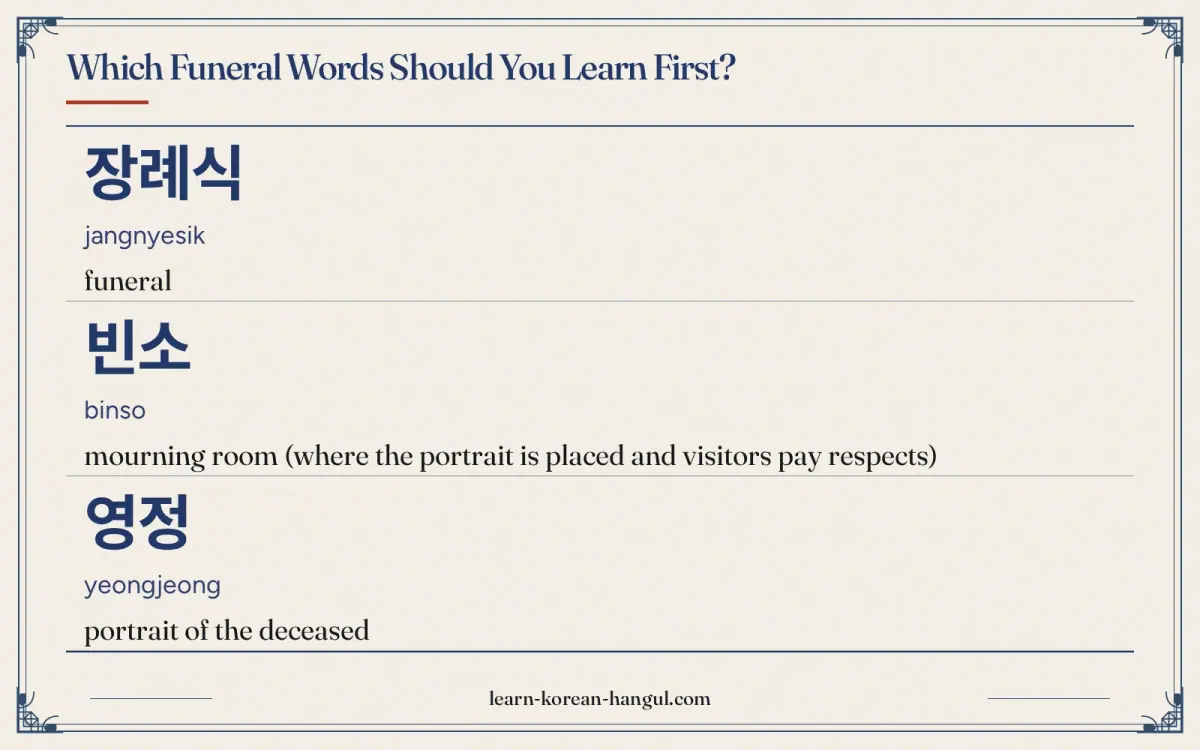
Learn 장례식, 장례식장, 조문 and 조의금 first. They are the four words you are most likely to hear or read, for example in a message that a friend's relative has died. The family words 상주 and 유족 come next, because they tell you who is who in a conversation about the funeral. The ritual and mourning-dress words matter most if you plan to attend.
- To understand a message or news item. 장례식, 장례식장, 빈소, 발인 and 고인.
- To attend as a guest. 조문, 조문객, 조의금, 부의금, 봉투 and 검은 옷.
- To talk with the family. 상주, 유족, 애도 and the line 고인의 명복을 빕니다.
- To follow the years after. 제사, 성묘, 기일 and 추모.
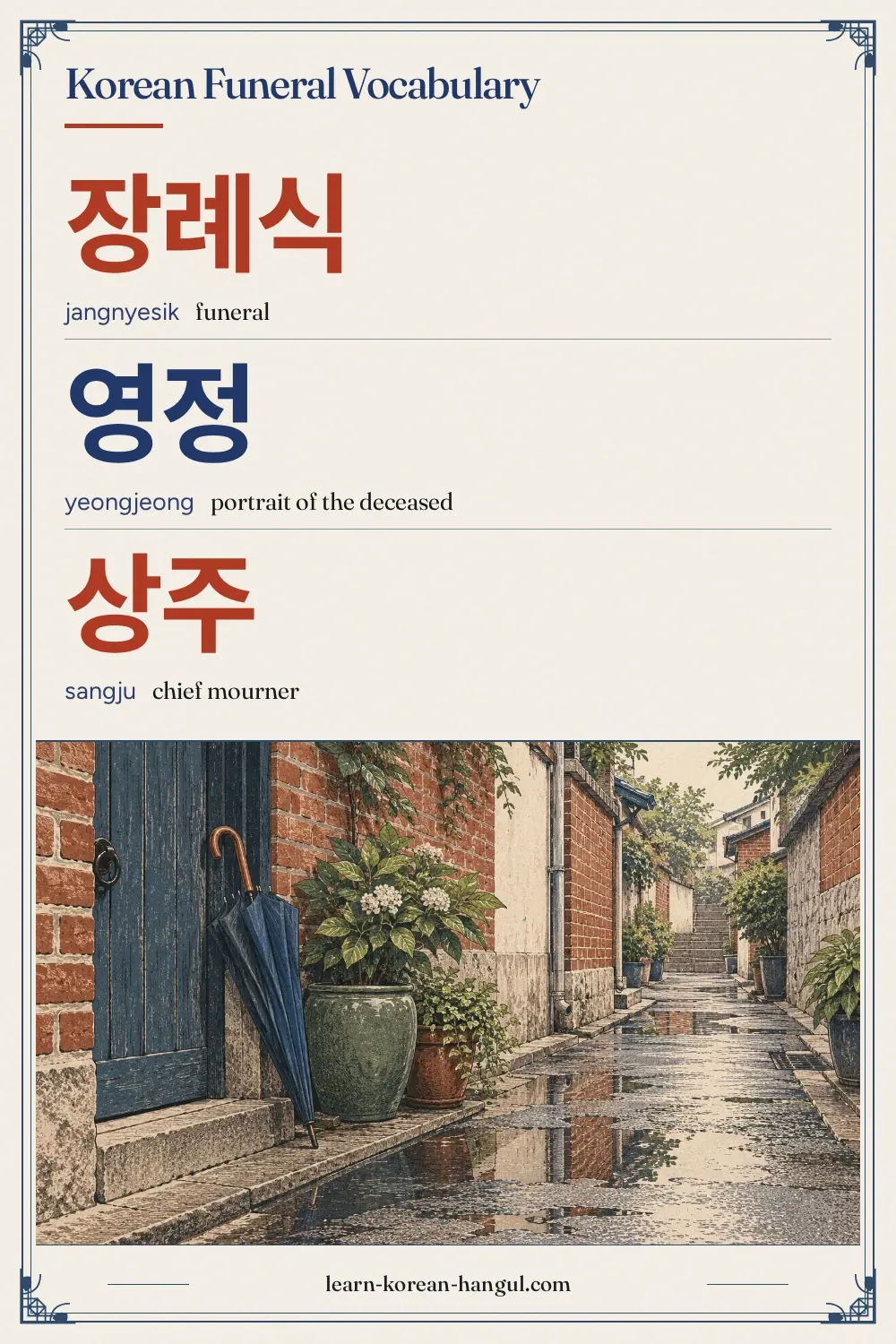
At 8 to 10 words a day, the list takes three to four days plus review. The scene below puts eight of the words on one picture.
Word · 8
- 1
장례식
jangnyesik
funeral
- 2
빈소
binso
mourning room (where the portrait is placed and visitors pay respects)
- 3
영정
yeongjeong
portrait of the deceased
- 4
상주
sangju
chief mourner
- 5
조의금
joeuigeum
condolence money
- 6
상복
sangbok
mourning clothes
- 7
검은 옷
geomeun ot
black clothes
- 8
제사
jesa
memorial rite for an ancestor
A funeral in Korea is often held in a funeral hall called a 장례식장, and many are attached to hospitals, which is why the example for that word mentions a hospital. The funeral often lasts three days, called 삼일장 (samiljang), but the length varies by family and by religion. Every date and custom on this page is a general description and not a rule.
Funeral Hall and Ritual
The funeral hall and ritual words name the place and the stages of the ceremony. 장례식 is the funeral as an event, and 장례식장 is the building. Inside it, the 빈소 is the room where the portrait of the deceased, the 영정, is placed and visitors pay their respects. After the ceremony comes the 발인, when the coffin (관) leaves for burial or cremation.
| No. | Hangul | Revised Romanization | Origin | Meaning | Example sentence | Audio assetId |
|---|---|---|---|---|---|---|
| 1 | 장례식 | jangnyesik | Sino-Korean | funeral | 친구 할아버지의 장례식에 가요. (I am going to my friend's grandfather's funeral.) | au-pg-vocabulary-culture-funeral-1; example: au-pg-vocabulary-culture-funeral-31 |
| 2 | 장례식장 | jangnyesikjang | Sino-Korean | funeral hall | 장례식장은 병원 옆에 있어요. (The funeral hall is next to the hospital.) | au-pg-vocabulary-culture-funeral-2; example: au-pg-vocabulary-culture-funeral-32 |
| 3 | 빈소 | binso | Sino-Korean | mourning room (where the portrait is placed and visitors pay respects) | 빈소는 이 층이에요. (The mourning room is on the second floor.) | au-pg-vocabulary-culture-funeral-3; example: au-pg-vocabulary-culture-funeral-33 |
| 4 | 영정 | yeongjeong | Sino-Korean | portrait of the deceased | 영정 앞에서 절을 해요. (I bow in front of the portrait.) | au-pg-vocabulary-culture-funeral-4; example: au-pg-vocabulary-culture-funeral-34 |
| 5 | 관 | gwan | Sino-Korean | coffin | 관을 옮겨요. (They carry the coffin.) | au-pg-vocabulary-culture-funeral-5; example: au-pg-vocabulary-culture-funeral-35 |
| 6 | 발인 | barin | Sino-Korean | carrying the coffin out for burial | 발인은 아침 여덟 시예요. (The coffin leaves at eight in the morning.) | au-pg-vocabulary-culture-funeral-6; example: au-pg-vocabulary-culture-funeral-36 |
| 7 | 화장 | hwajang | Sino-Korean | cremation (also: makeup) | 화장은 불로 하는 장례 방법이에요. (Cremation is a funeral method that uses fire.) | au-pg-vocabulary-culture-funeral-7; example: au-pg-vocabulary-culture-funeral-37 |
Three words need a note. 장례식장 literally means funeral-ceremony-place, and the same 장 (place) appears in 주차장 (parking lot) and 운동장 (sports field). 화장 has two meanings: cremation (火葬) and makeup (化粧). The spelling is the same, and context shows which one is meant. 화장하다 can mean either to cremate or to put on makeup. Finally, 빈소 and 장례식장 are not the same: a funeral hall can have several mourning rooms, one for each family.
The single-word page for funeral in Korean answers the quick lookup. The next group names the people.
Example Sentences
Each example is a short sentence in the polite -요 style, the safe everyday choice when you talk about these events. Most use a pattern you already know: noun + 에 + 가요 (go to), as in 장례식에 가요, and noun + 을/를 + verb, as in 조화를 보내요. Say each sentence aloud, then swap the noun. Replace 장례식 with 조문 in 장례식에 가요 and you get 조문을 가요, which is also natural. Note that a person who has died is spoken of with the honorific verb 돌아가시다 (to pass away), as in 할아버지께서 돌아가셨어요. See Korean honorific verbs for how this works.
How Do You Say Mourners and Relatives in Korean?
Mourners and relatives are named by their role. 상주 is the chief mourner, who receives the visitors on behalf of the family. 유족 is the bereaved family as a whole. The person who has died is called 고인, a respectful word that you use in speech and in writing instead of the plain word for a dead person.
| No. | Hangul | Revised Romanization | Origin | Meaning | Example sentence | Audio assetId |
|---|---|---|---|---|---|---|
| 8 | 상주 | sangju | Sino-Korean | chief mourner | 상주가 조문객에게 인사해요. (The chief mourner greets the visitors.) | au-pg-vocabulary-culture-funeral-8; example: au-pg-vocabulary-culture-funeral-38 |
| 9 | 유족 | yujok | Sino-Korean | bereaved family | 유족에게 위로의 말을 전해요. (I give words of comfort to the bereaved family.) | au-pg-vocabulary-culture-funeral-9; example: au-pg-vocabulary-culture-funeral-39 |
| 10 | 고인 | goin | Sino-Korean | the deceased (respectful) | 고인을 기억해요. (We remember the deceased.) | au-pg-vocabulary-culture-funeral-10; example: au-pg-vocabulary-culture-funeral-40 |
| 11 | 조문객 | jomungaek | Sino-Korean | mourner; condolence visitor | 조문객이 많이 왔어요. (Many visitors came to pay their respects.) | au-pg-vocabulary-culture-funeral-11; example: au-pg-vocabulary-culture-funeral-41 |
| 12 | 친척 | chincheok | Sino-Korean | relatives | 친척들이 모두 모였어요. (All the relatives gathered.) | au-pg-vocabulary-culture-funeral-12; example: au-pg-vocabulary-culture-funeral-42 |
| 13 | 상가 | sangga | Sino-Korean | house of mourning (also: shopping arcade) | 상가에 다녀왔어요. (I have been to the house of mourning.) | au-pg-vocabulary-culture-funeral-13; example: au-pg-vocabulary-culture-funeral-43 |
Notice that 고인 is a respectful term. A Korean speaker would not use a blunt word for someone who has died, especially in front of the family. That is also why the verb 돌아가시다 (honorific, to pass away) is used in place of 죽다 (to die) when the person is respected. Learn 고인 and 돌아가시다 as a pair.
상가 is a word to watch. Written 喪家, it is a house of mourning, and a different 상가 (商街) is a shopping arcade. The audio sounds the same, so the context is what separates them. 친척 is the same word that appears in the holiday lists, because relatives gather at funerals as they do at Chuseok. The next group is about gifts.
Condolence Money and Gifts
Visitors bring condolence money, called 조의금 or 부의금, as a way of sharing the cost of the funeral with the family. The two words mean the same thing, and 조의금 is the more common in speech. Many people put the money in a plain envelope, a 봉투, and write their name on it. Others send flowers, 조화. The visit itself is called a 조문.
| No. | Hangul | Revised Romanization | Origin | Meaning | Example sentence | Audio assetId |
|---|---|---|---|---|---|---|
| 14 | 조의금 | joeuigeum | Sino-Korean | condolence money | 조의금을 봉투에 넣어요. (I put the condolence money in an envelope.) | au-pg-vocabulary-culture-funeral-14; example: au-pg-vocabulary-culture-funeral-44 |
| 15 | 부의금 | buuigeum | Sino-Korean | condolence money (formal term) | 부의금은 조의금과 같은 뜻이에요. (Buuigeum has the same meaning as joeuigeum.) | au-pg-vocabulary-culture-funeral-15; example: au-pg-vocabulary-culture-funeral-45 |
| 16 | 조문 | jomun | Sino-Korean | condolence visit; paying respects | 내일 조문을 가요. (I am going to pay my respects tomorrow.) | au-pg-vocabulary-culture-funeral-16; example: au-pg-vocabulary-culture-funeral-46 |
| 17 | 애도 | aedo | Sino-Korean | mourning; expression of grief | 깊은 애도를 표해요. (I express deep condolences.) | au-pg-vocabulary-culture-funeral-17; example: au-pg-vocabulary-culture-funeral-47 |
| 18 | 조화 | johwa | Sino-Korean | funeral flowers (also: artificial flowers) | 조화를 보내요. (I send funeral flowers.) | au-pg-vocabulary-culture-funeral-18; example: au-pg-vocabulary-culture-funeral-48 |
| 19 | 봉투 | bongtu | Sino-Korean | envelope | 봉투에 이름을 써요. (I write my name on the envelope.) | au-pg-vocabulary-culture-funeral-19; example: au-pg-vocabulary-culture-funeral-49 |
Be careful with 조화. As funeral flowers it is 弔花, but the same spelling is also 造花, which means artificial flowers. In a funeral context only the first meaning applies. The word 애도 is the formal word for mourning or condolence, and you hear it in news reports: 깊은 애도를 표합니다 means we express deep condolences.
The set phrase of sympathy is 삼가 고인의 명복을 빕니다, which means I respectfully pray for the repose of the deceased. It is a formal written and spoken line, and it is explained in full on the sorry for your loss in Korean page, so this page does not repeat the other phrases of sympathy. The next group is about clothing.
How Do You Say Mourning Dress in Korean?
Mourning dress has two layers: the traditional clothes and the modern habit. The traditional mourning clothes are 상복, often made of hemp cloth, 삼베. Today most visitors wear 검은 옷 (black clothes) or a dark 정장, and the chief mourner may wear an armband, 완장.
| No. | Hangul | Revised Romanization | Origin | Meaning | Example sentence | Audio assetId |
|---|---|---|---|---|---|---|
| 20 | 상복 | sangbok | Sino-Korean | mourning clothes | 상복을 입어요. (They wear mourning clothes.) | au-pg-vocabulary-culture-funeral-20; example: au-pg-vocabulary-culture-funeral-50 |
| 21 | 검은 옷 | geomeun ot | phrase | black clothes | 조문 때는 검은 옷이 좋아요. (Black clothes are best for a condolence visit.) | au-pg-vocabulary-culture-funeral-21; example: au-pg-vocabulary-culture-funeral-51 |
| 22 | 정장 | jeongjang | Sino-Korean | formal suit | 정장은 어두운 색이 좋아요. (A formal suit is best in a dark colour.) | au-pg-vocabulary-culture-funeral-22; example: au-pg-vocabulary-culture-funeral-52 |
| 23 | 완장 | wanjang | Sino-Korean | armband | 상주는 완장을 차요. (The chief mourner wears an armband.) | au-pg-vocabulary-culture-funeral-23; example: au-pg-vocabulary-culture-funeral-53 |
| 24 | 삼베 | sambe | native | hemp cloth | 상복은 삼베로 만들어요. (Mourning clothes are made of hemp cloth.) | au-pg-vocabulary-culture-funeral-24; example: au-pg-vocabulary-culture-funeral-54 |
Notice that 검은 옷 is two words, an adjective form and a noun, and so it is written with a space and romanized as two words, geomeun ot. Said together in one breath, it sounds like [거므녿]. In older customs, white clothes (흰옷, written as one word) were the clothes of mourning. Because customs differ, treat these words as vocabulary and ask the family or a friend what to wear.
Mourning customs have changed over time and differ between religions, so this group is the most variable one on the page. The last group covers what happens after the funeral.
Memorial after the Funeral
The memorial words describe the remembrance that continues for years. 제사 is the rite held for an ancestor, usually on the 기일 (the anniversary of the death). 성묘 is a visit to a grave. 추모 and 추도 are more general words for remembering the dead, and 명복 is the repose that the condolence line wishes for.
| No. | Hangul | Revised Romanization | Origin | Meaning | Example sentence | Audio assetId |
|---|---|---|---|---|---|---|
| 25 | 제사 | jesa | Sino-Korean | memorial rite for an ancestor | 제사는 기일에 지내요. (The memorial rite is held on the anniversary of the death.) | au-pg-vocabulary-culture-funeral-25; example: au-pg-vocabulary-culture-funeral-55 |
| 26 | 성묘 | seongmyo | Sino-Korean | visiting a grave | 추석에 성묘를 가요. (We visit the graves at Chuseok.) | au-pg-vocabulary-culture-funeral-26; example: au-pg-vocabulary-culture-funeral-56 |
| 27 | 추도 | chudo | Sino-Korean | commemoration of the dead | 아버지를 추도해요. (We commemorate my father.) | au-pg-vocabulary-culture-funeral-27; example: au-pg-vocabulary-culture-funeral-57 |
| 28 | 추모 | chumo | Sino-Korean | remembrance; tribute | 추모 공간이 있어요. (There is a space for remembrance.) | au-pg-vocabulary-culture-funeral-28; example: au-pg-vocabulary-culture-funeral-58 |
| 29 | 기일 | giil | Sino-Korean | anniversary of a death | 오늘은 할아버지 기일이에요. (Today is my grandfather's death anniversary.) | au-pg-vocabulary-culture-funeral-29; example: au-pg-vocabulary-culture-funeral-59 |
| 30 | 명복 | myeongbok | Sino-Korean | repose of the dead (blessing for the afterlife) | 고인의 명복을 빕니다. (I pray for the repose of the deceased.) | au-pg-vocabulary-culture-funeral-30; example: au-pg-vocabulary-culture-funeral-60 |
제사 and 성묘 also appear in the holiday lists, because Koreans hold a rite and visit graves at Seollal and Chuseok. You can read the holiday versions on the Seollal and Chuseok vocabulary page. The difference is timing: a 제사 marks one person's death anniversary, while the holiday rite 차례 honours the ancestors together.
추모 and 추도 are close. 추모 is the wider word for tribute and remembrance, as in 추모 공간 (a memorial space), and 추도 is more often used in the set phrase 추도식 (memorial service). This is the end of the list, and the next section covers the sounds.
How Do You Pronounce These Words?
Most funeral words follow the spelling, but several undergo sound changes between syllables. The table shows seven that learners often get wrong.
| Spelling | Pronunciation | What happens |
|---|---|---|
| 장례식 | [장녜식] | ㄹ after a final ㅇ becomes ㄴ |
| 장례식장 | [장녜식짱] | The same ㄹ to ㄴ change, and ㅈ after a final ㄱ is said as a tense sound |
| 발인 | [바린] | The final ㄹ links to the vowel of the next syllable |
| 검은 옷 | [거므녿] | Said in one breath, the final ㄴ of 검은 carries over to 옷, and the final ㅅ of 옷 is said as ㄷ |
| 조의금 | [조의금] or [조이금] | ㅢ in a later syllable may be said [이] |
| 부의금 | [부의금] or [부이금] | ㅢ in a later syllable may be said [이] |
| 입어요 | [이버요] | The final ㅂ links to the vowel of the next syllable |
The rules come from the Standard Pronunciation rules (표준 발음법) of the 국립국어원. Revised Romanization shows the sound changes of 장례식 (jangnyesik) and 발인 (barin), but it does not show tensing caused by a neighbouring sound, so it writes 장례식장 as jangnyesikjang even though it is said [장녜식짱].
Audio and Slow Playback
Each word has a normal clip, and 5 key words also have a slow clip at 0.8 times the speed: 장례식, 장례식장, 빈소, 조의금 and 명복. Nothing plays until you press a button.
Listen to 장례식 first. You should hear a clear ㄴ in the middle, as if the word were spelled 장녜식. Then listen to 빈소. The first vowel is a bright ㅣ, and the second syllable is a plain 소 with a soft ㅅ.
What Mistakes Do Learners Make with Funeral Words?
- Using the blunt verb 죽다 for someone you respect. Use 돌아가시다 for an elder or a relative, and 고인 for the deceased.
- Mixing up 화장 (cremation) and 화장 (makeup). The spelling is identical, so rely on the context and on verbs such as 하다.
- Reading 상가 as a shopping arcade in a funeral context. In a message about a funeral, 상가 usually means the house of mourning.
- Confusing 장례식 with 제사. One is the funeral soon after a death, and the other is a rite held later, usually on the anniversary.
- Reading 장례식 as jang-rye-sik. The ㄹ becomes ㄴ after ㅇ, so it is said [장녜식].
- Treating these customs as fixed rules. Practices differ by family, religion and region, and the words are the part that stays constant.
Of these, the honorific verb is the one that matters most socially, because a blunt word can hurt a grieving family. The next section turns the list into practice.
Practice: Flashcards and Worksheet
Drill these words with the vocabulary flashcard decks. A printable worksheet for these words (word list, matching, writing practice, fill-in-the-blank exercises and answer key) is available in A4 and US Letter from the download card on this page. Progress in the decks is saved only in your browser.
Korean Funeral Vocabulary Worksheet
Try this five-question check, then say the 30 words aloud once more.
Practice · 5
What does 영정 mean?
Show answer
portrait of the deceased
영정 (yeongjeong) means portrait of the deceased.
What does 고인 mean?
Show answer
the deceased (respectful)
고인 (goin) means the deceased (respectful).
What does 조문 mean?
Show answer
condolence visit; paying respects
조문 (jomun) means condolence visit; paying respects.
What does 정장 mean?
Show answer
formal suit
정장 (jeongjang) means formal suit.
What does 추모 mean?
Show answer
remembrance; tribute
추모 (chumo) means remembrance; tribute.
Where to Go Next
This list sits inside Korean Culture Words. After the funeral words, many learners move on to Korean wedding vocabulary, the happier counterpart for life events. For the phrases to say to a grieving friend, open sorry for your loss in Korean.
Frequently Asked Questions
How Do You Say Funeral in Korean?
Funeral is 장례식 (jangnyesik). It is a Sino-Korean noun, and the place is 장례식장 (funeral hall). Pronounce 장례식 as [장녜식], because the ㄹ turns into ㄴ after ㅇ. For a quick lookup of this single word, see the funeral in Korean page.
How Do You Pronounce 장례식장 (jangnyesikjang)?
장례식장 is said [장녜식짱]. Two things change. The ㄹ in 례 becomes ㄴ after the ㅇ of 장, and the last syllable 장 is said with a tense ㅉ after the final ㄱ of 식. Say it slowly in four syllables, then speed up and compare with the audio.
How Many Funeral Words Should I Learn First?
Learn about 10 first: 장례식, 장례식장, 빈소, 조문, 조문객, 조의금, 상주, 유족, 고인 and 명복. They cover the place, the people and the line of condolence. Add the mourning-dress and memorial words later, when you need them, and review the first 10 again after two days so that they stay in memory.
Where Can I Practise Funeral Words with Flashcards?
Use the vocabulary flashcard decks, which list every deck with audio. A deck for funeral words is planned. Progress stays in your browser. Until then, copy the five tables above onto cards: Hangul on one side, English on the other.
Is the Romanization on This Page Official?
It follows the Revised Romanization of Korean, which South Korea officially adopted on 7 July 2000 and whose rules the National Institute of Korean Language (국립국어원) publishes. It is a learning aid that does not show tensing caused by a neighbouring sound, so learn the Hangul and use the audio.
Is There a Printable Worksheet for Funeral Words?
A printable worksheet for these words (word list, matching, writing practice, fill-in-the-blank exercises and answer key) is available in A4 and US Letter from the download card on this page. For practice, write the Hangul from memory, cover the English column and check your answers against the tables.