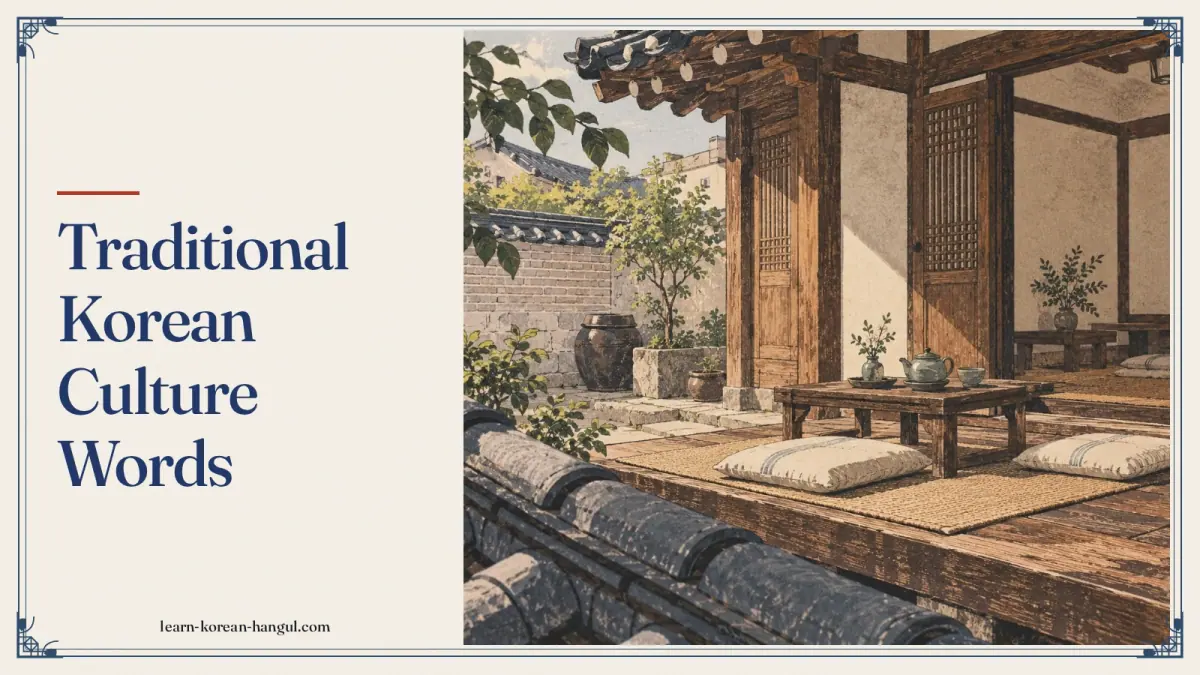
Traditional Korean Culture Words at a Glance
Traditional Korean culture words let you read the signs at a museum, a palace and a village of old houses. This page is a hub: it gives you the most useful 40 words from the whole topic, and it links to four deeper lists that expand each part. The words on traditional life, such as 한복, 한옥 and 온돌, are the ones every visitor meets first. Words for heritage, such as 문화재 and 국보, appear on every official sign. This page holds 40 words in six groups.
| Group | Words | Use |
|---|---|---|
| Culture and heritage | 4 | Reading heritage signs and talking about culture |
| Hanbok | 7 | Naming the main pieces of traditional clothing |
| Hanok and ondol | 7 | Naming a traditional house and its heating |
| Palaces and history | 7 | Reading palace names and history words |
| Leisure places | 6 | Naming the places where Koreans relax |
| Folk arts and crafts | 9 | Naming crafts, music and food heritage |
The list belongs to Korean Culture Words. The four deeper lists are Hanbok Vocabulary, Hanok and Ondol Vocabulary, Korean Palaces and History Vocabulary and Korean Leisure Places Vocabulary. The next section says where to start.
Which Traditional Culture Words Should You Learn First?
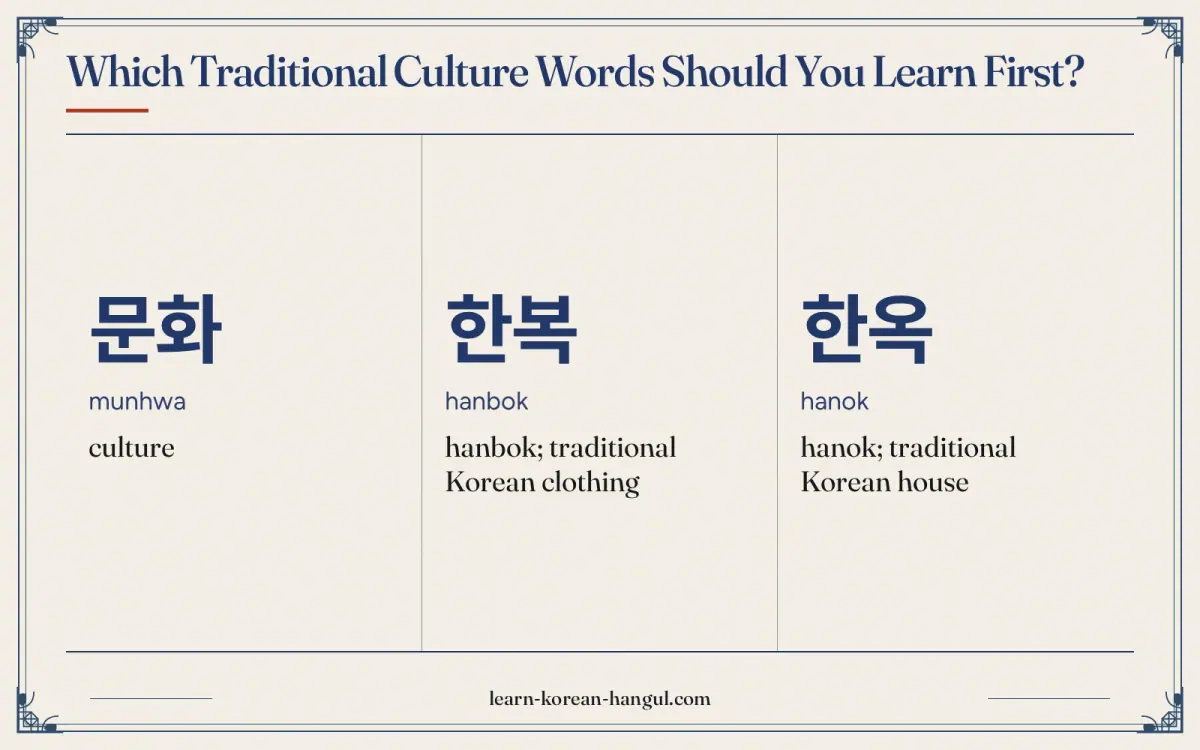
Learn 문화, 전통, 한복, 한옥 and 경복궁 first. They are the five words that open every conversation about Korean heritage. Then learn the words for the place you plan to visit, using the deeper lists.
- Day one. 문화, 전통, 문화재, 국보, 한복 and 한옥.
- Day two. The clothing and house words: 저고리, 치마, 온돌, 마당 and 기와.
- Day three. The palace words and the leisure places: 경복궁, 창덕궁, 찜질방 and 노래방.
- Day four. The folk arts and crafts: 도자기, 국악, 판소리, 탈춤 and 사물놀이.
At 8 to 10 words a day, the list takes four to five days plus review. This scene puts eight of the words on one picture.
Word · 8
- 1
문화
munhwa
culture
- 2
한복
hanbok
hanbok; traditional Korean clothing
- 3
한옥
hanok
hanok; traditional Korean house
- 4
온돌
ondol
ondol; underfloor heating
- 5
경복궁
gyeongbokgung
Gyeongbokgung; the main palace of the Joseon dynasty
- 6
찜질방
jjimjilbang
bathhouse; Korean spa with heated rooms
- 7
도자기
dojagi
pottery; ceramics
- 8
사물놀이
samullori
samullori; percussion performance for four instruments
By origin, the list has 21 Sino-Korean words, 12 native words, 6 mixed words and 1 phrase. Sino-Korean words dominate because heritage terms were written in Chinese characters for centuries, while native words such as 마당 and 저고리 name the things of daily life. The origin column in each table marks them.
Culture and Heritage
Four words frame the topic. 문화 is culture in general, and 전통 is tradition. A 문화재 is a piece of cultural property, such as a building or an object, and the state names the most important ones as 국보, a national treasure.
| No. | Hangul | Revised Romanization | Origin | Meaning | Example sentence | Audio assetId |
|---|---|---|---|---|---|---|
| 1 | 문화 | munhwa | Sino-Korean | culture | 한국 문화를 배워요. (I am learning Korean culture.) | au-pg-vocabulary-culture-traditional-1; example: au-pg-vocabulary-culture-traditional-41 |
| 2 | 전통 | jeontong | Sino-Korean | tradition | 한복은 한국의 전통 옷이에요. (Hanbok is traditional Korean clothing.) | au-pg-vocabulary-culture-traditional-2; example: au-pg-vocabulary-culture-traditional-42 |
| 3 | 문화재 | munhwajae | Sino-Korean | cultural property; cultural heritage item | 문화재를 소중히 지켜요. (We protect cultural heritage carefully.) | au-pg-vocabulary-culture-traditional-3; example: au-pg-vocabulary-culture-traditional-43 |
| 4 | 국보 | gukbo | Sino-Korean | national treasure | 국보는 가장 중요한 문화재예요. (A national treasure is the most important cultural property.) | au-pg-vocabulary-culture-traditional-4; example: au-pg-vocabulary-culture-traditional-44 |
These words appear on signs next to old buildings and on museum labels. The two words 문화 and 문화재 share the first syllable, but 문화 is an idea and 문화재 is a thing that is protected. The full heritage list is on the Korean Palaces and History Vocabulary page.
Example Sentences
Each example is a short polite sentence. Most follow the pattern noun + 을/를 + verb, as in 한국 문화를 배워요 (I am learning Korean culture), or place + 에 + 가요. Some end in 이에요/예요, which means is. Say each one aloud and swap the noun. For example, 박물관에서 도자기를 봤어요 becomes 박물관에서 한복을 봤어요 when you swap the noun.
The first group has the words you will use most. The sentences in the later groups are the ones to read before a museum visit.
Hanbok
Hanbok is traditional Korean clothing. It has a short jacket, the 저고리, and a full skirt, the 치마, for women, or trousers, the 바지, for men. Men wore a horsehair hat called 갓, both wore padded socks called 버선, and women hung a 노리개 from the skirt.
| No. | Hangul | Revised Romanization | Origin | Meaning | Example sentence | Audio assetId |
|---|---|---|---|---|---|---|
| 5 | 한복 | hanbok | Sino-Korean | hanbok; traditional Korean clothing | 설날에 한복을 입어요. (I wear hanbok at Seollal.) | au-pg-vocabulary-culture-traditional-5; example: au-pg-vocabulary-culture-traditional-45 |
| 6 | 저고리 | jeogori | native | jeogori; hanbok jacket | 저고리가 예뻐요. (The jeogori is pretty.) | au-pg-vocabulary-culture-traditional-6; example: au-pg-vocabulary-culture-traditional-46 |
| 7 | 치마 | chima | native | chima; skirt | 치마가 넓어요. (The skirt is wide.) | au-pg-vocabulary-culture-traditional-7; example: au-pg-vocabulary-culture-traditional-47 |
| 8 | 바지 | baji | native | baji; trousers | 바지가 헐렁해요. (The trousers are loose.) | au-pg-vocabulary-culture-traditional-8; example: au-pg-vocabulary-culture-traditional-48 |
| 9 | 갓 | gat | native | gat; traditional horsehair hat | 갓을 써요. (I wear a gat.) | au-pg-vocabulary-culture-traditional-9; example: au-pg-vocabulary-culture-traditional-49 |
| 10 | 버선 | beoseon | native | beoseon; padded traditional socks | 버선을 신어요. (I put on beoseon.) | au-pg-vocabulary-culture-traditional-10; example: au-pg-vocabulary-culture-traditional-50 |
| 11 | 노리개 | norigae | native | norigae; hanging ornament for hanbok | 노리개를 치마에 달아요. (I attach a norigae to the skirt.) | au-pg-vocabulary-culture-traditional-11; example: au-pg-vocabulary-culture-traditional-51 |
This is a short version of the topic. The Hanbok Vocabulary page has 30 words, including the ties, the overcoat, the fabrics and the words for renting hanbok.
How Do You Say Hanok and Ondol in Korean?
A hanok is a traditional Korean house. It has a tiled roof, called 기와, a wooden hall, called 대청마루, and a yard, called 마당. The doors are covered with 창호지, and the floor is heated by 온돌. The fire for the heating is lit in the 아궁이.
| No. | Hangul | Revised Romanization | Origin | Meaning | Example sentence | Audio assetId |
|---|---|---|---|---|---|---|
| 12 | 한옥 | hanok | Sino-Korean | hanok; traditional Korean house | 한옥에서 하룻밤 잤어요. (I slept one night in a hanok.) | au-pg-vocabulary-culture-traditional-12; example: au-pg-vocabulary-culture-traditional-52 |
| 13 | 온돌 | ondol | Sino-Korean | ondol; underfloor heating | 한옥에는 온돌이 있어요. (A hanok has ondol.) | au-pg-vocabulary-culture-traditional-13; example: au-pg-vocabulary-culture-traditional-53 |
| 14 | 마당 | madang | native | madang; yard; courtyard | 마당이 넓어요. (The yard is wide.) | au-pg-vocabulary-culture-traditional-14; example: au-pg-vocabulary-culture-traditional-54 |
| 15 | 기와 | giwa | native | giwa; roof tile | 지붕에 기와가 있어요. (There are roof tiles on the roof.) | au-pg-vocabulary-culture-traditional-15; example: au-pg-vocabulary-culture-traditional-55 |
| 16 | 대청마루 | daecheongmaru | mixed | daecheongmaru; wooden-floored main hall | 대청마루에서 쉬어요. (I rest on the daecheongmaru.) | au-pg-vocabulary-culture-traditional-16; example: au-pg-vocabulary-culture-traditional-56 |
| 17 | 창호지 | changhoji | Sino-Korean | changhoji; paper for doors and windows | 창호지를 문에 붙여요. (I stick changhoji on the door.) | au-pg-vocabulary-culture-traditional-17; example: au-pg-vocabulary-culture-traditional-57 |
| 18 | 아궁이 | agungi | native | agungi; the opening where the fire is lit | 아궁이에 불을 때요. (I light a fire in the agungi.) | au-pg-vocabulary-culture-traditional-18; example: au-pg-vocabulary-culture-traditional-58 |
This group gives the shape of a hanok. The Hanok and Ondol Vocabulary page has 30 words, including the heating words in order, the building materials and the words for a hanok stay.
Palaces and History
Seoul's grand palaces are called 궁궐. The best known are 경복궁 and 창덕궁. They were the homes of the 임금 (king) and the 왕비 (queen) of the 조선 dynasty. The general word for history is 역사.
| No. | Hangul | Revised Romanization | Origin | Meaning | Example sentence | Audio assetId |
|---|---|---|---|---|---|---|
| 19 | 경복궁 | gyeongbokgung | Sino-Korean | Gyeongbokgung; the main palace of the Joseon dynasty | 경복궁에서 사진을 찍어요. (I take photos at Gyeongbokgung.) | au-pg-vocabulary-culture-traditional-19; example: au-pg-vocabulary-culture-traditional-59 |
| 20 | 창덕궁 | changdeokgung | Sino-Korean | Changdeokgung; a palace known for its rear garden | 창덕궁은 후원이 유명해요. (Changdeokgung is famous for its rear garden.) | au-pg-vocabulary-culture-traditional-20; example: au-pg-vocabulary-culture-traditional-60 |
| 21 | 궁궐 | gunggwol | Sino-Korean | palace; royal palace complex | 서울에는 궁궐이 다섯 개 있어요. (There are five palaces in Seoul.) | au-pg-vocabulary-culture-traditional-21; example: au-pg-vocabulary-culture-traditional-61 |
| 22 | 임금 | imgeum | native | king; ruler (older, everyday word) | 옛날에는 임금이 나라를 다스렸어요. (In the old days a king ruled the country.) | au-pg-vocabulary-culture-traditional-22; example: au-pg-vocabulary-culture-traditional-62 |
| 23 | 왕비 | wangbi | Sino-Korean | queen; king's wife | 왕비는 왕의 부인이에요. (The queen is the king's wife.) | au-pg-vocabulary-culture-traditional-23; example: au-pg-vocabulary-culture-traditional-63 |
| 24 | 조선 | joseon | Sino-Korean | Joseon; the dynasty that ruled from 1392 to 1910 | 조선은 오백 년 넘게 이어졌어요. (Joseon lasted more than five hundred years.) | au-pg-vocabulary-culture-traditional-24; example: au-pg-vocabulary-culture-traditional-64 |
| 25 | 역사 | yeoksa | Sino-Korean | history | 한국 역사를 공부해요. (I study Korean history.) | au-pg-vocabulary-culture-traditional-25; example: au-pg-vocabulary-culture-traditional-65 |
The longer list is on Korean Palaces and History Vocabulary. It has 35 words, with the other three palaces, the royal titles, a table of eras and dates, and the heritage terms.
How Do You Say Leisure Places in Korean?
Not all tradition is old. Some everyday pastimes have names that every visitor learns. A 찜질방 is a bathhouse with hot rooms, and a 노래방 is a private karaoke room. A PC방 is a room of computers, and a 보드게임방 is a room for table games. People also eat 식혜, a sweet rice drink, and 구운 계란, roasted eggs, at a 찜질방.
| No. | Hangul | Revised Romanization | Origin | Meaning | Example sentence | Audio assetId |
|---|---|---|---|---|---|---|
| 26 | 찜질방 | jjimjilbang | mixed | bathhouse; Korean spa with heated rooms | 주말에 찜질방에 가요. (I go to the jjimjilbang on weekends.) | au-pg-vocabulary-culture-traditional-26; example: au-pg-vocabulary-culture-traditional-66 |
| 27 | 노래방 | noraebang | mixed | karaoke room | 친구와 노래방에 가요. (I go to the noraebang with friends.) | au-pg-vocabulary-culture-traditional-27; example: au-pg-vocabulary-culture-traditional-67 |
| 28 | PC방 | pisibang | mixed | PC room (internet and gaming cafe) | 저녁에 PC방에 가요. (I go to the PC bang in the evening.) | au-pg-vocabulary-culture-traditional-28; example: au-pg-vocabulary-culture-traditional-68 |
| 29 | 보드게임방 | bodeugeimbang | mixed | board-game room | 보드게임방에서 놀아요. (We play at the board-game room.) | au-pg-vocabulary-culture-traditional-29; example: au-pg-vocabulary-culture-traditional-69 |
| 30 | 식혜 | sikhye | Sino-Korean | sweet rice drink | 찜질방에서 식혜를 마셔요. (I drink sikhye at the jjimjilbang.) | au-pg-vocabulary-culture-traditional-30; example: au-pg-vocabulary-culture-traditional-70 |
| 31 | 구운 계란 | guun gyeran | phrase | roasted egg | 구운 계란을 먹어요. (I eat a roasted egg.) | au-pg-vocabulary-culture-traditional-31; example: au-pg-vocabulary-culture-traditional-71 |
All four place names end in 방, which means room. The longer list is on Korean Leisure Places Vocabulary. It has 30 words, with the -방 pattern, the items in each place and the newer rooms.
Folk Arts and Crafts
Korean crafts and arts have their own words. 한지 is traditional paper, and 도자기 is pottery. Two kinds of pottery are famous: 청자, a green-glazed type from the Goryeo period, and 백자, a white type known from Joseon. 국악 is traditional Korean music, and it includes 판소리, a story told in song, and 사물놀이, a percussion performance. 탈춤 is a mask dance. 김장 is the making of kimchi for the winter, a community custom.
| No. | Hangul | Revised Romanization | Origin | Meaning | Example sentence | Audio assetId |
|---|---|---|---|---|---|---|
| 32 | 한지 | hanji | Sino-Korean | hanji; traditional Korean paper | 한지는 튼튼해요. (Hanji is strong.) | au-pg-vocabulary-culture-traditional-32; example: au-pg-vocabulary-culture-traditional-72 |
| 33 | 도자기 | dojagi | Sino-Korean | pottery; ceramics | 박물관에서 도자기를 봤어요. (I saw pottery at the museum.) | au-pg-vocabulary-culture-traditional-33; example: au-pg-vocabulary-culture-traditional-73 |
| 34 | 청자 | cheongja | Sino-Korean | celadon; green-glazed pottery | 청자는 고려 시대의 도자기예요. (Celadon is pottery from the Goryeo period.) | au-pg-vocabulary-culture-traditional-34; example: au-pg-vocabulary-culture-traditional-74 |
| 35 | 백자 | baekja | Sino-Korean | white porcelain | 백자는 하얀 도자기예요. (White porcelain is white pottery.) | au-pg-vocabulary-culture-traditional-35; example: au-pg-vocabulary-culture-traditional-75 |
| 36 | 국악 | gugak | Sino-Korean | traditional Korean music | 국악 공연을 봤어요. (I saw a traditional music performance.) | au-pg-vocabulary-culture-traditional-36; example: au-pg-vocabulary-culture-traditional-76 |
| 37 | 판소리 | pansori | native | pansori; storytelling through song | 판소리는 노래와 이야기를 함께 해요. (Pansori combines singing and storytelling.) | au-pg-vocabulary-culture-traditional-37; example: au-pg-vocabulary-culture-traditional-77 |
| 38 | 탈춤 | talchum | native | mask dance | 탈춤은 탈을 쓰고 추는 춤이에요. (Talchum is a dance performed wearing a mask.) | au-pg-vocabulary-culture-traditional-38; example: au-pg-vocabulary-culture-traditional-78 |
| 39 | 사물놀이 | samullori | mixed | samullori; percussion performance for four instruments | 사물놀이는 네 가지 악기로 연주해요. (Samullori is played on four instruments.) | au-pg-vocabulary-culture-traditional-39; example: au-pg-vocabulary-culture-traditional-79 |
| 40 | 김장 | gimjang | Sino-Korean | gimjang; making kimchi for the winter | 가족이 모여서 김장을 해요. (The family gathers to make gimjang.) | au-pg-vocabulary-culture-traditional-40; example: au-pg-vocabulary-culture-traditional-80 |
Gimjang was added to UNESCO's list of Intangible Cultural Heritage, and the word 김장 on its own means the whole winter kimchi-making event. The four crafts and music words, 도자기, 국악, 판소리 and 사물놀이, are the ones that museums and performance halls use on their posters.
How Do You Pronounce These Words?
Many of these words change in speech because a final consonant meets a following consonant or vowel. The table lists the changes that learners most often miss.
| Spelling | Pronunciation | What happens |
|---|---|---|
| 한옥 | [하녹] | The final ㄴ moves onto the vowel ㅗ |
| 경복궁 | [경복꿍] | The ㄱ after the final ㄱ of 복 becomes a tense ㄲ |
| 국보 | [국뽀] | The ㅂ after a final ㄱ becomes tense |
| 국악 | [구각] | The final ㄱ of 국 moves onto the vowel of 악 |
| 백자 | [백짜] | The ㅈ after a final ㄱ becomes tense |
| 사물놀이 | [사물로리] | The final ㄹ is linked to the next syllable, and the ㄴ is said as ㄹ |
| 식혜 | [시켸/시케] | Final ㄱ and ㅎ merge into the aspirated ㅋ, and ㅖ after a consonant may be said [ㅔ] |
The rules come from the Standard Pronunciation rules (표준 발음법) of the 국립국어원.
Audio and Slow Playback
Each word has a normal clip, and 5 key words also have a slow clip at 0.8 times the speed: 문화, 한복, 한옥, 경복궁 and 사물놀이. Nothing plays until you press a button.
Listen to 사물놀이 first. You should hear [사물로리], four syllables, with a light l sound in the third, not a separate n.
What Mistakes Do Learners Make with Traditional Culture Words?
- Reading 한옥 as han-ok. The spoken form is [하녹].
- Reading 사물놀이 as sa-mul-nol-i. The spoken form is [사물로리].
- Using 한복 for a single piece of clothing. 한복 is the whole outfit, and 저고리 is the jacket.
- Taking 온돌 as the name of the house. It is the heating, and the house is a 한옥.
- Mixing up 문화 and 문화재. 문화 is culture, and 문화재 is a protected item.
The last three mistakes change the meaning, and the first two change the sound. The next section turns the list into practice.
Practice: Flashcards and Worksheet
Drill these words with the traditional Korean culture words flashcards or browse all the vocabulary flashcard decks. A printable worksheet for these words (word list, matching, writing practice, fill-in-the-blank exercises and answer key) is available in A4 and US Letter from the download card on this page. Progress in the decks is saved only in your browser.
Traditional Korean Culture Worksheet
Try this five-question check, then say the 40 words aloud once more.
Practice · 5
What does 문화 mean?
Show answer
culture
문화 (munhwa) means culture.
What does 한복 mean?
Show answer
hanbok; traditional Korean clothing
한복 (hanbok) means hanbok; traditional Korean clothing.
What does 온돌 mean?
Show answer
ondol; underfloor heating
온돌 (ondol) means ondol; underfloor heating.
What does 궁궐 mean?
Show answer
palace; royal palace complex
궁궐 (gunggwol) means palace; royal palace complex.
What does 탈춤 mean?
Show answer
mask dance
탈춤 (talchum) means mask dance.
For the topic one level up, the Korean Culture Words hub links to holidays, K-pop, religion and the other themed lists.
Where to Go Next
This list sits inside Korean Culture Words. After traditional Korean culture words, many learners move on to K-Drama Words or Korean Wedding Vocabulary, where hanbok and old customs appear in modern life.
Pages in This Section
Four pages sit below Traditional Culture.
- Hanbok Vocabulary: 30 words in five groups, from the jacket and skirt to the hat, socks, fabrics and rental words. Level A2.
- Hanok and Ondol Vocabulary: 30 words in five groups, with a table that follows the heat from the fire to the chimney, and the words for a hanok stay. Level A2.
- Korean Palaces and History Vocabulary: 35 words in five groups, with the five Seoul palaces, royal titles, a table of eras and dates, and heritage terms. Level B1.
- Korean Leisure Places Vocabulary: 30 words in five groups, from the jjimjilbang and noraebang to PC rooms and board-game cafes. Level A1.
Frequently Asked Questions
How Do You Say Culture in Korean?
Culture is 문화 (munhwa). It is a Sino-Korean word, and it joins with other words to make terms such as 문화재 (cultural property) and 전통문화 (traditional culture). To say you are learning Korean culture, use 한국 문화를 배워요 (hanguk munhwareul baewoyo). Press the audio button to hear the word.
How Do You Pronounce 경복궁 (gyeongbokgung)?
경복궁 is said [경복꿍], gyeong-bok-kkung, in three beats. The vowel ㅕ in the first syllable is a glide plus eo. The ㄱ at the end of 복 is closed, and the next ㄱ becomes a tense sound, as if spelled 꿍. Use the slow clip to match the rhythm, and keep the syllables even.
How Many Traditional Culture Words Should I Learn First?
Learn six first: 문화, 전통, 한복, 한옥, 경복궁 and 문화재. That takes one day. Then add the words of the part that interests you most. The whole list of 40 takes four to five days at 8 to 10 words a day, with review at the end.
Where Can I Practise Traditional Culture Words with Flashcards?
Use the traditional Korean culture words flashcards, a 29-card deck with audio that covers many of these words, such as 한복, 한옥, 온돌 and 사물놀이. Progress stays in your browser. The four deeper lists below this page each cover one part of the topic in more detail, so review them together with this overview.
Is the Romanization on This Page Official?
It follows the Revised Romanization of Korean, which South Korea officially adopted on 7 July 2000 and whose rules the National Institute of Korean Language (국립국어원) publishes. It is a learning aid that does not mark every sound change, so learn the Hangul and use the audio to hear the real sound.
Is There a Printable Worksheet for Traditional Culture Words?
A printable worksheet for these words (word list, matching, writing practice, fill-in-the-blank exercises and answer key) is available in A4 and US Letter from the download card on this page. For practice, copy the tables above by hand: write the Hangul, cover the English column, and check your answers against the page.