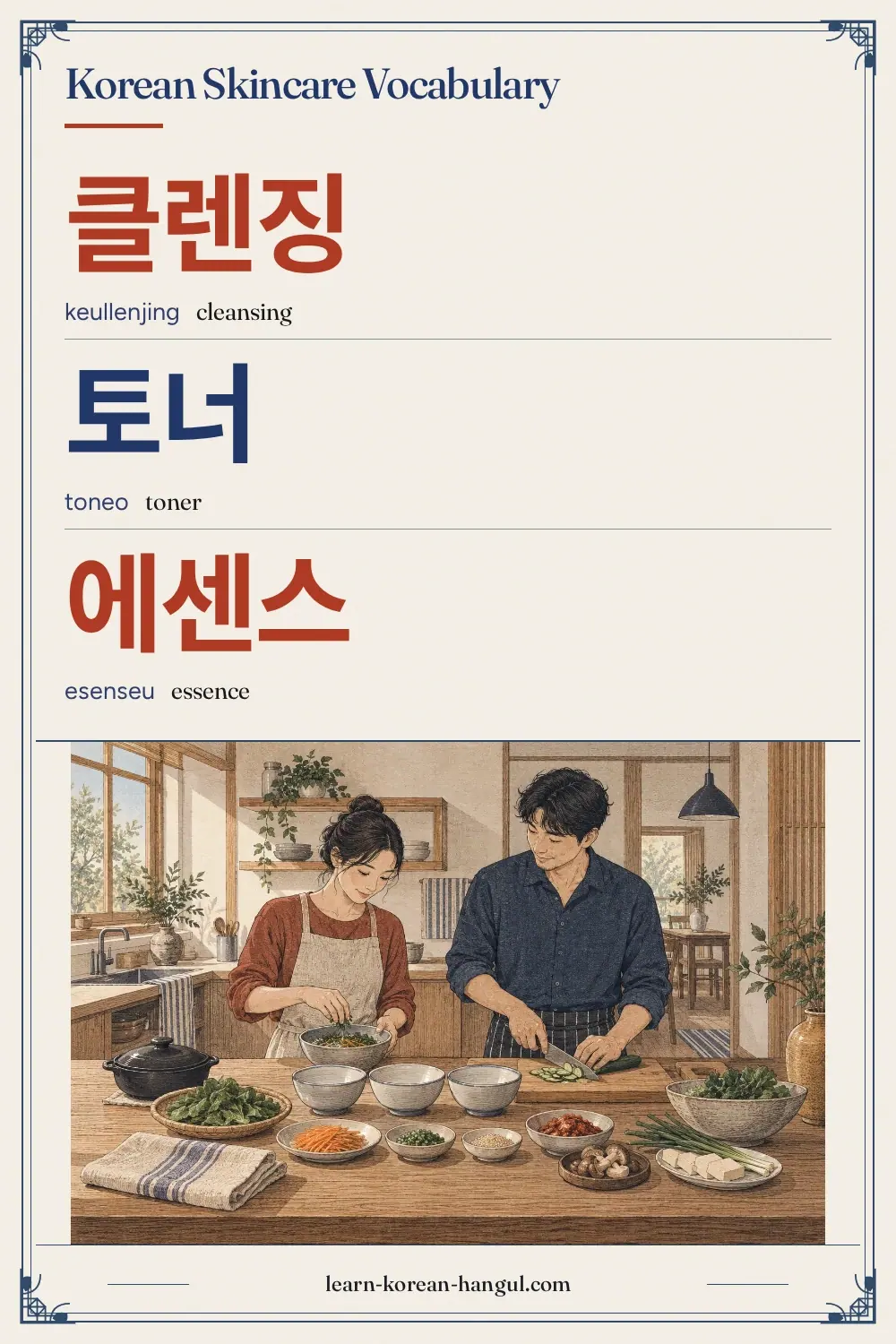
Korean Skincare Vocabulary at a Glance
A skincare routine runs from the thinnest product to the thickest, and the list follows that order. You clean the face first, then add watery toners, essences and serums, then richer creams and masks, and last protect the skin from the sun. The final group is the set of words for what you see in the mirror: dry or oily skin, spots and wrinkles. The page is a child of Korean Beauty Vocabulary, and it pairs with Korean Makeup Vocabulary. For the everyday washing words, see Korean Personal Care Vocabulary.
| Group | Words | Use |
|---|---|---|
| Cleansing | 7 | Washing the face and removing dirt |
| Toners and essences | 7 | Naming watery and concentrated products |
| Creams and masks | 7 | Naming moisturisers, masks and label words |
| Sun protection | 7 | Reading sunscreen labels and talking about the sun |
| Skin concerns | 7 | Describing your skin and its problems |
The words are mostly nouns. Many are loanwords for products, such as 토너 and 세럼, while the words for the skin itself are Sino-Korean, such as 건성 and 주름. The next section ranks the words by how soon you will need them.
Which Skincare Words Should You Learn First?
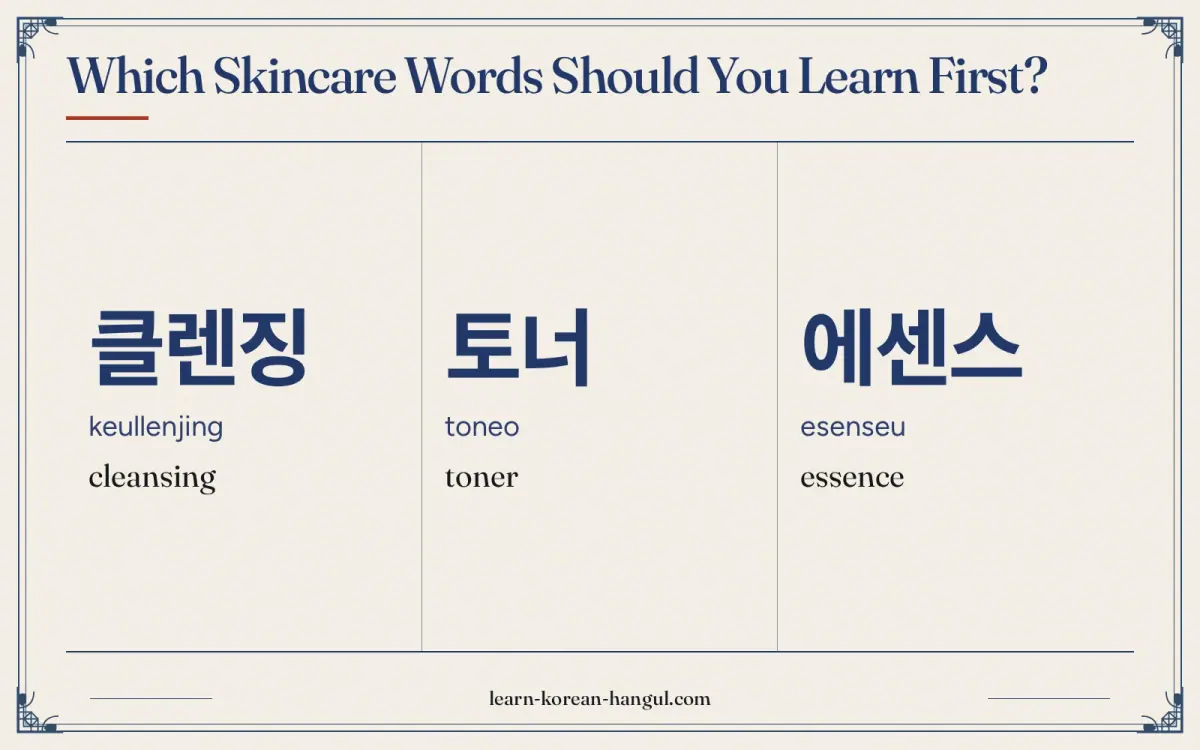
Learn 스킨케어 (skincare), 클렌징 (cleansing), 토너 (toner), 크림 (cream) and 선크림 (sunscreen) first. With those five you can say what you are doing, name four steps of a routine and ask for a product. Add 건성 and 지성 when you need to describe your skin type.
- Words to say. 토너, 로션, 크림, 선크림, 마스크팩, 피부. These are what you ask for and describe.
- Words to recognise. 성분, 보습, 미백, 자외선, 차단. You read these on boxes and labels.
- Words to understand when spoken. 건성, 지성, 민감성 and 트러블. Staff use these when they ask about your skin.
The number of steps in a routine varies from person to person, so there is no single correct list. What matters is the vocabulary for each kind of product, which this page teaches. A typical order from thin to thick is 클렌징, 토너, 에센스, 세럼, 크림 and, in the morning, 선크림.
At five new words a day, the whole list of 35 takes seven days plus review. The scene below puts eight of the 35 words on one shelf.
Word · 8
- 1
클렌징
keullenjing
cleansing
- 2
토너
toneo
toner
- 3
에센스
esenseu
essence
- 4
세럼
sereom
serum
- 5
크림
keurim
cream
- 6
마스크팩
maseukeupaek
sheet mask; face pack
- 7
선크림
seonkeurim
sunscreen
- 8
여드름
yeodeureum
acne; pimple
What Does 스킨 Mean in Korean Skincare?
This is the most common trap. In English, skin is the surface of your body. In Korean skincare, 스킨 (seukin) usually means toner, the watery liquid that you apply after cleansing. A bottle labelled 스킨 is therefore a toner, not a skin product in a broader sense. Shops often sell a matched pair called 스킨 and 로션, a toner and a lotion, as a basic set.
The same product has three names. 토너 (toneo) is the loanword in the English sense. 스킨 is the older loanword. 화장수 (hwajangsu) is the formal Sino-Korean word, used on labels and in descriptions. All three mean toner, and a Korean shop assistant will understand any of them.
The word for the skin itself is 피부 (pibu). When you talk about your skin type or your skin problems, always use 피부: 피부가 건조해요 (my skin is dry), not 스킨. Keep that difference in mind when you read a box, since 스킨 on a product name nearly always names the product and not the body.
Cleansing
The first group is about getting the face clean. 스킨케어 names the whole routine. 세안 and 세수 both mean washing the face, 클렌징 and 폼클렌징 name cleansing products, and 각질 and 모공 name what cleansing targets: dead skin and pores.
| No. | Hangul | Revised Romanization | Meaning and note | Example sentence | Audio assetId |
|---|---|---|---|---|---|
| 1 | 스킨케어 | seukinkeeo | skincare. Loanword for the whole routine. Also seen as 스킨 케어 with a space; this page uses the closed spelling. | 스킨케어를 해요. (I do my skincare.) | au-pg-vocabulary-daily-life-beauty-skincare-1; example: au-pg-vocabulary-daily-life-beauty-skincare-36 |
| 2 | 세안 | sean | face washing (formal). A Sino-Korean word used in product descriptions. The everyday word is 세수. | 세안 후에 토너를 써요. (I use toner after washing my face.) | au-pg-vocabulary-daily-life-beauty-skincare-2; example: au-pg-vocabulary-daily-life-beauty-skincare-37 |
| 3 | 세수 | sesu | washing one's face. The everyday word. 세수하다 means to wash your face. | 아침에 세수해요. (I wash my face in the morning.) | au-pg-vocabulary-daily-life-beauty-skincare-3; example: au-pg-vocabulary-daily-life-beauty-skincare-38 |
| 4 | 클렌징 | keullenjing | cleansing. Loanword. Used for makeup-removing oils and balms as well as for face washes. | 클렌징으로 화장을 지워요. (I remove makeup with a cleanser.) | au-pg-vocabulary-daily-life-beauty-skincare-4; example: au-pg-vocabulary-daily-life-beauty-skincare-39 |
| 5 | 폼클렌징 | pomkeullenjing | foaming cleanser. Loanword written as one word. A cleanser that foams when you add water. | 폼클렌징으로 씻어요. (I wash with a foaming cleanser.) | au-pg-vocabulary-daily-life-beauty-skincare-5; example: au-pg-vocabulary-daily-life-beauty-skincare-40 |
| 6 | 각질 | gakjil | dead skin cells; flaky skin. Said [각찔]. The thin outer layer that can flake off. | 각질이 일어나요. (My skin is flaking.) | au-pg-vocabulary-daily-life-beauty-skincare-6; example: au-pg-vocabulary-daily-life-beauty-skincare-41 |
| 7 | 모공 | mogong | pore. Sino-Korean word. Often appears in the phrase 모공 관리, pore care. | 모공이 넓어요. (My pores are wide.) | au-pg-vocabulary-daily-life-beauty-skincare-7; example: au-pg-vocabulary-daily-life-beauty-skincare-42 |
Two words for washing the face are worth separating. 세수 is the daily word that anyone says. 세안 sounds more formal, and it is the one that shops, labels and ads use, as in 세안제 (face-wash product). Learn 세수 to speak and 세안 to read.
The verb 씻다 (to wash) takes a body part or an item, as in 얼굴을 씻어요 (I wash my face). The noun 클렌징 takes the particle 으로 to mean by means of: 클렌징으로 지워요. For general washing words, the Korean Personal Care Vocabulary page has more.
After cleansing, the next group covers the thin, watery layers.
Toners and Essences
The second group holds the thin products. 토너, 스킨 and 화장수 are three names for toner. 에센스, 세럼 and 앰플 name more concentrated products, and 미스트 is a fine spray for the face. The differences between them are subtle, and the Korean labels describe them in words you now know.
| No. | Hangul | Revised Romanization | Meaning and note | Example sentence | Audio assetId |
|---|---|---|---|---|---|
| 8 | 토너 | toneo | toner. Loanword. The first watery step after cleansing. | 토너를 손에 덜어요. (I pour toner into my hand.) | au-pg-vocabulary-daily-life-beauty-skincare-8; example: au-pg-vocabulary-daily-life-beauty-skincare-43 |
| 9 | 스킨 | seukin | toner (skincare term). In skincare, 스킨 means toner. The skin itself is 피부. | 스킨이 촉촉해요. (The toner is moisturising.) | au-pg-vocabulary-daily-life-beauty-skincare-9; example: au-pg-vocabulary-daily-life-beauty-skincare-44 |
| 10 | 화장수 | hwajangsu | toner; skin lotion (formal). The formal Sino-Korean word used on labels. 수 means water. | 화장수는 토너와 같아요. (Hwajangsu is the same as toner.) | au-pg-vocabulary-daily-life-beauty-skincare-10; example: au-pg-vocabulary-daily-life-beauty-skincare-45 |
| 11 | 에센스 | esenseu | essence. Loanword. A light, concentrated liquid after toner. | 에센스를 두 번 발라요. (I apply essence twice.) | au-pg-vocabulary-daily-life-beauty-skincare-11; example: au-pg-vocabulary-daily-life-beauty-skincare-46 |
| 12 | 세럼 | sereom | serum. Loanword. A concentrated treatment for a specific concern. | 세럼을 한 방울 써요. (I use one drop of serum.) | au-pg-vocabulary-daily-life-beauty-skincare-12; example: au-pg-vocabulary-daily-life-beauty-skincare-47 |
| 13 | 앰플 | aempeul | ampoule. Loanword. A highly concentrated product in a small bottle. | 앰플은 농도가 진해요. (The ampoule is concentrated.) | au-pg-vocabulary-daily-life-beauty-skincare-13; example: au-pg-vocabulary-daily-life-beauty-skincare-48 |
| 14 | 미스트 | miseuteu | facial mist. Loanword. A fine spray used during the day. | 미스트를 뿌려요. (I spray facial mist.) | au-pg-vocabulary-daily-life-beauty-skincare-14; example: au-pg-vocabulary-daily-life-beauty-skincare-49 |
The verb 덜다 (to take out a portion) is used for pouring a small amount from a bottle, and 뿌리다 (to spray) goes with mists. The verb 바르다 (to spread on) is the all-purpose skincare verb: 에센스를 발라요, 로션을 발라요. Learn it first, because it covers nearly every step.
The counter words are simple. 한 방울 means one drop, 두 번 means twice, and 한 번 means once. Native numbers are used with these counters, so 하나 becomes 한 and 둘 becomes 두.
Next come the heavier layers that hold moisture in.
Creams and Masks
The third group is about hydration. 로션 and 크림 are the two main moisturisers, and 아이크림 is for the eye area. 마스크팩 is a sheet mask, 수분 and 보습 name hydration, and 성분 is the word for ingredients on the box.
| No. | Hangul | Revised Romanization | Meaning and note | Example sentence | Audio assetId |
|---|---|---|---|---|---|
| 15 | 로션 | rosyeon | lotion. Loanword. A lighter moisturiser than 크림. | 로션을 얼굴에 발라요. (I put lotion on my face.) | au-pg-vocabulary-daily-life-beauty-skincare-15; example: au-pg-vocabulary-daily-life-beauty-skincare-50 |
| 16 | 크림 | keurim | cream. Loanword. A richer moisturiser applied after lotion or essence. | 크림을 듬뿍 발라요. (I apply plenty of cream.) | au-pg-vocabulary-daily-life-beauty-skincare-16; example: au-pg-vocabulary-daily-life-beauty-skincare-51 |
| 17 | 아이크림 | aikeurim | eye cream. Loanword written as one word. A cream for the thin skin around the eyes. | 아이크림을 눈 밑에 발라요. (I put eye cream under my eyes.) | au-pg-vocabulary-daily-life-beauty-skincare-17; example: au-pg-vocabulary-daily-life-beauty-skincare-52 |
| 18 | 마스크팩 | maseukeupaek | sheet mask; face pack. A face pack. The medical or protective mask is 마스크, without 팩. | 마스크팩을 붙여요. (I put on a sheet mask.) | au-pg-vocabulary-daily-life-beauty-skincare-18; example: au-pg-vocabulary-daily-life-beauty-skincare-53 |
| 19 | 수분 | subun | moisture; water content. Sino-Korean word. 수 is water and 분 is a part. | 수분이 부족해요. (My skin lacks moisture.) | au-pg-vocabulary-daily-life-beauty-skincare-19; example: au-pg-vocabulary-daily-life-beauty-skincare-54 |
| 20 | 보습 | boseup | moisturising. A label word for keeping moisture in. | 보습에 좋아요. (It is good for moisturising.) | au-pg-vocabulary-daily-life-beauty-skincare-20; example: au-pg-vocabulary-daily-life-beauty-skincare-55 |
| 21 | 성분 | seongbun | ingredient; component. A box lists 성분. Read it before you buy if you have allergies. | 성분을 확인해요. (I check the ingredients.) | au-pg-vocabulary-daily-life-beauty-skincare-21; example: au-pg-vocabulary-daily-life-beauty-skincare-56 |
The two words 마스크 and 마스크팩 are easy to confuse, and the same mix-up appears in the pharmacy lesson. 마스크 is a face mask worn over the nose and mouth. 마스크팩 is a skincare sheet that you place on the face. Say the full word when you shop.
The label words 수분, 보습 and 성분 help you read a Korean box. 수분 크림 would be a moisture cream. A phrase like 성분을 확인해요 (I check the ingredients) is a good habit and a good sentence, particularly for sensitive skin.
Skincare also protects against the sun, and that is the next group.
Sun Protection
Sun protection is a daily step in many routines. 자외선 means ultraviolet rays, 선크림 and 자외선 차단제 name the product, and 차단 means blocking. 햇빛 and 그늘 are sunlight and shade. 미백 is a label word that you will see on many products.
| No. | Hangul | Revised Romanization | Meaning and note | Example sentence | Audio assetId |
|---|---|---|---|---|---|
| 22 | 자외선 | jaoeseon | ultraviolet rays; UV. Said [자외선] or [자웨선]. The sun's UV. | 자외선이 강해요. (The UV rays are strong.) | au-pg-vocabulary-daily-life-beauty-skincare-22; example: au-pg-vocabulary-daily-life-beauty-skincare-57 |
| 23 | 선크림 | seonkeurim | sunscreen. From sun cream. The formal term is 자외선 차단제. | 외출 전에 선크림을 발라요. (I put on sunscreen before going out.) | au-pg-vocabulary-daily-life-beauty-skincare-23; example: au-pg-vocabulary-daily-life-beauty-skincare-58 |
| 24 | 자외선 차단제 | jaoeseon chadanje | sunscreen (formal). The formal term, written as two words. | 자외선 차단제는 매일 필요해요. (Sunscreen is needed every day.) | au-pg-vocabulary-daily-life-beauty-skincare-24; example: au-pg-vocabulary-daily-life-beauty-skincare-59 |
| 25 | 차단 | chadan | blocking; protection. 차단하다 means to block. It appears on labels as 자외선 차단. | 자외선을 차단해요. (I block UV rays.) | au-pg-vocabulary-daily-life-beauty-skincare-25; example: au-pg-vocabulary-daily-life-beauty-skincare-60 |
| 26 | 햇빛 | haetbit | sunlight. Said [해삗]. 햇 comes from 해 (sun). | 햇빛을 피해요. (I avoid the sunlight.) | au-pg-vocabulary-daily-life-beauty-skincare-26; example: au-pg-vocabulary-daily-life-beauty-skincare-61 |
| 27 | 그늘 | geuneul | shade. A native word for a shaded place. | 그늘에 앉아요. (I sit in the shade.) | au-pg-vocabulary-daily-life-beauty-skincare-27; example: au-pg-vocabulary-daily-life-beauty-skincare-62 |
| 28 | 미백 | mibaek | brightening; whitening (label term). A label word, discussed in the text below. Often paired with 주름 개선. | 미백 제품을 써요. (I use a brightening product.) | au-pg-vocabulary-daily-life-beauty-skincare-28; example: au-pg-vocabulary-daily-life-beauty-skincare-63 |
The word 미백 needs a clear explanation. It appears on many Korean boxes. It is usually translated as whitening, but the practical meaning on a product is brightening or evening the tone of the skin, such as lightening dark spots. Korean cosmetics law groups some products under 기능성화장품 (functional cosmetics), and 미백, 주름 개선 (wrinkle improvement) and 자외선 차단 (UV protection) are claims in that group. Read the word as a label term, not as a statement about skin colour, and check the ministry's information for the current rules.
The word 선크림 is the everyday product word. 자외선 차단제 is the full name that you read on the box. In speech, the short word is far more common.
The last group turns from products to the problems they address.
Skin Concerns
The final group is about describing your skin. 피부 is the skin itself. 건성, 지성 and 민감성 are three skin types. 여드름, 주름 and 트러블 are three common concerns. These are the words a shop assistant or a dermatologist expects you to understand.
| No. | Hangul | Revised Romanization | Meaning and note | Example sentence | Audio assetId |
|---|---|---|---|---|---|
| 29 | 피부 | pibu | skin. The body skin. Not 스킨, which means toner in skincare. | 피부가 좋아요. (My skin is good.) | au-pg-vocabulary-daily-life-beauty-skincare-29; example: au-pg-vocabulary-daily-life-beauty-skincare-64 |
| 30 | 건성 | geonseong | dry skin type. 건 means dry and 성 means nature or type. | 건성 피부예요. (I have dry skin.) | au-pg-vocabulary-daily-life-beauty-skincare-30; example: au-pg-vocabulary-daily-life-beauty-skincare-65 |
| 31 | 지성 | jiseong | oily skin type. 지 means oil or fat and 성 means type. | 지성 피부예요. (I have oily skin.) | au-pg-vocabulary-daily-life-beauty-skincare-31; example: au-pg-vocabulary-daily-life-beauty-skincare-66 |
| 32 | 민감성 | mingamseong | sensitive skin type. 민감 means sensitive and 성 means type. | 피부가 민감해요. (My skin is sensitive.) | au-pg-vocabulary-daily-life-beauty-skincare-32; example: au-pg-vocabulary-daily-life-beauty-skincare-67 |
| 33 | 여드름 | yeodeureum | acne; pimple. Native word. | 여드름이 났어요. (I got a pimple.) | au-pg-vocabulary-daily-life-beauty-skincare-33; example: au-pg-vocabulary-daily-life-beauty-skincare-68 |
| 34 | 주름 | jureum | wrinkle. Native word. Also means a pleat in cloth. | 주름이 생겨요. (Wrinkles appear.) | au-pg-vocabulary-daily-life-beauty-skincare-34; example: au-pg-vocabulary-daily-life-beauty-skincare-69 |
| 35 | 트러블 | teureobeul | skin trouble; breakout. Loanword from trouble. Used for breakouts and irritation. | 트러블이 생겼어요. (I got a breakout.) | au-pg-vocabulary-daily-life-beauty-skincare-35; example: au-pg-vocabulary-daily-life-beauty-skincare-70 |
The suffix 성 is the key to this group. It means nature or type, so 건성 is a dry type, 지성 is an oily type and 민감성 is a sensitive type. Shops also use 복합성 (combination type) for skin that is oily in some places and dry in others. Pair each with 피부: 건성 피부, 지성 피부.
Concerns are described with 생기다 (to appear) and 나다 (to come out). 여드름이 났어요 and 트러블이 생겼어요 both say that something has appeared. Use 피부과 (dermatology clinic) when a problem needs a doctor; see Health and Medicine for the words you will need there.
How Do You Read a Korean Skincare Label?
A Korean skincare box packs a lot of information into a few words, and the words in this lesson cover most of it. The table lists the label words you are most likely to see.
| On the box | Spoken meaning | What it tells you |
|---|---|---|
| 성분 | ingredients | The list of what is in the product |
| 보습 | moisturising | The product helps skin keep moisture |
| 미백 | brightening | A label claim about evening skin tone |
| 주름 개선 | wrinkle improvement | A label claim about wrinkles |
| 자외선 차단 | UV protection | The product blocks UV rays |
| 건성용 / 지성용 | for dry / oily skin | The skin type the product is made for |
The ending 용 means for use by, so 건성용 is for dry skin. You will meet this ending on many Korean labels. The sentence frame for asking a shop assistant is simple: 건성 피부에 맞는 크림 있어요? (Do you have a cream that suits dry skin?).
A good practice habit is to pick up three products at home and read each box. Find the 성분 line, then find any claim word such as 보습 or 미백. Reading real labels teaches faster than any list.
How Do You Pronounce These Words?
Skincare words contain several sound changes, because many end in a consonant that changes before the next sound. Standard pronunciation follows the National Institute of Korean Language (국립국어원) rules. The romanization follows the Revised Romanization of Korean, which writes tense letters such as kk and tt but does not show tensing caused by a neighbouring sound.
| Spelling | Sounds like | What changes |
|---|---|---|
| 각질 | [각찔] | A final ㄱ makes the next ㅈ tense. |
| 자외선 | [자외선] or [자웨선] | The 외 may be said [웨]. Both are accepted. |
| 클렌징 | [클렌징] | Two ㄹ sounds join into one long l: keul-len-jing. |
| 폼클렌징 | [폼클렌징] | Four syllables: pom-keul-len-jing. |
| 보습 | [보습] | Said as written. The final ㅂ is closed and not released. |
| 건성 | [건성] | Said as written. After ㄴ the next ㅅ is not tensed in this word. |
| 햇빛 | [해삗] or [핻삗] | The final ㅅ is closed before ㅂ, and the ㅂ is said tense. Both spoken forms are accepted. |
Say 각질 with a tight throat on the tense ㅉ sound and no puff of breath. The page on tensification explains why a stop sound makes the next consonant tense. The vowels ㅓ and ㅡ in 토너, 세럼, 미스트 and 스킨케어 are said with unrounded lips.
Audio and Slow Playback
Every word and every example sentence has its own clip. The five clips below replay the trickiest words slowly. Play one, repeat it aloud, then play it again and compare.
What Mistakes Do Learners Make with Skincare Words?
These five mistakes cause most of the confusion in a skincare aisle.
- Reading 스킨 as skin. On a product, 스킨 means toner. Use 피부 for your skin.
- Mixing 마스크 and 마스크팩. A 마스크 covers the mouth and nose. A 마스크팩 is a sheet for the face.
- Treating 미백 as a statement about skin colour. On a box, 미백 is a label term for brightening or evening the tone.
- Using 세안 in casual speech. 세안 is the label and shop word. In conversation, say 세수.
- Forgetting the suffix 성 in skin types. Say 건성 피부, not 건 피부. The suffix 성 turns a quality into a type.
Learning 피부 and the suffix 성 removes most of the risk.
Practice: Flashcards and Worksheet
Study in three steps. First, run the flashcard deck in recognition mode until you recognise each of the 35 words. Second, switch to listening mode. Third, take the quiz. The deck covers all 35 words with audio, and your progress stays in your browser. The vocabulary flashcard decks page lists the other decks.
Practice · 75
- 01스킨케어
Show answer
headword 1: skincare
- 02세안
Show answer
headword 2: face washing (formal)
- 03세수
Show answer
headword 3: washing one's face
- 04클렌징
Show answer
headword 4: cleansing
- 05폼클렌징
Show answer
headword 5: foaming cleanser
- 06각질
Show answer
headword 6: dead skin cells; flaky skin
- 07모공
Show answer
headword 7: pore
- 08토너
Show answer
headword 8: toner
- 09스킨
Show answer
headword 9: toner (skincare term)
- 10화장수
Show answer
headword 10: toner; skin lotion (formal)
- 11에센스
Show answer
headword 11: essence
- 12세럼
Show answer
headword 12: serum
- 13앰플
Show answer
headword 13: ampoule
- 14미스트
Show answer
headword 14: facial mist
- 15로션
Show answer
headword 15: lotion
- 16크림
Show answer
headword 16: cream
- 17아이크림
Show answer
headword 17: eye cream
- 18마스크팩
Show answer
headword 18: sheet mask; face pack
- 19수분
Show answer
headword 19: moisture; water content
- 20보습
Show answer
headword 20: moisturising
- 21성분
Show answer
headword 21: ingredient; component
- 22자외선
Show answer
headword 22: ultraviolet rays; UV
- 23선크림
Show answer
headword 23: sunscreen
- 24자외선 차단제
Show answer
headword 24: sunscreen (formal)
- 25차단
Show answer
headword 25: blocking; protection
- 26햇빛
Show answer
headword 26: sunlight
- 27그늘
Show answer
headword 27: shade
- 28미백
Show answer
headword 28: brightening; whitening (label term)
- 29피부
Show answer
headword 29: skin
- 30건성
Show answer
headword 30: dry skin type
- 31지성
Show answer
headword 31: oily skin type
- 32민감성
Show answer
headword 32: sensitive skin type
- 33여드름
Show answer
headword 33: acne; pimple
- 34주름
Show answer
headword 34: wrinkle
- 35트러블
Show answer
headword 35: skin trouble; breakout
- 36스킨케어를 해요.
Show answer
example sentence for headword 1
- 37세안 후에 토너를 써요.
Show answer
example sentence for headword 2
- 38아침에 세수해요.
Show answer
example sentence for headword 3
- 39클렌징으로 화장을 지워요.
Show answer
example sentence for headword 4
- 40폼클렌징으로 씻어요.
Show answer
example sentence for headword 5
- 41각질이 일어나요.
Show answer
example sentence for headword 6
- 42모공이 넓어요.
Show answer
example sentence for headword 7
- 43토너를 손에 덜어요.
Show answer
example sentence for headword 8
- 44스킨이 촉촉해요.
Show answer
example sentence for headword 9
- 45화장수는 토너와 같아요.
Show answer
example sentence for headword 10
- 46에센스를 두 번 발라요.
Show answer
example sentence for headword 11
- 47세럼을 한 방울 써요.
Show answer
example sentence for headword 12
- 48앰플은 농도가 진해요.
Show answer
example sentence for headword 13
- 49미스트를 뿌려요.
Show answer
example sentence for headword 14
- 50로션을 얼굴에 발라요.
Show answer
example sentence for headword 15
- 51크림을 듬뿍 발라요.
Show answer
example sentence for headword 16
- 52아이크림을 눈 밑에 발라요.
Show answer
example sentence for headword 17
- 53마스크팩을 붙여요.
Show answer
example sentence for headword 18
- 54수분이 부족해요.
Show answer
example sentence for headword 19
- 55보습에 좋아요.
Show answer
example sentence for headword 20
- 56성분을 확인해요.
Show answer
example sentence for headword 21
- 57자외선이 강해요.
Show answer
example sentence for headword 22
- 58외출 전에 선크림을 발라요.
Show answer
example sentence for headword 23
- 59자외선 차단제는 매일 필요해요.
Show answer
example sentence for headword 24
- 60자외선을 차단해요.
Show answer
example sentence for headword 25
- 61햇빛을 피해요.
Show answer
example sentence for headword 26
- 62그늘에 앉아요.
Show answer
example sentence for headword 27
- 63미백 제품을 써요.
Show answer
example sentence for headword 28
- 64피부가 좋아요.
Show answer
example sentence for headword 29
- 65건성 피부예요.
Show answer
example sentence for headword 30
- 66지성 피부예요.
Show answer
example sentence for headword 31
- 67피부가 민감해요.
Show answer
example sentence for headword 32
- 68여드름이 났어요.
Show answer
example sentence for headword 33
- 69주름이 생겨요.
Show answer
example sentence for headword 34
- 70트러블이 생겼어요.
Show answer
example sentence for headword 35
- 71각질
Show answer
slow playback of headword 6: dead skin cells; flaky skin
- 72자외선
Show answer
slow playback of headword 22: ultraviolet rays; UV
- 73자외선 차단제
Show answer
slow playback of headword 24: sunscreen (formal)
- 74폼클렌징
Show answer
slow playback of headword 5: foaming cleanser
- 75미백
Show answer
slow playback of headword 28: brightening; whitening (label term)
Practice · 5
What does 클렌징 (keullenjing) mean?
Show answer
cleansing
클렌징 means cleansing. Example: 클렌징으로 화장을 지워요. (I remove makeup with a cleanser.)
What does 스킨 (seukin) mean?
Show answer
toner (skincare term)
스킨 means toner (skincare term). Example: 스킨이 촉촉해요. (The toner is moisturising.)
What does 마스크팩 (maseukeupaek) mean?
Show answer
sheet mask; face pack
마스크팩 means sheet mask; face pack. Example: 마스크팩을 붙여요. (I put on a sheet mask.)
What does 선크림 (seonkeurim) mean?
Show answer
sunscreen
선크림 means sunscreen. Example: 외출 전에 선크림을 발라요. (I put on sunscreen before going out.)
What does 건성 (geonseong) mean?
Show answer
dry skin type
건성 means dry skin type. Example: 건성 피부예요. (I have dry skin.)
Korean Skincare Vocabulary Worksheet (PDF)
A printable worksheet for these words (word list, matching, writing practice, fill-in-the-blank exercises and answer key) is available in A4 and US Letter from the download card on this page. For practice, copy the 35 words by hand and write the meaning beside each one. Then write two sentences of your own, such as 건성 피부예요. 크림을 발라요. (I have dry skin. I apply cream.)
Where to Go Next
After this page, continue with Korean Makeup Vocabulary, the lesson on what goes on top of the skin, or Korean Hair Salon Vocabulary. For the hub of all three, return to Korean Beauty Vocabulary. For the single word, see skincare in Korean, and for the skin, see skin in Korean.
Frequently Asked Questions
How Do You Say Skincare in Korean?
Skincare is 스킨케어 (seukinkeeo). Say 스킨케어를 해요 for I do my skincare. The routine words are 클렌징 (cleansing), 토너 (toner), 에센스 (essence), 크림 (cream) and 선크림 (sunscreen). For the single-word lookup with a pronunciation guide, see the page on skincare in Korean.
How Do You Say Cleansing in Korean?
Cleansing is 클렌징 (keullenjing), a loanword. A foaming cleanser is 폼클렌징 (pomkeullenjing). The everyday word for washing your face is 세수 (sesu), and 세안 (sean) is the formal word used on labels and by shops.
What Does 스킨 Mean in Skincare?
In skincare 스킨 (seukin) usually means toner, the watery liquid applied after cleansing. It does not mean the skin itself, which is 피부 (pibu). Toner also has two other names: 토너 (toneo) and the formal 화장수 (hwajangsu).
How Do You Pronounce 각질 (gakjil)?
Say gak-jil, but make the second sound tense, as in [각찔]. After a final ㄱ, the next ㅈ is said tight and unaspirated, with no puff of breath. Press the audio button on this page for the normal and slow versions.
Is the Romanization on This Page Official?
It follows the Revised Romanization of Korean, which South Korea adopted on 7 July 2000 and whose rules the National Institute of Korean Language (국립국어원) publishes. It is a learning aid and does not show every sound change, so rely on the Hangul and the audio.
Is There a Printable Worksheet for Skincare Words?
A printable worksheet for these words (word list, matching, writing practice, fill-in-the-blank exercises and answer key) is available in A4 and US Letter from the download card on this page. For practice, copy the tables on this page by hand or use the flashcard deck, which carries the same 35 words.