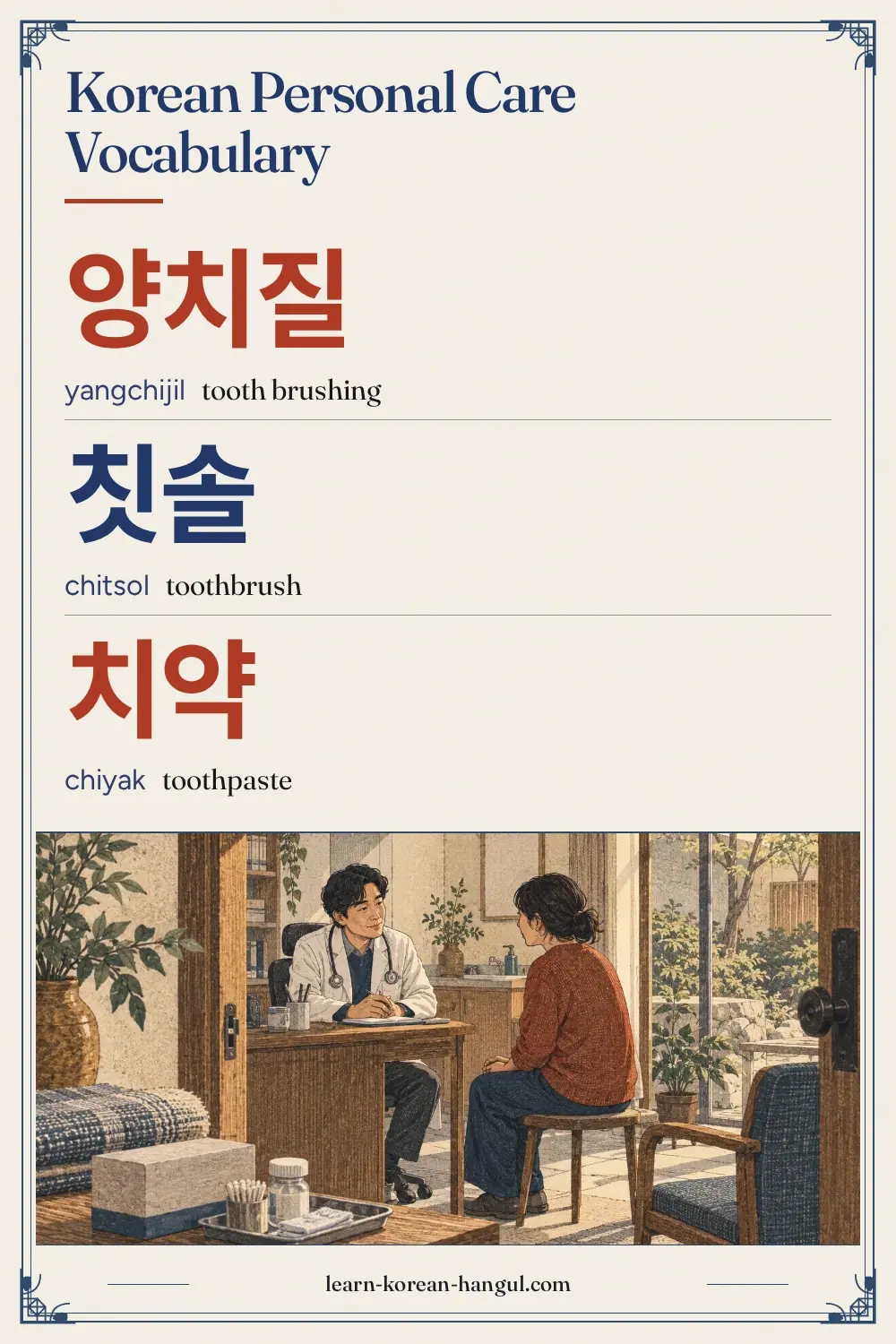
Korean Personal Care Vocabulary at a Glance
Personal care is the part of the daily routine that happens in the bathroom. In Korean most of these actions are expressed as a noun plus 하다 (to do), such as 양치질을 하다 (to brush the teeth) and 세수를 하다 (to wash the face), or as a short native verb, such as 이를 닦다 (to brush the teeth) and 머리를 감다 (to wash the hair). This page teaches the nouns, and the example sentences show each verb in a simple polite form.
By origin, the 30 words are 6 native Korean, 11 Sino-Korean (built from Chinese-derived syllables), 8 loanwords and 5 mixed. Origin is a useful hint: Sino-Korean syllables such as 치 (tooth) in 치약 and 치실 recur across words, and loanwords such as 샴푸 sound close to English. The groups are:
| Group | Words | Examples |
|---|---|---|
| Teeth and mouth | 6 | 양치질, 칫솔, 치약, 치실 |
| Washing and bathing | 8 | 세수, 샤워, 목욕, 비누 |
| Hair | 6 | 머리, 머리카락, 샴푸, 린스 |
| Skin | 5 | 피부, 로션, 선크림, 팩 |
| Toiletries | 5 | 화장지, 반창고, 마스크, 손톱깎이 |
Three words are easy to mix up: 세수 is washing only your face, 샤워 is a shower and 목욕 is a bath. Korean bathhouses also have the tradition of scrubbing off dead skin with a rough cloth, the 때수건. Most shop items (샴푸, 린스, 로션) are loanwords from English. This list sits inside Daily Routines, where you can find the related topics.
Which Personal Care Words Should You Learn First?
Start with five words that describe a basic hygiene routine: 양치질, 세수, 샤워, 목욕 and 비누. Each one is used in daily talk at home, at school and in a hotel. Press play, then the slow button, and say each word aloud.
양치질 (yangchijil) means tooth brushing. It is the everyday noun for the action and is used with 하다. A shorter form, 양치, is also common (양치하고 자요, I brush my teeth and go to bed), and the plain verb phrase is 이를 닦아요. Example: 양치질을 해요. (I brush my teeth.)
세수 (sesu) means face washing. It covers the face only, usually with the hands at a washbasin, so it is never used for a shower. Many people say 세수하고 양치해요 (I wash my face and brush my teeth) for the morning routine. Example: 세수를 해요. (I wash my face.)
샤워 (syawo) means shower. It is a loanword from English. In RR it is syawo, because ㅅ is written s and the vowel ㅑ is written ya; RR has no sh. Use 샤워를 해요 or 샤워해요 for "I take a shower". Example: 매일 샤워해요. (I shower every day.)
목욕 (mogyok) means bath. It is a full bath, in a bathtub or in a public bathhouse. The word 목욕탕 means a public bathhouse. In sound, the ㄱ moves to the next syllable: [모굑]. Example: 목욕을 하고 싶어요. (I want to take a bath.)
비누 (binu) means soap, for hands, face and body. Liquid hand soap is usually 핸드워시 or 물비누 on shop shelves. The particle 로 (with) marks it as the tool. Example: 비누로 손을 씻어요. (I wash my hands with soap.)
Teeth and Mouth
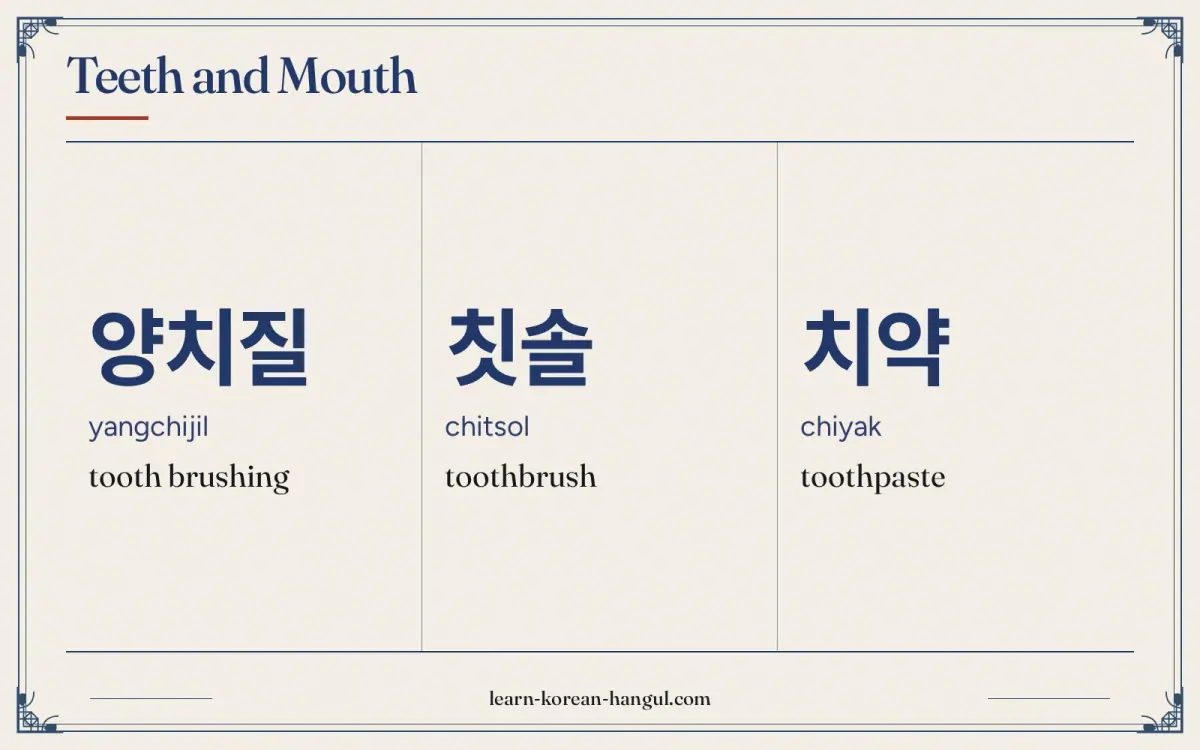
Dental care has two ways to say brushing: the noun 양치질 with 하다, and the plain phrase 이를 닦다. Learn both, because you will hear both every day.
| No. | Hangul | Revised Romanization | Meaning | Origin | Example sentence | Audio assetId |
|---|---|---|---|---|---|---|
| 1 | 양치질 | yangchijil | tooth brushing | mixed | 양치질을 해요. (yangchijireul haeyo; I brush my teeth.) | au-pg-vocabulary-daily-life-routines-personal-care-1; example: au-pg-vocabulary-daily-life-routines-personal-care-101 |
| 2 | 칫솔 | chitsol | toothbrush | mixed | 칫솔을 바꿔요. (chitsoreul bakkwoyo; I change my toothbrush.) | au-pg-vocabulary-daily-life-routines-personal-care-2; example: au-pg-vocabulary-daily-life-routines-personal-care-102 |
| 3 | 치약 | chiyak | toothpaste | Sino-Korean | 치약이 떨어졌어요. (chiyagi tteoreojyeosseoyo; We have run out of toothpaste.) | au-pg-vocabulary-daily-life-routines-personal-care-3; example: au-pg-vocabulary-daily-life-routines-personal-care-103 |
| 4 | 치실 | chisil | dental floss | mixed | 치실로 이 사이를 닦아요. (chisillo i saireul dakkayo; I clean between my teeth with floss.) | au-pg-vocabulary-daily-life-routines-personal-care-4; example: au-pg-vocabulary-daily-life-routines-personal-care-104 |
| 5 | 가글 | gageul | mouthwash | loanword | 가글을 해요. (gageureul haeyo; I use mouthwash.) | au-pg-vocabulary-daily-life-routines-personal-care-5; example: au-pg-vocabulary-daily-life-routines-personal-care-105 |
| 6 | 이 | i | tooth | native | 이를 닦아요. (ireul dakkayo; I brush my teeth.) | au-pg-vocabulary-daily-life-routines-personal-care-6; example: au-pg-vocabulary-daily-life-routines-personal-care-106 |
- 양치질 is the word for brushing, and you can also say 양치 on its own. The ending 질 is a suffix added to a tool or body-part noun to mean doing a repeated action with it, as in 가위질 (cutting with scissors) and 걸레질 (mopping).
- 이 (tooth) is the same sound as the number 이 (two), but the context makes the meaning clear. Do not confuse it with the subject marker 이.
- For a single-word explanation of the item, see toothbrush in korean.
Example Sentences
Two frames cover most of this page. The first is noun + 을/를 + 하다: 양치질을 해요 (I brush my teeth), 세수를 해요 (I wash my face), 샤워를 해요 (I take a shower). The second is object + native verb: 이를 닦아요 (I brush my teeth), 머리를 감아요 (I wash my hair), 손을 씻어요 (I wash my hands). Use the first frame for words that name an action and the second for body parts. Add 에 or 후에 for the time: 아침에 세수를 해요 (I wash my face in the morning) and 밥 먹은 후에 양치질을 해요 (I brush my teeth after eating). The routine words in Daily Routines give you the time words for these sentences.
How Do You Say Washing and Bathing in Korean?
Washing and bathing form the core of this page. The three main words, 세수, 샤워 and 목욕, name different amounts of washing.
| No. | Hangul | Revised Romanization | Meaning | Origin | Example sentence | Audio assetId |
|---|---|---|---|---|---|---|
| 7 | 세수 | sesu | face washing | Sino-Korean | 세수를 해요. (sesureul haeyo; I wash my face.) | au-pg-vocabulary-daily-life-routines-personal-care-7; example: au-pg-vocabulary-daily-life-routines-personal-care-107 |
| 8 | 샤워 | syawo | shower | loanword | 매일 샤워해요. (maeil syawohaeyo; I shower every day.) | au-pg-vocabulary-daily-life-routines-personal-care-8; example: au-pg-vocabulary-daily-life-routines-personal-care-108 |
| 9 | 목욕 | mogyok | bath | Sino-Korean | 목욕을 하고 싶어요. (mogyogeul hago sipeoyo; I want to take a bath.) | au-pg-vocabulary-daily-life-routines-personal-care-9; example: au-pg-vocabulary-daily-life-routines-personal-care-109 |
| 10 | 비누 | binu | soap | native | 비누로 손을 씻어요. (binuro soneul ssiseoyo; I wash my hands with soap.) | au-pg-vocabulary-daily-life-routines-personal-care-10; example: au-pg-vocabulary-daily-life-routines-personal-care-110 |
| 11 | 수건 | sugeon | towel | Sino-Korean | 수건으로 닦아요. (sugeoneuro dakkayo; I wipe myself with a towel.) | au-pg-vocabulary-daily-life-routines-personal-care-11; example: au-pg-vocabulary-daily-life-routines-personal-care-111 |
| 12 | 세면대 | semyeondae | washbasin | Sino-Korean | 세면대에서 손을 씻어요. (semyeondaeeseo soneul ssiseoyo; I wash my hands at the washbasin.) | au-pg-vocabulary-daily-life-routines-personal-care-12; example: au-pg-vocabulary-daily-life-routines-personal-care-112 |
| 13 | 욕조 | yokjo | bathtub | Sino-Korean | 욕조에 물을 받아요. (yokjoe mureul badayo; I fill the bathtub with water.) | au-pg-vocabulary-daily-life-routines-personal-care-13; example: au-pg-vocabulary-daily-life-routines-personal-care-113 |
| 14 | 때수건 | ttaesugeon | exfoliating scrub cloth | mixed | 때수건으로 때를 밀어요. (ttaesugeoneuro ttaereul mireoyo; I scrub off dead skin with a scrub cloth.) | au-pg-vocabulary-daily-life-routines-personal-care-14; example: au-pg-vocabulary-daily-life-routines-personal-care-114 |
- 세수, 샤워 and 목욕 are all used with 하다: 세수를 하다, 샤워를 하다, 목욕을 하다. The size of the action grows: face, then body under running water, then the whole body in a tub.
- 때수건 is the rough cloth used to scrub off dead skin (때). The action is 때를 밀다, and at a bathhouse you can pay an attendant, a 세신사, to do it for you. The older word 때밀이 names that attendant and now sounds blunt, so use 세신사. The jjimjilbang page explains more bathhouse words.
- 세면대 is the sink in a bathroom, and 욕조 is the tub. Together with 샤워기 (shower head) they are the main fixtures.
Hair
The hair group has a word that does double duty: 머리 means both head and hair. The verb tells you which.
| No. | Hangul | Revised Romanization | Meaning | Origin | Example sentence | Audio assetId |
|---|---|---|---|---|---|---|
| 15 | 머리 | meori | head; hair | native | 머리를 감아요. (meorireul gamayo; I wash my hair.) | au-pg-vocabulary-daily-life-routines-personal-care-15; example: au-pg-vocabulary-daily-life-routines-personal-care-115 |
| 16 | 머리카락 | meorikarak | strand of hair | native | 머리카락이 길어요. (meorikaragi gireoyo; My hair is long.) | au-pg-vocabulary-daily-life-routines-personal-care-16; example: au-pg-vocabulary-daily-life-routines-personal-care-116 |
| 17 | 샴푸 | syampu | shampoo | loanword | 샴푸를 써요. (syampureul sseoyo; I use shampoo.) | au-pg-vocabulary-daily-life-routines-personal-care-17; example: au-pg-vocabulary-daily-life-routines-personal-care-117 |
| 18 | 린스 | rinseu | conditioner | loanword | 린스를 발라요. (rinseureul ballayo; I apply conditioner.) | au-pg-vocabulary-daily-life-routines-personal-care-18; example: au-pg-vocabulary-daily-life-routines-personal-care-118 |
| 19 | 빗 | bit | comb | native | 빗으로 머리를 빗어요. (biseuro meorireul biseoyo; I comb my hair with a comb.) | au-pg-vocabulary-daily-life-routines-personal-care-19; example: au-pg-vocabulary-daily-life-routines-personal-care-119 |
| 20 | 드라이기 | deuraigi | hair dryer | mixed | 드라이기로 머리를 말려요. (deuraigiro meorireul mallyeoyo; I dry my hair with a hair dryer.) | au-pg-vocabulary-daily-life-routines-personal-care-20; example: au-pg-vocabulary-daily-life-routines-personal-care-120 |
- 머리를 감다 means to wash your hair, and 머리가 아파요 means "my head hurts". The same noun 머리 serves for both.
- 머리카락 is a single hair or strands of hair, as in 머리카락이 빠져요 (hair is falling out). 린스 is also called 컨디셔너 in shops.
- 드라이기 combines English "dry" with the Sino-Korean 기 (machine), which is why it is marked mixed. 헤어드라이어 is the full product name.
- 빗 is both a noun (comb) and the stem of the verb 빗다 (to comb), which is why the example sentence repeats the sound.
How Do You Say Skin in Korean?
Skin care vocabulary is large in Korean shops, and many of the words are loanwords. These five are the basic ones.
| No. | Hangul | Revised Romanization | Meaning | Origin | Example sentence | Audio assetId |
|---|---|---|---|---|---|---|
| 21 | 피부 | pibu | skin | Sino-Korean | 피부가 건조해요. (pibuga geonjohaeyo; My skin is dry.) | au-pg-vocabulary-daily-life-routines-personal-care-21; example: au-pg-vocabulary-daily-life-routines-personal-care-121 |
| 22 | 로션 | rosyeon | lotion | loanword | 로션을 발라요. (rosyeoneul ballayo; I put on lotion.) | au-pg-vocabulary-daily-life-routines-personal-care-22; example: au-pg-vocabulary-daily-life-routines-personal-care-122 |
| 23 | 선크림 | seonkeurim | sunscreen | loanword | 아침에 선크림을 발라요. (achime seonkeurimeul ballayo; I put on sunscreen in the morning.) | au-pg-vocabulary-daily-life-routines-personal-care-23; example: au-pg-vocabulary-daily-life-routines-personal-care-123 |
| 24 | 팩 | paek | face pack | loanword | 주말에 팩을 해요. (jumare paegeul haeyo; I do a face pack on weekends.) | au-pg-vocabulary-daily-life-routines-personal-care-24; example: au-pg-vocabulary-daily-life-routines-personal-care-124 |
| 25 | 면도기 | myeondogi | razor | Sino-Korean | 면도기로 면도해요. (myeondogiro myeondohaeyo; I shave with a razor.) | au-pg-vocabulary-daily-life-routines-personal-care-25; example: au-pg-vocabulary-daily-life-routines-personal-care-125 |
- The verb 바르다 (to put on, spread) goes with lotion, sunscreen and conditioner: 로션을 바르다.
- 팩 is a face pack or sheet mask. In shops you also see 마스크팩, which is a sheet face mask. Plain 마스크 is a protective face mask.
- 피부 appears in beauty talk, as in 피부 관리 (skin care) and 피부과 (dermatology).
Toiletries
The last group is small items you keep in the bathroom or in a pharmacy bag. Two of them, 반창고 and 마스크, connect to health talk.
| No. | Hangul | Revised Romanization | Meaning | Origin | Example sentence | Audio assetId |
|---|---|---|---|---|---|---|
| 26 | 화장지 | hwajangji | toilet paper | Sino-Korean | 화장지가 없어요. (hwajangjiga eopseoyo; There is no toilet paper.) | au-pg-vocabulary-daily-life-routines-personal-care-26; example: au-pg-vocabulary-daily-life-routines-personal-care-126 |
| 27 | 반창고 | banchanggo | adhesive plaster | Sino-Korean | 반창고를 붙여요. (banchanggoreul buchyeoyo; I put on a plaster.) | au-pg-vocabulary-daily-life-routines-personal-care-27; example: au-pg-vocabulary-daily-life-routines-personal-care-127 |
| 28 | 마스크 | maseukeu | face mask | loanword | 마스크를 써요. (maseukeureul sseoyo; I wear a mask.) | au-pg-vocabulary-daily-life-routines-personal-care-28; example: au-pg-vocabulary-daily-life-routines-personal-care-128 |
| 29 | 손톱깎이 | sontopkkakki | nail clipper | native | 손톱깎이로 손톱을 깎아요. (sontopkkakkiro sontobeul kkakkayo; I cut my nails with nail clippers.) | au-pg-vocabulary-daily-life-routines-personal-care-29; example: au-pg-vocabulary-daily-life-routines-personal-care-129 |
| 30 | 면봉 | myeonbong | cotton swab | Sino-Korean | 면봉으로 귀를 닦아요. (myeonbongeuro gwireul dakkayo; I clean my ear with a cotton swab.) | au-pg-vocabulary-daily-life-routines-personal-care-30; example: au-pg-vocabulary-daily-life-routines-personal-care-130 |
- 화장지 is the formal word for toilet paper, and 휴지 is the everyday word (also used for tissues). Both are common in shops.
- 반창고 is the Korean word for a sticking plaster. You will also hear 밴드, a brand-style loanword, in pharmacies.
- 손톱 is the fingernail and 발톱 is the toenail. The word 깎다 means to cut or trim, and it also works for fruit.
How Do You Pronounce These Words?
A few personal care words have sound changes that are easy to miss. The table gives five, following the Standard Pronunciation Rules (표준 발음법) published by the National Institute of Korean Language (국립국어원).
| Word | Romanization | Said | Rule |
|---|---|---|---|
| 칫솔 | chitsol | [치쏠] or [칟쏠] | the ㅅ written under 치 makes the next ㅅ tense (Article 30) |
| 목욕 | mogyok | [모굑] | final ㄱ moves onto the empty ㅇ of the next syllable |
| 손톱깎이 | sontopkkakki | [손톱까끼] | ㄲ moves onto the empty ㅇ of the next syllable |
| 빗 | bit | [빋] | final ㅅ is said [ㄷ] at the end of a word, but 빗으로 is [비스로] |
| 샤워 | syawo | [샤워] | no sound change; ㅅ + ㅑ is written sya in Revised Romanization, never sha |
Revised Romanization is the official romanization system of South Korea, announced on 7 July 2000. It follows the pronunciation for liaison and most sound changes, but it does not show tensing caused by a neighbouring sound, so it is only a learning aid. Always read the Hangul as well.
Audio and Slow Playback
Each headword and each example sentence has its own audio clip, and the 5 words in the first-words section also have a slow clip at 0.8 times the speed. Nothing plays until you press a button. Listen once, repeat aloud, and only then check the romanization.
What Mistakes Do Learners Make with Personal Care Words?
- Using 세수 for a shower. 세수 is the face only; use 샤워 for the body.
- Saying 이를 씻어요 for brushing teeth. 씻다 is washing with water; say 이를 닦아요 or 양치질을 해요.
- Forgetting that 머리 means both head and hair. The verb tells you: 머리를 감아요 is about hair and 머리가 아파요 is about the head.
- Mixing 마스크 and 마스크팩. The first is a protective mask and the second is a sheet face mask.
- Reading the romanization of 샤워 as shawo. The official form is syawo.
Practice: Flashcards and Worksheet
Drill these 30 words with the vocabulary flashcard decks: each card shows the Hangul on one side and the meaning on the other, so you can test recall instead of recognition. Print a labelling sheet from the vocabulary worksheets and write the Korean word for each numbered object in the scene above. A simple plan is to learn 8 to 10 words a day: read the table, press play, say the word, cover the English, then write one sentence of your own. Come back after a day and again after a week.
Self-Test: 10 Sentences
Fill each blank with a word from this page. Say the whole sentence aloud when you have it. The answers follow the test.
- ___을 해요. (I brush my teeth.)
- ___로 이를 닦아요. (I clean my teeth with floss.)
- ___를 해요. (I wash my face.)
- ___로 손을 씻어요. (I wash my hands with soap.)
- ___에 물을 받아요. (I fill the bathtub with water.)
- ___이 길어요. (My hair is long.)
- ___으로 머리를 빗어요. (I comb my hair with a comb.)
- ___을 발라요. (I put on lotion.)
- ___로 면도해요. (I shave with a razor.)
- ___를 써요. (I wear a mask.)
Answers: 1. 양치질; 2. 치실; 3. 세수; 4. 비누; 5. 욕조; 6. 머리카락; 7. 빗; 8. 로션; 9. 면도기; 10. 마스크.
A score of 8 or more suggests the words are settling in. If you scored lower, reread the groups where you missed words.
Where to Go Next
After personal care, many learners return to Daily Routines to combine these nouns with time words. For bathhouse words, see jjimjilbang.
FAQ
How Do You Say Tooth Brushing in Korean?
Say 양치질 (yangchijil) for tooth brushing. Use it with 하다: 양치질을 해요 (I brush my teeth). The shorter 양치 is just as common in speech (양치해요), and the plain verb phrase is 이를 닦아요 (I brush my teeth), with 닦다 meaning "to wipe or polish clean".
How Do You Pronounce 세수 (sesu)?
세수 is read sesu. Both vowels are like the e in "bed" (ㅔ) and the u in "too" (ㅜ). Say se, then su, with the same stress on each syllable. Korean does not have a strong stress, so keep both syllables even.
How Many Personal Care Words Should I Learn First?
Learn the 14 words in the first two groups (teeth and mouth, washing and bathing) first, because they cover the morning routine. Then add hair, skin and toiletries. At 8 to 10 new words a day, the whole list of 30 takes three to four days, plus a review after a day and after a week.
Where Can I Practise Personal Care Words with Flashcards?
Use the vocabulary flashcard decks. Start with the first 10 words of this page, then add about 10 more each day. Review the older cards before you add new ones, so the earlier words do not fade, and say each word aloud after its audio clip.
Is the Romanization on This Page Official?
Yes, as a learning aid. It follows the Revised Romanization of Korean, the official system in South Korea since 7 July 2000. It follows the pronunciation for most sound changes, but it does not show tensing caused by a neighbouring sound: 칫솔 is written chitsol but said [치쏠] or [칟쏠]. Treat the Hangul as the real spelling.
Is There a Printable Worksheet for Personal Care Words?
The vocabulary worksheets page lists the printable sheets. The sheet for this topic is a labelling task built on the same illustrated scene as this page, so you write the Korean word next to each numbered object.