
Korean Hospital Vocabulary at a Glance
Korean hospital vocabulary is mostly Sino-Korean. Of the 50 words, 43 are built from Chinese-derived syllables, such as 병원, 진료 and 처방전, so they are short, regular and easy to recombine once you know the syllables. A few common symptoms are native words, like 열 and 기침. This page is a child of Daily Life.
| Group | Words | Use |
|---|---|---|
| Health and the hospital | 7 | Naming places and people |
| Hospital departments | 9 | Choosing the right clinic |
| Symptoms | 9 | Saying what is wrong |
| Medicine | 8 | Pharmacy and prescriptions |
| Doctor's visit | 10 | Following the steps from reception to discharge |
| Check-ups and emergencies | 7 | Tests, the emergency room and surgery |
This page teaches vocabulary and is not medical advice. If you need urgent help in Korea, call 119 for an ambulance or fire service and 112 for the police. The next section says what to learn first.
Which Hospital and Health Words Should You Learn First?
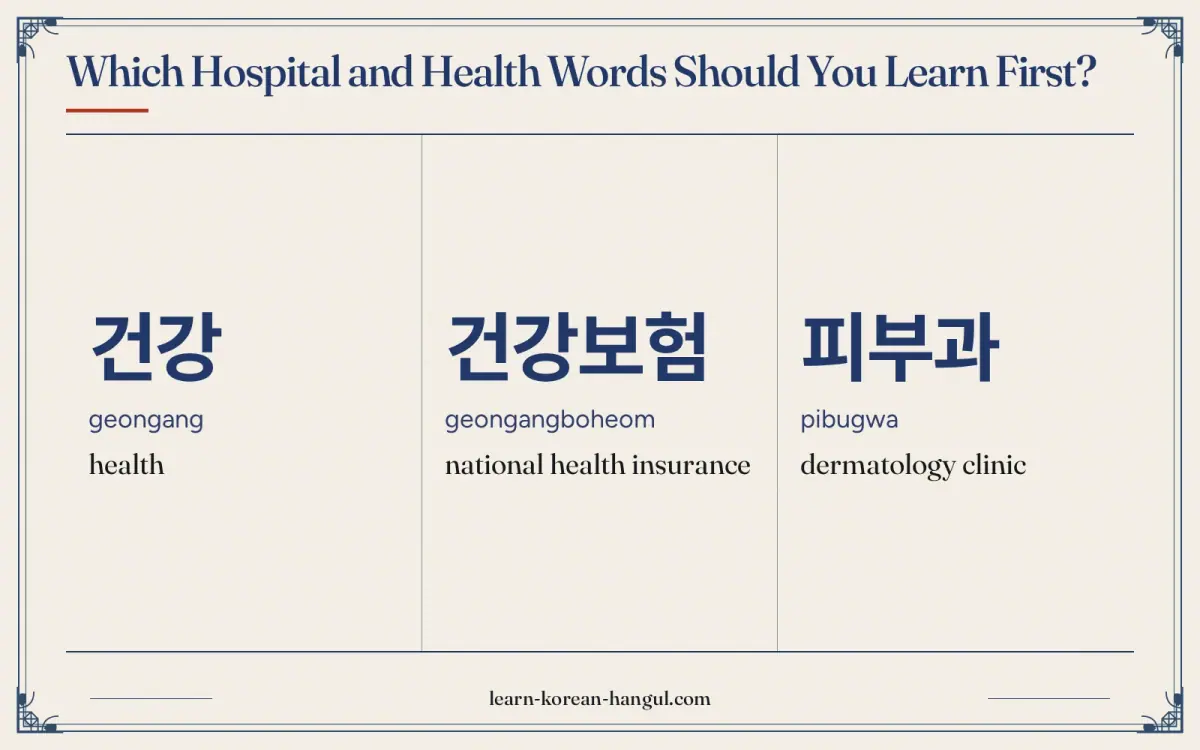
Learn 병원, 약, 약국 and 응급실 first, then the department names for the doctor you may need. Those words let you find help and name the kind of doctor. Symptoms and the visit steps follow.
- Day one. 건강, 병원, 의사, 약, 약국 and 응급실.
- Day two. The departments, especially 내과, 치과 and 정형외과.
- Day three. The symptoms: 열, 기침, 콧물, 두통, 복통 and 감기.
- Day four. The medicine and prescription words.
- Day five. The visit steps and the check-up words.
At 8 to 10 words a day, the list takes five to six days plus review. This scene puts eight of the words on one picture.
Word · 8
- 1
건강
geongang
health
- 2
건강보험
geongangboheom
national health insurance
- 3
피부과
pibugwa
dermatology clinic
- 4
기침
gichim
cough
- 5
통증
tongjeung
pain
- 6
연고
yeongo
ointment
- 7
진찰
jinchal
medical examination
- 8
진단서
jindanseo
medical certificate
Every group follows the order in which you meet the words at a hospital. The first group is the building and the people.
Health and the Hospital
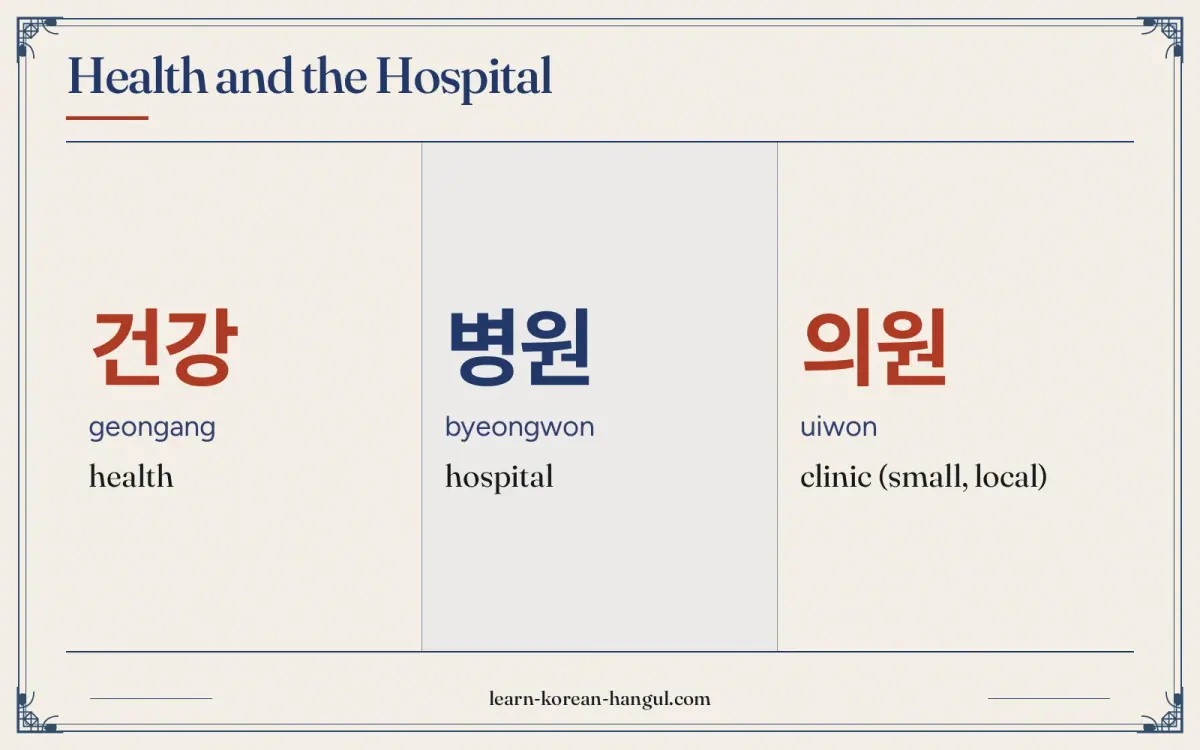
건강 is health, 병원 is a hospital and 의사 is a doctor. A 의원 is a smaller local clinic, and by law a 의원 has fewer beds than a 병원. A 환자 is a patient. 건강보험 is the national health insurance that most residents are covered by.
| No. | Hangul | Revised Romanization | Origin | Meaning | Example sentence | Audio assetId |
|---|---|---|---|---|---|---|
| 1 | 건강 | geongang | Sino-Korean | health | 건강이 중요해요. (Health is important.) | au-pg-vocabulary-daily-life-health-1; example: au-pg-vocabulary-daily-life-health-51 |
| 2 | 병원 | byeongwon | Sino-Korean | hospital | 병원에 가요. (I go to the hospital.) | au-pg-vocabulary-daily-life-health-2; example: au-pg-vocabulary-daily-life-health-52 |
| 3 | 의원 | uiwon | Sino-Korean | clinic (small, local) | 동네 의원에 가요. (I go to the local clinic.) | au-pg-vocabulary-daily-life-health-3; example: au-pg-vocabulary-daily-life-health-53 |
| 4 | 의사 | uisa | Sino-Korean | doctor | 의사 선생님을 만나요. (I see the doctor.) | au-pg-vocabulary-daily-life-health-4; example: au-pg-vocabulary-daily-life-health-54 |
| 5 | 간호사 | ganhosa | Sino-Korean | nurse | 간호사가 친절해요. (The nurse is kind.) | au-pg-vocabulary-daily-life-health-5; example: au-pg-vocabulary-daily-life-health-55 |
| 6 | 환자 | hwanja | Sino-Korean | patient | 환자가 많아요. (There are many patients.) | au-pg-vocabulary-daily-life-health-6; example: au-pg-vocabulary-daily-life-health-56 |
| 7 | 건강보험 | geongangboheom | Sino-Korean | national health insurance | 건강보험에 가입했어요. (I joined health insurance.) | au-pg-vocabulary-daily-life-health-7; example: au-pg-vocabulary-daily-life-health-57 |
Korean often drops the words for the person and says the place: 병원에 가요 (go to the hospital) is also how you say you are seeing a doctor. Use 선생님 after 의사 when you speak to one, as in 의사 선생님. The next group names the departments.
Hospital Departments
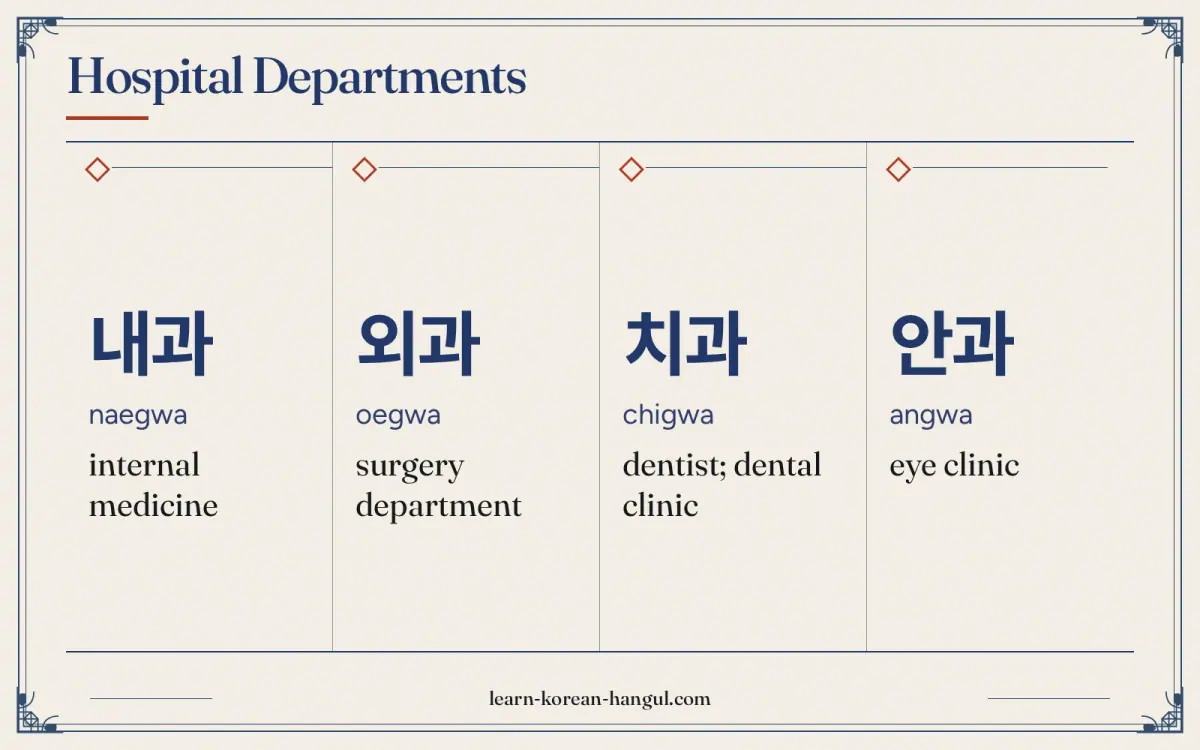
The names of most hospital departments follow one pattern: a word for the body part or the field, plus 과 (department). 내과 is the internal medicine department, 안과 is the eye department, and 치과 is the teeth department. Learn the pattern and you can read the sign on any clinic.
| No. | Hangul | Revised Romanization | Origin | Meaning | Example sentence | Audio assetId |
|---|---|---|---|---|---|---|
| 8 | 내과 | naegwa | Sino-Korean | internal medicine | 감기에 걸리면 내과에 가요. (If I catch a cold, I go to internal medicine.) | au-pg-vocabulary-daily-life-health-8; example: au-pg-vocabulary-daily-life-health-58 |
| 9 | 외과 | oegwa | Sino-Korean | surgery department | 외과는 수술을 해요. (The surgery department performs operations.) | au-pg-vocabulary-daily-life-health-9; example: au-pg-vocabulary-daily-life-health-59 |
| 10 | 치과 | chigwa | Sino-Korean | dentist; dental clinic | 치과에 가요. (I go to the dentist.) | au-pg-vocabulary-daily-life-health-10; example: au-pg-vocabulary-daily-life-health-60 |
| 11 | 안과 | angwa | Sino-Korean | eye clinic | 안과에서 눈을 검사해요. (I have my eyes tested at the eye clinic.) | au-pg-vocabulary-daily-life-health-11; example: au-pg-vocabulary-daily-life-health-61 |
| 12 | 이비인후과 | ibiinhugwa | Sino-Korean | ear, nose and throat clinic | 이비인후과에서 코를 봐요. (The ENT clinic examines my nose.) | au-pg-vocabulary-daily-life-health-12; example: au-pg-vocabulary-daily-life-health-62 |
| 13 | 피부과 | pibugwa | Sino-Korean | dermatology clinic | 피부과에 예약했어요. (I booked a dermatology appointment.) | au-pg-vocabulary-daily-life-health-13; example: au-pg-vocabulary-daily-life-health-63 |
| 14 | 소아과 | soagwa | Sino-Korean | paediatrics | 아이가 소아과에 가요. (The child goes to the paediatrician.) | au-pg-vocabulary-daily-life-health-14; example: au-pg-vocabulary-daily-life-health-64 |
| 15 | 산부인과 | sanbuingwa | Sino-Korean | obstetrics and gynaecology | 산부인과는 여성 건강을 봐요. (The OB-GYN department looks after women's health.) | au-pg-vocabulary-daily-life-health-15; example: au-pg-vocabulary-daily-life-health-65 |
| 16 | 정형외과 | jeonghyeongoegwa | Sino-Korean | orthopaedics | 다리가 아파서 정형외과에 가요. (My leg hurts, so I go to orthopaedics.) | au-pg-vocabulary-daily-life-health-16; example: au-pg-vocabulary-daily-life-health-66 |
Example Sentences
Each example is a short polite sentence. Most follow the pattern department + 에 + 가요 (go to) or body part + 이/가 + 아파요 (hurts). Say each sentence aloud and swap the department. Replace 내과 in 내과에 가요 with 안과 and you get 안과에 가요. Pick the department by the problem: eyes go to 안과, skin to 피부과, and a broken bone or a sore joint to 정형외과.
The name on the door matters because Korean clinics are often specialist clinics. A 내과 treats colds and stomach trouble, and a 가정의학과 (family medicine) is another door for the same problems. The next group is what you feel.
How Do You Say Symptoms in Korean?
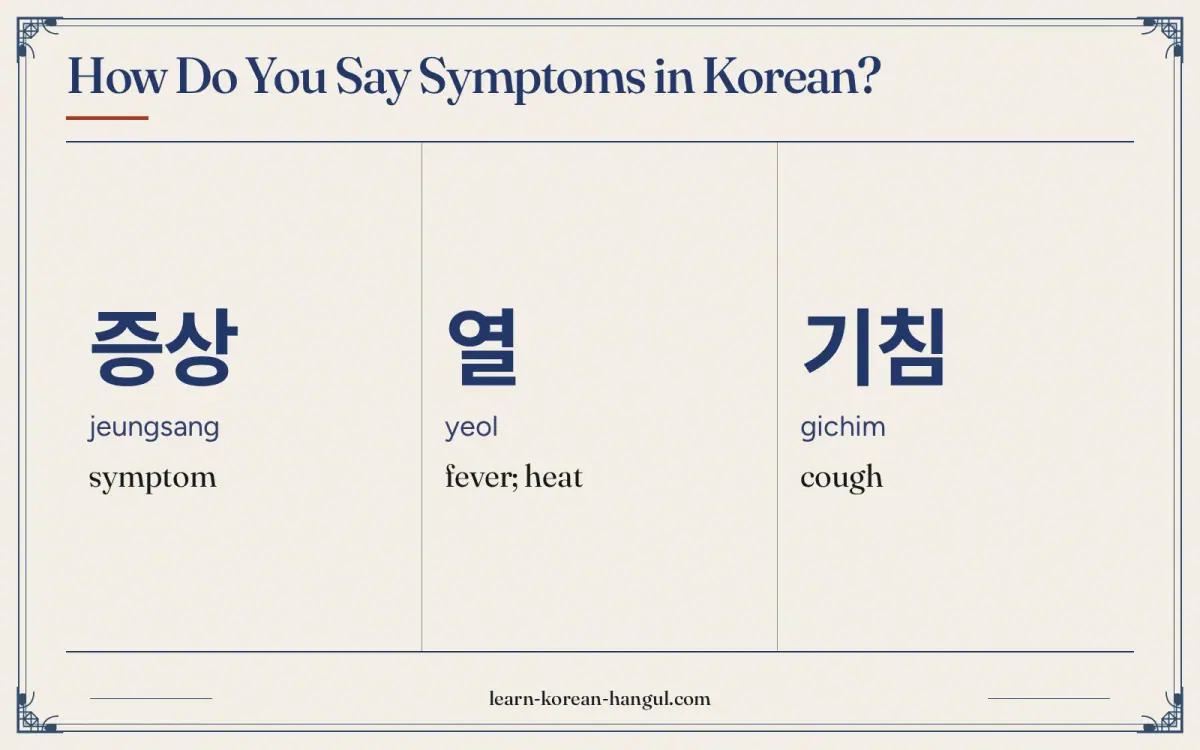
Symptoms are 증상. The simple way to describe one is symptom + 이/가 + 나요 for things that come out, such as 열이 나요 (I have a fever) and 기침이 나요 (I have a cough). For pain, say the body part and 아파요, as in 머리가 아파요 (my head hurts). The word 두통 means headache, but 머리가 아파요 is what people say aloud.
| No. | Hangul | Revised Romanization | Origin | Meaning | Example sentence | Audio assetId |
|---|---|---|---|---|---|---|
| 17 | 증상 | jeungsang | Sino-Korean | symptom | 증상이 어때요? (How are your symptoms?) | au-pg-vocabulary-daily-life-health-17; example: au-pg-vocabulary-daily-life-health-67 |
| 18 | 열 | yeol | native | fever; heat | 열이 나요. (I have a fever.) | au-pg-vocabulary-daily-life-health-18; example: au-pg-vocabulary-daily-life-health-68 |
| 19 | 기침 | gichim | native | cough | 기침이 나요. (I have a cough.) | au-pg-vocabulary-daily-life-health-19; example: au-pg-vocabulary-daily-life-health-69 |
| 20 | 콧물 | konmul | native | runny nose | 콧물이 나요. (I have a runny nose.) | au-pg-vocabulary-daily-life-health-20; example: au-pg-vocabulary-daily-life-health-70 |
| 21 | 두통 | dutong | Sino-Korean | headache | 두통이 심해요. (The headache is severe.) | au-pg-vocabulary-daily-life-health-21; example: au-pg-vocabulary-daily-life-health-71 |
| 22 | 복통 | boktong | Sino-Korean | stomachache | 복통 때문에 병원에 가요. (I go to the hospital because of stomach pain.) | au-pg-vocabulary-daily-life-health-22; example: au-pg-vocabulary-daily-life-health-72 |
| 23 | 감기 | gamgi | Sino-Korean | cold (illness) | 감기에 걸렸어요. (I caught a cold.) | au-pg-vocabulary-daily-life-health-23; example: au-pg-vocabulary-daily-life-health-73 |
| 24 | 알레르기 | allereugi | loanword | allergy | 저는 알레르기가 있어요. (I have an allergy.) | au-pg-vocabulary-daily-life-health-24; example: au-pg-vocabulary-daily-life-health-74 |
| 25 | 통증 | tongjeung | Sino-Korean | pain | 통증이 있어요. (I have pain.) | au-pg-vocabulary-daily-life-health-25; example: au-pg-vocabulary-daily-life-health-75 |
As with 두통, the word 복통 means stomachache in writing and on signs. In speech people say 배가 아파요. Use the Sino-Korean word on forms and the spoken phrase in conversation. The body parts page has the nouns for where it hurts. The full symptom list is on the Korean Symptoms Vocabulary page.
Medicine
약 is medicine, and 약국 is the pharmacy. After a visit, the doctor gives you a 처방전, which you take to the 약국. Medicine comes in forms: 알약 (tablet), 가루약 (powder), 연고 (ointment). Two common kinds are the 진통제 (painkiller) and the 소화제 (digestive medicine).
| No. | Hangul | Revised Romanization | Origin | Meaning | Example sentence | Audio assetId |
|---|---|---|---|---|---|---|
| 26 | 약 | yak | Sino-Korean | medicine | 약을 먹어요. (I take medicine.) | au-pg-vocabulary-daily-life-health-26; example: au-pg-vocabulary-daily-life-health-76 |
| 27 | 약국 | yakguk | Sino-Korean | pharmacy | 약국에서 약을 사요. (I buy medicine at the pharmacy.) | au-pg-vocabulary-daily-life-health-27; example: au-pg-vocabulary-daily-life-health-77 |
| 28 | 처방전 | cheobangjeon | Sino-Korean | prescription | 처방전을 받았어요. (I received a prescription.) | au-pg-vocabulary-daily-life-health-28; example: au-pg-vocabulary-daily-life-health-78 |
| 29 | 알약 | allyak | mixed | tablet; pill | 알약은 하루에 세 번 먹어요. (I take the tablet three times a day.) | au-pg-vocabulary-daily-life-health-29; example: au-pg-vocabulary-daily-life-health-79 |
| 30 | 가루약 | garuyak | mixed | powdered medicine | 가루약이 써요. (The powdered medicine is bitter.) | au-pg-vocabulary-daily-life-health-30; example: au-pg-vocabulary-daily-life-health-80 |
| 31 | 연고 | yeongo | Sino-Korean | ointment | 연고를 발라요. (I apply ointment.) | au-pg-vocabulary-daily-life-health-31; example: au-pg-vocabulary-daily-life-health-81 |
| 32 | 진통제 | jintongje | Sino-Korean | painkiller | 진통제가 필요해요. (I need a painkiller.) | au-pg-vocabulary-daily-life-health-32; example: au-pg-vocabulary-daily-life-health-82 |
| 33 | 소화제 | sohwaje | Sino-Korean | digestive medicine | 소화제를 주세요. (Please give me digestive medicine.) | au-pg-vocabulary-daily-life-health-33; example: au-pg-vocabulary-daily-life-health-83 |
You can buy simple medicines such as 소화제 and 진통제 at a 약국 without a 처방전. Prescription medicines need the paper. The word 쓰다 (to be bitter) is a homograph of 쓰다 (to write or to wear), and the example 가루약이 써요 uses the bitter sense. The words for the counter are on the Korean Pharmacy Vocabulary page.
How Do You Say Doctor's Visit in Korean?
A visit has fixed steps, and each has a noun. You do 접수 (register), wait, have the 진료 (consultation), get a 검사 (test) if needed, and receive a 진단 (diagnosis). Then you pay and pick up a 처방전.
- 접수. Give your name and your insurance details at the desk.
- 대기. Wait in the waiting area until your name is called.
- 진료. Meet the doctor, who does the 진찰 (examination).
- 검사. Have tests, if the doctor asks for them.
- 수납. Pay at the counter.
- 처방전. Take the prescription to a 약국.
| No. | Hangul | Revised Romanization | Origin | Meaning | Example sentence | Audio assetId |
|---|---|---|---|---|---|---|
| 34 | 접수 | jeopsu | Sino-Korean | registration; reception | 접수는 1층이에요. (Registration is on the first floor.) | au-pg-vocabulary-daily-life-health-34; example: au-pg-vocabulary-daily-life-health-84 |
| 35 | 예약 | yeyak | Sino-Korean | appointment; reservation | 내일 예약이 있어요. (I have an appointment tomorrow.) | au-pg-vocabulary-daily-life-health-35; example: au-pg-vocabulary-daily-life-health-85 |
| 36 | 진료 | jillyo | Sino-Korean | medical consultation; treatment | 진료는 9시에 시작해요. (Consultations start at nine.) | au-pg-vocabulary-daily-life-health-36; example: au-pg-vocabulary-daily-life-health-86 |
| 37 | 진찰 | jinchal | Sino-Korean | medical examination | 의사가 진찰해요. (The doctor examines me.) | au-pg-vocabulary-daily-life-health-37; example: au-pg-vocabulary-daily-life-health-87 |
| 38 | 검사 | geomsa | Sino-Korean | test; examination | 피 검사를 해요. (I have a blood test.) | au-pg-vocabulary-daily-life-health-38; example: au-pg-vocabulary-daily-life-health-88 |
| 39 | 진단 | jindan | Sino-Korean | diagnosis | 진단 결과가 나왔어요. (The diagnosis result came out.) | au-pg-vocabulary-daily-life-health-39; example: au-pg-vocabulary-daily-life-health-89 |
| 40 | 주사 | jusa | Sino-Korean | injection | 주사를 맞아요. (I get an injection.) | au-pg-vocabulary-daily-life-health-40; example: au-pg-vocabulary-daily-life-health-90 |
| 41 | 입원 | ibwon | Sino-Korean | hospital admission | 삼 일 동안 입원했어요. (I was in hospital for three days.) | au-pg-vocabulary-daily-life-health-41; example: au-pg-vocabulary-daily-life-health-91 |
| 42 | 퇴원 | toewon | Sino-Korean | discharge from hospital | 내일 퇴원해요. (I leave the hospital tomorrow.) | au-pg-vocabulary-daily-life-health-42; example: au-pg-vocabulary-daily-life-health-92 |
| 43 | 진단서 | jindanseo | Sino-Korean | medical certificate | 진단서가 필요해요. (I need a medical certificate.) | au-pg-vocabulary-daily-life-health-43; example: au-pg-vocabulary-daily-life-health-93 |
Note the difference between 진료 and 진찰. 진료 is the whole consultation or treatment, and 진찰 is the examination the doctor performs inside it. 예약 is an appointment, and many clinics take them by phone or app. 입원 is being admitted, 퇴원 is being discharged, and a 진단서 is the certificate you need for work or insurance. See Korean Dentist Vocabulary.
Check-Ups and Emergencies
건강검진 is a health check-up, and Korea runs a national programme that covers many adults. The usual measurements are 혈압 (blood pressure) and 체온 (body temperature). An 엑스레이 is an X-ray.
Details of who qualifies change, so ask the clinic. This page only teaches the words. The next group is the urgent one.
How Do You Say Emergencies in Korean?
An emergency is an 응급 상황, and the place for it is the 응급실 (emergency room). A 구급차 is an ambulance, and you call it on 119. A 수술 is surgery. In an emergency you can say 도와주세요 (please help) and 구급차를 불러 주세요 (please call an ambulance).
| No. | Hangul | Revised Romanization | Origin | Meaning | Example sentence | Audio assetId |
|---|---|---|---|---|---|---|
| 44 | 건강검진 | geonganggeomjin | Sino-Korean | health check-up | 매년 건강검진을 받아요. (I get a health check-up every year.) | au-pg-vocabulary-daily-life-health-44; example: au-pg-vocabulary-daily-life-health-94 |
| 45 | 혈압 | hyeorap | Sino-Korean | blood pressure | 혈압을 재요. (I measure my blood pressure.) | au-pg-vocabulary-daily-life-health-45; example: au-pg-vocabulary-daily-life-health-95 |
| 46 | 체온 | che-on | Sino-Korean | body temperature | 체온을 재요. (I take my temperature.) | au-pg-vocabulary-daily-life-health-46; example: au-pg-vocabulary-daily-life-health-96 |
| 47 | 엑스레이 | ekseurei | loanword | X-ray | 엑스레이를 찍어요. (I get an X-ray taken.) | au-pg-vocabulary-daily-life-health-47; example: au-pg-vocabulary-daily-life-health-97 |
| 48 | 응급실 | eunggeupsil | Sino-Korean | emergency room | 응급실로 가요. (I go to the emergency room.) | au-pg-vocabulary-daily-life-health-48; example: au-pg-vocabulary-daily-life-health-98 |
| 49 | 구급차 | gugeupcha | Sino-Korean | ambulance | 구급차를 불러요. (I call an ambulance.) | au-pg-vocabulary-daily-life-health-49; example: au-pg-vocabulary-daily-life-health-99 |
| 50 | 수술 | susul | Sino-Korean | surgery; operation | 수술을 받았어요. (I had surgery.) | au-pg-vocabulary-daily-life-health-50; example: au-pg-vocabulary-daily-life-health-100 |
To say you are calling, use 119에 전화해요 (I call 119). The Korean Medical Emergencies Vocabulary page has the full emergency list, and the emergency phrases page has the sentences you may need to say. See Korean Mental Health Vocabulary.
How Do You Pronounce These Words?
Most hospital words follow the spelling, but several undergo sound changes between syllables. The table shows seven cases that learners often miss.
| Spelling | Pronunciation | What happens |
|---|---|---|
| 진료 | [질료] | ㄴ before ㄹ becomes ㄹ, so the two syllables share the sound ㄹㄹ |
| 콧물 | [콘물] | Final ㅅ is said as [ㄷ], then becomes [ㄴ] before ㅁ |
| 약국 | [약꾹] | ㄱ after a final ㄱ becomes tense |
| 알약 | [알략] | A ㄴ sound is added before 약, and then becomes ㄹ after ㄹ |
| 입원 | [이붠] | The final ㅂ links to the vowel of 원 |
| 응급실 | [응급씰] | ㅅ after a final ㅂ becomes tense |
| 내과 | [내꽈] | The 과 of a department name is usually said tense, as in 치과 [치꽈] and 안과 [안꽈] |
The rules come from the Standard Pronunciation rules (표준 발음법) of the 국립국어원, and the tense 과 follows the pronunciations listed in the Standard Korean Language Dictionary. The audio is generated with text-to-speech and checked by a Korean teacher before publication.
Audio and Slow Playback
Each word has a normal clip, and 5 key words also have a slow clip at 0.8 times the speed: 건강, 이비인후과, 처방전, 진료 and 응급실. Nothing plays until you press a button.
Listen to 진료 first. You should hear [질료], with a long, clear ㄹ in the middle.
What Mistakes Do Learners Make with Hospital and Health Words?
- Using 두통이 있어요 in speech. It is correct but formal, and people usually say 머리가 아파요.
- Reading 진료 as jin-ryo. The spoken form is [질료].
- Confusing 병원 and 의원. A 의원 is a smaller clinic, and both are places where you see a doctor.
- Saying 아파요 without the body part. Name the place first: 배가 아파요, 머리가 아파요, 이가 아파요.
- Mixing up 약 and 약국. 약 is the medicine, and 약국 is the shop where you buy it.
The first mistake sounds stiff but is understood, and the last two cause real confusion at a counter. The next section turns the list into practice.
Practice: Flashcards and Worksheet
Drill these words with the vocabulary flashcard decks. A printable worksheet for these words (word list, matching, writing practice, fill-in-the-blank exercises and answer key) is available in A4 and US Letter from the download card on this page. Progress in the decks is saved only in your browser.
Korean Hospital Vocabulary Worksheet
Try this five-question check, then say the 50 words aloud once more.
Practice · 5
What does 건강 mean?
Show answer
health
건강 (geongang) means health.
What does 이비인후과 mean?
Show answer
ear, nose and throat clinic
이비인후과 (ibiinhugwa) means ear, nose and throat clinic.
What does 감기 mean?
Show answer
cold (illness)
감기 (gamgi) means cold (illness).
What does 연고 mean?
Show answer
ointment
연고 (yeongo) means ointment.
What does 퇴원 mean?
Show answer
discharge from hospital
퇴원 (toewon) means discharge from hospital.
For the single-word entry, see hospital in Korean, which gives the meaning, pronunciation and one word in use.
Where to Go Next
After the Korean hospital vocabulary, open Korean Symptoms Vocabulary for the full list of symptoms or Korean Pharmacy Vocabulary for the pharmacy counter. Learners who want a lighter topic can move to Beauty and K-Beauty Vocabulary or Technology and Internet, the other lists in Daily Life.
Pages in This Section
Five pages sit below Health and Medicine. Each one goes deeper into one part of this list.
- Korean Symptoms Vocabulary: 40 words for pains, coughs, fevers, stomach trouble and the sentences for describing them to a doctor.
- Korean Pharmacy Vocabulary: 30 words for the pharmacy counter: medicines, dosage, prescriptions and the instructions on a packet.
- Korean Dentist Vocabulary: teeth, cavities, scaling and implants.
- Korean Mental Health Vocabulary: stress, anxiety, sleep and counselling words.
- Korean Medical Emergencies Vocabulary: 25 words for calling for help, describing an accident and getting to the emergency room.
Frequently Asked Questions
How Do You Say Health in Korean?
Health is 건강 (geongang). It is a Sino-Korean word made of 건 (strong) and 강 (healthy), and it appears in 건강보험 (health insurance) and 건강검진 (health check-up). To say you are healthy, use 건강해요. To wish someone good health, say 건강하세요.
How Do You Pronounce 약 (yak)?
약 is said yak, in one syllable. It starts with a plain y glide and the vowel a, and it ends in ㄱ, which is unreleased: the back of the tongue presses against the soft palate and no air comes out. When 약 is followed by 국 it becomes [약꾹] (pharmacy). Press the audio button to compare.
How Many Hospital and Health Words Should I Learn First?
Learn about 20 first: 건강, 병원, 의사, 약, 약국, 응급실, the main departments, and the symptoms 열, 기침, 감기 and 두통. That is two to three days at 8 to 10 words a day. Add the medicine and visit steps afterwards, and review all 50 with the flashcards.
Where Can I Practise Hospital and Health Words with Flashcards?
Use the vocabulary flashcard decks, which list every deck with audio. A deck for these words is planned. Progress stays in your browser. The symptoms and pharmacy pages have second lists that overlap with this one, so review them together for the best result.
Is the Romanization on This Page Official?
It follows the Revised Romanization of Korean, which South Korea officially adopted on 7 July 2000 and whose rules the National Institute of Korean Language (국립국어원) publishes. It is a learning aid that does not mark every sound change, so learn the Hangul and use the audio to hear the real sound.
Is There a Printable Worksheet for Hospital and Health Words?
A printable worksheet for these words (word list, matching, writing practice, fill-in-the-blank exercises and answer key) is available in A4 and US Letter from the download card on this page. For practice, copy the tables above by hand: write the Hangul, cover the English column, and check your answers against the page.