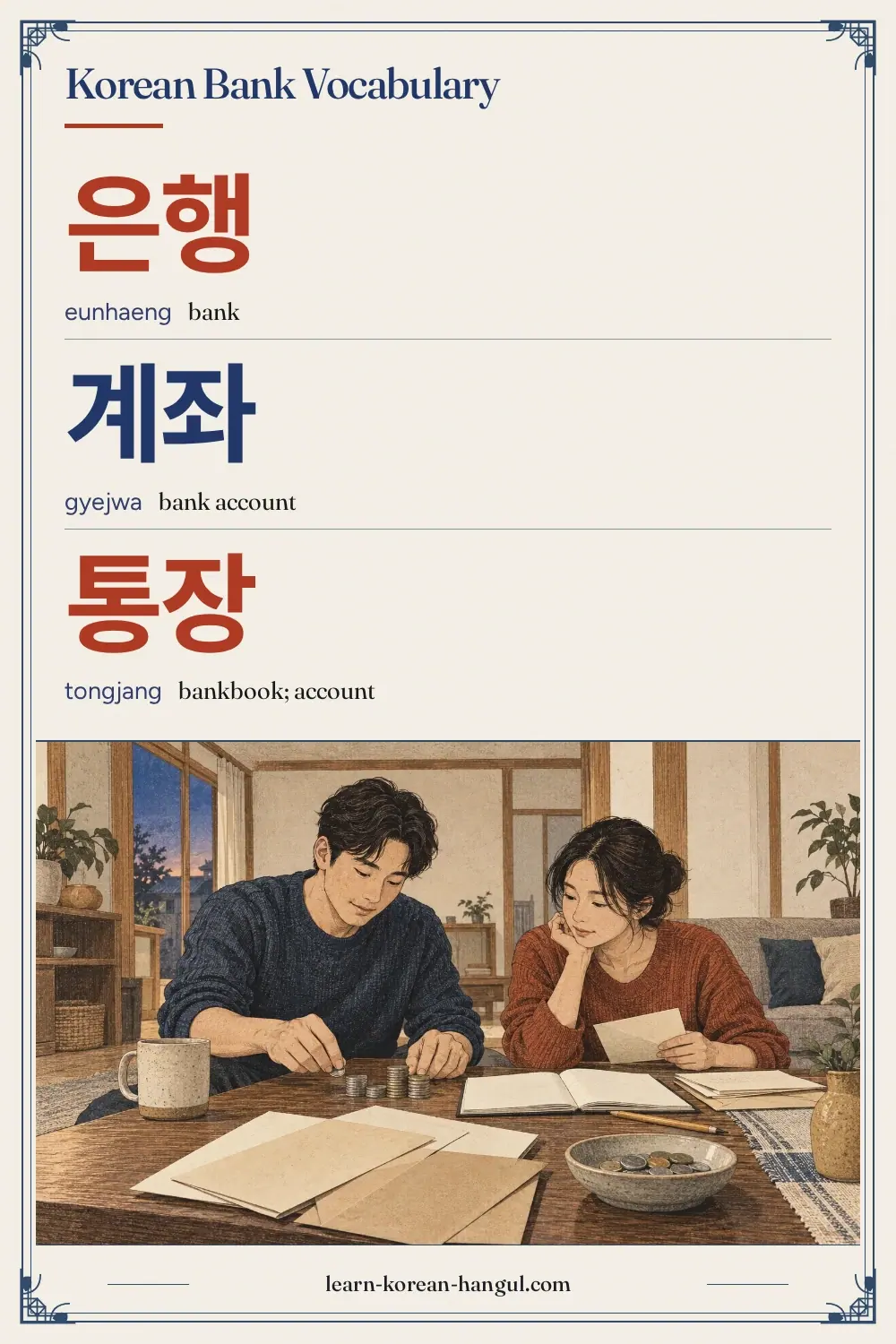
Korean Bank Vocabulary at a Glance
A bank visit in Korea uses a small set of formal nouns, most of them Sino-Korean, and the clerk speaks in polite requests. If you know about forty nouns, you can follow what is asked and answer with the noun and a verb. This list is level A2, so it assumes you can already read Hangul and know basic polite endings.
The list holds 40 words. By origin, the list has no native Korean words, 36 Sino-Korean (built from Chinese-derived syllables), 3 loanwords and 1 mixed. Knowing the origin helps you guess how a new word will behave. The groups are:
| Group | Words | Examples |
|---|---|---|
| Accounts | 9 | 은행, 계좌, 통장, 계좌번호 |
| Deposits and withdrawals | 8 | 입금, 출금, 예금, 저축 |
| Transfers | 8 | 이체, 송금, 자동이체, 해외송금 |
| Loans and interest | 7 | 대출, 이자, 금리, 만기 |
| Cards and ATM | 8 | 에이티엠, 현금자동입출금기, 비밀번호, 조회 |
One pattern unlocks a whole family of words. The syllable 금 means money, and it appears in 입금 (paying in), 출금 (taking out), 송금 (sending) and 예금 (bank deposit) on this list, and in 현금 (cash) and 적금 (installment savings) on the money page. The first syllable tells you what kind of money action it is: 입 means in, 출 means out and 송 means send. This list sits inside Money and Banking, where you can find the related topics.
Which Bank Words Should You Learn First?
Start with five words you will need on the first visit: 계좌, 통장, 입금, 송금 and 잔액. Press play, then the slow button, and say each word aloud.
계좌 (gyejwa) means bank account. It is the first word the clerk will use: 계좌를 만드시겠어요? (Would you like to open an account?). The syllable 계 may be said [계] or [게], and the standard pronunciation rules allow both. Example: 새 계좌를 만들고 싶어요. (I want to open a new account.)
통장 (tongjang) means bankbook or account. This is the bankbook or, in everyday talk, the account itself. A clerk may ask 통장 있으세요? (Do you have a bankbook?). Many banks now issue a bankbook only on request, but the word stays in use. Example: 통장을 보여 주세요. (Please show me your bankbook.)
입금 (ipgeum) means deposit (paying in). You will see it on app messages: 입금 완료 (deposit complete). The 금 here means money. The final ㅂ and the next ㄱ make a tense sound, so it is said [입끔]. Example: 오늘 입금했어요. (I made a deposit today.)
송금 (songgeum) means sending money. It works for sending to a person or to a bank in another country. Compare 해외송금 (overseas remittance), which appears on bank counters and apps. Example: 친구에게 송금해요. (I send money to a friend.)
잔액 (janaek) means balance. It is what is left in your account. 잔액 조회 means a balance inquiry, a choice on every ATM screen. The final ㄴ of 잔 moves to the next syllable: [자낵]. Example: 잔액을 확인해요. (I check the balance.)
Accounts
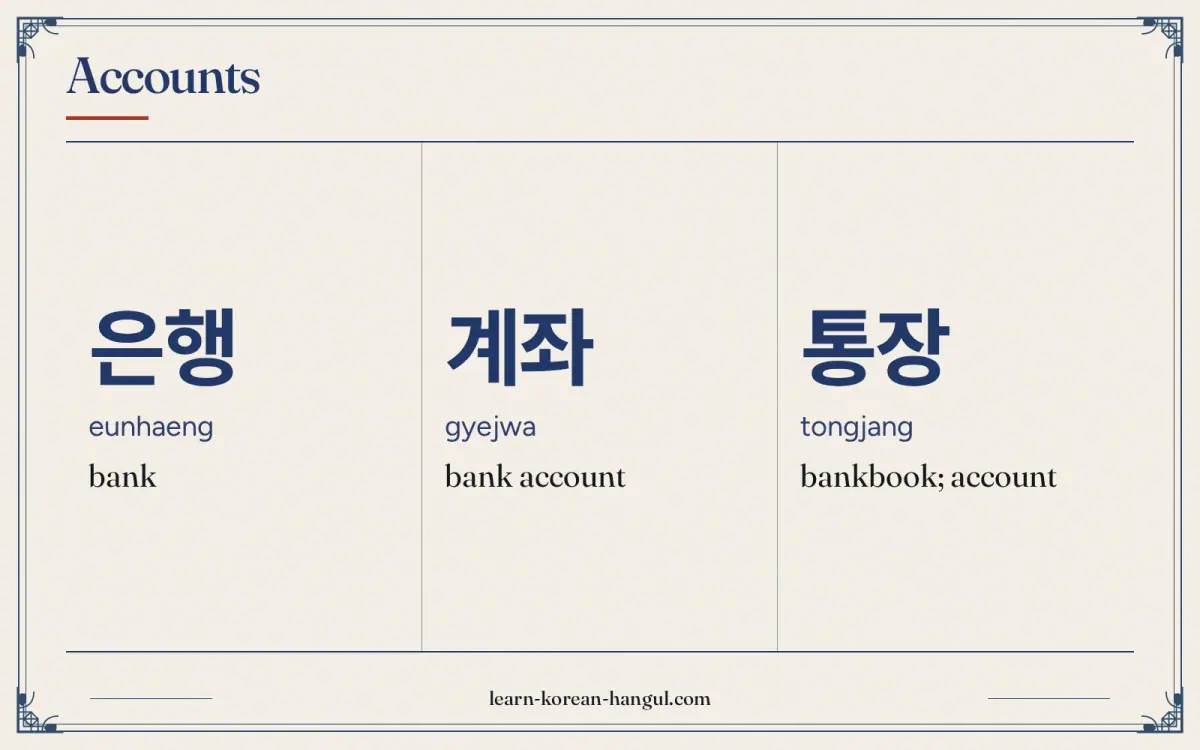
Opening an account is the first task for a new resident, and these nine words cover what you ask for and what you bring.
| No. | Hangul | Revised Romanization | Meaning | Origin | Example sentence | Audio assetId |
|---|---|---|---|---|---|---|
| 1 | 은행 | eunhaeng | bank | Sino-Korean | 은행에 가요. (eunhaenge gayo; I go to the bank.) | au-pg-vocabulary-daily-life-money-bank-1; example: au-pg-vocabulary-daily-life-money-bank-101 |
| 2 | 계좌 | gyejwa | bank account | Sino-Korean | 새 계좌를 만들고 싶어요. (sae gyejwareul mandeulgo sipeoyo; I want to open a new account.) | au-pg-vocabulary-daily-life-money-bank-2; example: au-pg-vocabulary-daily-life-money-bank-102 |
| 3 | 통장 | tongjang | bankbook; account | Sino-Korean | 통장을 보여 주세요. (tongjangeul boyeo juseyo; Please show me your bankbook.) | au-pg-vocabulary-daily-life-money-bank-3; example: au-pg-vocabulary-daily-life-money-bank-103 |
| 4 | 계좌번호 | gyejwabeonho | account number | Sino-Korean | 계좌번호를 알려 주세요. (gyejwabeonhoreul allyeo juseyo; Please tell me your account number.) | au-pg-vocabulary-daily-life-money-bank-4; example: au-pg-vocabulary-daily-life-money-bank-104 |
| 5 | 개설 | gaeseol | opening (an account) | Sino-Korean | 계좌 개설은 십 분 걸려요. (gyejwa gaeseoreun sip bun geollyeoyo; Opening an account takes ten minutes.) | au-pg-vocabulary-daily-life-money-bank-5; example: au-pg-vocabulary-daily-life-money-bank-105 |
| 6 | 신분증 | sinbunjeung | ID card | Sino-Korean | 신분증을 가져왔어요. (sinbunjeungeul gajyeowasseoyo; I brought my ID card.) | au-pg-vocabulary-daily-life-money-bank-6; example: au-pg-vocabulary-daily-life-money-bank-106 |
| 7 | 외국인등록증 | oegugindeungnokjeung | alien registration card | Sino-Korean | 외국인등록증이 필요해요. (oegugindeungnokjeungi piryohaeyo; You need an alien registration card.) | au-pg-vocabulary-daily-life-money-bank-7; example: au-pg-vocabulary-daily-life-money-bank-107 |
| 8 | 서명 | seomyeong | signature | Sino-Korean | 여기에 서명해 주세요. (yeogie seomyeonghae juseyo; Please sign here.) | au-pg-vocabulary-daily-life-money-bank-8; example: au-pg-vocabulary-daily-life-money-bank-108 |
| 9 | 도장 | dojang | seal; stamp | Sino-Korean | 도장을 찍어 주세요. (dojangeul jjigeo juseyo; Please stamp your seal.) | au-pg-vocabulary-daily-life-money-bank-9; example: au-pg-vocabulary-daily-life-money-bank-109 |
- 계좌 개설 is the formal phrase on forms. In speech people say 계좌를 만들다 (to make an account) or 계좌를 열다 (to open one).
- For foreign residents the banks ask for a passport or an 외국인등록증. The card's official name and rules can change, so check the current name with the bank or the Ministry of Justice before you go.
- 도장 is a personal seal. It is used less than before, but some older forms and small banks still ask for a seal or a signature, 서명.
Example Sentences
A bank visit follows four steps, and each step has one useful sentence. First, say what you want: 계좌를 만들고 싶어요 (I want to open an account). Second, the clerk asks for ID: 신분증을 보여 주세요 (Please show your ID). Third, you sign: 여기에 서명해 주세요 (Please sign here). Fourth, you set a PIN: 비밀번호를 눌러 주세요 (Please enter your PIN). The ending 주세요 turns a request into polite Korean, and each of the sentences above uses the pattern noun + 을/를 + verb + 주세요. For phone banking, see phone calls. The single-word page bank in korean explains the word 은행 on its own.
How Do You Say Deposits and Withdrawals in Korean?
This group has the words for money going in and out. Learn 입금 and 출금 as a pair.
| No. | Hangul | Revised Romanization | Meaning | Origin | Example sentence | Audio assetId |
|---|---|---|---|---|---|---|
| 10 | 입금 | ipgeum | deposit (paying in) | Sino-Korean | 오늘 입금했어요. (oneul ipgeumhaesseoyo; I made a deposit today.) | au-pg-vocabulary-daily-life-money-bank-10; example: au-pg-vocabulary-daily-life-money-bank-110 |
| 11 | 출금 | chulgeum | withdrawal | Sino-Korean | 출금은 어디서 해요? (chulgeumeun eodiseo haeyo; Where do I withdraw money?) | au-pg-vocabulary-daily-life-money-bank-11; example: au-pg-vocabulary-daily-life-money-bank-111 |
| 12 | 예금 | yegeum | bank deposit | Sino-Korean | 예금 계좌를 만들었어요. (yegeum gyejwareul mandeureosseoyo; I opened a deposit account.) | au-pg-vocabulary-daily-life-money-bank-12; example: au-pg-vocabulary-daily-life-money-bank-112 |
| 13 | 저축 | jeochuk | savings | Sino-Korean | 저축 통장이 있어요. (jeochuk tongjangi isseoyo; I have a savings account.) | au-pg-vocabulary-daily-life-money-bank-13; example: au-pg-vocabulary-daily-life-money-bank-113 |
| 14 | 잔액 | janaek | balance | Sino-Korean | 잔액을 확인해요. (janaegeul hwaginhaeyo; I check the balance.) | au-pg-vocabulary-daily-life-money-bank-14; example: au-pg-vocabulary-daily-life-money-bank-114 |
| 15 | 인출 | inchul | withdrawal (taking out) | Sino-Korean | 한도까지 인출할 수 있어요. (handokkaji inchulhal su isseoyo; You can withdraw up to the limit.) | au-pg-vocabulary-daily-life-money-bank-15; example: au-pg-vocabulary-daily-life-money-bank-115 |
| 16 | 창구 | changgu | service window | Sino-Korean | 창구에서 기다려요. (changgueseo gidaryeoyo; I wait at the counter.) | au-pg-vocabulary-daily-life-money-bank-16; example: au-pg-vocabulary-daily-life-money-bank-116 |
| 17 | 번호표 | beonhopyo | queue ticket | Sino-Korean | 번호표를 뽑아요. (beonhopyoreul ppobayo; I take a queue ticket.) | au-pg-vocabulary-daily-life-money-bank-17; example: au-pg-vocabulary-daily-life-money-bank-117 |
- 입금 and 출금 mirror each other, as 입 means in and 출 means out. The same pair appears in 입구 (entrance) and 출구 (exit).
- 인출 is also taking money out, but it is the word on ATM screens and in bank notices. In ordinary talk Koreans say 돈을 찾다 (to take out money).
- 번호표 is the paper ticket from the machine at the door. You take the ticket, wait for your number, then go to the 창구.
Transfers
Transfers are the most common digital banking task. These eight words appear on bank apps and on the bank's website.
| No. | Hangul | Revised Romanization | Meaning | Origin | Example sentence | Audio assetId |
|---|---|---|---|---|---|---|
| 18 | 이체 | iche | transfer | Sino-Korean | 이체가 끝났어요. (ichega kkeunnasseoyo; The transfer is finished.) | au-pg-vocabulary-daily-life-money-bank-18; example: au-pg-vocabulary-daily-life-money-bank-118 |
| 19 | 송금 | songgeum | sending money | Sino-Korean | 친구에게 송금해요. (chinguege songgeumhaeyo; I send money to a friend.) | au-pg-vocabulary-daily-life-money-bank-19; example: au-pg-vocabulary-daily-life-money-bank-119 |
| 20 | 자동이체 | jadongiche | automatic payment | Sino-Korean | 월세는 자동이체예요. (wolseneun jadongicheyeyo; The rent is an automatic payment.) | au-pg-vocabulary-daily-life-money-bank-20; example: au-pg-vocabulary-daily-life-money-bank-120 |
| 21 | 해외송금 | haeoesonggeum | overseas remittance | Sino-Korean | 해외송금 수수료가 비싸요. (haeoesonggeum susuryoga bissayo; The overseas remittance fee is expensive.) | au-pg-vocabulary-daily-life-money-bank-21; example: au-pg-vocabulary-daily-life-money-bank-121 |
| 22 | 수취인 | suchwiin | recipient | Sino-Korean | 수취인 이름을 써요. (suchwiin ireumeul sseoyo; I write the recipient's name.) | au-pg-vocabulary-daily-life-money-bank-22; example: au-pg-vocabulary-daily-life-money-bank-122 |
| 23 | 수수료 | susuryo | fee | Sino-Korean | 수수료는 천 원이에요. (susuryoneun cheon wonieyo; The fee is 1,000 won.) | au-pg-vocabulary-daily-life-money-bank-23; example: au-pg-vocabulary-daily-life-money-bank-123 |
| 24 | 한도 | hando | limit | Sino-Korean | 하루 이체 한도가 있어요. (haru iche handoga isseoyo; There is a daily transfer limit.) | au-pg-vocabulary-daily-life-money-bank-24; example: au-pg-vocabulary-daily-life-money-bank-124 |
| 25 | 인터넷뱅킹 | inteonetbaengking | internet banking | loanword | 인터넷뱅킹으로 이체해요. (inteonetbaengkingeuro ichehaeyo; I transfer by internet banking.) | au-pg-vocabulary-daily-life-money-bank-25; example: au-pg-vocabulary-daily-life-money-bank-125 |
- 이체 is the bank's word for moving money from one account to another. 송금 is the wider word for sending money. In practice, both appear on the same app screens.
- 자동이체 is set up for regular bills such as rent, phone and insurance. The money leaves the account on a fixed date each month.
- 한도 appears on cards and on transfers: 1일 이체 한도 means the daily transfer limit. If a transfer fails, 한도 is one of the first things to check.
How Do You Say Loans and Interest in Korean?
Loans and interest use abstract Sino-Korean nouns. They are less common for a visitor but important for a resident.
| No. | Hangul | Revised Romanization | Meaning | Origin | Example sentence | Audio assetId |
|---|---|---|---|---|---|---|
| 26 | 대출 | daechul | loan | Sino-Korean | 대출 상담을 받아요. (daechul sangdameul badayo; I have a loan consultation.) | au-pg-vocabulary-daily-life-money-bank-26; example: au-pg-vocabulary-daily-life-money-bank-126 |
| 27 | 이자 | ija | interest | Sino-Korean | 이자가 매달 나가요. (ijaga maedal nagayo; Interest goes out every month.) | au-pg-vocabulary-daily-life-money-bank-27; example: au-pg-vocabulary-daily-life-money-bank-127 |
| 28 | 금리 | geumni | interest rate | Sino-Korean | 금리가 올랐어요. (geumniga ollasseoyo; The interest rate went up.) | au-pg-vocabulary-daily-life-money-bank-28; example: au-pg-vocabulary-daily-life-money-bank-128 |
| 29 | 만기 | mangi | maturity date | Sino-Korean | 적금 만기가 다음 달이에요. (jeokgeum mangiga daeum darieyo; The savings plan matures next month.) | au-pg-vocabulary-daily-life-money-bank-29; example: au-pg-vocabulary-daily-life-money-bank-129 |
| 30 | 상환 | sanghwan | repayment | Sino-Korean | 상환은 매달 해요. (sanghwaneun maedal haeyo; I repay every month.) | au-pg-vocabulary-daily-life-money-bank-30; example: au-pg-vocabulary-daily-life-money-bank-130 |
| 31 | 신용 | sinyong | credit (trustworthiness) | Sino-Korean | 신용 점수가 중요해요. (sinyong jeomsuga jungyohaeyo; The credit score is important.) | au-pg-vocabulary-daily-life-money-bank-31; example: au-pg-vocabulary-daily-life-money-bank-131 |
| 32 | 담보 | dambo | collateral | Sino-Korean | 집을 담보로 대출을 받아요. (jibeul damboro daechureul badayo; I take a loan with the house as collateral.) | au-pg-vocabulary-daily-life-money-bank-32; example: au-pg-vocabulary-daily-life-money-bank-132 |
- 이자 is the money you pay or earn for a loan or deposit. 금리 is the rate itself. News reports use 금리 인상 (rate rise) and 금리 인하 (rate cut).
- 만기 is the date a product ends. 만기 후에는 이자가 달라요 means that after maturity the interest is different.
- In 금리 the ㅁ and ㄹ meet, and the ㄹ becomes ㄴ, so it is said [금니].
Cards and ATM
The last group covers the machine and the card. The word ATM is said in English letters or as 에이티엠, and the long Korean name is mostly seen on signs.
| No. | Hangul | Revised Romanization | Meaning | Origin | Example sentence | Audio assetId |
|---|---|---|---|---|---|---|
| 33 | 에이티엠 | eitiem | ATM | loanword | 에이티엠에서 돈을 찾아요. (eitiemeseo doneul chajayo; I withdraw money at the ATM.) | au-pg-vocabulary-daily-life-money-bank-33; example: au-pg-vocabulary-daily-life-money-bank-133 |
| 34 | 현금자동입출금기 | hyeongeumjadongipchulgeumgi | ATM (full name) | Sino-Korean | 현금자동입출금기는 일 층에 있어요. (hyeongeumjadongipchulgeumgineun il cheunge isseoyo; The ATM is on the first floor.) | au-pg-vocabulary-daily-life-money-bank-34; example: au-pg-vocabulary-daily-life-money-bank-134 |
| 35 | 비밀번호 | bimilbeonho | PIN; password | Sino-Korean | 비밀번호를 눌러요. (bimilbeonhoreul nulleoyo; I enter the PIN.) | au-pg-vocabulary-daily-life-money-bank-35; example: au-pg-vocabulary-daily-life-money-bank-135 |
| 36 | 조회 | johoe | inquiry; lookup | Sino-Korean | 잔액 조회를 해요. (janaek johoereul haeyo; I check the balance.) | au-pg-vocabulary-daily-life-money-bank-36; example: au-pg-vocabulary-daily-life-money-bank-136 |
| 37 | 체크카드 | chekeukadeu | debit card | loanword | 체크카드를 발급받았어요. (chekeukadeureul balgeupbadasseoyo; I got a debit card issued.) | au-pg-vocabulary-daily-life-money-bank-37; example: au-pg-vocabulary-daily-life-money-bank-137 |
| 38 | 신용카드 | sinyongkadeu | credit card | mixed | 신용카드를 신청해요. (sinyongkadeureul sincheonghaeyo; I apply for a credit card.) | au-pg-vocabulary-daily-life-money-bank-38; example: au-pg-vocabulary-daily-life-money-bank-138 |
| 39 | 명세서 | myeongseseo | statement | Sino-Korean | 카드 명세서가 왔어요. (kadeu myeongseseoga wasseoyo; The card statement has arrived.) | au-pg-vocabulary-daily-life-money-bank-39; example: au-pg-vocabulary-daily-life-money-bank-139 |
| 40 | 분실 | bunsil | loss (losing something) | Sino-Korean | 카드를 분실했어요. (kadeureul bunsilhaesseoyo; I lost my card.) | au-pg-vocabulary-daily-life-money-bank-40; example: au-pg-vocabulary-daily-life-money-bank-140 |
- The everyday word is 에이티엠 or the letters ATM. 현금자동입출금기 is the official full name, which breaks down as cash, automatic, deposit and withdrawal machine. You will see it on signs and forms.
- 비밀번호 literally means secret number. It names a PIN for a card and a password for an app.
- If you lose a card, call the card company and say 카드를 분실했어요. 분실 신고 means a loss report.
How Do You Pronounce These Words?
Bank words are mostly Sino-Korean and follow a few sound rules. The table gives five that learners often miss, based on the Standard Pronunciation rules (표준 발음법) of the 국립국어원.
| Word | Romanization | Said | Rule |
|---|---|---|---|
| 입금 | ipgeum | [입끔] | ㄱ after ㅂ becomes tense |
| 잔액 | janaek | [자낵] | final ㄴ moves onto the empty ㅇ of the next syllable |
| 금리 | geumni | [금니] | ㄹ after ㅁ becomes ㄴ |
| 출금 | chulgeum | [출금] | no change; the final ㄹ is a clear l, and ㄱ stays plain |
| 조회 | johoe | [조회] | the standard lists ㅚ among the 10 simple vowels and allows the diphthong [we]; most speakers use the diphthong |
Revised Romanization is the official romanization system of South Korea, announced on 7 July 2000. It follows most sound changes, but it does not show tensing caused by a neighbouring sound, so it is only a learning aid. Always read the Hangul as well.
Audio and Slow Playback
Each headword and each example sentence has its own audio clip, and the 5 words in the first-words section also have a slow clip at 0.8 times the speed. Nothing plays until you press a button. Listen once, repeat aloud, and only then check the romanization.
What Mistakes Do Learners Make with Bank Words?
- Mixing 입금 and 출금. Remember 입 (in) and 출 (out), which you also know from 입구 and 출구.
- Using 송금 and 이체 as if they are always the same. 이체 is account to account, and 송금 is any sending of money.
- Treating 계좌 and 통장 as different things in speech. In daily talk they are often used for the same account.
- Saying 현금자동입출금기 in conversation. Most people say 에이티엠 or ATM.
- Assuming the name 외국인등록증 never changes. Confirm the current card name with the bank.
Practice: Flashcards and Worksheet
Drill these 40 words with the vocabulary flashcard decks: each card shows the Hangul on one side and the meaning on the other, so you can test recall instead of recognition. Print a labelling sheet from the vocabulary worksheets and write the Korean word for each numbered object in the scene above. A simple plan is to learn 8 to 10 words a day: read the table, press play, say the word, cover the English, then write one sentence of your own. Come back after a day and again after a week.
Self-Test: 10 Sentences
Fill each blank with a word from this page. Say the whole sentence aloud when you have it. The answers follow the test.
- ___에 가요. (I go to the bank.)
- 계좌 ___은 십 분 걸려요. (Opening an account takes ten minutes.)
- ___을 찍어 주세요. (Please stamp your seal.)
- ___ 통장이 있어요. (I have a savings account.)
- ___를 뽑아요. (I take a queue ticket.)
- ___ 수수료가 비싸요. (The overseas remittance fee is expensive.)
- ___으로 이체해요. (I transfer by internet banking.)
- 적금 ___가 다음 달이에요. (The savings plan matures next month.)
- ___에서 돈을 찾아요. (I withdraw money at the ATM.)
- ___를 발급받았어요. (I got a debit card issued.)
Answers: 1. 은행; 2. 개설; 3. 도장; 4. 저축; 5. 번호표; 6. 해외송금; 7. 인터넷뱅킹; 8. 만기; 9. 에이티엠; 10. 체크카드.
A score of 8 or more suggests the words are settling in. If you scored lower, reread the groups where you missed words.
Where to Go Next
This list sits inside Money and Banking, which covers cash, cards, taxes and exchange rates. For a phone call to a bank, see phone calls.
FAQ
How Do You Say Account in Korean?
Say 계좌 (gyejwa) for a bank account. To say that you want to open one, say 계좌를 만들고 싶어요. In casual talk many people also say 통장 (tongjang) for the account.
How Do You Pronounce 통장 (tongjang)?
통장 is read tongjang. Both syllables end in ng, the sound at the end of English "song". The ㅈ in 장 is a plain, soft sound between English j and ch, with no puff of air. Say tong, then jang, without a pause.
How Many Bank Words Should I Learn First?
Learn the first 17 words (accounts, and deposits and withdrawals) before your first bank visit. At 8 to 10 new words a day the core set takes two days; review it for the rest of the week, then add transfers, loans and card words.
Where Can I Practise Bank Words with Flashcards?
Use the vocabulary flashcard decks. Start with the first 10 words of this page, then add 10 more each day. Review the older cards before you add new ones, so the earlier words do not fade.
Is the Romanization on This Page Official?
Yes, as a learning aid. It follows the Revised Romanization of Korean, the system South Korea has officially used since 7 July 2000, and the page also gives the Hangul for every word. It follows most sound changes, but it does not show tensing caused by a neighbouring sound: 입금 is written ipgeum but said [입끔]. Treat the Hangul as the real spelling.
Is There a Printable Worksheet for Bank Words?
The vocabulary worksheets page lists the printable sheets. The sheet for this topic is a labelling task built on the same illustrated scene as this page, so you write the Korean word next to each numbered object.