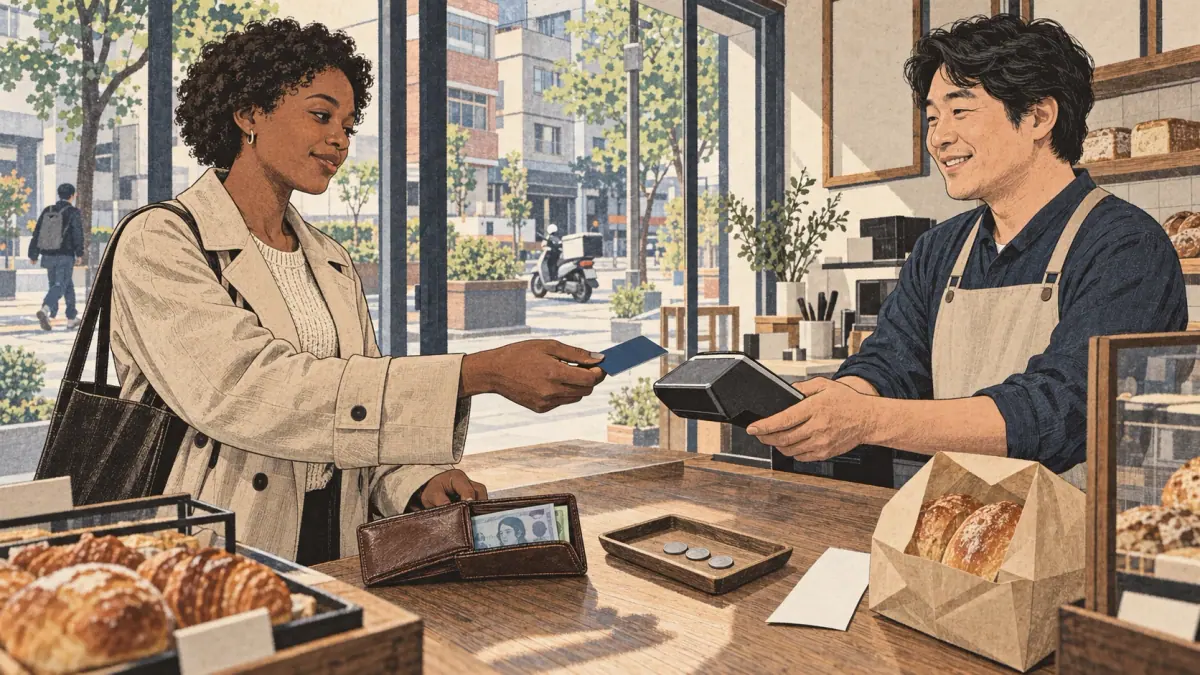
Korean Money Vocabulary at a Glance
Money words matter as soon as you live, work or travel in Korea: you read prices, pay by card, receive a salary and sometimes exchange currency. Korean money talk is built on a few short nouns and on Sino-Korean numbers, the series 일, 이, 삼 used for prices. This page lists the nouns. The number rules themselves are taught in prices and money, so they are not repeated here.
The list holds 45 words. By origin, the list has 2 native Korean, 35 Sino-Korean (built from Chinese-derived syllables), 6 loanwords and 2 mixed. Knowing the origin helps you guess how a new word will behave. The groups are:
| Group | Words | Examples |
|---|---|---|
| Banknotes and coins | 8 | 돈, 원, 지폐, 동전 |
| Cash and cards | 10 | 현금, 카드, 체크카드, 신용카드 |
| Savings and loans | 10 | 계좌, 통장, 입금, 저축 |
| Taxes and fees | 9 | 세금, 수수료, 요금, 비용 |
| Exchange rates | 8 | 환율, 환전, 달러, 유로 |
Two facts make the list easier. First, the unit 원 (won) follows the number with a space: 이천 원 is 2,000 won. Second, 만 means ten thousand, not one thousand, so 이만 원 is 20,000 won and 오만 원 is 50,000 won. Many words on this page end in -금 (money), such as 현금 (cash), 입금 (deposit) and 송금 (sending money), so one suffix opens a whole family of words. This list sits inside Daily Life, where you can find the related topics.
Which Money Words Should You Learn First?
Start with five words that appear in almost every money conversation: 계좌, 통장, 돈, 수수료 and 환율. Press play, then the slow button, and say each word aloud.
계좌 (gyejwa) means bank account. You will say it when you open an account or give your account number. 계좌번호 means account number. The syllable 계 may be said [계] or [게], and the standard pronunciation rules allow both. The second syllable 좌 is jwa. Example: 계좌를 만들었어요. (I opened an account.)
통장 (tongjang) means bankbook or account. It is the passbook or the account itself, depending on the context. Many people still say 통장 for the account even when they only use a phone app. The pair 계좌 and 통장 is the first pair of money words to learn. Example: 통장에 돈이 있어요. (There is money in the account.)
돈 (don) means money. It is short and native Korean: 돈이 없어요 (I have no money) is a sentence you will hear often. Notice that 돈 is not the word for the unit; the unit is 원. Example: 돈이 없어요. (I have no money.)
수수료 (susuryo) means fee or commission. It covers charges such as a bank transfer fee or a card fee. The question 수수료가 얼마예요? (How much is the fee?) is a key sentence for sending money abroad. Example: 수수료가 얼마예요? (How much is the fee?)
환율 (hwanyul) means exchange rate. Travelers hear 오늘 환율 (today's rate) at exchange counters. In speech the ㄴ sound moves to the next syllable, so it is said hwa-nyul. Example: 오늘 환율이 올랐어요. (The exchange rate went up today.)
Banknotes and Coins
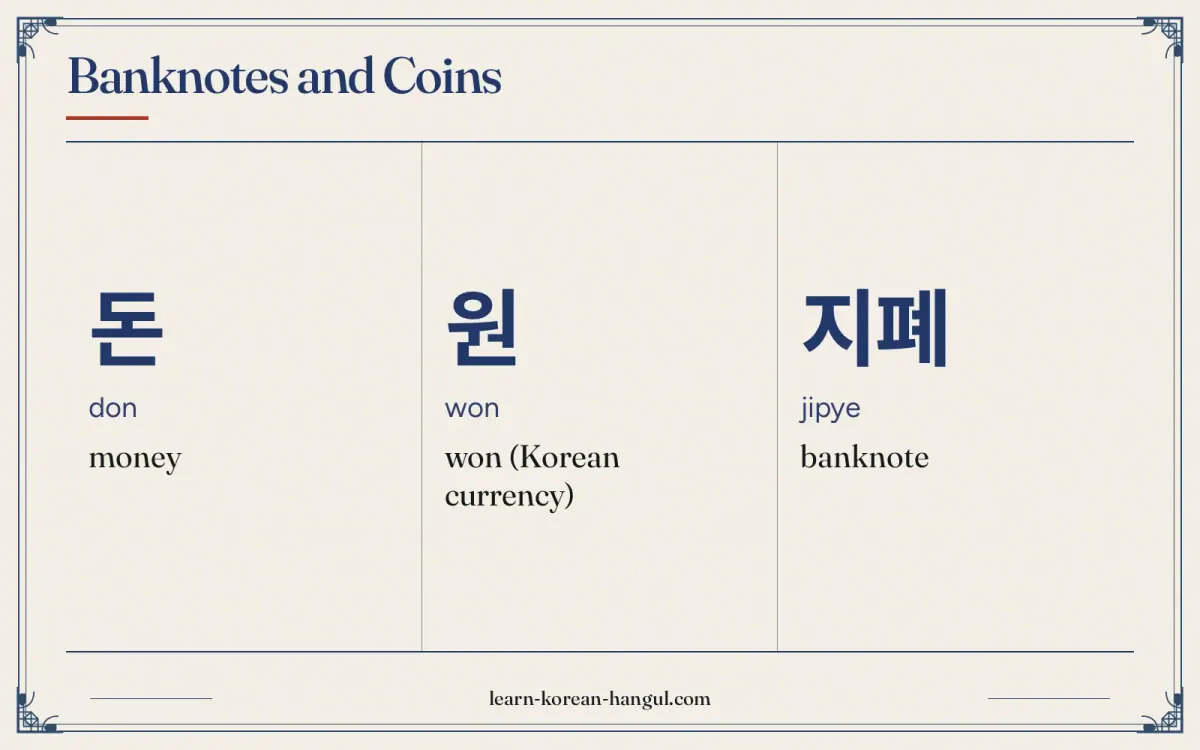
Korean prices are said with Sino-Korean numbers plus 원. These words name the money itself and the sizes you will hold.
| No. | Hangul | Revised Romanization | Meaning | Origin | Example sentence | Audio assetId |
|---|---|---|---|---|---|---|
| 1 | 돈 | don | money | native | 돈이 없어요. (doni eopseoyo; I have no money.) | au-pg-vocabulary-daily-life-money-1; example: au-pg-vocabulary-daily-life-money-101 |
| 2 | 원 | won | won (Korean currency) | Sino-Korean | 이 빵은 이천 원이에요. (i ppangeun icheon wonieyo; This bread is 2,000 won.) | au-pg-vocabulary-daily-life-money-2; example: au-pg-vocabulary-daily-life-money-102 |
| 3 | 지폐 | jipye | banknote | Sino-Korean | 지폐를 동전으로 바꿔요. (jipyereul dongjeoneuro bakkwoyo; I change a banknote into coins.) | au-pg-vocabulary-daily-life-money-3; example: au-pg-vocabulary-daily-life-money-103 |
| 4 | 동전 | dongjeon | coin | Sino-Korean | 동전이 필요해요. (dongjeoni piryohaeyo; I need coins.) | au-pg-vocabulary-daily-life-money-4; example: au-pg-vocabulary-daily-life-money-104 |
| 5 | 천 원 | cheon won | 1,000 won | Sino-Korean | 천 원짜리 지폐가 있어요. (cheon wonjjari jipyega isseoyo; I have a 1,000-won note.) | au-pg-vocabulary-daily-life-money-5; example: au-pg-vocabulary-daily-life-money-105 |
| 6 | 만 원 | man won | 10,000 won | Sino-Korean | 이 책은 만 원이에요. (i chaegeun man wonieyo; This book is 10,000 won.) | au-pg-vocabulary-daily-life-money-6; example: au-pg-vocabulary-daily-life-money-106 |
| 7 | 오만 원 | oman won | 50,000 won | Sino-Korean | 오만 원은 가장 큰 지폐예요. (oman woneun gajang keun jipyeyeyo; 50,000 won is the biggest banknote.) | au-pg-vocabulary-daily-life-money-7; example: au-pg-vocabulary-daily-life-money-107 |
| 8 | 오백 원 | obaek won | 500 won | Sino-Korean | 오백 원짜리 동전이 있어요. (obaek wonjjari dongjeoni isseoyo; I have a 500-won coin.) | au-pg-vocabulary-daily-life-money-8; example: au-pg-vocabulary-daily-life-money-108 |
- The suffix 짜리 means "worth" or "of that value", so 천 원짜리 is a 1,000-won note and 오백 원짜리 is a 500-won coin.
- Count the notes with 장 (sheets), as in 만 원짜리 두 장 (two 10,000-won notes). Coins use 개.
- South Korean notes are 1,000, 5,000, 10,000 and 50,000 won, and common coins are 10, 50, 100 and 500 won. Check the current series at the Bank of Korea (한국은행) before you travel.
Example Sentences
Prices are the best practice for money words. Say the number, then 원: 삼천 원 (3,000 won), 이만 오천 원 (25,000 won). To ask for a price say 얼마예요? (How much is it?). To pay, say the method plus 로: 카드로 할게요 (I will pay by card), 현금으로 할게요 (I will pay in cash). To talk about your own money, use the noun with 이/가 and 있어요 or 없어요: 돈이 있어요 (I have money), 돈이 없어요 (I have no money). The single-word page money in korean explains 돈 on its own.
How Do You Say Cash and Cards in Korean?
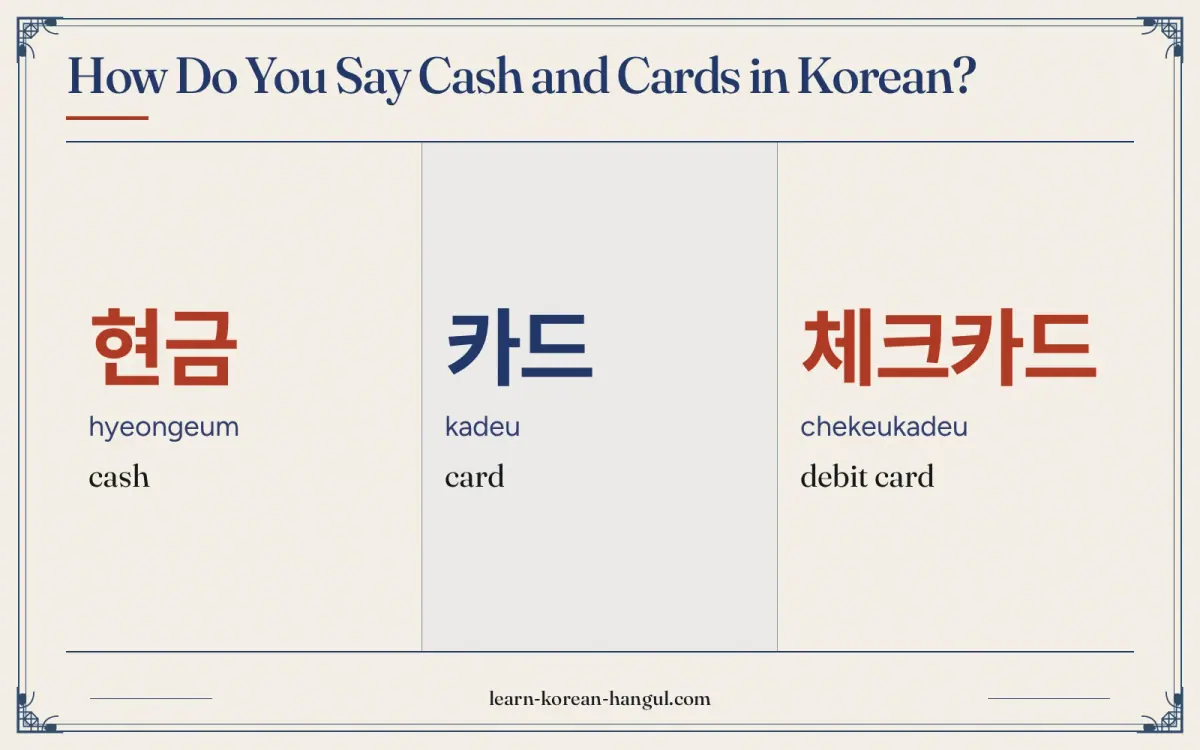
Koreans often pay with a card or a phone, so this group has more payment words than cash words. It also adds the words for money you receive.
| No. | Hangul | Revised Romanization | Meaning | Origin | Example sentence | Audio assetId |
|---|---|---|---|---|---|---|
| 9 | 현금 | hyeongeum | cash | Sino-Korean | 현금으로 낼게요. (hyeongeumeuro naelgeyo; I will pay in cash.) | au-pg-vocabulary-daily-life-money-9; example: au-pg-vocabulary-daily-life-money-109 |
| 10 | 카드 | kadeu | card | loanword | 카드를 지갑에 넣어요. (kadeureul jigabe neoeoyo; I put the card in my wallet.) | au-pg-vocabulary-daily-life-money-10; example: au-pg-vocabulary-daily-life-money-110 |
| 11 | 체크카드 | chekeukadeu | debit card | loanword | 체크카드로 결제해요. (chekeukadeuro gyeoljehaeyo; I pay with a debit card.) | au-pg-vocabulary-daily-life-money-11; example: au-pg-vocabulary-daily-life-money-111 |
| 12 | 신용카드 | sinyongkadeu | credit card | mixed | 신용카드는 한도가 있어요. (sinyongkadeuneun handoga isseoyo; A credit card has a limit.) | au-pg-vocabulary-daily-life-money-12; example: au-pg-vocabulary-daily-life-money-112 |
| 13 | 간편결제 | ganpyeongyeolje | mobile payment | Sino-Korean | 간편결제로 계산해요. (ganpyeongyeoljero gyesanhaeyo; I pay by mobile payment.) | au-pg-vocabulary-daily-life-money-13; example: au-pg-vocabulary-daily-life-money-113 |
| 14 | 지갑 | jigap | wallet | Sino-Korean | 지갑을 잃어버렸어요. (jigabeul ireobeoryeosseoyo; I lost my wallet.) | au-pg-vocabulary-daily-life-money-14; example: au-pg-vocabulary-daily-life-money-114 |
| 15 | 결제 | gyeolje | payment | Sino-Korean | 결제가 안 돼요. (gyeoljega an dwaeyo; The payment does not go through.) | au-pg-vocabulary-daily-life-money-15; example: au-pg-vocabulary-daily-life-money-115 |
| 16 | 월급 | wolgeup | monthly salary | Sino-Korean | 월급은 이십오 일에 받아요. (wolgeubeun isibo ire badayo; I get my salary on the 25th.) | au-pg-vocabulary-daily-life-money-16; example: au-pg-vocabulary-daily-life-money-116 |
| 17 | 용돈 | yongdon | pocket money | mixed | 아이에게 용돈을 줘요. (aiege yongdoneul jwoyo; I give pocket money to the child.) | au-pg-vocabulary-daily-life-money-17; example: au-pg-vocabulary-daily-life-money-117 |
| 18 | 현금영수증 | hyeongeumyeongsujeung | cash receipt (for tax records) | Sino-Korean | 현금영수증 필요하세요? (hyeongeumyeongsujeung piryohaseyo; Do you need a cash receipt?) | au-pg-vocabulary-daily-life-money-18; example: au-pg-vocabulary-daily-life-money-118 |
- The usual "payment ladder" in Korea is 현금, then 카드, then 간편결제 (a phone-based pay service). Ask 카드 돼요? (Can I pay by card?) in small shops.
- 월급 is a wage paid every month, 용돈 is money given for personal spending, such as from parents to children, and 세금 (on the next list) is what is taken from income.
- 현금영수증 is a record that lets a buyer claim an income-tax deduction. Shops ask whether you want it when you pay in cash.
Savings and Loans
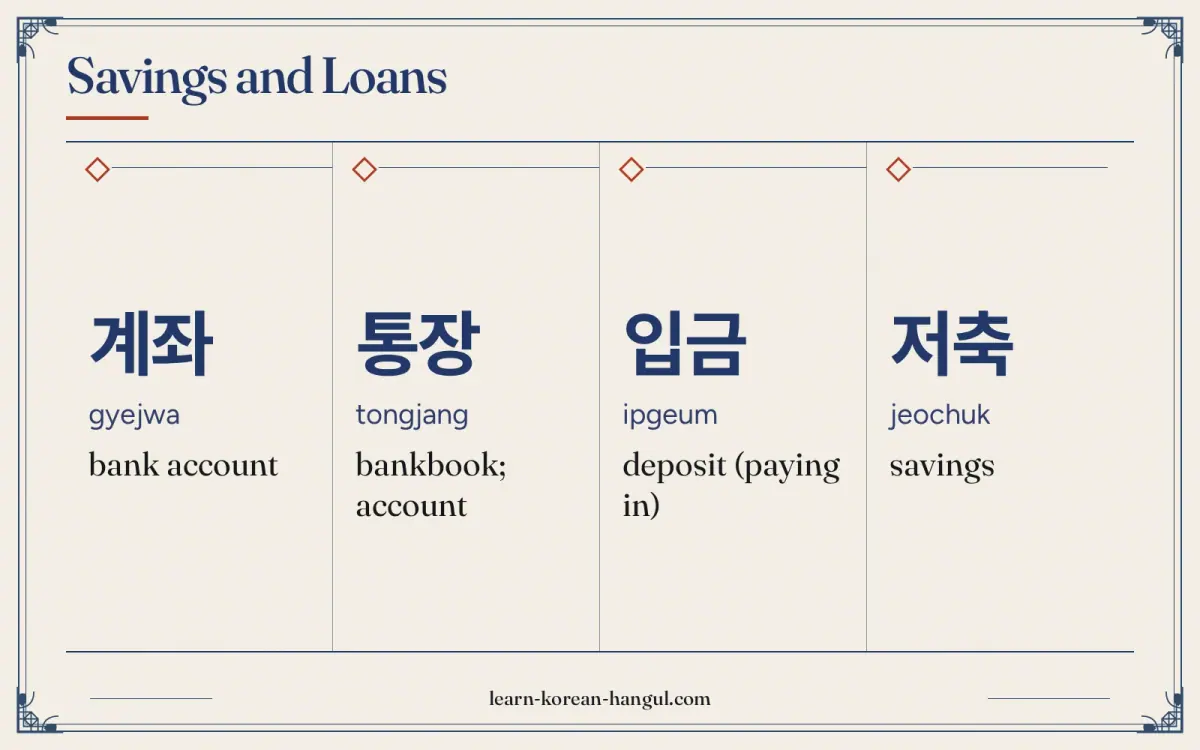
This group names accounts and the money that moves in and out of them. The bank words in more detail are on bank vocabulary.
| No. | Hangul | Revised Romanization | Meaning | Origin | Example sentence | Audio assetId |
|---|---|---|---|---|---|---|
| 19 | 계좌 | gyejwa | bank account | Sino-Korean | 계좌를 만들었어요. (gyejwareul mandeureosseoyo; I opened an account.) | au-pg-vocabulary-daily-life-money-19; example: au-pg-vocabulary-daily-life-money-119 |
| 20 | 통장 | tongjang | bankbook; account | Sino-Korean | 통장에 돈이 있어요. (tongjange doni isseoyo; There is money in the account.) | au-pg-vocabulary-daily-life-money-20; example: au-pg-vocabulary-daily-life-money-120 |
| 21 | 입금 | ipgeum | deposit (paying in) | Sino-Korean | 월급이 입금됐어요. (wolgeubi ipgeumdwaesseoyo; My salary was paid in.) | au-pg-vocabulary-daily-life-money-21; example: au-pg-vocabulary-daily-life-money-121 |
| 22 | 저축 | jeochuk | savings | Sino-Korean | 매달 저축해요. (maedal jeochukaeyo; I save every month.) | au-pg-vocabulary-daily-life-money-22; example: au-pg-vocabulary-daily-life-money-122 |
| 23 | 예금 | yegeum | bank deposit | Sino-Korean | 예금 이자가 낮아요. (yegeum ijaga najayo; The deposit interest is low.) | au-pg-vocabulary-daily-life-money-23; example: au-pg-vocabulary-daily-life-money-123 |
| 24 | 적금 | jeokgeum | installment savings | Sino-Korean | 적금을 시작했어요. (jeokgeumeul sijakaesseoyo; I started an installment savings plan.) | au-pg-vocabulary-daily-life-money-24; example: au-pg-vocabulary-daily-life-money-124 |
| 25 | 대출 | daechul | loan | Sino-Korean | 대출을 받았어요. (daechureul badasseoyo; I took out a loan.) | au-pg-vocabulary-daily-life-money-25; example: au-pg-vocabulary-daily-life-money-125 |
| 26 | 이자 | ija | interest | Sino-Korean | 이자가 높아요. (ijaga nopayo; The interest is high.) | au-pg-vocabulary-daily-life-money-26; example: au-pg-vocabulary-daily-life-money-126 |
| 27 | 빚 | bit | debt | native | 빚을 갚아요. (bijeul gapayo; I repay a debt.) | au-pg-vocabulary-daily-life-money-27; example: au-pg-vocabulary-daily-life-money-127 |
| 28 | 보험 | boheom | insurance | Sino-Korean | 보험에 가입했어요. (boheome gaipaesseoyo; I signed up for insurance.) | au-pg-vocabulary-daily-life-money-28; example: au-pg-vocabulary-daily-life-money-128 |
- 예금 is money kept in a deposit account that you can leave, while 적금 is a plan where you put in a fixed amount every month. Both are kinds of 저축 (saving).
- 대출을 받다 means to take out a loan, and 빚을 갚다 means to repay a debt. The verb choices are worth learning with the noun.
- In 빚 the final ㅊ is said [ㄷ] before a pause, so 빚 is read bit. With a vowel after it, as in 빚이, the ㅈ sound returns: [비지].
How Do You Say Taxes and Fees in Korean?
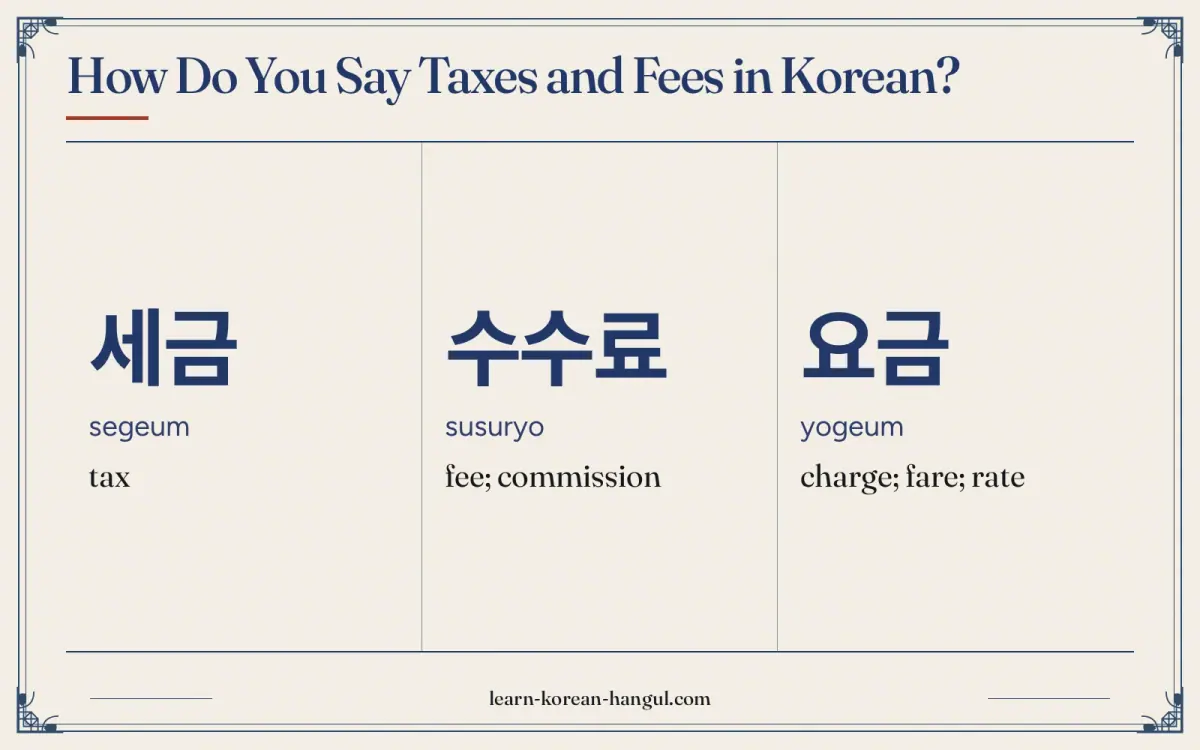
Money also leaves your account through taxes, fees and regular bills. These nine words appear on receipts and bills.
| No. | Hangul | Revised Romanization | Meaning | Origin | Example sentence | Audio assetId |
|---|---|---|---|---|---|---|
| 29 | 세금 | segeum | tax | Sino-Korean | 세금을 내요. (segeumeul naeyo; I pay tax.) | au-pg-vocabulary-daily-life-money-29; example: au-pg-vocabulary-daily-life-money-129 |
| 30 | 수수료 | susuryo | fee; commission | Sino-Korean | 수수료가 얼마예요? (susuryoga eolmayeyo; How much is the fee?) | au-pg-vocabulary-daily-life-money-30; example: au-pg-vocabulary-daily-life-money-130 |
| 31 | 요금 | yogeum | charge; fare; rate | Sino-Korean | 전기 요금이 올랐어요. (jeongi yogeumi ollasseoyo; The electricity charge went up.) | au-pg-vocabulary-daily-life-money-31; example: au-pg-vocabulary-daily-life-money-131 |
| 32 | 비용 | biyong | cost; expense | Sino-Korean | 이사 비용이 많이 들어요. (isa biyongi mani deureoyo; Moving costs a lot.) | au-pg-vocabulary-daily-life-money-32; example: au-pg-vocabulary-daily-life-money-132 |
| 33 | 월세 | wolse | monthly rent | Sino-Korean | 월세는 팔십만 원이에요. (wolseneun palsimman wonieyo; The monthly rent is 800,000 won.) | au-pg-vocabulary-daily-life-money-33; example: au-pg-vocabulary-daily-life-money-133 |
| 34 | 관리비 | gwallibi | building maintenance fee | Sino-Korean | 관리비는 따로 내요. (gwallibineun ttaro naeyo; I pay the maintenance fee separately.) | au-pg-vocabulary-daily-life-money-34; example: au-pg-vocabulary-daily-life-money-134 |
| 35 | 부가세 | bugase | VAT (value-added tax) | Sino-Korean | 가격에 부가세가 포함돼요. (gagyeoge bugasega pohamdwaeyo; VAT is included in the price.) | au-pg-vocabulary-daily-life-money-35; example: au-pg-vocabulary-daily-life-money-135 |
| 36 | 벌금 | beolgeum | fine (penalty) | Sino-Korean | 벌금을 내야 해요. (beolgeumeul naeya haeyo; I have to pay a fine.) | au-pg-vocabulary-daily-life-money-36; example: au-pg-vocabulary-daily-life-money-136 |
| 37 | 공과금 | gonggwageum | utility bills | Sino-Korean | 공과금을 납부해요. (gonggwageumeul napbuhaeyo; I pay the utility bills.) | au-pg-vocabulary-daily-life-money-37; example: au-pg-vocabulary-daily-life-money-137 |
- 요금 is a charge for a service, such as 전화 요금 (phone bill) or 버스 요금 (bus fare). 비용 is the total cost of something you do, such as moving or studying.
- In Korean housing, 월세 is monthly rent and 관리비 is the extra monthly fee for building upkeep.
- 부가세 is short for 부가가치세 (value-added tax). Prices in Korea normally include it.
Exchange Rates
Traveling or sending money abroad needs the last group. Currency names are loanwords. Even 위안 comes from the Chinese pronunciation of 元; the Korean reading of that character is 원.
| No. | Hangul | Revised Romanization | Meaning | Origin | Example sentence | Audio assetId |
|---|---|---|---|---|---|---|
| 38 | 환율 | hwanyul | exchange rate | Sino-Korean | 오늘 환율이 올랐어요. (oneul hwanyuri ollasseoyo; The exchange rate went up today.) | au-pg-vocabulary-daily-life-money-38; example: au-pg-vocabulary-daily-life-money-138 |
| 39 | 환전 | hwanjeon | currency exchange | Sino-Korean | 공항에서 환전해요. (gonghangeseo hwanjeonhaeyo; I exchange money at the airport.) | au-pg-vocabulary-daily-life-money-39; example: au-pg-vocabulary-daily-life-money-139 |
| 40 | 달러 | dalleo | dollar | loanword | 백 달러를 원으로 바꿔요. (baek dalleoreul woneuro bakkwoyo; I change 100 dollars into won.) | au-pg-vocabulary-daily-life-money-40; example: au-pg-vocabulary-daily-life-money-140 |
| 41 | 유로 | yuro | euro | loanword | 유로는 환율이 높아요. (yuroneun hwanyuri nopayo; The euro has a high exchange rate.) | au-pg-vocabulary-daily-life-money-41; example: au-pg-vocabulary-daily-life-money-141 |
| 42 | 엔 | en | yen | loanword | 엔으로 얼마예요? (eneuro eolmayeyo; How much is it in yen?) | au-pg-vocabulary-daily-life-money-42; example: au-pg-vocabulary-daily-life-money-142 |
| 43 | 위안 | wian | yuan | loanword | 위안을 받아요? (wianeul badayo; Do you accept yuan?) | au-pg-vocabulary-daily-life-money-43; example: au-pg-vocabulary-daily-life-money-143 |
| 44 | 외화 | oehwa | foreign currency | Sino-Korean | 외화를 원화로 바꿔요. (oehwareul wonhwaro bakkwoyo; I change foreign currency into won.) | au-pg-vocabulary-daily-life-money-44; example: au-pg-vocabulary-daily-life-money-144 |
| 45 | 송금 | songgeum | sending money | Sino-Korean | 친구에게 송금했어요. (chinguege songgeumhaesseoyo; I sent money to a friend.) | au-pg-vocabulary-daily-life-money-45; example: au-pg-vocabulary-daily-life-money-145 |
- The pattern is currency + 으로 or 로, as in 달러로 (in dollars). Use 로 after a vowel and 으로 after a consonant, so 엔으로 and 유로로.
- 원화 means Korean won as a currency, and 외화 is all non-Korean money. A bank sign with 외화 환전 offers foreign exchange.
- 송금 is sending money, and its pair 입금 is paying in. The bank page explains how the -금 words fit together.
How Do You Pronounce These Words?
Money words contain several common sound changes. The table shows five that learners often miss, following the Standard Pronunciation rules (표준 발음법) of the 국립국어원.
| Word | Romanization | Said | Rule |
|---|---|---|---|
| 입금 | ipgeum | [입끔] | ㄱ after ㅂ becomes tense |
| 환율 | hwanyul | [화뉼] | final ㄴ moves onto the empty ㅇ of the next syllable |
| 달러 | dalleo | [달러] | ㄹ + ㄹ is one long l sound |
| 적금 | jeokgeum | [적끔] | ㄱ after ㄱ becomes tense |
| 빚 | bit | [빋] | final ㅈ closes as [ㄷ] |
Revised Romanization is the official romanization system of South Korea, announced on 7 July 2000. It follows most sound changes, but it does not show tensing caused by a neighbouring sound, so it is only a learning aid. Always read the Hangul as well.
Audio and Slow Playback
Each headword and each example sentence has its own audio clip, and the 5 words in the first-words section also have a slow clip at 0.8 times the speed. Nothing plays until you press a button. Listen once, repeat aloud, and only then check the romanization.
What Mistakes Do Learners Make with Money Words?
- Reading 만 as one thousand. 만 is ten thousand, so 만 원 is 10,000 won and 천 원 is 1,000 won.
- Using native numbers for prices. Say 이천 원, not 둘 원 or 두 원. Prices use Sino-Korean numbers.
- Confusing 예금, 적금 and 저축. 저축 is the idea of saving, and 예금 and 적금 are two bank products.
- Treating 체크카드 and 신용카드 as the same. 체크카드 takes money from your account at once, while 신용카드 bills you later.
- Mixing 요금 and 비용. Use 요금 for a regular charge such as a fare, and 비용 for the cost of a job or event.
Practice: Flashcards and Worksheet
Drill these 45 words with the vocabulary flashcard decks: each card shows the Hangul on one side and the meaning on the other, so you can test recall instead of recognition. Print a labelling sheet from the vocabulary worksheets and write the Korean word for each numbered object in the scene above. A simple plan is to learn 8 to 10 words a day: read the table, press play, say the word, cover the English, then write one sentence of your own. Come back after a day and again after a week.
Self-Test: 10 Sentences
Fill each blank with a word from this page. Say the whole sentence aloud when you have it. The answers follow the test.
- ___이 없어요. (I have no money.)
- ___짜리 지폐가 있어요. (I have a 1,000-won note.)
- ___으로 낼게요. (I will pay in cash.)
- ___로 계산해요. (I pay by mobile payment.)
- 아이에게 ___을 줘요. (I give pocket money to the child.)
- 월급이 ___됐어요. (My salary was paid in.)
- ___을 받았어요. (I took out a loan.)
- ___을 내요. (I pay tax.)
- ___는 팔십만 원이에요. (The monthly rent is 800,000 won.)
- ___을 납부해요. (I pay the utility bills.)
Answers: 1. 돈; 2. 천 원; 3. 현금; 4. 간편결제; 5. 용돈; 6. 입금; 7. 대출; 8. 세금; 9. 월세; 10. 공과금.
A score of 8 or more suggests the words are settling in. If you scored lower, reread the groups where you missed words.
Where to Go Next
After money, many learners move on to Technology and Internet or go back to Shopping. The next deeper list is bank vocabulary, with the words an account clerk and an ATM use.
Pages in This Section
- Korean Bank Vocabulary: 40 words for accounts, deposits, transfers, loans and ATMs.
FAQ
How Do You Say Account in Korean?
Say 계좌 (gyejwa) for a bank account. Say 통장 (tongjang) for the bankbook or for an account in everyday speech. To say "I want to open an account", use 계좌를 만들고 싶어요.
How Do You Pronounce 통장 (tongjang)?
통장 is read tongjang. Both syllables end in ng, the sound at the end of English "song". The ㅈ in 장 is a plain, soft sound between English j and ch, with no puff of air. Say tong, then jang, with no pause.
How Many Money Words Should I Learn First?
Learn the first 18 words (banknotes and coins, cash and cards) first; at 8 to 10 new words a day that takes about two days. Then add the savings, tax and exchange words, and keep reviewing for a week. These words are A2 level, so learn the Sino-Korean numbers first if prices still slow you down.
Where Can I Practise Money Words with Flashcards?
Use the vocabulary flashcard decks. Start with the first 10 words of this page, then add 10 more each day. Review the older cards before you add new ones, so the earlier words do not fade.
Is the Romanization on This Page Official?
Yes, as a learning aid. It follows the Revised Romanization of Korean, the system South Korea has officially used since 7 July 2000, and the page also gives the Hangul for every word. It follows most sound changes, but it does not show tensing caused by a neighbouring sound: 입금 is written ipgeum but said [입끔]. Treat the Hangul as the real spelling.
Is There a Printable Worksheet for Money Words?
The vocabulary worksheets page lists the printable sheets. The sheet for this topic is a labelling task built on the same illustrated scene as this page, so you write the Korean word next to each numbered object.