
Korean Daily Routine at a Glance
A daily routine is the set of things you do on most days, such as waking up, eating, working and sleeping. In Korean the time-of-day words and the activity words are mostly nouns, and you add 해요 (haeyo, "do") or another verb to make a sentence. This page teaches the nouns first, because a noun plus a time word is already enough to be understood.
The list holds 40 words. By origin, the list has 11 native Korean, 26 Sino-Korean (built from Chinese-derived syllables) and 3 loanwords. Knowing the origin helps you guess how a new word will behave. The groups are:
| Group | Words | Examples |
|---|---|---|
| Words for the whole day | 3 | 일상, 일과, 하루 |
| Morning | 7 | 아침, 알람, 세수, 샤워 |
| Meals | 7 | 점심, 저녁, 밥, 식사 |
| Work or school | 8 | 출근, 퇴근, 회사, 학교 |
| Evening | 6 | 운동, 산책, 청소, 빨래 |
| Night and sleep | 5 | 밤, 잠, 낮잠, 꿈 |
| Weekends | 4 | 주말, 휴일, 휴가, 약속 |
Two facts help before you start. First, the time words 아침 and 저녁 each carry two meanings: 아침 is both morning and breakfast, and 저녁 is both evening and dinner. Second, many work and school words are built from two Chinese-derived syllables, so 출근 (going to work) and 퇴근 (leaving work) look and sound like a pair. This list sits inside Daily Life, where you can find the related topics.
Which Daily Routine Words Should You Learn First?
Start with five words that show up in almost every conversation about a day: 아침, 저녁, 일상, 출근 and 퇴근. Press the play button, then the slow button, and say each word aloud before you read the romanization.
아침 (achim) means morning or breakfast. This is the first word to learn because it does double duty. 아침에 일어나요 means "I get up in the morning", and 아침을 먹어요 means "I eat breakfast". The meaning is clear from the verb, just as it is in English with "breakfast time". Example: 아침에 커피를 마셔요. (I drink coffee in the morning.)
저녁 (jeonyeok) means evening or dinner. Like 아침, it covers a time of day and a meal. 저녁에 만나요 means "Let us meet in the evening", and 저녁을 먹어요 means "I eat dinner". Note the sound: the vowel in the first syllable is ㅓ, so say jeo, not ju. Example: 저녁에 가족과 밥을 먹어요. (I eat dinner with my family in the evening.)
일상 (ilsang) means daily life or daily routine. It is a slightly written word, so you will see 일상 in captions, blogs and video titles, such as 일상 브이로그 (a daily-life vlog). A close partner is 일과, the schedule of one day. Example: 제 일상은 단순해요. (My daily routine is simple.)
출근 (chulgeun) means going to work. It is the standard word for going to work, and it is a noun, so say 출근해요 (I go to work) or use it in a phrase such as 출근 시간 (commuting time). It is a very common word in working life. Example: 아홉 시에 출근해요. (I go to work at nine.)
퇴근 (toegeun) means leaving work. It is the mirror of 출근, the end of the working day. 퇴근 후에 운동해요 means "I exercise after work". Learning the pair together gives you both ends of the working day. Example: 여섯 시에 퇴근해요. (I leave work at six.)
Words for the Whole Day
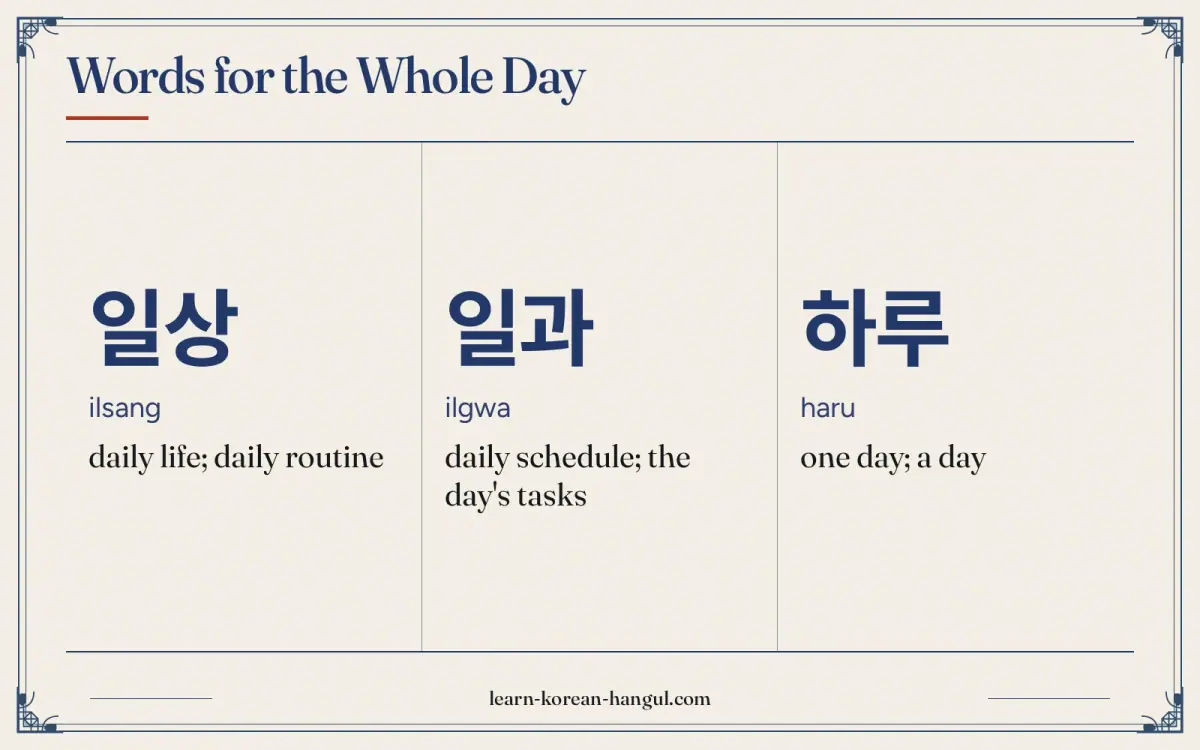
Three words describe the day as a whole. They are good starters for a sentence about your life.
| No. | Hangul | Revised Romanization | Meaning | Origin | Example sentence | Audio assetId |
|---|---|---|---|---|---|---|
| 1 | 일상 | ilsang | daily life; daily routine | Sino-Korean | 제 일상은 단순해요. (je ilsangeun dansunhaeyo; My daily routine is simple.) | au-pg-vocabulary-daily-life-routines-1; example: au-pg-vocabulary-daily-life-routines-101 |
| 2 | 일과 | ilgwa | daily schedule; the day's tasks | Sino-Korean | 제 일과는 일곱 시에 시작해요. (je ilgwaneun ilgop sie sijakaeyo; My daily schedule starts at seven.) | au-pg-vocabulary-daily-life-routines-2; example: au-pg-vocabulary-daily-life-routines-102 |
| 3 | 하루 | haru | one day; a day | native | 하루가 너무 짧아요. (haruga neomu jjalbayo; The day is too short.) | au-pg-vocabulary-daily-life-routines-3; example: au-pg-vocabulary-daily-life-routines-103 |
- 일상 and 일과 are close but not identical. 일상 is the broad idea of everyday life, while 일과 is the list of things you plan to do in one day. The Standard Korean Dictionary of the 국립국어원 gives both as nouns.
- 하루 is a native Korean word and also counts days: 하루, 이틀, 사흘. Use it when you mean one whole day, as in 하루에 세 번 (three times a day).
Example Sentences
Use this frame to build your own sentences: time word + 에 + noun + verb. For example, 아침에 샤워해요 (I shower in the morning) and 저녁에 산책을 해요 (I take a walk in the evening). The particle 에 marks the time. For clock times use a number plus 시, as in 일곱 시에 일어나요 (I get up at seven). Learn the clock numbers in telling time, and the words for today, tomorrow and yesterday in time expressions. The single-word page daily routine in korean explains the word 일상 on its own.
Morning
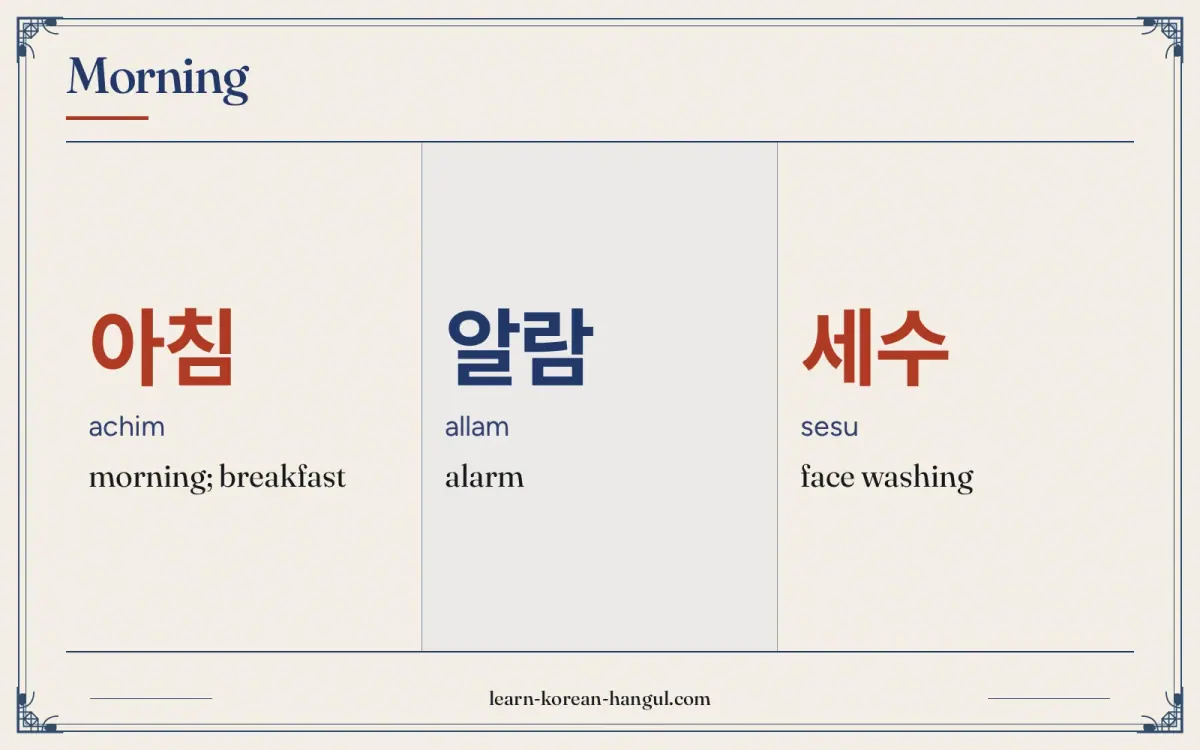
The morning group covers waking up, washing and getting ready. Most of these words are used with 해요 or with a place word, so they combine easily.
| No. | Hangul | Revised Romanization | Meaning | Origin | Example sentence | Audio assetId |
|---|---|---|---|---|---|---|
| 4 | 아침 | achim | morning; breakfast | native | 아침에 커피를 마셔요. (achime keopireul masyeoyo; I drink coffee in the morning.) | au-pg-vocabulary-daily-life-routines-4; example: au-pg-vocabulary-daily-life-routines-104 |
| 5 | 알람 | allam | alarm | loanword | 알람이 울려요. (allami ullyeoyo; The alarm rings.) | au-pg-vocabulary-daily-life-routines-5; example: au-pg-vocabulary-daily-life-routines-105 |
| 6 | 세수 | sesu | face washing | Sino-Korean | 일어나서 세수해요. (ireonaseo sesuhaeyo; I get up and wash my face.) | au-pg-vocabulary-daily-life-routines-6; example: au-pg-vocabulary-daily-life-routines-106 |
| 7 | 샤워 | syawo | shower | loanword | 아침에 샤워해요. (achime syawohaeyo; I take a shower in the morning.) | au-pg-vocabulary-daily-life-routines-7; example: au-pg-vocabulary-daily-life-routines-107 |
| 8 | 화장품 | hwajangpum | cosmetics | Sino-Korean | 화장품을 가방에 넣어요. (hwajangpumeul gabange neoeoyo; I put cosmetics in my bag.) | au-pg-vocabulary-daily-life-routines-8; example: au-pg-vocabulary-daily-life-routines-108 |
| 9 | 준비 | junbi | preparation; getting ready | Sino-Korean | 출근 준비를 해요. (chulgeun junbireul haeyo; I get ready for work.) | au-pg-vocabulary-daily-life-routines-9; example: au-pg-vocabulary-daily-life-routines-109 |
| 10 | 출발 | chulbal | departure | Sino-Korean | 여덟 시에 출발해요. (yeodeol sie chulbalhaeyo; I leave at eight o'clock.) | au-pg-vocabulary-daily-life-routines-10; example: au-pg-vocabulary-daily-life-routines-110 |
- 세수 means washing your face only. Washing the whole body is 샤워 (shower) or 목욕 (bath), which are covered with other personal care words in Korean Personal Care Vocabulary.
- 알람 is a loanword from English. The ringing is 알람 소리 (alarm sound), and setting an alarm is 알람을 맞추다.
- 준비 is useful in many phrases: 식사 준비 (meal preparation), 시험 준비 (exam preparation). Put the thing before 준비.
How Do You Say Meals in Korean?
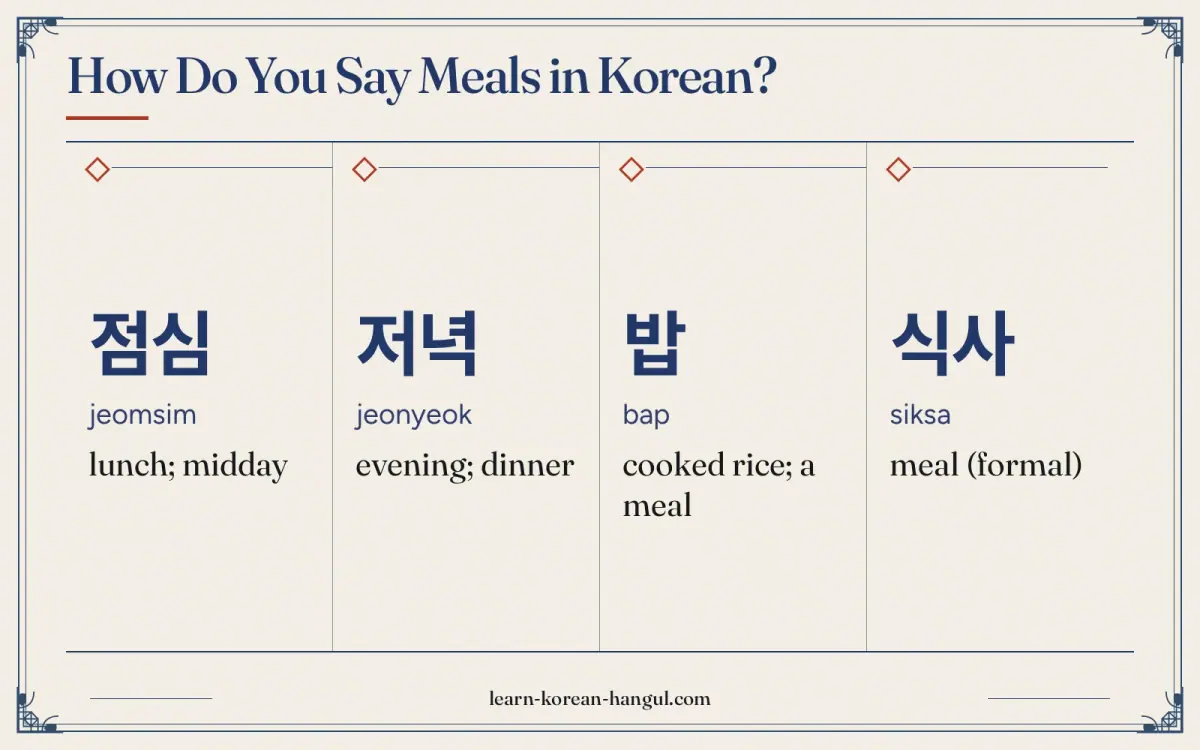
Meals are central to a Korean day. The general word for a meal is 식사 (formal) or 밥 (everyday), and the three main meals use the time-of-day words.
| No. | Hangul | Revised Romanization | Meaning | Origin | Example sentence | Audio assetId |
|---|---|---|---|---|---|---|
| 11 | 점심 | jeomsim | lunch; midday | Sino-Korean | 점심에 친구를 만나요. (jeomsime chingureul mannayo; I meet a friend at lunch.) | au-pg-vocabulary-daily-life-routines-11; example: au-pg-vocabulary-daily-life-routines-111 |
| 12 | 저녁 | jeonyeok | evening; dinner | native | 저녁에 가족과 밥을 먹어요. (jeonyeoge gajokgwa babeul meogeoyo; I eat dinner with my family in the evening.) | au-pg-vocabulary-daily-life-routines-12; example: au-pg-vocabulary-daily-life-routines-112 |
| 13 | 밥 | bap | cooked rice; a meal | native | 밥 먹었어요? (bap meogeosseoyo; Have you eaten?) | au-pg-vocabulary-daily-life-routines-13; example: au-pg-vocabulary-daily-life-routines-113 |
| 14 | 식사 | siksa | meal (formal) | Sino-Korean | 식사 시간이에요. (siksa siganieyo; It is mealtime.) | au-pg-vocabulary-daily-life-routines-14; example: au-pg-vocabulary-daily-life-routines-114 |
| 15 | 간식 | gansik | snack | Sino-Korean | 오후에 간식을 먹어요. (ohue gansigeul meogeoyo; I eat a snack in the afternoon.) | au-pg-vocabulary-daily-life-routines-15; example: au-pg-vocabulary-daily-life-routines-115 |
| 16 | 야식 | yasik | late-night snack | Sino-Korean | 밤에 야식을 먹어요. (bame yasigeul meogeoyo; I eat a late-night snack at night.) | au-pg-vocabulary-daily-life-routines-16; example: au-pg-vocabulary-daily-life-routines-116 |
| 17 | 커피 | keopi | coffee | loanword | 점심 후에 커피를 마셔요. (jeomsim hue keopireul masyeoyo; I drink coffee after lunch.) | au-pg-vocabulary-daily-life-routines-17; example: au-pg-vocabulary-daily-life-routines-117 |
- 밥 literally means cooked rice, and it stands for a whole meal. That is why 밥 먹었어요? works like "Have you eaten?", a friendly greeting between Koreans.
- The pattern is time word plus meal: 아침 (breakfast), 점심 (lunch), 저녁 (dinner). Add 식사 for a formal tone: 아침 식사, 점심 식사, 저녁 식사.
- 야식 is the snack or light meal people eat late at night, often ordered for delivery. The word is common in conversation and in food advertising.
Work or School
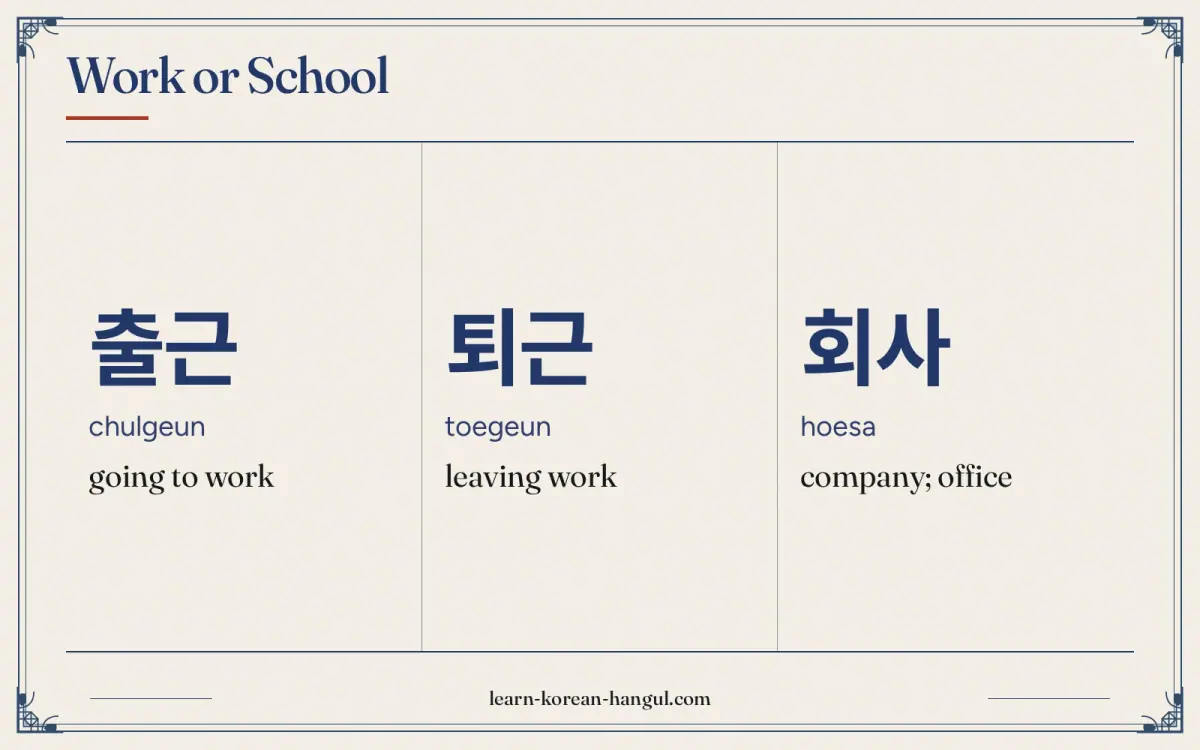
These eight words describe the middle of the day. Several of them pair up as opposites: 출근 and 퇴근, and 수업 with 숙제 as the work in class and the work at home.
| No. | Hangul | Revised Romanization | Meaning | Origin | Example sentence | Audio assetId |
|---|---|---|---|---|---|---|
| 18 | 출근 | chulgeun | going to work | Sino-Korean | 아홉 시에 출근해요. (ahop sie chulgeunhaeyo; I go to work at nine.) | au-pg-vocabulary-daily-life-routines-18; example: au-pg-vocabulary-daily-life-routines-118 |
| 19 | 퇴근 | toegeun | leaving work | Sino-Korean | 여섯 시에 퇴근해요. (yeoseot sie toegeunhaeyo; I leave work at six.) | au-pg-vocabulary-daily-life-routines-19; example: au-pg-vocabulary-daily-life-routines-119 |
| 20 | 회사 | hoesa | company; office | Sino-Korean | 회사가 지하철역 근처에 있어요. (hoesaga jihacheoryeok geuncheoe isseoyo; My company is near the subway station.) | au-pg-vocabulary-daily-life-routines-20; example: au-pg-vocabulary-daily-life-routines-120 |
| 21 | 학교 | hakgyo | school | Sino-Korean | 학교에 걸어서 가요. (hakgyoe georeoseo gayo; I walk to school.) | au-pg-vocabulary-daily-life-routines-21; example: au-pg-vocabulary-daily-life-routines-121 |
| 22 | 수업 | sueop | class; lesson | Sino-Korean | 오늘 수업이 열 시에 시작해요. (oneul sueobi yeol sie sijakaeyo; Today's class starts at ten.) | au-pg-vocabulary-daily-life-routines-22; example: au-pg-vocabulary-daily-life-routines-122 |
| 23 | 숙제 | sukje | homework | Sino-Korean | 저녁에 숙제를 해요. (jeonyeoge sukjereul haeyo; I do homework in the evening.) | au-pg-vocabulary-daily-life-routines-23; example: au-pg-vocabulary-daily-life-routines-123 |
| 24 | 점심시간 | jeomsimsigan | lunch break | Sino-Korean | 점심시간은 한 시간이에요. (jeomsimsiganeun han siganieyo; The lunch break is one hour.) | au-pg-vocabulary-daily-life-routines-24; example: au-pg-vocabulary-daily-life-routines-124 |
| 25 | 회의 | hoeui | meeting | Sino-Korean | 오후에 회의가 있어요. (ohue hoeuiga isseoyo; There is a meeting in the afternoon.) | au-pg-vocabulary-daily-life-routines-25; example: au-pg-vocabulary-daily-life-routines-125 |
- 회사 and 학교 are places, so they take 에 (to or at): 회사에 가요, 학교에 가요.
- 수업 is a class as an event. The room is 교실 and the subject is 과목. Say 수업이 끝나요 for "class ends".
- In 숙제 the ㄱ makes the next sound tense, so it is said [숙쩨], while the romanization stays sukje.
How Do You Say Evening in Korean?
After work the vocabulary moves to chores and rest. 저녁 (evening) is already on the meals list, so this group covers what people do in the evening.
| No. | Hangul | Revised Romanization | Meaning | Origin | Example sentence | Audio assetId |
|---|---|---|---|---|---|---|
| 26 | 운동 | undong | exercise | Sino-Korean | 퇴근 후에 운동해요. (toegeun hue undonghaeyo; I exercise after work.) | au-pg-vocabulary-daily-life-routines-26; example: au-pg-vocabulary-daily-life-routines-126 |
| 27 | 산책 | sanchaek | walk; stroll | Sino-Korean | 저녁에 산책을 해요. (jeonyeoge sanchaegeul haeyo; I take a walk in the evening.) | au-pg-vocabulary-daily-life-routines-27; example: au-pg-vocabulary-daily-life-routines-127 |
| 28 | 청소 | cheongso | cleaning | Sino-Korean | 집 청소를 해요. (jip cheongsoreul haeyo; I clean the house.) | au-pg-vocabulary-daily-life-routines-28; example: au-pg-vocabulary-daily-life-routines-128 |
| 29 | 빨래 | ppallae | laundry | native | 빨래를 널어요. (ppallaereul neoreoyo; I hang up the laundry.) | au-pg-vocabulary-daily-life-routines-29; example: au-pg-vocabulary-daily-life-routines-129 |
| 30 | 설거지 | seolgeoji | washing the dishes | native | 저녁 먹고 설거지를 해요. (jeonyeok meokgo seolgeojireul haeyo; After dinner I wash the dishes.) | au-pg-vocabulary-daily-life-routines-30; example: au-pg-vocabulary-daily-life-routines-130 |
| 31 | 휴식 | hyusik | rest | Sino-Korean | 저녁에 휴식을 취해요. (jeonyeoge hyusigeul chwihaeyo; I take a rest in the evening.) | au-pg-vocabulary-daily-life-routines-31; example: au-pg-vocabulary-daily-life-routines-131 |
- 운동, 산책, 청소 and 설거지 all combine with 하다 (to do): 운동을 해요 or 운동해요. For 설거지, both 설거지를 해요 and 설거지해요 are correct.
- 빨래 is the everyday word for laundry. 세탁 is the formal word you see on clothing labels and dry-cleaning shops.
- 휴식 is a little formal. In casual talk, people say 쉬어요 (I rest), a verb you can look up with the verb guides.
Night and Sleep
The night group is short but tied to one of the most common questions in daily talk: when do you sleep?
| No. | Hangul | Revised Romanization | Meaning | Origin | Example sentence | Audio assetId |
|---|---|---|---|---|---|---|
| 32 | 밤 | bam | night | native | 밤에 일찍 자요. (bame iljjik jayo; I sleep early at night.) | au-pg-vocabulary-daily-life-routines-32; example: au-pg-vocabulary-daily-life-routines-132 |
| 33 | 잠 | jam | sleep | native | 잠이 와요. (jami wayo; I feel sleepy.) | au-pg-vocabulary-daily-life-routines-33; example: au-pg-vocabulary-daily-life-routines-133 |
| 34 | 낮잠 | natjam | nap | native | 주말에 낮잠을 자요. (jumare natjameul jayo; I take a nap on weekends.) | au-pg-vocabulary-daily-life-routines-34; example: au-pg-vocabulary-daily-life-routines-134 |
| 35 | 꿈 | kkum | dream | native | 어젯밤에 꿈을 꿨어요. (eojetbame kkumeul kkwosseoyo; I had a dream last night.) | au-pg-vocabulary-daily-life-routines-35; example: au-pg-vocabulary-daily-life-routines-135 |
| 36 | 새벽 | saebyeok | dawn; small hours | native | 새벽 다섯 시에 일어나요. (saebyeok daseot sie ireonayo; I wake up at five in the early morning.) | au-pg-vocabulary-daily-life-routines-36; example: au-pg-vocabulary-daily-life-routines-136 |
- 잠이 와요 means "sleep comes", which is how Korean says "I am sleepy". Compare 잠을 자요, "I sleep", where 잠 is the object.
- 새벽 is the early hours before and around dawn. Koreans use it for any time from about midnight until sunrise, as in 새벽 두 시 (2 a.m.), so 새벽 다섯 시 sounds very early.
- In 낮잠 the ㅈ closes as [ㄷ], so it is said [낟짬] and written natjam in Revised Romanization.
How Do You Say Weekends in Korean?
The last group is for days off. These words let you say what you do when the usual schedule stops.
| No. | Hangul | Revised Romanization | Meaning | Origin | Example sentence | Audio assetId |
|---|---|---|---|---|---|---|
| 37 | 주말 | jumal | weekend | Sino-Korean | 주말에 쉬어요. (jumare swieoyo; I rest on weekends.) | au-pg-vocabulary-daily-life-routines-37; example: au-pg-vocabulary-daily-life-routines-137 |
| 38 | 휴일 | hyuil | day off; holiday | Sino-Korean | 휴일에는 늦게 일어나요. (hyuireneun neutge ireonayo; On days off I get up late.) | au-pg-vocabulary-daily-life-routines-38; example: au-pg-vocabulary-daily-life-routines-138 |
| 39 | 휴가 | hyuga | vacation; leave | Sino-Korean | 다음 주에 휴가예요. (daeum jue hyugayeyo; Next week is my vacation.) | au-pg-vocabulary-daily-life-routines-39; example: au-pg-vocabulary-daily-life-routines-139 |
| 40 | 약속 | yaksok | appointment; plan to meet | Sino-Korean | 토요일에 약속이 있어요. (toyoire yaksogi isseoyo; I have plans on Saturday.) | au-pg-vocabulary-daily-life-routines-40; example: au-pg-vocabulary-daily-life-routines-140 |
- 휴일 is any day when you do not work, including public holidays. 휴가 is a period of leave that you request, such as a summer vacation.
- 약속 covers an appointment, a promise and a plan to meet. 약속이 있어요 is a polite way to say you are busy.
- 주말 is 토요일 (Saturday) and 일요일 (Sunday). 주말에 means on the weekend; add 는 only to contrast it with weekdays, as in 주말에는 쉬어요.
Describe Your Day: a "My Day" Template
Put the words together with one frame: 저는 + time + 에 + activity. Change the times to match your own day. Hours use native Korean numbers with 시, as in 일곱 시 (seven o'clock), and 반 means half past.
| Time | Korean | Revised Romanization | Meaning |
|---|---|---|---|
| 7:00 | 저는 일곱 시에 일어나요. | jeoneun ilgop sie ireonayo. | I get up at seven. |
| 7:10 | 일곱 시 십 분에 세수해요. | ilgop si sip bune sesuhaeyo. | I wash my face at ten past seven. |
| 7:30 | 일곱 시 반에 아침을 먹어요. | ilgop si bane achimeul meogeoyo. | I eat breakfast at half past seven. |
| 8:00 | 여덟 시에 출발해요. | yeodeol sie chulbalhaeyo. | I leave home at eight. |
| 9:00 | 아홉 시에 출근해요. | ahop sie chulgeunhaeyo. | I start work at nine. |
| 12:00 | 열두 시에 점심을 먹어요. | yeoldu sie jeomsimeul meogeoyo. | I eat lunch at twelve. |
| 18:00 | 여섯 시에 퇴근해요. | yeoseot sie toegeunhaeyo. | I leave work at six. |
| 19:30 | 일곱 시 반에 저녁을 먹어요. | ilgop si bane jeonyeogeul meogeoyo. | I eat dinner at half past seven. |
| 21:00 | 밤 아홉 시에 운동해요. | bam ahop sie undonghaeyo. | I exercise at nine at night. |
| 23:00 | 열한 시에 자요. | yeolhan sie jayo. | I go to bed at eleven. |
After 다섯, 여섯, 일곱 and 아홉, the 시 is said tense: 일곱 시 sounds like [일곱씨]. After 여덟 and 열 the standard is plain, [여덜시] and [열시], though a tense 시 is often heard. To say morning or evening clearly, put 아침, 저녁 or 밤 before the time, as in 밤 아홉 시.
How Do You Pronounce These Words?
Most routine words sound as they are written, but five show common sound changes. The table gives the Revised Romanization, the way the word is said, and the rule behind it, following the Standard Pronunciation rules (표준 발음법) of the 국립국어원.
| Word | Romanization | Said | Rule |
|---|---|---|---|
| 숙제 | sukje | [숙쩨] | ㄱ followed by ㅈ makes the second sound tense |
| 낮잠 | natjam | [낟짬] | final ㅈ closes as [ㄷ], then ㅈ becomes tense |
| 일상 | ilsang | [일쌍] | ㅅ after ㄹ becomes tense |
| 약속 | yaksok | [약쏙] | ㅅ after ㄱ becomes tense |
| 설거지 | seolgeoji | [설거지] | no change; the final ㄹ is a clear l before ㄱ |
Revised Romanization is the official romanization system of South Korea, announced on 7 July 2000. It follows most sound changes, but it does not show tensing caused by a neighbouring sound, so it is only a learning aid. Always read the Hangul as well.
Audio and Slow Playback
Each headword and each example sentence has its own audio clip, and the 5 words in the first-words section also have a slow clip at 0.8 times the speed. Nothing plays until you press a button. Listen once, repeat aloud, and only then check the romanization.
What Mistakes Do Learners Make with Daily Routine Words?
- Treating 아침 as only "morning" or only "breakfast". Read the verb in the sentence: 먹어요 points to the meal and 일어나요 points to the time.
- Using 저녁 to mean "night". Night is 밤. 저녁 is the early evening and also dinner.
- Mixing up 출근 and 퇴근. Both end in 근 (work). The first syllable tells them apart: 출 means going out to work and 퇴 means stepping back from it.
- Forgetting 에 after a time word. Say 아침에, 저녁에, 주말에 for "in the morning, in the evening, on the weekend". The words 오늘 (today) and 내일 (tomorrow) do not take 에.
- Reading the romanization instead of the Hangul. Cover the romanization column and read the Hangul aloud.
Practice: Flashcards and Worksheet
Drill these 40 words with the vocabulary flashcard decks: each card shows the Hangul on one side and the meaning on the other, so you can test recall instead of recognition. Print a labelling sheet from the vocabulary worksheets and write the Korean word for each numbered object in the scene above. A simple plan is to learn 8 to 10 words a day: read the table, press play, say the word, cover the English, then write one sentence of your own. Come back after a day and again after a week.
Self-Test: 10 Sentences
Fill each blank with a word from this page. Say the whole sentence aloud when you have it. The answers follow the test.
- 제 ___은 단순해요. (My daily routine is simple.)
- ___이 울려요. (The alarm rings.)
- 출근 ___를 해요. (I get ready for work.)
- ___ 먹었어요? (Have you eaten?)
- 점심 후에 ___를 마셔요. (I drink coffee after lunch.)
- ___에 걸어서 가요. (I walk to school.)
- 오후에 ___가 있어요. (There is a meeting in the afternoon.)
- ___를 널어요. (I hang up the laundry.)
- ___이 와요. (I feel sleepy.)
- ___에 쉬어요. (I rest on weekends.)
Answers: 1. 일상; 2. 알람; 3. 준비; 4. 밥; 5. 커피; 6. 학교; 7. 회의; 8. 빨래; 9. 잠; 10. 주말.
A score of 8 or more suggests the words are settling in. If you scored lower, reread the groups where you missed words.
Where to Go Next
After daily routines, many learners move on to Clothing and then Shopping. For more detail on washing and hygiene, open Korean Personal Care Vocabulary. Verbs for these activities are in the action verbs guide at daily action verbs.
Pages in This Section
- Korean Personal Care Vocabulary: 30 words for teeth, washing, hair and skin.
FAQ
How Do You Say Breakfast in Korean?
Say 아침 (achim) for breakfast in everyday talk, or 아침 식사 (achim siksa) when you want to be formal. The same word 아침 also means morning, so listen to the verb: 아침을 먹어요 means "I eat breakfast".
How Do You Pronounce 저녁 (jeonyeok)?
저녁 is read jeonyeok. The first syllable has ㅓ (eo), a vowel said with the mouth open and the lips relaxed, not rounded. The final ㄱ in the second syllable is closed with no puff of air, so it ends sharply: [저녁].
How Many Daily Routine Words Should I Learn First?
Learn the 17 words in the first three groups (the whole day, morning and meals) first. These cover most of what you need to describe a morning. At 8 to 10 new words a day that takes two days; add the work, evening, night and weekend words over the next three days, and keep reviewing for a week.
Where Can I Practise Daily Routine Words with Flashcards?
Use the vocabulary flashcard decks. Start with the first 10 words of this page, then add 10 more each day. Review the older cards before you add new ones, so the earlier words do not fade.
Is the Romanization on This Page Official?
Yes, as a learning aid. It follows the Revised Romanization of Korean, the system South Korea has officially used since 7 July 2000, and the page also gives the Hangul for every word. It follows most sound changes, but it does not show tensing caused by a neighbouring sound: 숙제 is written sukje but said [숙쩨]. Treat the Hangul as the real spelling.
Is There a Printable Worksheet for Daily Routine Words?
The vocabulary worksheets page lists the printable sheets. The sheet for this topic is a labelling task built on the same illustrated scene as this page, so you write the Korean word next to each numbered object.