
Korean Reasoning Words Vocabulary at a Glance
Beginner Korean teaches concrete nouns: food, places, family. Once you move past that, you need abstract nouns to explain why something happened or what you think about it. This list has 30 such words in five groups of six. It belongs to Korean Pronouns, Question Words and Connectors, next to the Korean Conjunctions Vocabulary page. The conjunctions join sentences, and these nouns fill the sentences with the content of an argument.
| Group | Words | Use |
|---|---|---|
| Reason and result | 6 | Why something happened and what came of it |
| Method and purpose | 6 | How and what for |
| Opinion | 6 | What you think and how you support it |
| Problem and solution | 6 | Naming a problem and what to do about it |
| Comparison | 6 | Differences, advantages and features |
Most of the words are Sino-Korean, which means they come from Chinese characters and have a formal feel. That is why you hear them in news reports, meetings, school essays and exam writing more than in casual chat. They also work as building blocks: once you know 방법, you can read 해결 방법 (a way to solve something) and 공부 방법 (study method). Learning them in groups helps you compare similar pairs, such as 이유 and 원인, and 목적 and 목표, which the sections below explain.
Which Reasoning Words Should You Learn First?
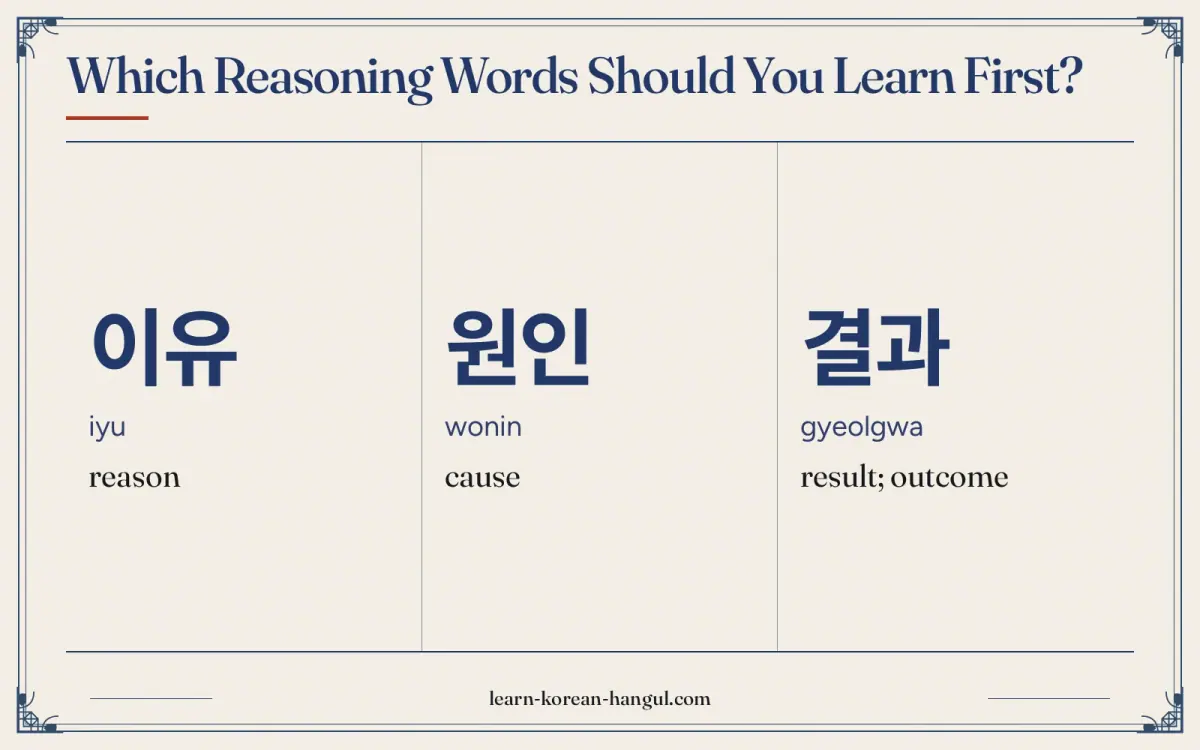
Learn 이유, 방법, 생각, 문제 and 때문 first. With those five you can ask why, say how, give an opinion and name a problem: 왜 그렇게 생각해요? 이유가 뭐예요? (Why do you think so? What is the reason?). Then add 결과, 목적 and 해결, which appear in almost every explanation or report. The group sections are ordered the way an argument is built: reason, method, opinion, problem, comparison.
- Words to say. 이유, 방법, 생각, 문제, 때문. They carry everyday explanations.
- Words to recognise. 원인, 결과, 영향, 목적, 해결. You meet these in news and in essays.
- Words to add later. 입장, 주장, 근거, 방안, 공통점. They make an opinion sound organised.
The scene below shows a classroom with a board of diagrams, with twelve numbered objects that match words in the tables.
Word · 12
- 1
이유
iyu
reason
- 2
원인
wonin
cause
- 3
결과
gyeolgwa
result; outcome
- 4
방법
bangbeop
method; way
- 5
목적
mokjeok
purpose; aim
- 6
의견
uigyeon
opinion
- 7
생각
saenggak
thought; opinion
- 8
입장
ipjang
position; stance
- 9
문제
munje
problem; question
- 10
해결
haegyeol
solution; resolving
- 11
차이
chai
difference
- 12
비교
bigyo
comparison
Reason and Result (이유, 결과, 원인)
This group answers 왜 (why). 이유 is the reason a person gives, 원인 is the cause of an event, and 결과 is what followed. The last three words are connectors in noun form: 때문 (because of), 영향 (influence) and 덕분 (thanks to).
| No. | Hangul | Revised Romanization | Meaning and note | Example sentence | Audio assetId |
|---|---|---|---|---|---|
| 1 | 이유 | iyu | reason. The explanation a person gives for an action. Ask 이유가 뭐예요? | 늦은 이유가 뭐예요? (What is the reason you are late?) | au-pg-vocabulary-function-words-discourse-nouns-1; example: au-pg-vocabulary-function-words-discourse-nouns-31 |
| 2 | 원인 | wonin | cause. The thing that makes an event or problem happen. Said [워닌]. | 사고의 원인을 찾고 있어요. (I am looking for the cause of the accident.) | au-pg-vocabulary-function-words-discourse-nouns-2; example: au-pg-vocabulary-function-words-discourse-nouns-32 |
| 3 | 결과 | gyeolgwa | result; outcome. What happens in the end. | 시험 결과가 나왔어요. (The exam results are out.) | au-pg-vocabulary-function-words-discourse-nouns-3; example: au-pg-vocabulary-function-words-discourse-nouns-33 |
| 4 | 때문 | ttaemun | reason; because of. A dependent noun used as 때문에 (because of) or 때문이다. | 비 때문에 못 갔어요. (I couldn't go because of the rain.) | au-pg-vocabulary-function-words-discourse-nouns-4; example: au-pg-vocabulary-function-words-discourse-nouns-34 |
| 5 | 영향 | yeonghyang | influence; effect. Give one with 주다: 영향을 주다. | 날씨가 기분에 영향을 줘요. (The weather affects your mood.) | au-pg-vocabulary-function-words-discourse-nouns-5; example: au-pg-vocabulary-function-words-discourse-nouns-35 |
| 6 | 덕분 | deokbun | thanks to; credit. Said [덕뿐]. Used for good results: 덕분에. | 선생님 덕분에 시험에 합격했어요. (Thanks to my teacher, I passed the exam.) | au-pg-vocabulary-function-words-discourse-nouns-6; example: au-pg-vocabulary-function-words-discourse-nouns-36 |
The pair 때문에 and 덕분에 matters more than it looks. 때문에 is neutral or negative, as in 비 때문에 (because of the rain), and 덕분에 gives credit for a good result. Using the wrong one changes the tone of the whole sentence.
Example Sentences
The examples use three frames. The first is noun + 이/가 + descriptive verb, as in 방법이 있어요. The second is noun + 을/를 + verb, as in 문제를 해결했어요. The third is noun + 은/는 + noun + 이에요/예요, as in 올해 목표는 한국어 공부예요. Particles follow the last sound of the noun: 이유가 (vowel, so 가), 결과가 (vowel, so 가), 문제를 (vowel, so 를) and 방법이 (consonant, so 이). Say each sentence aloud after the audio and replace the noun with another from the table.
How Do You Say Method and Purpose (방법, 목적) in Korean?
This group answers 어떻게 (how) and 왜 (why, in the sense of "what for"). A method is a way to do something, a purpose is why you do it, and a goal is what you aim to reach. A plan, a process and a stage describe how the work unfolds.
| No. | Hangul | Revised Romanization | Meaning and note | Example sentence | Audio assetId |
|---|---|---|---|---|---|
| 7 | 방법 | bangbeop | method; way. The way to do something. 방법이 있어요 means "there is a way". | 좋은 방법이 있어요. (There is a good way.) | au-pg-vocabulary-function-words-discourse-nouns-7; example: au-pg-vocabulary-function-words-discourse-nouns-37 |
| 8 | 목적 | mokjeok | purpose; aim. Said [목쩍]. The reason you do something. | 이 모임의 목적은 친구 사귀기예요. (The purpose of this meeting is making friends.) | au-pg-vocabulary-function-words-discourse-nouns-8; example: au-pg-vocabulary-function-words-discourse-nouns-38 |
| 9 | 목표 | mokpyo | goal; target. What you aim to reach. 목표를 세우다 means to set a goal. | 올해 목표는 한국어 공부예요. (This year's goal is studying Korean.) | au-pg-vocabulary-function-words-discourse-nouns-9; example: au-pg-vocabulary-function-words-discourse-nouns-39 |
| 10 | 계획 | gyehoek | plan. 계획을 세우다 means to make a plan. | 여행 계획을 세웠어요. (I made a travel plan.) | au-pg-vocabulary-function-words-discourse-nouns-10; example: au-pg-vocabulary-function-words-discourse-nouns-40 |
| 11 | 과정 | gwajeong | process; course. The steps by which something happens. Also a course of study. | 결과보다 과정이 중요해요. (The process is more important than the result.) | au-pg-vocabulary-function-words-discourse-nouns-11; example: au-pg-vocabulary-function-words-discourse-nouns-41 |
| 12 | 단계 | dangye | step; stage. One stage in a process. | 첫 번째 단계는 계획이에요. (The first stage is planning.) | au-pg-vocabulary-function-words-discourse-nouns-12; example: au-pg-vocabulary-function-words-discourse-nouns-42 |
Look at the particle 보다 in the example 결과보다 과정이 중요해요. It means "than" and makes a comparison: A보다 B가 더 ... (B is more ... than A). Comparison nouns come later in this list, and you will use 보다 with them.
Opinion (의견, 생각)
Opinion words let you state a view and defend it. 생각 is a thought and 의견 is an opinion stated to others. 입장 is your position, 주장 is a claim, 근거 is the evidence and 판단 is your judgement. Together they form the structure of a short argument.
| No. | Hangul | Revised Romanization | Meaning and note | Example sentence | Audio assetId |
|---|---|---|---|---|---|
| 13 | 의견 | uigyeon | opinion. Said [의견]. Say 제 의견은 ... to introduce your view. | 제 의견을 말해도 될까요? (May I give my opinion?) | au-pg-vocabulary-function-words-discourse-nouns-13; example: au-pg-vocabulary-function-words-discourse-nouns-43 |
| 14 | 생각 | saenggak | thought; opinion. 생각하다 means to think. | 저는 그렇게 생각해요. (I think so.) | au-pg-vocabulary-function-words-discourse-nouns-14; example: au-pg-vocabulary-function-words-discourse-nouns-44 |
| 15 | 입장 | ipjang | position; stance. Said [입짱]. A different word with the same spelling, 입장 (入場), means "entry; admission", as in 입장료 (admission fee). | 상대방의 입장도 생각해 보세요. (Please also think about the other person's position.) | au-pg-vocabulary-function-words-discourse-nouns-15; example: au-pg-vocabulary-function-words-discourse-nouns-45 |
| 16 | 주장 | jujang | claim; argument. 주장하다 means to claim. | 그의 주장에 동의해요. (I agree with his claim.) | au-pg-vocabulary-function-words-discourse-nouns-16; example: au-pg-vocabulary-function-words-discourse-nouns-46 |
| 17 | 근거 | geungeo | evidence; basis. What supports a claim. | 의견에는 근거가 필요해요. (An opinion needs evidence.) | au-pg-vocabulary-function-words-discourse-nouns-17; example: au-pg-vocabulary-function-words-discourse-nouns-47 |
| 18 | 판단 | pandan | judgement. 판단하다 means to judge. | 정확한 판단이 중요해요. (Accurate judgement is important.) | au-pg-vocabulary-function-words-discourse-nouns-18; example: au-pg-vocabulary-function-words-discourse-nouns-48 |
The two words 생각 and 의견 overlap, but not fully. 제 생각에는 (in my opinion) works almost anywhere, from chat to essays. 의견 sounds more formal and is the usual word in meetings and writing, as in 제 의견은 (my opinion is). The spelling 입장 is shared by two words, "position" and "admission", so the topic decides which.
How Do You Say Problem and Solution (문제, 해결) in Korean?
Problem and solution words are the second half of most explanations. You name a problem (문제), mention the difficulty (어려움), say what is needed (필요) and propose a measure (방안) or effect (효과). The solution itself is 해결, usually with 하다: 해결하다 (to solve).
| No. | Hangul | Revised Romanization | Meaning and note | Example sentence | Audio assetId |
|---|---|---|---|---|---|
| 19 | 문제 | munje | problem; question. Also an exam question. | 문제가 생겼어요. (A problem has come up.) | au-pg-vocabulary-function-words-discourse-nouns-19; example: au-pg-vocabulary-function-words-discourse-nouns-49 |
| 20 | 해결 | haegyeol | solution; resolving. 해결하다 means to solve. | 문제를 해결했어요. (I solved the problem.) | au-pg-vocabulary-function-words-discourse-nouns-20; example: au-pg-vocabulary-function-words-discourse-nouns-50 |
| 21 | 방안 | bangan | plan; measure. A formal word for a proposed way of dealing with something. | 새로운 방안을 찾고 있어요. (We are looking for a new measure.) | au-pg-vocabulary-function-words-discourse-nouns-21; example: au-pg-vocabulary-function-words-discourse-nouns-51 |
| 22 | 어려움 | eoryeoum | difficulty. From 어렵다 (to be hard). | 어려움이 있으면 말씀해 주세요. (If you have difficulties, please tell me.) | au-pg-vocabulary-function-words-discourse-nouns-22; example: au-pg-vocabulary-function-words-discourse-nouns-52 |
| 23 | 필요 | piryo | need; necessity. Said [피료]. 필요하다 means to be necessary. | 이 일에는 시간이 필요해요. (This job needs time.) | au-pg-vocabulary-function-words-discourse-nouns-23; example: au-pg-vocabulary-function-words-discourse-nouns-53 |
| 24 | 효과 | hyogwa | effect; effectiveness. 효과가 있다 means to be effective. | 이 방법은 효과가 있어요. (This method is effective.) | au-pg-vocabulary-function-words-discourse-nouns-24; example: au-pg-vocabulary-function-words-discourse-nouns-54 |
The word 문제 has two meanings, "problem" and "test question", and the context decides which. 문제가 생겼어요 means "a problem has come up", but in a classroom 문제를 풀어요 means "I work through the questions", because 문제 is also the word for a test item. A question you ask a person is 질문, not 문제.
Comparison (차이, 비교)
Comparison words are the last group. They let you set two things side by side, name what is shared and what differs, and judge the advantages and disadvantages. 차이 and 비교 are the core pair, and 장점 and 단점 are the pair you will use most often in an essay.
| No. | Hangul | Revised Romanization | Meaning and note | Example sentence | Audio assetId |
|---|---|---|---|---|---|
| 25 | 차이 | chai | difference. Ask 차이가 뭐예요? to find out the difference. | 두 방법의 차이가 커요. (The difference between the two methods is big.) | au-pg-vocabulary-function-words-discourse-nouns-25; example: au-pg-vocabulary-function-words-discourse-nouns-55 |
| 26 | 비교 | bigyo | comparison. 비교하다 means to compare. | 두 가격을 비교해 보세요. (Please compare the two prices.) | au-pg-vocabulary-function-words-discourse-nouns-26; example: au-pg-vocabulary-function-words-discourse-nouns-56 |
| 27 | 공통점 | gongtongjeom | common point. Said [공통쩜]. 공통 (shared) + 점 (point). | 두 나라의 공통점을 찾아요. (I look for the common points of the two countries.) | au-pg-vocabulary-function-words-discourse-nouns-27; example: au-pg-vocabulary-function-words-discourse-nouns-57 |
| 28 | 장점 | jangjeom | advantage; strength. Said [장쩜]. The good side of something. | 이 방법의 장점은 빠른 거예요. (The advantage of this method is that it is fast.) | au-pg-vocabulary-function-words-discourse-nouns-28; example: au-pg-vocabulary-function-words-discourse-nouns-58 |
| 29 | 단점 | danjeom | disadvantage; weakness. Said [단쩜]. The weak side of something. | 단점도 있지만 장점이 더 많아요. (There are drawbacks, but more advantages.) | au-pg-vocabulary-function-words-discourse-nouns-29; example: au-pg-vocabulary-function-words-discourse-nouns-59 |
| 30 | 특징 | teukjing | feature; characteristic. Said [특찡]. What makes something recognisable. | 이 도시의 특징은 조용한 거예요. (The characteristic of this city is that it is quiet.) | au-pg-vocabulary-function-words-discourse-nouns-30; example: au-pg-vocabulary-function-words-discourse-nouns-60 |
The words 장점 and 단점 differ by one letter and a meaning that is the opposite. Remember them by 장 (long, strong, good) for 장점 and 단 (short, lacking) for 단점. The pair almost always appears together in a comparison: 장점과 단점 (advantages and disadvantages).
How Do 이유 and 원인, and 목적 and 목표, Differ?
Two pairs cause the most confusion, because English often translates both words in each pair with one word. The table sets the pairs side by side.
| Word | Core idea | Typical sentence |
|---|---|---|
| 이유 | the reason a person gives for a choice or action | 늦은 이유를 말해 주세요 (Please tell me the reason you are late) |
| 원인 | the cause of an event or a problem | 사고의 원인을 조사해요 (They investigate the cause of the accident) |
| 목적 | the purpose, the "what for" behind an action | 여행의 목적은 휴식이에요 (The purpose of the trip is rest) |
| 목표 | a goal you aim to reach, often measurable | 이번 달 목표는 단어 오십 개예요 (This month's goal is fifty words) |
In short, 이유 is the human reason and 원인 is the cause behind an event. 목적 is why you act, and 목표 is the target. Both pairs can overlap in real speech, so treat the table as a guide and not a hard rule.
Which Sentence Frames Carry These Words?
Reasoning nouns work best inside a few fixed frames. The table lists five frames with a spoken or written example. Written Korean often ends in -다 where spoken Korean ends in -요.
| Frame | Example | Meaning |
|---|---|---|
| A 때문에 B | 비 때문에 못 갔어요. | I couldn't go because of the rain. |
| A는 B 때문이다 | 그가 늦은 것은 사고 때문이다. | He was late because of an accident. |
| A 덕분에 B | 선생님 덕분에 합격했어요. | Thanks to my teacher, I passed. |
| A하는 방법은 B | 단어를 외우는 방법은 여러 가지가 있다. | There are several ways to memorise words. |
| 제 생각에는 A | 제 생각에는 아침 운동이 좋아요. | In my opinion, morning exercise is good. |
To connect two sentences with a reason, add a conjunction from the conjunctions page, such as 그래서 (so) or 왜냐하면 (because). These frames are also the base of exam answers: the TOPIK writing section asks candidates to explain and give opinions, so the nouns on this page appear often. Check topik.go.kr for the current exam format, and see TOPIK writing for practice.
How Do You Build a Short Opinion with Eight of These Words?
Here is a short opinion paragraph in formal written Korean (the -ㅂ니다 style) that uses eight words from the list: 방법, 목표, 계획, 의견, 이유, 효과, 단점 and 결과.
저는 한국어 공부에서 가장 중요한 것은 방법이라고 생각합니다. 목표가 분명하면 계획을 세우기 쉽습니다. 제 의견은 매일 조금씩 공부하는 것입니다. 그 이유는 효과가 크기 때문입니다. 단점은 시간이 걸리는 것이지만, 결과는 좋습니다.
The English meaning is: "I think the most important thing in studying Korean is the method. If the goal is clear, it is easy to make a plan. My opinion is to study a little every day. The reason is that the effect is large. The disadvantage is that it takes time, but the result is good." Notice how each sentence has one job: claim, support, opinion, reason, then a balance of the downside and the result. Try writing your own version about a topic you care about.
How Do You Pronounce These Words?
Reasoning words are mostly Sino-Korean, so they follow fairly regular sound rules, with a few tense consonants and some links between syllables. The Hangul shows the written form, while the spoken form shifts where one sound meets another. Standard pronunciation follows the National Institute of Korean Language (국립국어원) rules, and the romanization follows the Revised Romanization of Korean, which writes double-letter tense consonants but does not show tensing caused by a neighbouring sound.
| Spelling | Sounds like | What changes |
|---|---|---|
| 원인 | [워닌] | The final ㄴ of 원 links to the vowel of 인. |
| 덕분 | [덕뿐] | After a final ㄱ, ㅂ becomes tense [ㅃ]. |
| 입장 | [입짱] | After a final ㅂ, ㅈ becomes tense [ㅉ]. |
| 특징 | [특찡] | After a final ㄱ, ㅈ becomes tense [ㅉ]. |
| 목적 | [목쩍] | After a final ㄱ, ㅈ becomes tense [ㅉ]. |
| 장점 | [장쩜] | The 점 (point) in these words is said tense; so are 단점 [단쩜] and 공통점 [공통쩜]. RR still writes jeom. |
| 필요 | [피료] | The final ㄹ links to the vowel of 요. |
| 의견 | [의견] | At the start of a word, 의 is said as [의]. |
The vowel ㅢ in 의견 and 의 is the hardest to say, because it starts with the flat ㅡ and glides to ㅣ. Say eu-i quickly, as one syllable. The ㅓ in 견 is unrounded: keep the lips relaxed. In 원 the lips round only for the w glide, then relax for ㅓ. Listen to the clips before you copy them.
Audio and Slow Playback
Every headword and every example sentence has its own audio. The five clips below replay the hardest words slowly. Play one, repeat it aloud, then play it again and compare.
What Mistakes Do Learners Make with Reasoning Words?
Five mistakes appear often.
- Using 이유 and 원인 as the same word. 이유 is the reason a person gives for a choice, and 원인 is the cause of an event. Ask 이유가 뭐예요? to a person, and 원인이 뭐예요? about an accident.
- Using 때문에 for a good result. 비 때문에 못 갔어요 is fine for a problem. For a good outcome, say 덕분에: 선생님 덕분에 합격했어요.
- Mixing 목적 and 목표. A 목적 is why you do something, and a 목표 is the target you aim for. A trip can have a purpose (rest) and a goal (walk ten kilometres).
- Dropping 에 or 이다 after 때문. 때문 needs a partner: 비 때문에 (because of the rain) or 비 때문이다 (it is because of the rain). Saying 비 때문 alone is not a sentence.
- Using only 생각 to state a view. 생각하다 is fine in speech and in essays (the sample paragraph above uses 생각합니다). To name your position more precisely in formal writing, add 의견, 주장 or 입장: 제 주장은 ... (my argument is ...).
If you only fix one, fix the 때문에 and 덕분에 pair, because the wrong choice changes the feeling of the sentence.
Practice: Flashcards and Worksheet
Study in three steps. First, run the flashcard deck in recognition mode until you recognise all 30 words. Second, switch to listening mode and answer from the audio alone. Third, take the quiz. The deck covers all 30 words with audio, and your progress stays in your browser. The vocabulary flashcard decks page lists the other decks.
Practice · 65
- 01이유
Show answer
headword 1: reason
- 02원인
Show answer
headword 2: cause
- 03결과
Show answer
headword 3: result; outcome
- 04때문
Show answer
headword 4: reason; because of
- 05영향
Show answer
headword 5: influence; effect
- 06덕분
Show answer
headword 6: thanks to; credit
- 07방법
Show answer
headword 7: method; way
- 08목적
Show answer
headword 8: purpose; aim
- 09목표
Show answer
headword 9: goal; target
- 10계획
Show answer
headword 10: plan
- 11과정
Show answer
headword 11: process; course
- 12단계
Show answer
headword 12: step; stage
- 13의견
Show answer
headword 13: opinion
- 14생각
Show answer
headword 14: thought; opinion
- 15입장
Show answer
headword 15: position; stance
- 16주장
Show answer
headword 16: claim; argument
- 17근거
Show answer
headword 17: evidence; basis
- 18판단
Show answer
headword 18: judgement
- 19문제
Show answer
headword 19: problem; question
- 20해결
Show answer
headword 20: solution; resolving
- 21방안
Show answer
headword 21: plan; measure
- 22어려움
Show answer
headword 22: difficulty
- 23필요
Show answer
headword 23: need; necessity
- 24효과
Show answer
headword 24: effect; effectiveness
- 25차이
Show answer
headword 25: difference
- 26비교
Show answer
headword 26: comparison
- 27공통점
Show answer
headword 27: common point
- 28장점
Show answer
headword 28: advantage; strength
- 29단점
Show answer
headword 29: disadvantage; weakness
- 30특징
Show answer
headword 30: feature; characteristic
- 31늦은 이유가 뭐예요?
Show answer
example for 이유
- 32사고의 원인을 찾고 있어요.
Show answer
example for 원인
- 33시험 결과가 나왔어요.
Show answer
example for 결과
- 34비 때문에 못 갔어요.
Show answer
example for 때문
- 35날씨가 기분에 영향을 줘요.
Show answer
example for 영향
- 36선생님 덕분에 시험에 합격했어요.
Show answer
example for 덕분
- 37좋은 방법이 있어요.
Show answer
example for 방법
- 38이 모임의 목적은 친구 사귀기예요.
Show answer
example for 목적
- 39올해 목표는 한국어 공부예요.
Show answer
example for 목표
- 40여행 계획을 세웠어요.
Show answer
example for 계획
- 41결과보다 과정이 중요해요.
Show answer
example for 과정
- 42첫 번째 단계는 계획이에요.
Show answer
example for 단계
- 43제 의견을 말해도 될까요?
Show answer
example for 의견
- 44저는 그렇게 생각해요.
Show answer
example for 생각
- 45상대방의 입장도 생각해 보세요.
Show answer
example for 입장
- 46그의 주장에 동의해요.
Show answer
example for 주장
- 47의견에는 근거가 필요해요.
Show answer
example for 근거
- 48정확한 판단이 중요해요.
Show answer
example for 판단
- 49문제가 생겼어요.
Show answer
example for 문제
- 50문제를 해결했어요.
Show answer
example for 해결
- 51새로운 방안을 찾고 있어요.
Show answer
example for 방안
- 52어려움이 있으면 말씀해 주세요.
Show answer
example for 어려움
- 53이 일에는 시간이 필요해요.
Show answer
example for 필요
- 54이 방법은 효과가 있어요.
Show answer
example for 효과
- 55두 방법의 차이가 커요.
Show answer
example for 차이
- 56두 가격을 비교해 보세요.
Show answer
example for 비교
- 57두 나라의 공통점을 찾아요.
Show answer
example for 공통점
- 58이 방법의 장점은 빠른 거예요.
Show answer
example for 장점
- 59단점도 있지만 장점이 더 많아요.
Show answer
example for 단점
- 60이 도시의 특징은 조용한 거예요.
Show answer
example for 특징
- 61원인
Show answer
slow playback: 원인
- 62덕분
Show answer
slow playback: 덕분
- 63필요
Show answer
slow playback: 필요
- 64어려움
Show answer
slow playback: 어려움
- 65공통점
Show answer
slow playback: 공통점
Practice · 6
What does 이유 (iyu) mean?
Show answer
reason
이유 means reason. Example: 늦은 이유가 뭐예요? (What is the reason you are late?)
What does 원인 (wonin) mean?
Show answer
cause
원인 means cause. Example: 사고의 원인을 찾고 있어요. (I am looking for the cause of the accident.)
What does 방법 (bangbeop) mean?
Show answer
method; way
방법 means method; way. Example: 좋은 방법이 있어요. (There is a good way.)
What does 의견 (uigyeon) mean?
Show answer
opinion
의견 means opinion. Example: 제 의견을 말해도 될까요? (May I give my opinion?)
What does 문제 (munje) mean?
Show answer
problem; question
문제 means problem; question. Example: 문제가 생겼어요. (A problem has come up.)
What does 차이 (chai) mean?
Show answer
difference
차이 means difference. Example: 두 방법의 차이가 커요. (The difference between the two methods is big.)
Korean Reasoning Words Vocabulary Worksheet (PDF)
A printable worksheet for these words (word list, matching, writing practice, fill-in-the-blank exercises and answer key) is available in A4 and US Letter from the download card on this page. For practice, write your own short opinion in Korean with three of these words: one reason, one method and one result.
Where to Go Next
After this page, continue with Korean Conjunctions Vocabulary to connect your reasons into longer sentences. For exam writing, open TOPIK writing. To move up a level, return to Korean Pronouns, Question Words and Connectors.
Frequently Asked Questions
How Do You Say Reason in Korean?
Reason is 이유 (iyu). Ask for one with 이유가 뭐예요? (iyuga mwoyeyo?), which means "what is the reason?". The question word 뭐 carries the stress, and the voice does not climb sharply at the end. Use 원인 (wonin) when you mean the cause of an event. Press the audio button to hear 이유.
How Do You Pronounce 원인 (wonin)?
Say wo-nin in two beats, written [워닌]. The final ㄴ of 원 moves to the empty first slot of 인, so it sounds like 워-닌, not "won-in". The lips round only for the w at the start of 원; the ㅓ after it is unrounded. Use the slow clip to repeat it.
How Many Reasoning Words Should I Learn First?
Five first: 이유, 방법, 생각, 문제 and 때문. At five new words a day, the 30-word list takes six days plus review. Learn 때문에 and 덕분에 together in the first week, because they decide the tone of a reason.
Where Can I Practise Reasoning Words with Flashcards?
Use the vocabulary flashcard decks. The deck for this page holds all 30 words with Hangul, romanization and audio, and it offers recognition and listening modes. Your progress stays in your browser, so return daily and review the cards you missed.
Is the Romanization on This Page Official?
It follows the Revised Romanization of Korean, which South Korea adopted on 7 July 2000 and whose rules the National Institute of Korean Language (국립국어원) publishes. It is a learning aid and does not show every sound change, so rely on the Hangul and the audio.
Is There a Printable Worksheet for Reasoning Words?
A printable worksheet for these words (word list, matching, writing practice, fill-in-the-blank exercises and answer key) is available in A4 and US Letter from the download card on this page. For practice, copy the tables on this page by hand or use the flashcard deck, which carries the same 30 words.