Korean Conjunctions Vocabulary at a Glance
A conjunction is a word that links two ideas, such as and, but or so. In Korean, the words on this page are linking adverbs. They stand at the start of a sentence and connect it to the sentence before. A second kind of link sits inside the sentence, as a verb ending such as -아서 (because) or -지만 (but). This page covers the first kind, and the connectors page covers the second.
The list has 25 words in five groups. Many of the words come in pairs of a spoken form and a written form, so the page labels the register next to each one. The words sit at A2, because they work across two sentences and need confidence with the polite endings of the previous lessons. The list sits inside Korean Pronouns, Question Words and Connectors.
| Group | Words | Examples |
|---|---|---|
| And and then | 5 | 그리고, 그러면, 그럼, 및 |
| But | 6 | 그런데, 근데, 하지만, 그러나 |
| Because and so | 5 | 그래서, 그러니까, 그러므로, 왜냐하면 |
| Or and also | 4 | 또는, 아니면, 또한, 또 |
| Order | 5 | 먼저, 우선, 그다음, 마지막으로 |
By word origin, the list has 23 native and 2 Sino-Korean entries. Most connectors are native Korean words, and many are built from 그 (that), which points back to what was just said. 우선 and 결국 are the only Sino-Korean words.
Which Conjunctions Should You Learn First?
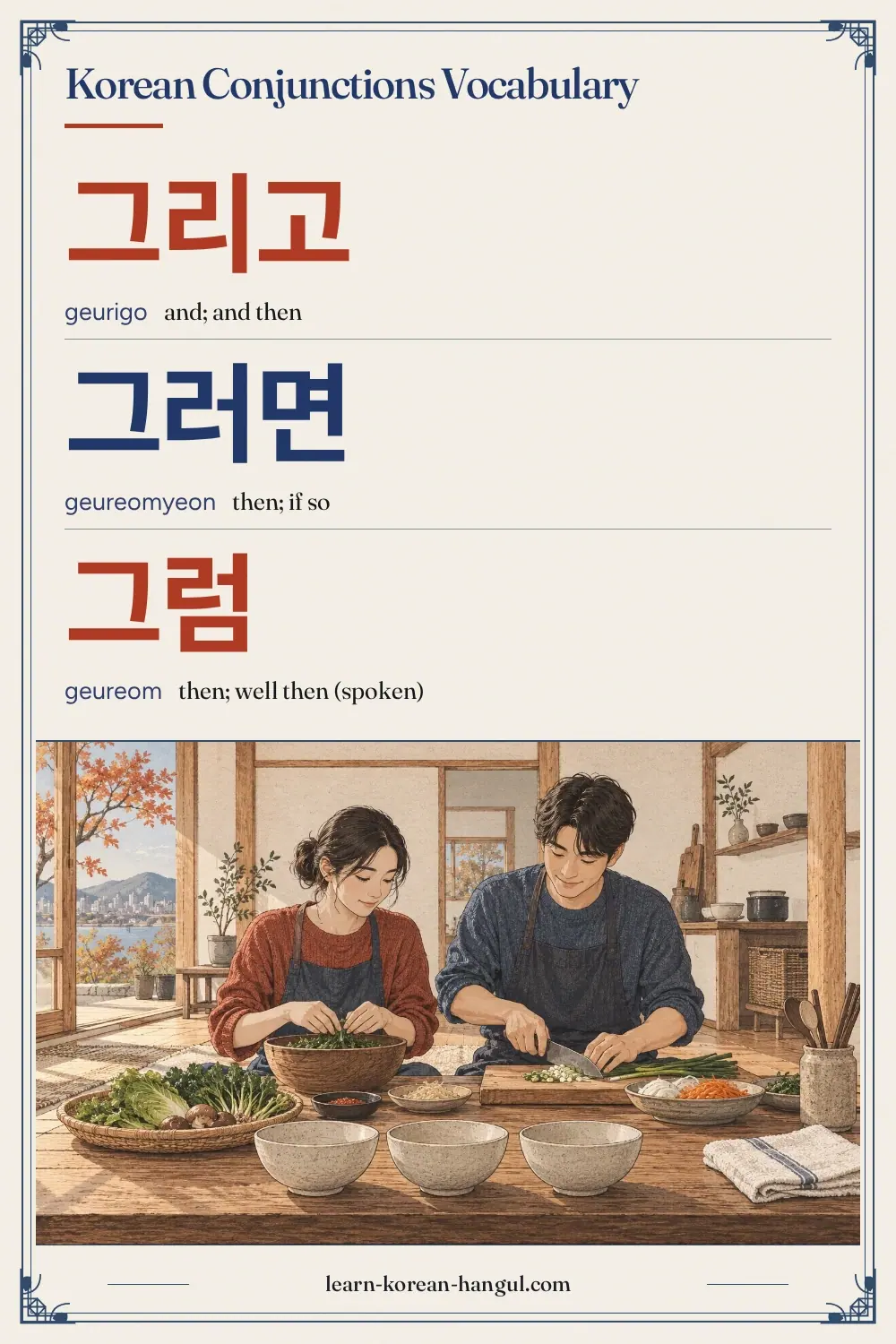
Start with five words that cover most links: 그리고, 그런데, 하지만, 그래서 and 그러면. Press play, then the slow button, and say each word aloud.
그리고 (geurigo) means and; and then. It joins two sentences and adds a new fact, much like English and at the start of a sentence. It links ideas and actions, but for two nouns the usual choice is 하고 or 와/과. Example: 저는 커피를 마셔요. 그리고 빵도 먹어요. (I drink coffee. And I also eat bread.)
그런데 (geureonde) means but; by the way. It does two jobs. It means but when the second idea contrasts with the first, and it means by the way when you change the topic. Context shows which one is meant. Example: 날씨가 좋아요. 그런데 바람이 불어요. (The weather is nice. But the wind is blowing.)
하지만 (hajiman) means but; however. It means but, and it is the most useful word of the contrast group because it suits speech and writing, formal and informal. Example: 한국어는 어려워요. 하지만 재미있어요. (Korean is hard. But it is fun.)
그래서 (geuraeseo) means so; therefore. It means so or therefore, and it states the result of the sentence before. The sentence before gives the cause, so 그래서 never starts a text. Example: 비가 와요. 그래서 집에 있어요. (It is raining. So I am staying home.)
그러면 (geureomyeon) means then; if so. It means then or if so, and the 면 ending shows a condition. It is used to say what follows from what was just said. Example: 지금 출발하세요. 그러면 늦지 않아요. (Leave now. Then you will not be late.)
And and Then (그리고, 그러면)
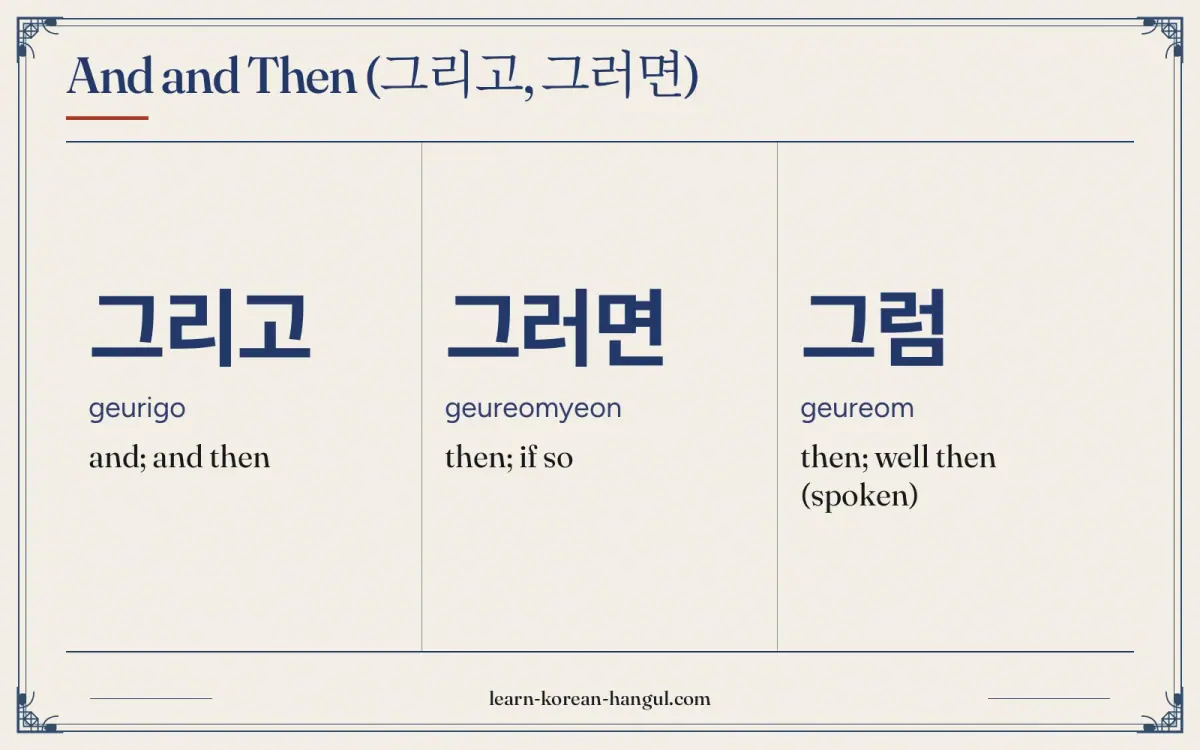
These five words add information or draw a conclusion. 그리고 adds, 그러면 and 그럼 conclude, 및 is for forms and 게다가 piles on.
| No. | Hangul | Revised Romanization | Meaning | Origin | Example sentence | Audio assetId |
|---|---|---|---|---|---|---|
| 1 | 그리고 | geurigo | and; and then | native | 저는 커피를 마셔요. 그리고 빵도 먹어요. (jeoneun keopireul masyeoyo geurigo ppangdo meogeoyo; I drink coffee. And I also eat bread.) | au-pg-vocabulary-function-words-conjunctions-1; example: au-pg-vocabulary-function-words-conjunctions-101 |
| 2 | 그러면 | geureomyeon | then; if so | native | 지금 출발하세요. 그러면 늦지 않아요. (jigeum chulbalhaseyo geureomyeon neutji anayo; Leave now. Then you will not be late.) | au-pg-vocabulary-function-words-conjunctions-2; example: au-pg-vocabulary-function-words-conjunctions-102 |
| 3 | 그럼 | geureom | then; well then (spoken) | native | 그럼 내일 만나요. (geureom naeil mannayo; Then let us meet tomorrow.) | au-pg-vocabulary-function-words-conjunctions-3; example: au-pg-vocabulary-function-words-conjunctions-103 |
| 4 | 및 | mit | and (in forms and notices) | native | 이름 및 전화번호를 쓰세요. (ireum mit jeonhwabeonhoreul sseuseyo; Write your name and phone number.) | au-pg-vocabulary-function-words-conjunctions-4; example: au-pg-vocabulary-function-words-conjunctions-104 |
| 5 | 게다가 | gedaga | moreover; on top of that | native | 이 식당은 맛있어요. 게다가 싸요. (i sikdangeun masisseoyo gedaga ssayo; This restaurant is tasty. On top of that, it is cheap.) | au-pg-vocabulary-function-words-conjunctions-5; example: au-pg-vocabulary-function-words-conjunctions-105 |
- 그리고: It links two whole sentences. To join two nouns inside a sentence, use 하고, as in 커피하고 빵 (coffee and bread).
- 그러면: The word is made of 그러다 (to do so) and 면 (if). It states what follows if the earlier sentence is true.
- 그럼: It is the short spoken form of 그러면. It also means of course in the phrase 그럼요.
- 및: It joins nouns in forms, notices and rules. It is written Korean and sounds stiff in conversation.
- 게다가: It adds a further point that supports the same argument. Both facts have to point in the same direction.
Example Sentences
The best way to feel these words is to read them in a short paragraph. In the text below, each conjunction is in bold. 어제는 날씨가 좋았어요. 그래서 공원에 갔어요. 그런데 사람이 너무 많았어요. 그래도 재미있었어요. 그리고 저녁에는 친구를 만났어요. In English: The weather was good yesterday. So I went to the park. But there were too many people. Even so, it was fun. And in the evening I met a friend. Each sentence stands alone, and the conjunction tells you how it relates to the one before. The table gives the spoken and written pairs.
| Everyday or spoken | Written or formal | Difference |
|---|---|---|
| 근데 | 그런데 | 근데 is for chat, 그런데 for all uses |
| 그럼 | 그러면 | 그럼 is shorter and spoken |
| 그러니까 | 그러므로 | 그러므로 is for essays and reports |
| 하지만 | 그러나 | 그러나 is written only |
| 아니면 | 또는 | 또는 is formal and written |
How Do You Say but (그런데, 하지만) in Korean?
Korean has six words for contrast, and the choice depends on the strength of the contrast and the register. They range from the soft 그런데 to the strong 그러나.
| No. | Hangul | Revised Romanization | Meaning | Origin | Example sentence | Audio assetId |
|---|---|---|---|---|---|---|
| 6 | 그런데 | geureonde | but; by the way | native | 날씨가 좋아요. 그런데 바람이 불어요. (nalssiga joayo geureonde barami bureoyo; The weather is nice. But the wind is blowing.) | au-pg-vocabulary-function-words-conjunctions-6; example: au-pg-vocabulary-function-words-conjunctions-106 |
| 7 | 근데 | geunde | but; by the way (spoken) | native | 근데 너 어디 가? (geunde neo eodi ga; By the way, where are you going?) | au-pg-vocabulary-function-words-conjunctions-7; example: au-pg-vocabulary-function-words-conjunctions-107 |
| 8 | 하지만 | hajiman | but; however | native | 한국어는 어려워요. 하지만 재미있어요. (hangugeoneun eoryeowoyo hajiman jaemiisseoyo; Korean is hard. But it is fun.) | au-pg-vocabulary-function-words-conjunctions-8; example: au-pg-vocabulary-function-words-conjunctions-108 |
| 9 | 그러나 | geureona | but; however (written) | native | 그는 노력했다. 그러나 실패했다. (geuneun noryeokaetda geureona silpaehaetda; He tried hard. But he failed.) | au-pg-vocabulary-function-words-conjunctions-9; example: au-pg-vocabulary-function-words-conjunctions-109 |
| 10 | 그렇지만 | geureochiman | but; nevertheless | native | 피곤해요. 그렇지만 가야 해요. (pigonhaeyo geureochiman gaya haeyo; I am tired. But I have to go.) | au-pg-vocabulary-function-words-conjunctions-10; example: au-pg-vocabulary-function-words-conjunctions-110 |
| 11 | 그래도 | geuraedo | even so; still | native | 비가 와요. 그래도 나갈 거예요. (biga wayo geuraedo nagal geoyeyo; It is raining. Even so, I will go out.) | au-pg-vocabulary-function-words-conjunctions-11; example: au-pg-vocabulary-function-words-conjunctions-111 |
- 그런데: This is the softest of the contrast words. It also opens a new topic, as in 그런데 이름이 뭐예요? (By the way, what is your name?).
- 근데: It is the spoken short form of 그런데 and is common in chat. Avoid it in an essay or an email to a teacher. The example is in casual speech (반말), as used between friends.
- 하지만: It contrasts the second idea with the first, in speech and in writing. This is the safest default.
- 그러나: It is a written word, used in articles, books and formal speeches. The sentences are in the plain written style that ends in -다.
- 그렇지만: It is close to 하지만 but a little firmer: it grants the first point and then pushes against it. It is used in speech and in writing.
- 그래도: It concedes the first idea but keeps the plan. The second sentence usually expresses a decision.
Because and so (그래서, 왜냐하면)
The causal words work in two directions. 그래서 and 그러니까 state a result of the sentence before, and 왜냐하면 introduces the reason for what was just said.
| No. | Hangul | Revised Romanization | Meaning | Origin | Example sentence | Audio assetId |
|---|---|---|---|---|---|---|
| 12 | 그래서 | geuraeseo | so; therefore | native | 비가 와요. 그래서 집에 있어요. (biga wayo geuraeseo jibe isseoyo; It is raining. So I am staying home.) | au-pg-vocabulary-function-words-conjunctions-12; example: au-pg-vocabulary-function-words-conjunctions-112 |
| 13 | 그러니까 | geureonikka | so; therefore; I mean | native | 늦었어요. 그러니까 빨리 가요. (neujeosseoyo geureonikka ppalli gayo; It is late. So let us go quickly.) | au-pg-vocabulary-function-words-conjunctions-13; example: au-pg-vocabulary-function-words-conjunctions-113 |
| 14 | 그러므로 | geureomeuro | therefore (written) | native | 시간이 없다. 그러므로 서둘러야 한다. (sigani eopda geureomeuro seodulleoya handa; There is no time. Therefore we must hurry.) | au-pg-vocabulary-function-words-conjunctions-14; example: au-pg-vocabulary-function-words-conjunctions-114 |
| 15 | 왜냐하면 | waenyahamyeon | because | native | 저는 늦었어요. 왜냐하면 버스가 늦게 왔기 때문이에요. (jeoneun neujeosseoyo waenyahamyeon beoseuga neutge watgi ttaemunieyo; I am late. Because the bus came late.) | au-pg-vocabulary-function-words-conjunctions-15; example: au-pg-vocabulary-function-words-conjunctions-115 |
| 16 | 따라서 | ttaraseo | therefore; accordingly | native | 비용이 올랐다. 따라서 가격도 올랐다. (biyongi ollatda ttaraseo gagyeokdo ollatda; Costs rose. Therefore prices rose as well.) | au-pg-vocabulary-function-words-conjunctions-16; example: au-pg-vocabulary-function-words-conjunctions-116 |
- 그래서: The same idea inside one sentence is 비가 와서 집에 있어요, with the ending -아서 (see connectors).
- 그러니까: It points to a conclusion the listener should draw, often followed by a request or a suggestion. It also restates an idea, much like I mean.
- 그러므로: It is the written, logical form, found in essays and reports. The ending 므로 makes it formal.
- 왜냐하면: The reason clause usually ends in -기 때문이에요 (it is because), or -기 때문이다 in writing. The word starts with 왜 (why).
- 따라서: It is a written word that shows a logical result, and it is common in news and reports.
How Do You Say or and Also (또는, 또한) in Korean?
Or and also offer a choice or add one more item. The first two are choices and the last two add.
| No. | Hangul | Revised Romanization | Meaning | Origin | Example sentence | Audio assetId |
|---|---|---|---|---|---|---|
| 17 | 또는 | ttoneun | or (written) | native | 커피 또는 차를 드시겠어요? (keopi ttoneun chareul deusigesseoyo; Would you like coffee or tea?) | au-pg-vocabulary-function-words-conjunctions-17; example: au-pg-vocabulary-function-words-conjunctions-117 |
| 18 | 아니면 | animyeon | or; if not | native | 커피 마실래요? 아니면 차 마실래요? (keopi masillaeyo animyeon cha masillaeyo; Do you want coffee? Or do you want tea?) | au-pg-vocabulary-function-words-conjunctions-18; example: au-pg-vocabulary-function-words-conjunctions-118 |
| 19 | 또한 | ttohan | also; moreover | native | 그 사람은 가수이고 또한 배우예요. (geu sarameun gasuigo ttohan baeuyeyo; That person is a singer and also an actor.) | au-pg-vocabulary-function-words-conjunctions-19; example: au-pg-vocabulary-function-words-conjunctions-119 |
| 20 | 또 | tto | again; also | native | 오늘 또 비가 와요. (oneul tto biga wayo; It is raining again today.) | au-pg-vocabulary-function-words-conjunctions-20; example: au-pg-vocabulary-function-words-conjunctions-120 |
- 또는: It offers a choice between two or more items in a formal tone, as in forms and menus.
- 아니면: The word literally means if it is not, and it offers an alternative in speech. It stands between two questions.
- 또한: It adds another quality of the same subject, in speech and in writing.
- 또: Its main meaning is again, and it adds more of the same. It is a short, common word in everyday speech.
Order (먼저, 그다음)
The order words guide an instruction or a story from the first step to the last, and they are the words of recipes, directions and routines.
| No. | Hangul | Revised Romanization | Meaning | Origin | Example sentence | Audio assetId |
|---|---|---|---|---|---|---|
| 21 | 먼저 | meonjeo | first; ahead of others | native | 먼저 손을 씻으세요. (meonjeo soneul ssiseuseyo; First, wash your hands.) | au-pg-vocabulary-function-words-conjunctions-21; example: au-pg-vocabulary-function-words-conjunctions-121 |
| 22 | 우선 | useon | first of all; for now | Sino-Korean | 우선 이름을 쓰세요. (useon ireumeul sseuseyo; First of all, write your name.) | au-pg-vocabulary-function-words-conjunctions-22; example: au-pg-vocabulary-function-words-conjunctions-122 |
| 23 | 그다음 | geudaeum | after that; next | native | 먼저 씻어요. 그다음 밥을 먹어요. (meonjeo ssiseoyo geudaeum babeul meogeoyo; First I wash. Then I eat.) | au-pg-vocabulary-function-words-conjunctions-23; example: au-pg-vocabulary-function-words-conjunctions-123 |
| 24 | 마지막으로 | majimageuro | finally; lastly | native | 마지막으로 소금을 넣어요. (majimageuro sogeumeul neoeoyo; Finally, add the salt.) | au-pg-vocabulary-function-words-conjunctions-24; example: au-pg-vocabulary-function-words-conjunctions-124 |
| 25 | 결국 | gyeolguk | in the end; after all | Sino-Korean | 결국 우리가 이겼어요. (gyeolguk uriga igyeosseoyo; In the end, we won.) | au-pg-vocabulary-function-words-conjunctions-25; example: au-pg-vocabulary-function-words-conjunctions-125 |
- 먼저: It also means going before someone else, as in 먼저 가세요 (please go first).
- 우선: It starts a list of steps and suggests that other steps follow. It is slightly more formal than 먼저.
- 그다음: The spelling is 그다음 and 그 다음 is also seen. Use it between steps.
- 마지막으로: The 으로 ending turns the noun 마지막 (the last) into an adverb. It announces the final step.
- 결국: It marks a result that came after a long process, whether the result is good or bad.
How Do You Pronounce These Words?
Most connectors sound as they are spelled. Five are worth listening to, including one that learners often over-correct, based on the Standard Pronunciation rules (표준 발음법) of the 국립국어원.
| Word | Romanization | Said | Rule |
|---|---|---|---|
| 그렇지만 | geureochiman | [그러치만] | the ㅎ and the following ㅈ combine into one ㅊ sound |
| 마지막으로 | majimageuro | [마지마그로] | the final ㄱ of 막 moves onto the empty ㅇ of 으 |
| 결국 | gyeolguk | [결국] | no change: in Sino-Korean words only ㄷ, ㅅ and ㅈ turn tense after ㄹ, so the ㄱ stays plain |
| 및 | mit | [믿] | the final ㅊ is said as ㄷ at the end of a word |
| 그러니까 | geureonikka | [그러니까] | no change; the ㄲ is a real tense consonant, so the sound is tight and short |
Revised Romanization is the official romanization system of South Korea, announced on 7 July 2000. It follows most sound changes, so 그렇지만 is written geureochiman to match [그러치만], but it does not show tensing caused by a neighbouring sound. It is only a learning aid. Always read the Hangul as well.
Audio and Slow Playback
Each headword and each example sentence has its own audio clip, and the 5 words in the first-words section also have a slow clip at 0.8 times the speed. Nothing plays until you press a button. Listen to 그렇지만 and 하지만 one after the other and hear how the ㅎ changes the first.
What Mistakes Do Learners Make with Conjunctions?
- Using 그리고 between two nouns. For coffee and bread, say 커피하고 빵 or 커피와 빵. 그리고 joins sentences.
- Starting a text with 그래서. The word needs a cause in the sentence before it.
- Using 그러나 or 그러므로 in conversation. They are written words, and 하지만 and 그러니까 are the spoken choices.
- Putting 그래서 and -아서 together. 비가 와서 그래서 is double marking. Choose one: 비가 와서 or 비가 와요. 그래서.
- Ending a 왜냐하면 sentence with a plain verb. The usual pattern is 왜냐하면 ... -기 때문이에요, or ... -거든요 in relaxed speech.
- Treating 그런데 as always meaning but. It also changes the topic, and the context tells you which.
Practice: Flashcards and Worksheet
Drill all 25 words with the vocabulary flashcard decks: each card shows the Hangul on one side and the meaning on the other, so you can test yourself in both directions. Consult the vocabulary worksheets page for printable sheets; for practice, write the Korean word for each numbered arrow in the scene above by hand. A simple plan is to learn the first three groups in one week, one group per day, and to write one two-sentence pair for each word using a real fact from your day. Then read the paragraph above again and replace each conjunction with another one that also fits.
Self-Test: 10 Sentences
Fill each blank with a word from this page. Say the whole sentence aloud when you have it. The answers follow the test.
- 저는 커피를 마셔요. ___ 빵도 먹어요. (I drink coffee. And I also eat bread.)
- ___ 내일 만나요. (Then let us meet tomorrow.)
- 날씨가 좋아요. ___ 바람이 불어요. (The weather is nice. But the wind is blowing.)
- 한국어는 어려워요. ___ 재미있어요. (Korean is hard. But it is fun.)
- 비가 와요. ___ 나갈 거예요. (It is raining. Even so, I will go out.)
- 늦었어요. ___ 빨리 가요. (It is late. So let us go quickly.)
- 비용이 올랐다. ___ 가격도 올랐다. (Costs rose. Therefore prices rose as well.)
- 커피 마실래요? ___ 차 마실래요? (Do you want coffee? Or do you want tea?)
- ___ 손을 씻으세요. (First, wash your hands.)
- 먼저 씻어요. ___ 밥을 먹어요. (First I wash. Then I eat.)
Answers: 1. 그리고; 2. 그럼; 3. 그런데; 4. 하지만; 5. 그래도; 6. 그러니까; 7. 따라서; 8. 아니면; 9. 먼저; 10. 그다음.
A score of 8 or more suggests the words are settling in. If you scored lower, reread the groups where you missed words.
Where to Go Next
This Korean conjunctions vocabulary list sits inside Korean Pronouns, Question Words and Connectors. Continue with Korean Question Words and Korean Reasoning Words Vocabulary. For the connecting endings that join clauses inside one sentence, see connectors.
FAQ
How Do You Say and in Korean?
Say 그리고 (geurigo) at the start of a sentence to add a new fact, as in 그리고 빵도 먹어요 (And I also eat bread). To join two nouns, use 하고 or 와/과 instead, as in 커피하고 빵 (coffee and bread). Inside one sentence, the ending -고 links two actions, as in 커피를 마시고 빵을 먹어요.
How Do You Pronounce 그런데 (geureonde)?
Say geu-reon-de. The first vowel ㅡ is made with spread lips, like a short "uh" with no rounding. The ㄹ is a light flap between vowels. The last syllable 데 is like English "deh". In fast speech it shrinks to 근데 (geunde), which is fine in chat but not in an essay.
How Many Conjunctions Should I Learn First?
Learn the five words in the first-words section: 그리고, 그런데, 하지만, 그래서 and 그러면. They cover most links in daily speech. Then add the order words 먼저, 그다음 and 마지막으로, and leave the written forms such as 그러나 and 그러므로 until you read articles or write essays.
Where Can I Practise Conjunctions with Flashcards?
Use the vocabulary flashcard decks. Start with the first five words, then add one group a day. Review the older cards before you add new ones, so the earlier words do not fade, and say a two-sentence example aloud for each card.
Is the Romanization on This Page Official?
Yes, as a learning aid. It follows the Revised Romanization of Korean, the system South Korea has officially used since 7 July 2000, and the page also gives the Hangul for every word. It follows most sound changes, so 그렇지만 is written geureochiman to match [그러치만], but it does not show tensing caused by a neighbouring sound. Treat the Hangul as the real spelling.
Is There a Printable Worksheet for Conjunctions?
The vocabulary worksheets page lists the printable sheets. For paper practice, use the illustrated scene on this page as a labelling task and write the Korean word next to each numbered arrow. You can also copy the scene words by hand.