Seasons in Korean at a Glance
Korea has four clear seasons, which is why 사계절 is a word children learn early. This list gives the four names, the objects and events that mark each one, the foods and clothes that go with them and four solar terms. The page sits in Nature and the World, next to Weather and Plants and Flowers.
| Group | Words | Use |
|---|---|---|
| Four seasons | 6 | Naming each season and the idea of a season |
| Season markers | 6 | Natural signs: blossoms, rains, leaves and snow |
| Seasonal events and foods | 6 | Foods tied to a season |
| Seasonal clothing | 6 | What people wear in each season |
| Seasonal weather and solar terms | 6 | Solar terms and the shaky weeks between seasons |
Which Season Words Should You Learn First?
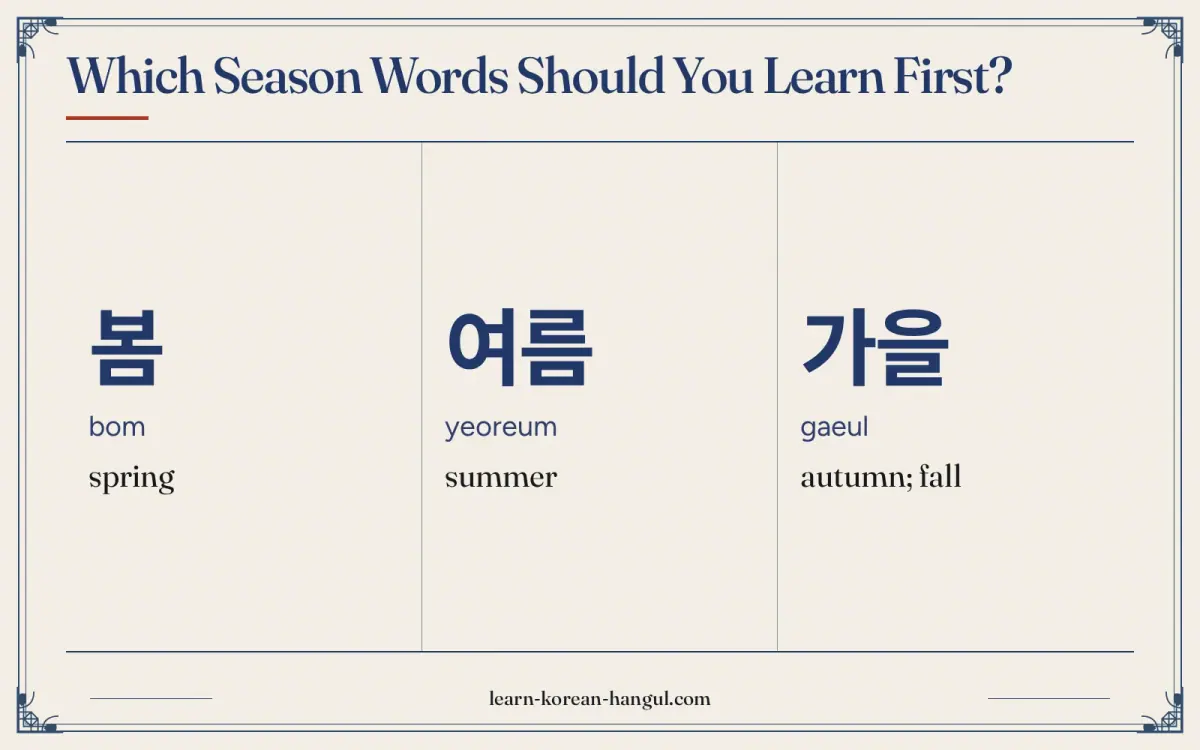
Learn 봄, 여름, 가을, 겨울 and 에 first, in that order. Then add 눈, 단풍 and 장마, the three signs you will hear most often in conversation. After that, the food and clothing groups are the easiest to remember because they attach to real objects.
- Words to say. 봄, 여름, 가을, 겨울, 계절, 눈.
- Words to recognise. 절기, 입춘, 동지, 환절기. They appear in news and calendars.
- Words to attach. 벚꽃, 단풍, 수박, 호떡. Put each one in a sentence with a season and 에.
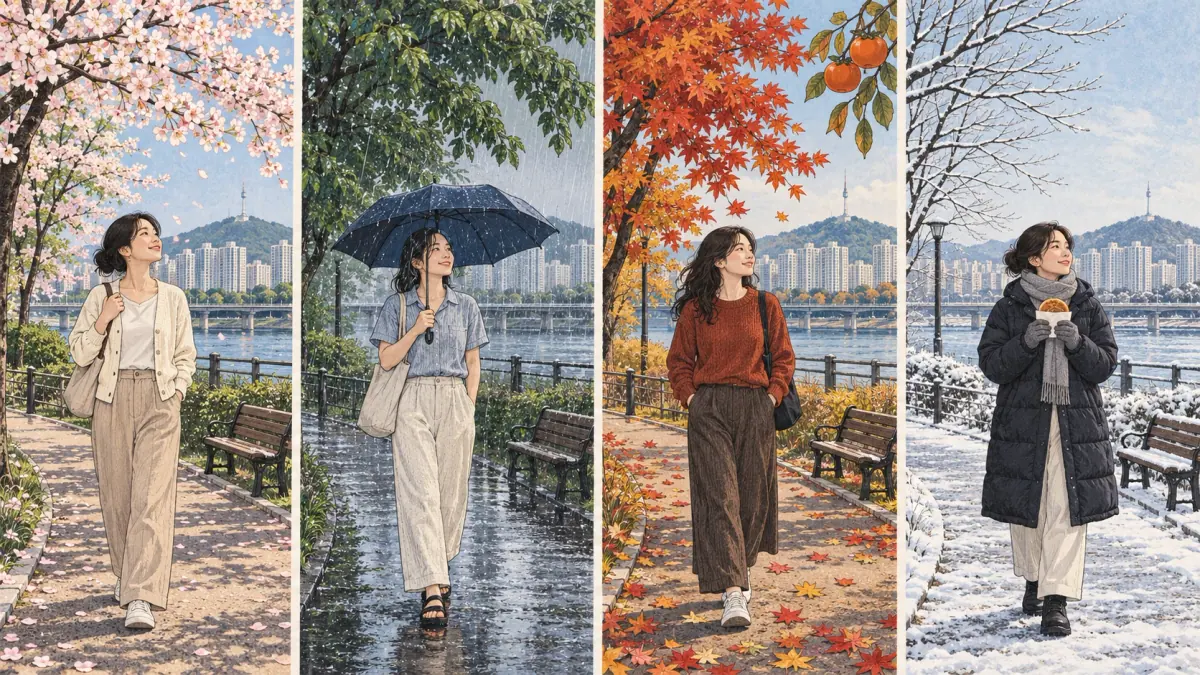
Two spellings look alike. 겨울 (winter) and 거울 (mirror) differ by one vowel, and 눈 means both snow and eye. The scene below shows a park through the year, with ten of the words as numbered objects.
Word · 10
- 1
봄
bom
spring
- 2
여름
yeoreum
summer
- 3
가을
gaeul
autumn; fall
- 4
겨울
gyeoul
winter
- 5
벚꽃
beotkkot
cherry blossom
- 6
장마
jangma
rainy season (early summer monsoon)
- 7
단풍
danpung
autumn leaves
- 8
눈
nun
snow
- 9
감
gam
persimmon
- 10
긴팔
ginpal
long sleeves
What Are the Four Seasons in Korean?
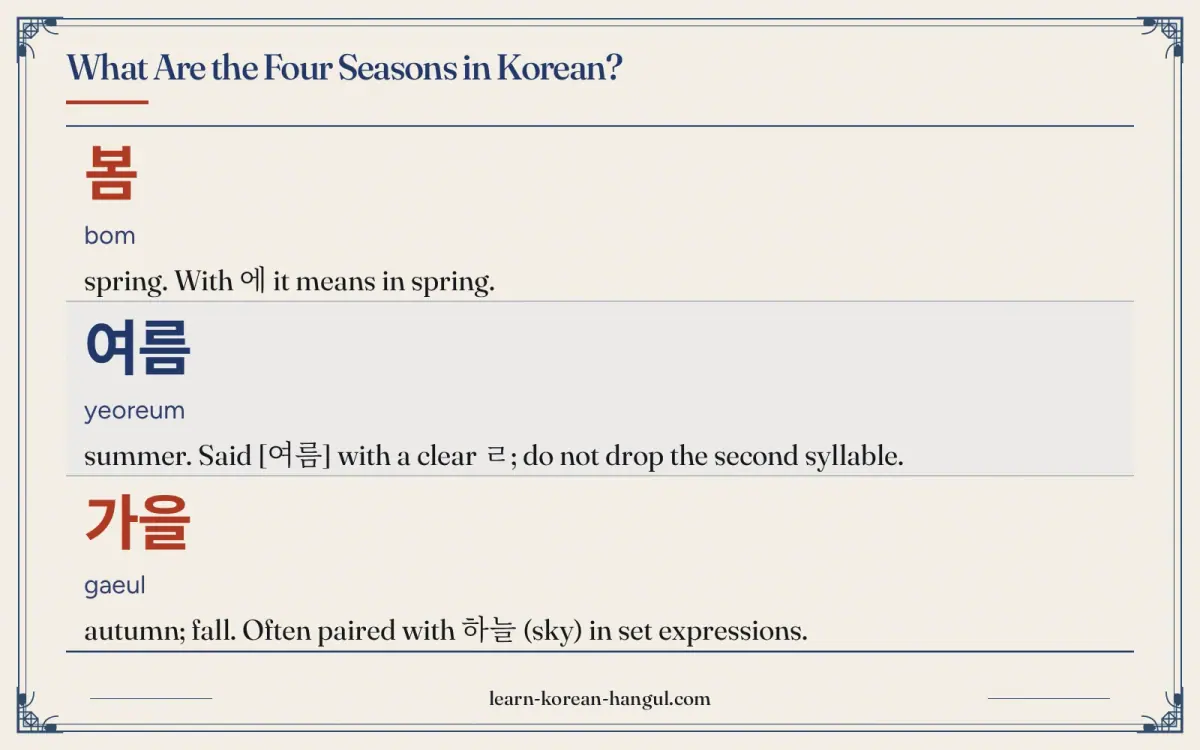
The four seasons are 봄, 여름, 가을 and 겨울. Each is a native Korean word. To say in a season, add 에: 봄에, 여름에, 가을에, 겨울에. When a season is the topic, add 은 after a consonant or 는 after a vowel, as in 여름은 더워요. The words 사계절 and 계절 describe the system and the general idea.
| No. | Hangul | Revised Romanization | Meaning and note | Example sentence | Audio assetId |
|---|---|---|---|---|---|
| 1 | 봄 | bom | spring. With 에 it means in spring. | 봄에 꽃이 피어요. (Flowers bloom in spring.) | au-pg-vocabulary-nature-seasons-1; example: au-pg-vocabulary-nature-seasons-31 |
| 2 | 여름 | yeoreum | summer. Said [여름] with a clear ㄹ; do not drop the second syllable. | 여름은 더워요. (Summer is hot.) | au-pg-vocabulary-nature-seasons-2; example: au-pg-vocabulary-nature-seasons-32 |
| 3 | 가을 | gaeul | autumn; fall. Often paired with 하늘 (sky) in set expressions. | 가을 하늘이 높아요. (The autumn sky is high.) | au-pg-vocabulary-nature-seasons-3; example: au-pg-vocabulary-nature-seasons-33 |
| 4 | 겨울 | gyeoul | winter. Not 거울 (mirror), which has a different first vowel. | 겨울에 눈이 와요. (It snows in winter.) | au-pg-vocabulary-nature-seasons-4; example: au-pg-vocabulary-nature-seasons-34 |
| 5 | 사계절 | sagyejeol | four seasons. 사 is four. The 계 may be said [게], so [사게절] is also heard. | 한국은 사계절이 있어요. (Korea has four seasons.) | au-pg-vocabulary-nature-seasons-5; example: au-pg-vocabulary-nature-seasons-35 |
| 6 | 계절 | gyejeol | season. The general word; it can name any of the four. | 어느 계절을 좋아해요? (Which season do you like?) | au-pg-vocabulary-nature-seasons-6; example: au-pg-vocabulary-nature-seasons-36 |
Example Sentences
Each example shows a season with a plain statement about it. Learn the frame season + 에 + noun + verb, as in 봄에 꽃이 피어요. The particle 이 or 가 marks the thing that happens, here 꽃. Say the sentence aloud after the audio, then change the season and the noun.
The season names are the base. The next group gives the signs that tell you the season has arrived.
How Do You Say Season Markers in Korean?
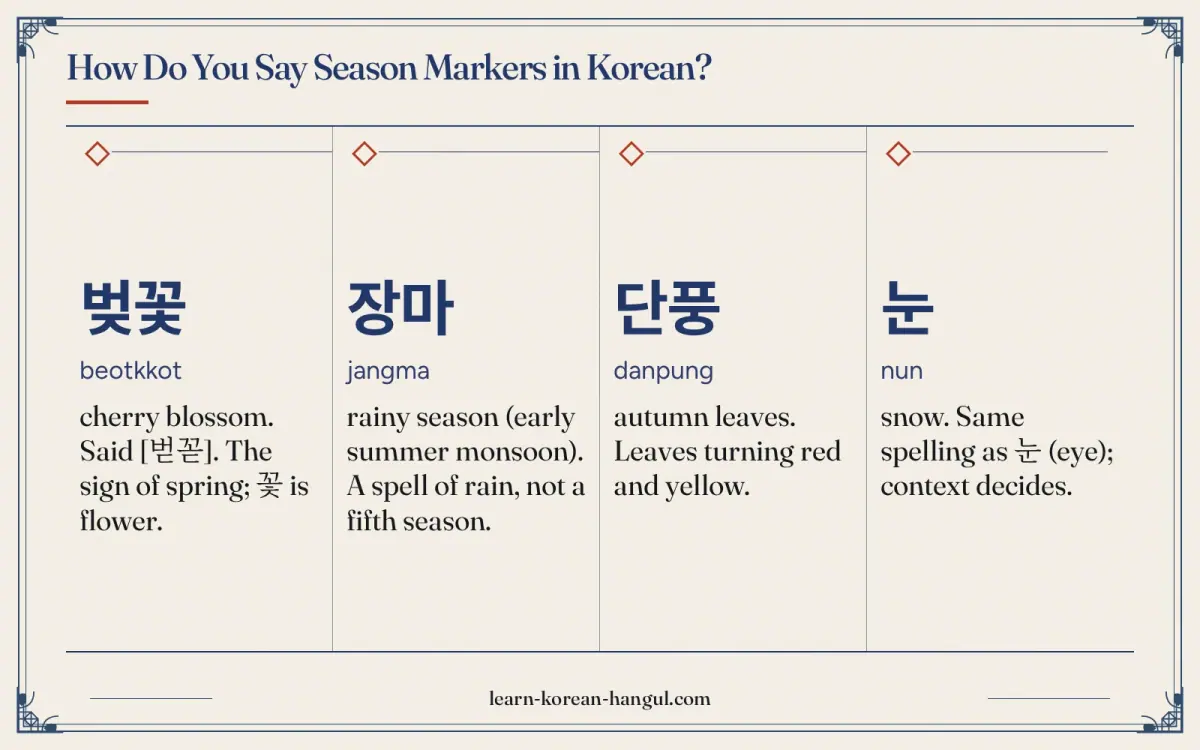
Each season has a sign people talk about. In spring it is 벚꽃, in early summer it is 장마, in autumn it is 단풍 and in winter it is 눈. These words are common in news, weather talk and small talk. Many Koreans plan trips around them, such as a 벚꽃 구경, a blossom-viewing outing. 첫눈, the first snow, has its own word because people mark it.
| No. | Hangul | Revised Romanization | Meaning and note | Example sentence | Audio assetId |
|---|---|---|---|---|---|
| 7 | 벚꽃 | beotkkot | cherry blossom. Said [벋꼳]. The sign of spring; 꽃 is flower. | 벚꽃 구경을 가요. (I go to see the cherry blossoms.) | au-pg-vocabulary-nature-seasons-7; example: au-pg-vocabulary-nature-seasons-37 |
| 8 | 장마 | jangma | rainy season (early summer monsoon). A spell of rain, not a fifth season. | 장마가 시작됐어요. (The rainy season has started.) | au-pg-vocabulary-nature-seasons-8; example: au-pg-vocabulary-nature-seasons-38 |
| 9 | 단풍 | danpung | autumn leaves. Leaves turning red and yellow. | 단풍이 예뻐요. (The autumn leaves are pretty.) | au-pg-vocabulary-nature-seasons-9; example: au-pg-vocabulary-nature-seasons-39 |
| 10 | 눈 | nun | snow. Same spelling as 눈 (eye); context decides. | 눈이 많이 왔어요. (A lot of snow fell.) | au-pg-vocabulary-nature-seasons-10; example: au-pg-vocabulary-nature-seasons-40 |
| 11 | 첫눈 | cheonnun | first snow. Said [천눈]. 첫 means first. | 오늘 첫눈이 왔어요. (The first snow fell today.) | au-pg-vocabulary-nature-seasons-11; example: au-pg-vocabulary-nature-seasons-41 |
| 12 | 무더위 | mudeowi | sultry heat. Hot and humid summer weather. | 무더위가 계속돼요. (The sultry heat continues.) | au-pg-vocabulary-nature-seasons-12; example: au-pg-vocabulary-nature-seasons-42 |
Note that 무더위 describes heat that is also humid, which is how a Korean summer often feels. It is not a month or a season; it is a kind of weather inside the season.
Seasonal Events and Foods
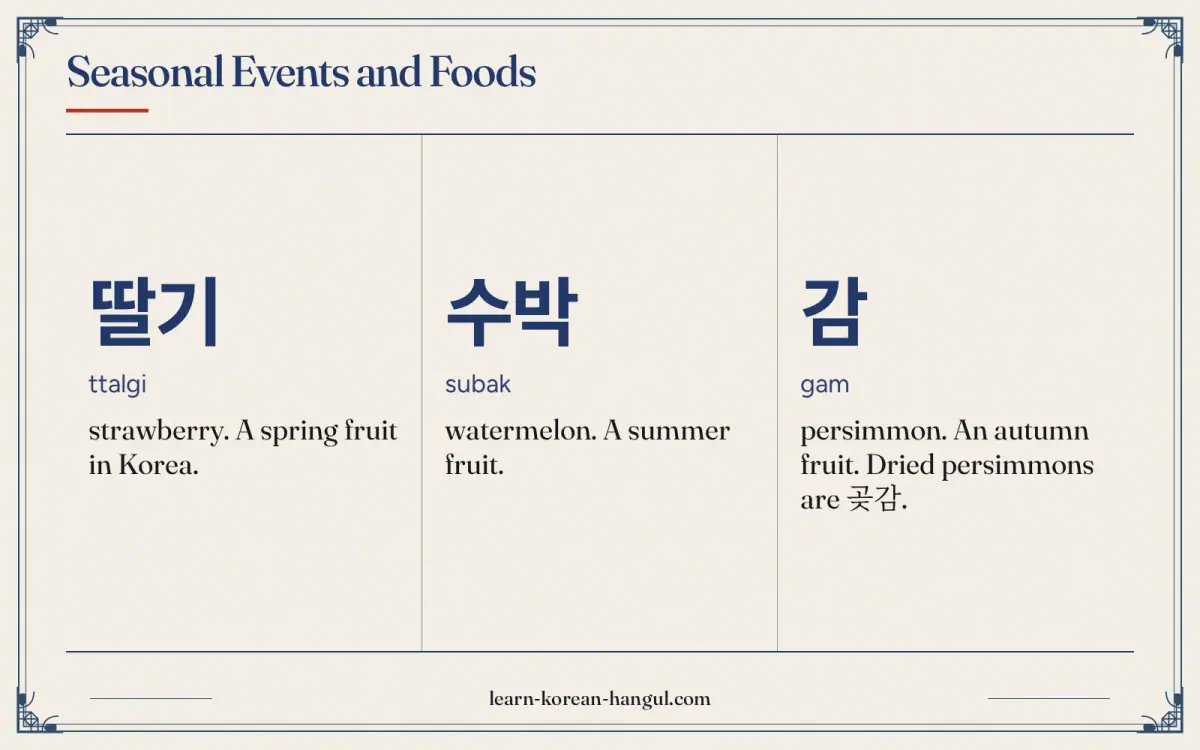
Seasons are also eaten. 딸기 comes first in spring, 수박 and 빙수 cool the summer, 감 ripens in autumn, and 호떡 is the street snack of winter. 팥죽, a red bean porridge, is linked to 동지, the winter solstice. People traditionally eat it on that day. Food words are a quick way to put 에 and a verb together: 겨울에 호떡을 먹어요.
| No. | Hangul | Revised Romanization | Meaning and note | Example sentence | Audio assetId |
|---|---|---|---|---|---|
| 13 | 딸기 | ttalgi | strawberry. A spring fruit in Korea. | 봄에 딸기를 먹어요. (I eat strawberries in spring.) | au-pg-vocabulary-nature-seasons-13; example: au-pg-vocabulary-nature-seasons-43 |
| 14 | 수박 | subak | watermelon. A summer fruit. | 여름에 수박을 먹어요. (I eat watermelon in summer.) | au-pg-vocabulary-nature-seasons-14; example: au-pg-vocabulary-nature-seasons-44 |
| 15 | 감 | gam | persimmon. An autumn fruit. Dried persimmons are 곶감. | 가을에는 감이 맛있어요. (Persimmons are tasty in autumn.) | au-pg-vocabulary-nature-seasons-15; example: au-pg-vocabulary-nature-seasons-45 |
| 16 | 호떡 | hotteok | hotteok (sweet filled pancake). A winter street snack. | 겨울에 호떡을 사 먹어요. (I buy and eat hotteok in winter.) | au-pg-vocabulary-nature-seasons-16; example: au-pg-vocabulary-nature-seasons-46 |
| 17 | 팥죽 | patjuk | red bean porridge. Said [팓쭉]. Eaten on 동지 (winter solstice). | 동지에 팥죽을 먹어요. (We eat red bean porridge on the winter solstice.) | au-pg-vocabulary-nature-seasons-17; example: au-pg-vocabulary-nature-seasons-47 |
| 18 | 빙수 | bingsu | shaved ice dessert. Popular in hot weather. | 여름에 빙수가 인기예요. (Shaved ice is popular in summer.) | au-pg-vocabulary-nature-seasons-18; example: au-pg-vocabulary-nature-seasons-48 |
Fruit and snack words attach to the season with 에. Clothing is the next place where seasons change vocabulary.
How Do You Say Seasonal Clothing in Korean?
Clothing words answer the question 뭐 입어요? (what do you wear?). 반팔 and 긴팔 are the short-sleeve and long-sleeve shirts that mark summer and autumn. 패딩, 목도리 and 장갑 are the winter set, and 샌들 are summer shoes. The verb changes with the item: 입다 for clothes on the body, 신다 for shoes, 하다 for a scarf and 끼다 for gloves.
| No. | Hangul | Revised Romanization | Meaning and note | Example sentence | Audio assetId |
|---|---|---|---|---|---|
| 19 | 반팔 | banpal | short sleeves. Literally half arm. | 여름에는 반팔을 입어요. (I wear short sleeves in summer.) | au-pg-vocabulary-nature-seasons-19; example: au-pg-vocabulary-nature-seasons-49 |
| 20 | 긴팔 | ginpal | long sleeves. Literally long arm. | 가을에는 긴팔을 입어요. (I wear long sleeves in autumn.) | au-pg-vocabulary-nature-seasons-20; example: au-pg-vocabulary-nature-seasons-50 |
| 21 | 샌들 | saendeul | sandals. Loanword. | 여름에 샌들을 신어요. (I wear sandals in summer.) | au-pg-vocabulary-nature-seasons-21; example: au-pg-vocabulary-nature-seasons-51 |
| 22 | 패딩 | paeding | padded jacket. Loanword for a puffy winter coat. | 겨울에는 패딩을 입어요. (I wear a padded jacket in winter.) | au-pg-vocabulary-nature-seasons-22; example: au-pg-vocabulary-nature-seasons-52 |
| 23 | 목도리 | mokdori | scarf. Said [목또리]. 목 is neck. | 목도리를 해요. (I wear a scarf.) | au-pg-vocabulary-nature-seasons-23; example: au-pg-vocabulary-nature-seasons-53 |
| 24 | 장갑 | janggap | gloves. Used with 끼다 (to put on something that fits closely, such as gloves or a ring). | 장갑을 껴요. (I put on gloves.) | au-pg-vocabulary-nature-seasons-24; example: au-pg-vocabulary-nature-seasons-54 |
The verbs matter as much as the nouns. If you say 장갑을 입어요, a Korean listener will understand, but 장갑을 껴요 is the natural phrase.
Seasonal Weather and Solar Terms
The traditional calendar divides the year into 24 solar terms, called 절기. They follow the sun, not the month, so they fall on nearly the same date each year. Four terms are useful for learners. 입춘 and 입추 mark the start of spring and autumn, and 하지 and 동지 are the summer and winter solstices. The solar term and the real weather do not always agree: 입추 comes in early August, when it is still very hot.
| No. | Hangul | Revised Romanization | Meaning and note | Example sentence | Audio assetId |
|---|---|---|---|---|---|
| 25 | 절기 | jeolgi | solar term. One of 24 points that divide the year. | 한국에는 이십사 절기가 있어요. (Korea has twenty-four solar terms.) | au-pg-vocabulary-nature-seasons-25; example: au-pg-vocabulary-nature-seasons-55 |
| 26 | 입춘 | ipchun | start of spring (solar term). Falls in early February, while it is still cold. | 입춘은 이월에 있어요. (Ipchun is in February.) | au-pg-vocabulary-nature-seasons-26; example: au-pg-vocabulary-nature-seasons-56 |
| 27 | 하지 | haji | summer solstice. The day with the longest daylight. | 하지는 낮이 가장 길어요. (On the summer solstice the day is longest.) | au-pg-vocabulary-nature-seasons-27; example: au-pg-vocabulary-nature-seasons-57 |
| 28 | 입추 | ipchu | start of autumn (solar term). Falls in early August, in the heat. | 입추가 지났어요. (Ipchu has passed.) | au-pg-vocabulary-nature-seasons-28; example: au-pg-vocabulary-nature-seasons-58 |
| 29 | 동지 | dongji | winter solstice. The longest night; the porridge day. | 동지는 밤이 가장 길어요. (On the winter solstice the night is longest.) | au-pg-vocabulary-nature-seasons-29; example: au-pg-vocabulary-nature-seasons-59 |
| 30 | 환절기 | hwanjeolgi | change of seasons. The shaky weeks between seasons. | 환절기에는 감기에 걸려요. (People catch colds when the seasons change.) | au-pg-vocabulary-nature-seasons-30; example: au-pg-vocabulary-nature-seasons-60 |
환절기 is the word you will hear in real life, usually followed by a warning about colds. For month names and dates, see months.
How Do You Pronounce These Words?
Season words have several tense sounds and linking sounds. Standard pronunciation follows the National Institute of Korean Language (국립국어원) rules, and the romanization follows the Revised Romanization of Korean, which does not mark every sound change.
| Spelling | Sounds like | What changes |
|---|---|---|
| 벚꽃 | [벋꼳] | The final ㅈ of 벚 and the final ㅊ of 꽃 are both said as [ㄷ]. |
| 첫눈 | [천눈] | The final ㅅ is said as [ㄷ], then ㄷ before ㄴ becomes [ㄴ]. |
| 팥죽 | [팓쭉] | Final ㅌ is said as [ㄷ]; ㅈ after it is tense [ㅉ]. |
| 목도리 | [목또리] | After a final ㄱ, ㄷ is said as tense [ㄸ]. |
| 사계절 | [사계절] or [사게절] | After a consonant, the vowel ㅖ may be said as [ㅔ]. |
| 여름 | [여름] | No change; do not skip the second syllable. |
The pair to practise is 벚꽃 and 첫눈. Both end a syllable with a consonant that changes before the next sound. Say 벚 as a short stop, then add the next syllable without a pause.
Audio and Slow Playback
Each word and sentence has its own clip. The five clips below replay the trickiest words slowly. Play one, repeat it, then play it again and compare.
What Mistakes Do Learners Make with Season Words?
Five mistakes come up often.
- Leaving out 에. 봄 꽃이 피어요 is understood, but 봄에 꽃이 피어요 says clearly that it happens in spring.
- Mixing up 겨울 and 거울. 겨울 is winter and 거울 is a mirror. Check the vowel.
- Treating 눈 as always snow. 눈이 와요 is it is snowing, while 눈이 아파요 is my eyes hurt. The verb tells you which one.
- Calling 장마 a season. It is a rainy period within summer, not a fifth season.
- Using the wrong verb for clothes. Use 입다 for shirts and jackets, 신다 for shoes, 하다 for scarves and 끼다 for gloves.
These mistakes involve small grammar words and one-vowel differences, so they are easy to fix with a few repetitions. The practice section turns the list into drills.
Practice: Flashcards and Worksheet
Use three steps. Run the flashcard deck in recognition mode until the 30 words come quickly. Switch to listening mode, then take the quiz. The deck holds all the words on this page with audio, and your progress stays in your browser. The vocabulary flashcard decks page lists the other decks.
Practice · 65
- 01봄
Show answer
headword 1: spring
- 02여름
Show answer
headword 2: summer
- 03가을
Show answer
headword 3: autumn; fall
- 04겨울
Show answer
headword 4: winter
- 05사계절
Show answer
headword 5: four seasons
- 06계절
Show answer
headword 6: season
- 07벚꽃
Show answer
headword 7: cherry blossom
- 08장마
Show answer
headword 8: rainy season (early summer monsoon)
- 09단풍
Show answer
headword 9: autumn leaves
- 10눈
Show answer
headword 10: snow
- 11첫눈
Show answer
headword 11: first snow
- 12무더위
Show answer
headword 12: sultry heat
- 13딸기
Show answer
headword 13: strawberry
- 14수박
Show answer
headword 14: watermelon
- 15감
Show answer
headword 15: persimmon
- 16호떡
Show answer
headword 16: hotteok (sweet filled pancake)
- 17팥죽
Show answer
headword 17: red bean porridge
- 18빙수
Show answer
headword 18: shaved ice dessert
- 19반팔
Show answer
headword 19: short sleeves
- 20긴팔
Show answer
headword 20: long sleeves
- 21샌들
Show answer
headword 21: sandals
- 22패딩
Show answer
headword 22: padded jacket
- 23목도리
Show answer
headword 23: scarf
- 24장갑
Show answer
headword 24: gloves
- 25절기
Show answer
headword 25: solar term
- 26입춘
Show answer
headword 26: start of spring (solar term)
- 27하지
Show answer
headword 27: summer solstice
- 28입추
Show answer
headword 28: start of autumn (solar term)
- 29동지
Show answer
headword 29: winter solstice
- 30환절기
Show answer
headword 30: change of seasons
- 31봄에 꽃이 피어요.
Show answer
example sentence for 봄
- 32여름은 더워요.
Show answer
example sentence for 여름
- 33가을 하늘이 높아요.
Show answer
example sentence for 가을
- 34겨울에 눈이 와요.
Show answer
example sentence for 겨울
- 35한국은 사계절이 있어요.
Show answer
example sentence for 사계절
- 36어느 계절을 좋아해요?
Show answer
example sentence for 계절
- 37벚꽃 구경을 가요.
Show answer
example sentence for 벚꽃
- 38장마가 시작됐어요.
Show answer
example sentence for 장마
- 39단풍이 예뻐요.
Show answer
example sentence for 단풍
- 40눈이 많이 왔어요.
Show answer
example sentence for 눈
- 41오늘 첫눈이 왔어요.
Show answer
example sentence for 첫눈
- 42무더위가 계속돼요.
Show answer
example sentence for 무더위
- 43봄에 딸기를 먹어요.
Show answer
example sentence for 딸기
- 44여름에 수박을 먹어요.
Show answer
example sentence for 수박
- 45가을에는 감이 맛있어요.
Show answer
example sentence for 감
- 46겨울에 호떡을 사 먹어요.
Show answer
example sentence for 호떡
- 47동지에 팥죽을 먹어요.
Show answer
example sentence for 팥죽
- 48여름에 빙수가 인기예요.
Show answer
example sentence for 빙수
- 49여름에는 반팔을 입어요.
Show answer
example sentence for 반팔
- 50가을에는 긴팔을 입어요.
Show answer
example sentence for 긴팔
- 51여름에 샌들을 신어요.
Show answer
example sentence for 샌들
- 52겨울에는 패딩을 입어요.
Show answer
example sentence for 패딩
- 53목도리를 해요.
Show answer
example sentence for 목도리
- 54장갑을 껴요.
Show answer
example sentence for 장갑
- 55한국에는 이십사 절기가 있어요.
Show answer
example sentence for 절기
- 56입춘은 이월에 있어요.
Show answer
example sentence for 입춘
- 57하지는 낮이 가장 길어요.
Show answer
example sentence for 하지
- 58입추가 지났어요.
Show answer
example sentence for 입추
- 59동지는 밤이 가장 길어요.
Show answer
example sentence for 동지
- 60환절기에는 감기에 걸려요.
Show answer
example sentence for 환절기
- 61벚꽃
Show answer
slow playback: 벚꽃
- 62첫눈
Show answer
slow playback: 첫눈
- 63팥죽
Show answer
slow playback: 팥죽
- 64목도리
Show answer
slow playback: 목도리
- 65여름
Show answer
slow playback: 여름
Practice · 5
What does 봄 (bom) mean?
Show answer
spring
봄 means spring. Example: 봄에 꽃이 피어요. (Flowers bloom in spring.)
What does 벚꽃 (beotkkot) mean?
Show answer
cherry blossom
벚꽃 means cherry blossom. Example: 벚꽃 구경을 가요. (I go to see the cherry blossoms.)
What does 장마 (jangma) mean?
Show answer
rainy season (early summer monsoon)
장마 means rainy season (early summer monsoon). Example: 장마가 시작됐어요. (The rainy season has started.)
What does 호떡 (hotteok) mean?
Show answer
hotteok (sweet filled pancake)
호떡 means hotteok (sweet filled pancake). Example: 겨울에 호떡을 사 먹어요. (I buy and eat hotteok in winter.)
What does 절기 (jeolgi) mean?
Show answer
solar term
절기 means solar term. Example: 한국에는 이십사 절기가 있어요. (Korea has twenty-four solar terms.)
Seasons in Korean Worksheet (PDF)
A printable worksheet for these words (word list, matching, writing practice, fill-in-the-blank exercises and answer key) is available in A4 and US Letter from the download card on this page. For practice, draw four boxes, label them 봄, 여름, 가을 and 겨울, and write the food, clothing and weather words under each.
Where to Go Next
After this page, continue with Weather for rain, wind and temperature, or Plants and Flowers for the spring and autumn plants. For dates, see months. To move up a level, return to Nature and the World.
Frequently Asked Questions
How Do You Say Spring in Korean?
Spring is 봄 (bom). Say 봄에 to mean in spring, as in 봄에 꽃이 피어요, flowers bloom in spring. The same word also appears in 봄비, spring rain.
How Do You Pronounce 여름 (yeoreum)?
Say yeo-reum with two clear syllables: 여 then 름. The ㄹ is a quick tap, close to a soft English d or r. Press the audio button on this page to hear the word and the slow clip.
How Many Season Words Should I Learn First?
Learn the four season names first, then the particle 에 (in), 눈 (snow) and 단풍 (autumn leaves). That is about eight items, enough to say what happens in each season. The full list of 30 takes about a week at five new words a day, with a short review of earlier words each day.
Where Can I Practise Season Words with Flashcards?
Use the deck on this page, which holds all 30 words with Hangul, romanization and audio, in recognition and listening modes. The vocabulary flashcard decks page lists the decks for weather, plants and other nature topics. Progress is saved only in your browser.
Is the Romanization on This Page Official?
It follows the Revised Romanization of Korean, which South Korea adopted on 7 July 2000 and whose rules the National Institute of Korean Language (국립국어원) publishes. It is a learning aid and does not mark every sound change, so rely on the Hangul and the audio.
Is There a Printable Worksheet for Season Words?
A printable worksheet for these words (word list, matching, writing practice, fill-in-the-blank exercises and answer key) is available in A4 and US Letter from the download card on this page. For practice, use the flashcard deck, which carries the same 30 words, or draw four boxes labelled 봄, 여름, 가을 and 겨울 and fill them with the food, clothing and weather words.