
Korean Flower Names at a Glance
Korean plant names mix short native words, such as 꽃, 잎 and 풀, with Sino-Korean ones, such as 장미, 국화 and 무궁화, and many trees end in 나무, the word for tree. This list covers flowers you will see in a Korean spring and autumn, the trees that appear in poems and parks, plants in a garden or flowerpot and the words for a plant's parts. The page is the hub for Korean Flowers Vocabulary and Korean Trees and Plants Vocabulary, and it sits in Nature and the World.
| Group | Words | Use |
|---|---|---|
| Flowers | 9 | Common flowers and their seasons |
| Trees | 9 | Common trees and forest words |
| Garden plants | 9 | Gardens, lawns, pots and small plants |
| Parts of a plant | 8 | Roots, stems, leaves, seeds and fruit |
Which Flower and Plant Names Should You Learn First?
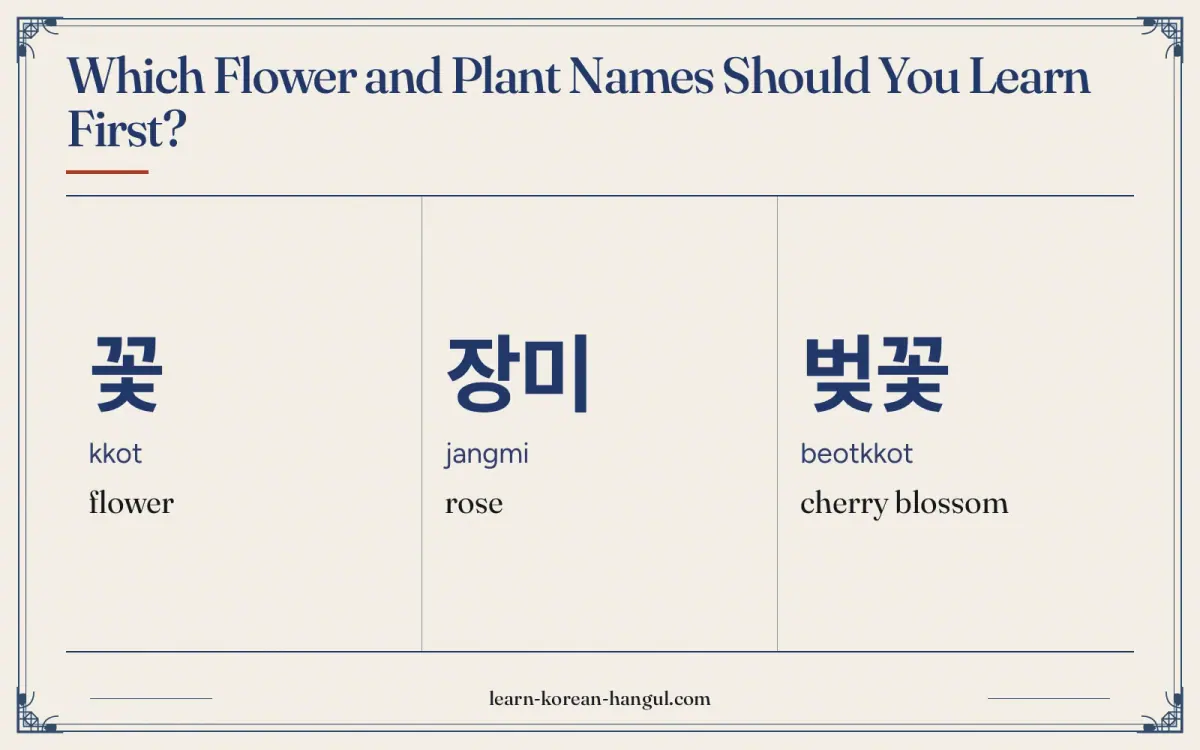
Learn 꽃, 나무, 장미, 벚꽃 and 잎 first. They cover the general word, the tree and the two flowers most often named. Then add the seasonal ones: 진달래, 개나리, 단풍나무 and 국화.
- Words to say. 꽃, 나무, 장미, 벚꽃, 잎, 씨앗.
- Words to recognise. 무궁화, 소나무, 은행나무, 잔디. They appear on signs and in parks.
- Words to build. Fruit + 나무 for a tree and 꽃 + word for a flower compound.
Two words repeat across the list: 나무 means tree and wood, and 가지 means branch, eggplant and kind. The scene below shows a garden with numbered plants.
Word · 10
- 1
꽃
kkot
flower
- 2
장미
jangmi
rose
- 3
벚꽃
beotkkot
cherry blossom
- 4
무궁화
mugunghwa
rose of Sharon (national flower)
- 5
진달래
jindallae
azalea
- 6
연꽃
yeonkkot
lotus flower
- 7
나무
namu
tree; wood
- 8
소나무
sonamu
pine tree
- 9
뿌리
ppuri
root
- 10
잎
ip
leaf
Flowers
Start with the general word 꽃, which means flower and is the base of many compounds. Then learn the flowers by season. In spring you see 벚꽃, 진달래 and 개나리. In summer you see 장미 and 연꽃. In autumn there is 국화. The 해바라기 sunflower and the national flower 무궁화 are also common. Most flower names are one word with no special ending.
| No. | Hangul | Revised Romanization | Meaning and note | Example sentence | Audio assetId |
|---|---|---|---|---|---|
| 1 | 꽃 | kkot | flower. Said [꼳] alone and [꼬치] before 이. | 꽃이 예뻐요. (The flowers are pretty.) | au-pg-vocabulary-nature-plants-1; example: au-pg-vocabulary-nature-plants-36 |
| 2 | 장미 | jangmi | rose. A common gift flower. | 장미를 선물했어요. (I gave roses as a gift.) | au-pg-vocabulary-nature-plants-2; example: au-pg-vocabulary-nature-plants-37 |
| 3 | 벚꽃 | beotkkot | cherry blossom. Said [벋꼳]. The sign of spring. | 벚꽃이 피었어요. (The cherry blossoms have bloomed.) | au-pg-vocabulary-nature-plants-3; example: au-pg-vocabulary-nature-plants-38 |
| 4 | 무궁화 | mugunghwa | rose of Sharon (national flower). Korea's national flower. | 무궁화는 한국의 나라꽃이에요. (The mugunghwa is Korea's national flower.) | au-pg-vocabulary-nature-plants-4; example: au-pg-vocabulary-nature-plants-39 |
| 5 | 진달래 | jindallae | azalea. Blooms on hills in early spring. | 진달래가 산에 피어요. (Azaleas bloom on the mountain.) | au-pg-vocabulary-nature-plants-5; example: au-pg-vocabulary-nature-plants-40 |
| 6 | 개나리 | gaenari | forsythia. A yellow spring flower. | 개나리는 노란색이에요. (Forsythia is yellow.) | au-pg-vocabulary-nature-plants-6; example: au-pg-vocabulary-nature-plants-41 |
| 7 | 국화 | gukhwa | chrysanthemum. An autumn flower. | 가을에 국화가 피어요. (Chrysanthemums bloom in autumn.) | au-pg-vocabulary-nature-plants-7; example: au-pg-vocabulary-nature-plants-42 |
| 8 | 해바라기 | haebaragi | sunflower. From 해 (sun) and 바라기 (one that gazes at): a sun-gazer. | 해바라기가 커요. (The sunflower is big.) | au-pg-vocabulary-nature-plants-8; example: au-pg-vocabulary-nature-plants-43 |
| 9 | 연꽃 | yeonkkot | lotus flower. Said [연꼳]. | 연못에 연꽃이 있어요. (There are lotus flowers in the pond.) | au-pg-vocabulary-nature-plants-9; example: au-pg-vocabulary-nature-plants-44 |
Example Sentences
The easiest sentence is flower + 이/가 + verb, such as 꽃이 피어요 (the flower blooms). For adjectives, use 꽃이 예뻐요. The verb 피다, to bloom, is the one to remember: 피어요 in the present and 피었어요 in the past. Say each sentence aloud after the audio and replace 꽃 with another flower.
Flowers belong to seasons, so the seasons page is a good companion.
How Do You Say Trees in Korean?
The general word is 나무. Most tree names end in 나무: 소나무 (pine), 은행나무 (ginkgo), 단풍나무 (maple), 버드나무 (willow) and 사과나무 (apple tree). 대나무 is bamboo, which is grouped with trees in Korean. Beyond the single tree, 숲 is a forest and 가로수 is a tree planted along a street. Ginkgo and maple trees give many Korean streets and parks their autumn colour.
| No. | Hangul | Revised Romanization | Meaning and note | Example sentence | Audio assetId |
|---|---|---|---|---|---|
| 10 | 나무 | namu | tree; wood. Tree and the material wood share one word. | 나무를 심어요. (I plant a tree.) | au-pg-vocabulary-nature-plants-10; example: au-pg-vocabulary-nature-plants-45 |
| 11 | 소나무 | sonamu | pine tree. Symbol of long life. | 산에 소나무가 많아요. (There are many pine trees on the mountain.) | au-pg-vocabulary-nature-plants-11; example: au-pg-vocabulary-nature-plants-46 |
| 12 | 대나무 | daenamu | bamboo. The 대 means bamboo on its own. | 대나무 숲이 있어요. (There is a bamboo grove.) | au-pg-vocabulary-nature-plants-12; example: au-pg-vocabulary-nature-plants-47 |
| 13 | 은행나무 | eunhaengnamu | ginkgo tree. Turns yellow in autumn. | 가을에 은행나무가 노래져요. (Ginkgo trees turn yellow in autumn.) | au-pg-vocabulary-nature-plants-13; example: au-pg-vocabulary-nature-plants-48 |
| 14 | 단풍나무 | danpungnamu | maple tree. Famous for red autumn leaves. | 단풍나무 잎이 빨개요. (The maple leaves are red.) | au-pg-vocabulary-nature-plants-14; example: au-pg-vocabulary-nature-plants-49 |
| 15 | 버드나무 | beodeunamu | willow tree. Grows by rivers. | 강가에 버드나무가 있어요. (There are willow trees by the river.) | au-pg-vocabulary-nature-plants-15; example: au-pg-vocabulary-nature-plants-50 |
| 16 | 사과나무 | sagwanamu | apple tree. 사과 (apple) + 나무. | 사과나무에 사과가 열렸어요. (Apples have grown on the apple tree.) | au-pg-vocabulary-nature-plants-16; example: au-pg-vocabulary-nature-plants-51 |
| 17 | 가로수 | garosu | street tree. Trees planted along a road. | 길에 가로수가 많아요. (There are many street trees on the road.) | au-pg-vocabulary-nature-plants-17; example: au-pg-vocabulary-nature-plants-52 |
| 18 | 숲 | sup | forest. Said [숩]; before 이 it is [수피]. | 숲에서 산책해요. (I take a walk in the forest.) | au-pg-vocabulary-nature-plants-18; example: au-pg-vocabulary-nature-plants-53 |
Because 나무 is the last part of each compound, you can build tree names yourself: fruit + 나무 is the tree of that fruit. 감나무 is a persimmon tree and 배나무 is a pear tree.
Garden Plants
Garden words mix places and plants. 정원 is a garden, 화단 is a flower bed and 화분 is a flowerpot. Plants are 풀 (grass), 잔디 (lawn), 이끼 (moss), 선인장 (cactus) and 허브 (herbs), and 잡초 is the weed you pull out. 잔디 often appears on signs in parks, as in 잔디에 들어가지 마세요, please do not walk on the lawn. 화분 is the usual home for a cactus or a herb.
| No. | Hangul | Revised Romanization | Meaning and note | Example sentence | Audio assetId |
|---|---|---|---|---|---|
| 19 | 풀 | pul | grass; weed. Everyday word for any green blades. | 풀이 자라요. (The grass grows.) | au-pg-vocabulary-nature-plants-19; example: au-pg-vocabulary-nature-plants-54 |
| 20 | 잔디 | jandi | lawn grass. A common sign: 잔디에 들어가지 마세요. | 잔디에 앉지 마세요. (Please do not sit on the lawn.) | au-pg-vocabulary-nature-plants-20; example: au-pg-vocabulary-nature-plants-55 |
| 21 | 잡초 | japcho | weed. 잡 means mixed; 초 means grass. | 잡초를 뽑아요. (I pull out weeds.) | au-pg-vocabulary-nature-plants-21; example: au-pg-vocabulary-nature-plants-56 |
| 22 | 화분 | hwabun | flowerpot. For indoor and balcony plants. | 화분에 물을 줘요. (I water the flowerpot.) | au-pg-vocabulary-nature-plants-22; example: au-pg-vocabulary-nature-plants-57 |
| 23 | 정원 | jeongwon | garden. A larger, planned garden. | 정원이 넓어요. (The garden is spacious.) | au-pg-vocabulary-nature-plants-23; example: au-pg-vocabulary-nature-plants-58 |
| 24 | 화단 | hwadan | flower bed. Often found outside apartment blocks. | 화단에 꽃을 심었어요. (I planted flowers in the flower bed.) | au-pg-vocabulary-nature-plants-24; example: au-pg-vocabulary-nature-plants-59 |
| 25 | 선인장 | seoninjang | cactus. A popular easy houseplant. | 선인장은 물이 조금만 필요해요. (A cactus needs only a little water.) | au-pg-vocabulary-nature-plants-25; example: au-pg-vocabulary-nature-plants-60 |
| 26 | 이끼 | ikki | moss. Grows on wet rocks and trees. | 바위에 이끼가 있어요. (There is moss on the rock.) | au-pg-vocabulary-nature-plants-26; example: au-pg-vocabulary-nature-plants-61 |
| 27 | 허브 | heobeu | herb. Loanword. | 허브를 키워요. (I grow herbs.) | au-pg-vocabulary-nature-plants-27; example: au-pg-vocabulary-nature-plants-62 |
Apartments in Korea often have a small 화단 outside the entrance, and balconies hold 화분. The verbs to know are 심다 (to plant), 키우다 (to grow) and 뽑다 (to pull out).
How Do You Say Parts of a Plant in Korean?
The parts of a plant run from the ground up: 뿌리 (root), 줄기 (stem), 가지 (branch), 잎 (leaf), 꽃잎 (petal), 열매 (fruit) and 씨앗 (seed). A new plant begins as a 싹, a sprout. The word 꽃잎 is 꽃 (flower) plus 잎 (leaf), so a petal is a flower leaf. The same pattern builds 나뭇잎, a tree leaf. Use these words when you describe how something grows, as in 씨앗을 심어요, I plant a seed.
| No. | Hangul | Revised Romanization | Meaning and note | Example sentence | Audio assetId |
|---|---|---|---|---|---|
| 28 | 뿌리 | ppuri | root. Also used for origins, as in 뿌리를 찾다 (to look for your roots). | 뿌리가 깊어요. (The roots are deep.) | au-pg-vocabulary-nature-plants-28; example: au-pg-vocabulary-nature-plants-63 |
| 29 | 줄기 | julgi | stem; trunk. The main stalk of a plant. | 줄기가 길어요. (The stem is long.) | au-pg-vocabulary-nature-plants-29; example: au-pg-vocabulary-nature-plants-64 |
| 30 | 잎 | ip | leaf. Said [입]; before 이 it is [이피]. | 잎이 떨어져요. (The leaves fall.) | au-pg-vocabulary-nature-plants-30; example: au-pg-vocabulary-nature-plants-65 |
| 31 | 꽃잎 | kkonnip | petal. Said [꼰닙]. | 꽃잎이 날려요. (The petals blow around.) | au-pg-vocabulary-nature-plants-31; example: au-pg-vocabulary-nature-plants-66 |
| 32 | 열매 | yeolmae | fruit; berry (of a plant). Botanical fruit; 과일 is edible fruit. | 열매가 열렸어요. (Fruit has formed.) | au-pg-vocabulary-nature-plants-32; example: au-pg-vocabulary-nature-plants-67 |
| 33 | 씨앗 | ssiat | seed. Said [씨앋]. Also 씨. | 씨앗을 심어요. (I plant seeds.) | au-pg-vocabulary-nature-plants-33; example: au-pg-vocabulary-nature-plants-68 |
| 34 | 가지 | gaji | branch. Also means eggplant and kind. | 가지가 부러졌어요. (The branch broke.) | au-pg-vocabulary-nature-plants-34; example: au-pg-vocabulary-nature-plants-69 |
| 35 | 싹 | ssak | sprout. The verb is 나다 (to come out). | 싹이 났어요. (A sprout has come up.) | au-pg-vocabulary-nature-plants-35; example: au-pg-vocabulary-nature-plants-70 |
The botanical word 열매 is different from 과일, the everyday word for fruit you eat. A pear is a 과일 on a plate and a 열매 on its branch.
Plants in Culture
Some plants carry meaning in Korea. The 무궁화 is the national flower by long custom rather than by a specific law, and the refrain of the national anthem mentions it. Watch the homophones: 국화 (國花) means national flower, and 국화 (菊花) is the chrysanthemum. The 소나무 stands for long life and steadiness, and 대나무 stands for integrity because it stays green in winter. The 연꽃 is a symbol in Buddhism. The 국화 is the autumn flower, and white chrysanthemums are used at funerals, so choose other flowers for a cheerful gift.
| Compound | Revised Romanization | Meaning |
|---|---|---|
| 꽃집 | kkotjip | flower shop |
| 꽃다발 | kkotdabal | bouquet |
| 꽃구경 | kkotgugyeong | flower viewing |
| 꽃말 | kkonmal | flower language, the meaning given to a flower |
The base word 꽃 appears in each, so one word unlocks four. 꽃구경 is the outing to see blossoms, such as 벚꽃 in April. Flowers have 꽃말, a meaning traditionally given to each, such as a gift of 장미 for love.
How Do You Pronounce These Words?
Plant words are full of final consonants that move to the next syllable and tense sounds. Standard pronunciation follows the National Institute of Korean Language (국립국어원) rules, and the romanization follows the Revised Romanization of Korean, which does not mark every sound change.
| Spelling | Sounds like | What changes |
|---|---|---|
| 꽃이 | [꼬치] | The final ㅊ moves to the next syllable before 이. |
| 벚꽃 | [벋꼳] | Both final consonants are said as [ㄷ]. |
| 꽃잎 | [꼰닙] | ㄴ is inserted, and the final ㅊ becomes [ㄴ]. |
| 잎이 | [이피] | The final ㅍ moves to the next syllable. |
| 숲 | [숩] | The final ㅍ is said as [ㅂ] when alone. |
| 씨앗 | [씨앋] | The final ㅅ is said as [ㄷ]. |
Final-consonant linking is the main habit to learn. A flower on its own is [꼳], but the same flower with 이 is [꼬치]. Say it as one flowing word, 꼬치, not 꼳 + 이.
Audio and Slow Playback
Each word and sentence has its own clip. The five clips below replay the hardest words slowly. Play one, repeat it aloud, then play it again and compare.
What Mistakes Do Learners Make with Flower and Plant Names?
Five mistakes come up again and again.
- Saying 꽃이 열려요 for bloom. Flowers bloom with 피다: 꽃이 피어요. Fruit forms with 열리다: 열매가 열려요.
- Reading 꽃이 as [꽃이]. The standard sound is [꼬치]. The final ㅊ moves to the next syllable.
- Missing the double meaning of 나무. 나무 is both tree and wood, so 나무 의자 is a wooden chair.
- Confusing 가지. 가지 can mean branch, eggplant or kind. The sentence tells you which.
- Treating 열매 and 과일 as the same. 열매 is the fruit as part of the plant. 과일 is fruit as food.
Most of these mistakes come from verbs and from words with more than one meaning. The practice section turns the list into drills.
Practice: Flashcards and Worksheet
Use three steps. Run the flashcard deck in recognition mode until the 35 words come quickly. Switch to listening mode, then take the quiz. The deck holds every word on this page with audio, and your progress stays in your browser. The vocabulary flashcard decks page lists the other decks.
Practice · 75
- 01꽃
Show answer
headword 1: flower
- 02장미
Show answer
headword 2: rose
- 03벚꽃
Show answer
headword 3: cherry blossom
- 04무궁화
Show answer
headword 4: rose of Sharon (national flower)
- 05진달래
Show answer
headword 5: azalea
- 06개나리
Show answer
headword 6: forsythia
- 07국화
Show answer
headword 7: chrysanthemum
- 08해바라기
Show answer
headword 8: sunflower
- 09연꽃
Show answer
headword 9: lotus flower
- 10나무
Show answer
headword 10: tree; wood
- 11소나무
Show answer
headword 11: pine tree
- 12대나무
Show answer
headword 12: bamboo
- 13은행나무
Show answer
headword 13: ginkgo tree
- 14단풍나무
Show answer
headword 14: maple tree
- 15버드나무
Show answer
headword 15: willow tree
- 16사과나무
Show answer
headword 16: apple tree
- 17가로수
Show answer
headword 17: street tree
- 18숲
Show answer
headword 18: forest
- 19풀
Show answer
headword 19: grass; weed
- 20잔디
Show answer
headword 20: lawn grass
- 21잡초
Show answer
headword 21: weed
- 22화분
Show answer
headword 22: flowerpot
- 23정원
Show answer
headword 23: garden
- 24화단
Show answer
headword 24: flower bed
- 25선인장
Show answer
headword 25: cactus
- 26이끼
Show answer
headword 26: moss
- 27허브
Show answer
headword 27: herb
- 28뿌리
Show answer
headword 28: root
- 29줄기
Show answer
headword 29: stem; trunk
- 30잎
Show answer
headword 30: leaf
- 31꽃잎
Show answer
headword 31: petal
- 32열매
Show answer
headword 32: fruit; berry (of a plant)
- 33씨앗
Show answer
headword 33: seed
- 34가지
Show answer
headword 34: branch
- 35싹
Show answer
headword 35: sprout
- 36꽃이 예뻐요.
Show answer
example sentence for 꽃
- 37장미를 선물했어요.
Show answer
example sentence for 장미
- 38벚꽃이 피었어요.
Show answer
example sentence for 벚꽃
- 39무궁화는 한국의 나라꽃이에요.
Show answer
example sentence for 무궁화
- 40진달래가 산에 피어요.
Show answer
example sentence for 진달래
- 41개나리는 노란색이에요.
Show answer
example sentence for 개나리
- 42가을에 국화가 피어요.
Show answer
example sentence for 국화
- 43해바라기가 커요.
Show answer
example sentence for 해바라기
- 44연못에 연꽃이 있어요.
Show answer
example sentence for 연꽃
- 45나무를 심어요.
Show answer
example sentence for 나무
- 46산에 소나무가 많아요.
Show answer
example sentence for 소나무
- 47대나무 숲이 있어요.
Show answer
example sentence for 대나무
- 48가을에 은행나무가 노래져요.
Show answer
example sentence for 은행나무
- 49단풍나무 잎이 빨개요.
Show answer
example sentence for 단풍나무
- 50강가에 버드나무가 있어요.
Show answer
example sentence for 버드나무
- 51사과나무에 사과가 열렸어요.
Show answer
example sentence for 사과나무
- 52길에 가로수가 많아요.
Show answer
example sentence for 가로수
- 53숲에서 산책해요.
Show answer
example sentence for 숲
- 54풀이 자라요.
Show answer
example sentence for 풀
- 55잔디에 앉지 마세요.
Show answer
example sentence for 잔디
- 56잡초를 뽑아요.
Show answer
example sentence for 잡초
- 57화분에 물을 줘요.
Show answer
example sentence for 화분
- 58정원이 넓어요.
Show answer
example sentence for 정원
- 59화단에 꽃을 심었어요.
Show answer
example sentence for 화단
- 60선인장은 물이 조금만 필요해요.
Show answer
example sentence for 선인장
- 61바위에 이끼가 있어요.
Show answer
example sentence for 이끼
- 62허브를 키워요.
Show answer
example sentence for 허브
- 63뿌리가 깊어요.
Show answer
example sentence for 뿌리
- 64줄기가 길어요.
Show answer
example sentence for 줄기
- 65잎이 떨어져요.
Show answer
example sentence for 잎
- 66꽃잎이 날려요.
Show answer
example sentence for 꽃잎
- 67열매가 열렸어요.
Show answer
example sentence for 열매
- 68씨앗을 심어요.
Show answer
example sentence for 씨앗
- 69가지가 부러졌어요.
Show answer
example sentence for 가지
- 70싹이 났어요.
Show answer
example sentence for 싹
- 71벚꽃
Show answer
slow playback: 벚꽃
- 72꽃잎
Show answer
slow playback: 꽃잎
- 73은행나무
Show answer
slow playback: 은행나무
- 74무궁화
Show answer
slow playback: 무궁화
- 75선인장
Show answer
slow playback: 선인장
Practice · 5
What does 장미 (jangmi) mean?
Show answer
rose
장미 means rose. Example: 장미를 선물했어요. (I gave roses as a gift.)
What does 벚꽃 (beotkkot) mean?
Show answer
cherry blossom
벚꽃 means cherry blossom. Example: 벚꽃이 피었어요. (The cherry blossoms have bloomed.)
What does 무궁화 (mugunghwa) mean?
Show answer
rose of Sharon (national flower)
무궁화 means rose of Sharon (national flower). Example: 무궁화는 한국의 나라꽃이에요. (The mugunghwa is Korea's national flower.)
What does 대나무 (daenamu) mean?
Show answer
bamboo
대나무 means bamboo. Example: 대나무 숲이 있어요. (There is a bamboo grove.)
What does 줄기 (julgi) mean?
Show answer
stem; trunk
줄기 means stem; trunk. Example: 줄기가 길어요. (The stem is long.)
Korean Flower Names Worksheet (PDF)
A printable worksheet for these words (word list, matching, writing practice, fill-in-the-blank exercises and answer key) is available in A4 and US Letter from the download card on this page. For practice, draw a flower with its parts and label them 뿌리, 줄기, 잎, 꽃잎 and 열매.
Where to Go Next
After this page, continue with Korean Flowers Vocabulary for a season-by-season flower list, or Korean Trees and Plants Vocabulary. For the seasons of bloom, see Seasons. To move up a level, return to Nature and the World.
Pages in This Section
Two pages go deeper than this hub. Korean Flowers Vocabulary lists 30 flowers by season, from 개나리 to 동백, with gift words such as 꽃다발. See Korean Trees and Plants Vocabulary.
Frequently Asked Questions
How Do You Say Rose in Korean?
Rose is 장미 (jangmi). Say 장미를 선물했어요 for I gave roses as a gift. The word has two syllables, jang and mi, and is the same for the flower and the plant.
How Do You Pronounce 벚꽃 (beotkkot)?
Say beot-kkot, but the standard sound is [벋꼳]. Both final consonants are said as [ㄷ], and the second syllable starts with a tight ㄲ. Press the audio button on this page to hear the word and the slow clip.
How Many Flower and Plant Names Should I Learn First?
Start with the five starter words, 꽃, 나무, 장미, 벚꽃 and 잎, then add 소나무, 씨앗 and 뿌리. The whole list of 35 takes about a week at five new words a day, with review.
Where Can I Practise Flower and Plant Names with Flashcards?
Use the vocabulary flashcard decks. The deck for this page holds all 35 words with Hangul, romanization and audio, in recognition and listening modes. Your progress stays in your browser.
Is the Romanization on This Page Official?
It follows the Revised Romanization of Korean, which South Korea adopted on 7 July 2000 and whose rules the National Institute of Korean Language (국립국어원) publishes. It is a learning aid and does not mark every sound change, so rely on the Hangul and the audio.
Is There a Printable Worksheet for Flower and Plant Names?
A printable worksheet for these words (word list, matching, writing practice, fill-in-the-blank exercises and answer key) is available in A4 and US Letter from the download card on this page. For practice, use the flashcard deck, which carries the same 35 words, or copy the tables by hand.